
July 26, 2026
When Simplicity Becomes a Competitive Advantage in Gold Development
The Western Australian gold sector has long rewarded projects that marry geological endowment with engineering pragmatism. Across the industry's history, some of the most durable producers have not been the most technically complex operations, but rather those built on straightforward mining methods, predictable metallurgy, and conservative capital structures. This foundational principle sits at the heart of the Horizon Gold Gum Creek DFS, a study that positions one of WA's largest undeveloped gold resources on a credible, financeable pathway toward production.
Completed in July 2026, the definitive feasibility study for the Gum Creek Gold Project represents far more than a technical exercise. In the mining project lifecycle, a DFS occupies the highest rung of pre-construction confidence. It is the document that lenders require before committing debt, the milestone that transforms a resource estimate into a bankable mine plan, and the signal that a company has moved decisively from studying its asset to building it.
When big ASX news breaks, our subscribers know first
What the Horizon Gold Gum Creek DFS Numbers Actually Reveal
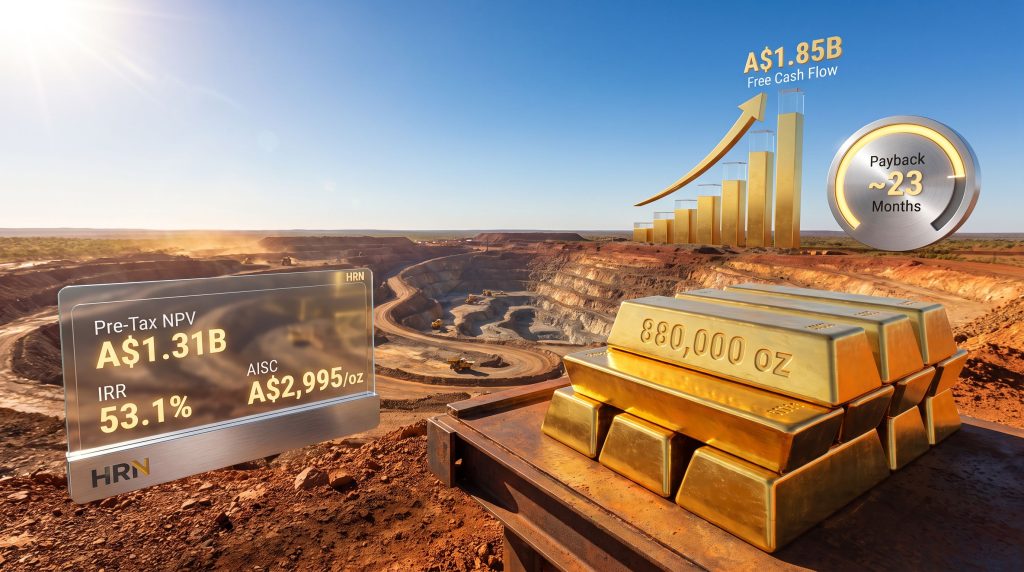
The headline economics from the Horizon Gold Gum Creek DFS are difficult to ignore. Using a gold price assumption of A$5,500 per ounce, the study calculates a pre-tax net present value of A$1.31 billion and a pre-tax internal rate of return of 53.1%. Over the initial 10-year mine life, total recovered production is estimated at 880,000 ounces, with pre-tax free cash flow projected at A$1.85 billion.
| DFS Metric | Value |
|---|---|
| Pre-Tax NPV | A$1.31 billion |
| Internal Rate of Return (IRR) | 53.1% |
| Pre-Tax Free Cash Flow | A$1.85 billion |
| Gold Price Assumption | A$5,500/oz |
| Pre-Production Capital | A$350 million |
| All-In Sustaining Cost (AISC) | A$2,995/oz |
| Payback Period (from first production) | ~23 months |
| First Gold Target | H2 2028 |
| Initial Mine Life | 10 years |
| Total Recovered Production | 880,000 oz |
| Average Annual Production (Years 1–5) | ~98,000 oz/year |
| Maiden Probable Ore Reserve | 728,000 oz |
| Total Mineral Resource | 2.3 million oz |
What makes these figures particularly notable is the context in which they are being delivered. The gold price outlook has seen Australian dollar gold prices remain elevated through 2025 and into 2026, structurally improving the economics of WA gold development projects across the board. Gum Creek's metrics remain compelling even relative to peers benefiting from the same tailwind, suggesting the project possesses genuine intrinsic quality rather than purely price-driven appeal.
Mining Method and Metallurgy: The Strategic Logic of Keeping It Simple
The Gum Creek development plan targets open-pit mining across seven priority deposits, processing 25.1 million tonnes at 1.19 grams per tonne of gold for approximately 962,000 contained ounces. The processing approach centres on a conventional gravity and carbon-in-leach (CIL) circuit, exploiting what geologists describe as free-milling mineralisation.
Free-milling gold is a term that carries significant weight in project financing circles. Unlike refractory ores, which require additional oxidation steps such as pressure oxidation or biological treatment to liberate gold from sulphide minerals, free-milling material responds readily to standard grinding and leaching processes. This characteristic reduces both capital intensity and technical risk, two qualities that project finance banks weight heavily in their independent assessments.
The initial processing plant is designed for 2.4 million tonnes per annum (Mtpa), but critically, the infrastructure has been pre-engineered to accommodate a future expansion to 3.0 Mtpa. This design choice reflects a deliberate philosophy: build a robust, fundable base case first, then expand from a position of operational strength. Managing director Scott Williamson has described the project's development philosophy as one of intentional simplicity, noting that the straightforward nature of the plan is precisely what should facilitate discussions with financing counterparties.
Capital Structure and the A$350 Million Build Cost
Pre-production capital is estimated at A$350 million, covering mine development, processing plant construction, supporting infrastructure, and contingency allowances. For context, this positions Gum Creek within the mid-range of WA gold development capex, neither so small as to raise questions about production scale nor so large as to create financing hurdles that could stall progress.
The projected payback period of approximately 23 months from first production is a particularly investor-friendly metric. For project lenders evaluating debt serviceability, a sub-two-year payback provides meaningful comfort, especially when the AISC of A$2,995 per ounce leaves a substantial operating margin against current gold price levels.
| Gold Price Scenario (A$/oz) | Approximate AISC Margin |
|---|---|
| A$4,500/oz | ~A$1,505/oz |
| A$5,500/oz (DFS base case) | ~A$2,505/oz |
| A$6,500/oz | ~A$3,505/oz |
Horizon Gold intends to fund the development through a combination of project debt and equity, with the precise structure to be determined through a financing process expected to run over approximately six months following DFS completion. The company plans to engage banks and independent technical experts during this window, with the project's simple metallurgy and open-pit design expected to be viewed positively through that review process.
The Reserve and Resource Gap: Where Gum Creek's Real Upside Resides
One of the most analytically interesting aspects of the Horizon Gold Gum Creek DFS is the substantial distance between the maiden probable ore reserve and the project's total mineral resource base.
The DFS is underpinned by a maiden probable ore reserve of 728,000 ounces, converted from a subset of the broader 2.3-million-ounce total mineral resource. This means approximately 1.57 million ounces of resource material currently sit outside the DFS mine plan.
It is worth understanding why this gap exists. The conversion of mineral resources into ore reserves requires a higher standard of technical confidence, including detailed geotechnical studies, metallurgical test work, and, in some cases, heritage approvals for specific areas. Several of Gum Creek's deposits are in various stages of this process, meaning the reserve base is expected to grow progressively as additional studies are completed.
The material outside the reserve includes:
- More than 400,000 ounces of free-milling underground resources not captured in the current open-pit study
- The Wilsons refractory deposit, hosting approximately 400,000 ounces grading in excess of 4 grams per tonne underground
The Wilsons grade figure deserves attention. At more than 4 g/t Au, this material is roughly 3.3 times the head grade of the open-pit plan. The challenge is metallurgical: refractory sulphide ores require processing approaches beyond conventional CIL, which is why this material is excluded from the base case. However, at sustained elevated gold prices, the economics of refractory processing improve materially, and Wilsons represents a meaningful long-term optionality position.
Three Pathways That Could Transform the Base Case
Pathway One: Throughput Expansion to 3.0 Mtpa
Because the processing plant infrastructure has been pre-designed to accommodate a capacity increase, the pathway from 2.4 Mtpa to 3.0 Mtpa involves incremental rather than transformative capital expenditure. The estimated production uplift from this expansion is approximately 25%, which would push average annual output well above the base-case figure of 98,000 ounces per annum in the first five years. For a project already generating strong margins at the base case, a 25% production increase for relatively modest additional capital represents an attractive return on incremental investment.
Pathway Two: Underground Mining Integration
The Kingfisher and Swan ore bodies are currently the focus of active drilling programmes. Both represent high-grade underground targets that could, if developed, materially improve the blended feed grade entering the processing plant. The current open-pit head grade of approximately 1.19 g/t Au is serviceable but unspectacular. Introducing underground ore at higher grades would improve the project's unit cost structure, extend economic mine life, and potentially support a revised DFS with stronger economics than the current base case.
Infill drilling at these targets serves a dual purpose: it adds geological confidence for resource-to-reserve conversion while also informing underground mine design parameters. Furthermore, investors should distinguish between exploration drilling, which aims to discover new ounces, and infill drilling, which tightens the confidence intervals around already-defined mineralisation to support engineering studies. Understanding how interpreting gold drill results works can help investors better assess the significance of these updates as they are released.
Pathway Three: Unlocking Wilsons Refractory Material
The Wilsons deposit remains a longer-dated option rather than a near-term catalyst. Processing refractory sulphide gold requires additional infrastructure, including pressure oxidation circuits or bacterial oxidation systems, both of which carry meaningful capital costs. However, the grade profile of Wilsons at greater than 4 g/t Au means that if gold prices remain elevated and the project generates sufficient cash flow from its open-pit operations, the economics of developing this resource could become compelling in a later phase of the project's life.
The DFS base case is deliberately structured as a conservative foundation. Each of the three upside pathways above is independent, meaning they can be pursued sequentially or in combination, and the project's ultimate production ceiling may be substantially higher than the current study suggests.
The De-Risking Curve and What Investors Should Watch
In development-stage mining companies, market valuation tends to lag physical progress. This dynamic, well-documented across ASX gold developers, reflects investor uncertainty about execution risk. As each successive milestone is achieved, that uncertainty diminishes and valuation multiples typically expand to reflect the narrowing gap between a project's potential and its realisation.
For Gum Creek, the staged catalyst calendar between now and first production includes:
- Heritage and environmental permitting approvals, which are preconditions for construction commencement
- Financing milestones, including bank engagement, independent technical reviews, and debt term sheet execution
- Early works activity, such as site preparation, access road upgrades, and accommodation camp construction
- Long-lead equipment orders, particularly processing plant components with extended manufacturing timelines, which signal genuine construction commitment to the market
The timeline runs from DFS completion in July 2026 through a targeted Final Investment Decision in Q2 2027, construction commencement in Q4 2027, and first gold production in H2 2028. Each step along this path carries the potential to trigger incremental market recognition.
Scott Williamson has noted that what could most meaningfully re-rate Horizon Gold in investors' eyes is the market's growing appreciation of how close the company is to actually producing gold. Physical development milestones, from early works announcements through to commissioning updates, tend to resonate differently with investors than study results, because they represent irreversible capital commitment rather than analytical projections.
How Gum Creek Stacks Up Against WA Gold Development Peers
| Metric | Gum Creek (HRN) | Typical WA Mid-Tier Developer Range |
|---|---|---|
| Pre-Tax NPV | A$1.31 billion | A$300M – A$1.5B |
| IRR | 53.1% | 20% – 50%+ |
| AISC | A$2,995/oz | A$2,500 – A$3,500/oz |
| Pre-Production Capex | A$350 million | A$200M – A$600M |
| Annual Production (Yr 1–5) | ~98,000 oz | 50,000 – 150,000 oz |
| Payback Period | ~23 months | 18 – 36 months |
Note: Peer range figures are indicative and based on publicly available DFS disclosures from comparable WA gold development projects. Independent verification is recommended.
A pre-tax IRR of 53.1% sits at the upper end of outcomes typically seen in WA gold DFS studies. Moreover, understanding the relationship between gold price and mining equities helps explain why even accounting for the broadly elevated Australian dollar gold price environment, this figure reflects genuine project quality: a low-complexity processing approach, a manageable capital requirement, and an AISC that preserves strong operating margins across a wide range of gold price scenarios.
The next major ASX story will hit our subscribers first
Frequently Asked Questions: Horizon Gold Gum Creek DFS
What is the Horizon Gold Gum Creek DFS?
A Definitive Feasibility Study represents the highest level of confidence in a pre-construction mining study. Horizon Gold's Gum Creek DFS, completed in July 2026, establishes a technically and financially viable development plan for the Gum Creek Gold Project in Western Australia, targeting first gold production in H2 2028 via a 10-year open-pit operation.
What is the NPV of the Gum Creek project?
The study calculates a pre-tax NPV of A$1.31 billion at a gold price assumption of A$5,500 per ounce, with a corresponding pre-tax IRR of 53.1%.
How much will it cost to build the Gum Creek mine?
Pre-production capital expenditure is estimated at A$350 million, covering mine development, a new 2.4 Mtpa processing plant, infrastructure, and contingency allowances. Funding is expected to combine project debt and equity.
When will Gum Creek produce first gold?
First gold production is targeted for H2 2028, subject to financing completion, permitting approvals, and construction. The Final Investment Decision is targeted for Q2 2027, with construction expected to begin in Q4 2027.
What is the Gum Creek gold resource and reserve?
The total mineral resource stands at 2.3 million ounces. The DFS is supported by a maiden probable ore reserve of 728,000 ounces, underpinning the initial 10-year open-pit plan. More than 800,000 ounces of underground and refractory resources are excluded from the current study.
What is the all-in sustaining cost at Gum Creek?
The DFS estimates an AISC of A$2,995 per ounce, providing a substantial operating margin against prevailing Australian dollar gold prices.
What upside exists beyond the DFS base case?
Three primary upside pathways have been identified:
- Mill throughput expansion from 2.4 Mtpa to 3.0 Mtpa, estimated to deliver approximately 25% additional production
- Integration of underground mining at Kingfisher and Swan to lift head grade above the current open-pit average of 1.19 g/t Au
- Longer-term development of the Wilsons refractory resource (~400,000 oz at more than 4 g/t Au)
A Foundation Built for Expansion, Not Just Production
The Horizon Gold Gum Creek DFS should be read as a starting point rather than a ceiling. With pre-tax free cash flow of A$1.85 billion, an AISC positioned well below current gold price levels, and more than 1.5 million ounces of resource sitting outside the current mine plan, the project's economics at the DFS stage represent a deliberately conservative entry point into what could become a substantially larger and longer-lived operation.
In addition, broader gold exploration trends across Western Australia continue to reinforce the strategic value of large, well-located resource bases like Gum Creek. The combination of technical simplicity, strong reserve quality, and multiple independently executable upside pathways places the project in a comparatively strong position within the WA gold development cohort. As the company moves through permitting, financing, and early works over the next 12 to 18 months, each milestone will serve to narrow the gap between Gum Creek's current development-stage profile and its eventual status as a producing Western Australian gold mine.
For those seeking further detail on the project's technical parameters, the full DFS announcement provides comprehensive disclosure of the study's assumptions, sensitivities, and development schedule.
This article is for informational purposes only and does not constitute financial or investment advice. All financial metrics referenced are sourced from Horizon Gold's publicly disclosed DFS documentation. Forecasts, projections, and scenario analyses involve inherent uncertainty and should not be relied upon as predictions of future outcomes. Readers should conduct independent due diligence and consult a licensed financial adviser before making any investment decisions.
Want to Catch the Next Major ASX Gold Discovery Before the Market Moves?
Discovery Alert's proprietary Discovery IQ model scans ASX announcements in real time, delivering instant alerts on significant mineral discoveries — turning complex data into actionable opportunities for investors at every experience level. Explore historic examples of exceptional discovery returns and begin your 14-day free trial at Discovery Alert to position yourself ahead of the market.