August 23, 2026
When Chokepoints Become Leverage: Understanding the Hormuz Crisis
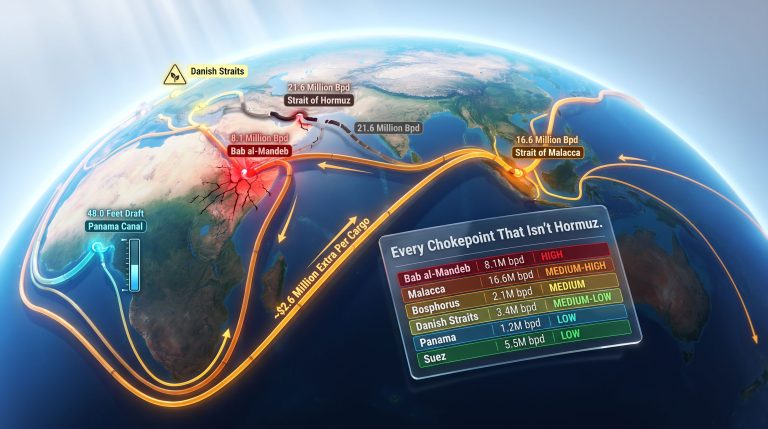
Throughout modern energy history, the world's most consequential supply disruptions have rarely originated in oilfields. They have emerged from the narrow corridors between them. Maritime chokepoints, those slim passages through which enormous volumes of crude oil and liquefied natural gas must travel, represent the most concentrated points of vulnerability in the entire global energy supply chain. When political actors recognise this, they gain extraordinary leverage over markets, governments, and economies simultaneously.
No chokepoint illustrates this more acutely than the Strait of Hormuz. Approximately 21 million barrels of oil per day transited Hormuz in recent years, representing roughly 20% of global petroleum liquids consumption and close to 30% of all seaborne crude trade. The strait is not simply a geographic feature. It is a financial instrument, and whoever controls access to it controls a variable that feeds directly into the cost of energy across Asia, Europe, and beyond.
The Trump Hormuz blockade and transit fee announced on July 13, 2026, pushed this dynamic into unprecedented territory. For the first time in modern history, the United States positioned itself not merely as a protector of commercial shipping through the strait, but as a toll collector.
When big ASX news breaks, our subscribers know first
The Policy Architecture: What Was Actually Announced
A Dual-Track Intervention With No Historical Precedent
The July 13, 2026 announcement combined two distinct but reinforcing mechanisms. First, a reinstated naval blockade targeting Iranian vessels and Iranian-linked shipping. Second, a proposed 20% levy on all other cargo transiting the Strait of Hormuz, framed by the Trump administration as a reimbursement mechanism for U.S. security expenditures in the region.
The framing was notably assertive. Trump described the United States as the waterway's guardian and asserted that Hormuz would remain open with or without Iranian cooperation. According to NBC News, the U.S. Joint Maritime Information Center confirmed that U.S. Central Command would begin enforcing the blockade of Iranian ports and coastal areas starting at 4 p.m. ET on Tuesday, July 15, 2026.
What the White House did not immediately provide was any operational detail on how the transit levy would be administered, which vessels it would apply to, or whether Gulf allies had been consulted prior to the announcement. That absence of implementation clarity became a critical variable in how markets priced the news.
Breaking Down the Cost: What $32 Million Per Transit Actually Means
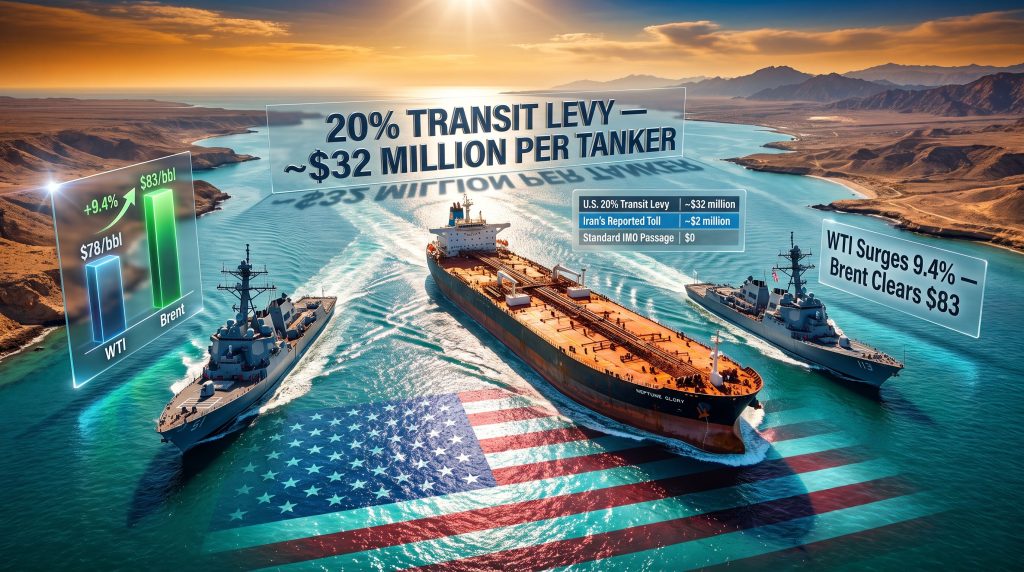
The financial magnitude of the proposed fee structure is striking when translated into concrete figures. At prevailing oil prices, a fully laden Very Large Crude Carrier (VLCC) carrying approximately 2 million barrels would face an estimated transit charge of roughly $32 million under the 20% levy framework.
To appreciate how structurally different this is from prior toll regimes, consider the following comparison:
| Fee Structure | Estimated Cost Per Tanker | Imposed By | Legal Basis Claimed |
|---|---|---|---|
| U.S. 20% Transit Levy (2026) | ~$32 million | United States | Security reimbursement |
| Iran's Reported Toll (prior period) | ~$2 million | Iran (IRGC) | Strait sovereignty claim |
| Standard IMO Transit Passage | $0 | N/A | International maritime law (UNCLOS) |
The U.S. fee is 16 times larger than the Iranian toll that the Trump administration had previously described as an illegal Tehran tollbooth. That asymmetry carries both economic and diplomatic weight, and it creates a logical contradiction the administration will need to resolve as implementation details emerge.
Shipping cost increases of this magnitude do not remain confined to freight markets. They transmit through crude benchmarks, then into refined product prices, and ultimately reach consumers at the pump. The time lag between a freight rate shock and retail fuel price adjustment typically runs four to eight weeks, meaning the consumer-level impact of a sustained Hormuz toll regime would become visible across major importing nations by late August or September 2026.
The Road to Escalation: April Through July 2026
How a Ceasefire Became a Catalyst
Understanding why July 2026 matters requires tracing the arc from April. An interim U.S.-Iran peace agreement reached in April had briefly reduced Hormuz tensions and pulled crude benchmarks lower through June. That ceasefire created expectations of normalisation that were reflected in price, with the geopolitical risk premium embedded in crude oil gradually eroding.
Trump's posture during this period was publicly confrontational toward Iranian toll collection while simultaneously, reportedly, exploring the concept of a joint arrangement with Iran to co-manage strait revenue. That rhetorical contradiction made the eventual policy reversal more jarring for markets. Consequently, the administration moved from condemning Iranian fees as illegal to proposing its own fee structure at the same chokepoint within weeks.
The Weekend Military Exchange That Reset Market Expectations
The immediate trigger for the July 13 announcement was a weekend exchange of military strikes that eliminated whatever remained of the April ceasefire framework. The broader context of geopolitical tensions and trade disruptions had been building for months prior to this flashpoint:
- U.S. forces struck dozens of IRGC-linked targets across the region, specifically designed to degrade Iran's capacity to threaten Hormuz shipping lanes.
- Iran launched retaliatory strikes against U.S. allies, with confirmed attacks hitting Bahrain, Jordan, Kuwait, and Oman.
- A Kuwaiti offshore drilling platform sustained damage in a direct strike, marking the first confirmed attack on energy infrastructure in weeks and raising the stakes considerably.
- Yemen's Houthi forces claimed responsibility for missile and drone attacks on a Saudi airport, linked to prior Saudi strikes on Sanaa.
Each of these events, taken individually, would move crude markets. Taken together over a single weekend, they collapsed the diplomatic architecture that had been holding the geopolitical risk premium in check since April.
Oil Market Response: Anatomy of a 9.4% Single-Day Surge
Price Movements and the Return of the Risk Premium
The crude market's response to the Trump Hormuz blockade and transit fee announcement was immediate and substantial:
- WTI crude futures surged 9.4%, settling near $78 per barrel, the highest level in approximately one month.
- Brent crude closed above $83 per barrel, with further gains recorded in post-settlement trading after Trump indicated the U.S. would strike Iran very hard on Monday and Tuesday nights.
- The magnitude of the single-day rally represented the largest crude price move since April 2026.
The geopolitical risk premium that markets had spent weeks unwinding following the April ceasefire was repriced in a matter of hours. This is consistent with how energy markets historically behave during chokepoint escalations: the initial move is sharp and sentiment-driven, while the sustained price level depends on whether operational disruption materialises.
Rebecca Babin, Senior Energy Trader at CIBC Private Wealth Group, characterised the blockade reinstatement as another step up the escalation ladder, one that forced crude to reprice geopolitical risk rapidly. Critically, she identified implementation uncertainty around the 20% fee as the key variable that would determine whether the price move was durable or speculative. Furthermore, the crude oil volatility trends emerging from this episode mirror patterns seen in prior Hormuz escalations.
Saul Kavonic, Senior Energy Analyst at MST Marquee, placed a conditional ceiling on the crude price trajectory: if the conflict were to expand to target major Gulf energy facilities more broadly, oil could reach $100 per barrel.
Scenario Analysis: Three Price Pathways
| Scenario | Key Trigger | Estimated WTI Range |
|---|---|---|
| De-escalation / Diplomatic Resolution | Ceasefire restored, fee policy abandoned | $65 to $72/bbl |
| Sustained Tension, No Major Escalation | Blockade maintained, no infrastructure strikes | $75 to $85/bbl |
| Expanded Conflict | Major Gulf energy facility targeted | $90 to $100+/bbl |
Disclaimer: These price ranges represent analyst scenario frameworks and should not be construed as investment advice or price forecasts. Crude oil markets are subject to rapid and unpredictable change driven by geopolitical, macroeconomic, and supply-side factors.
The International Law Problem Nobody Is Talking About
UNCLOS, Transit Passage Rights, and the U.S. Contradiction
The proposed transit fee creates a significant problem under established international maritime law. Under the United Nations Convention on the Law of the Sea (UNCLOS), international straits used for global navigation are subject to the right of transit passage, a legal principle that explicitly prohibits coastal or controlling states from charging fees for passage through internationally recognised waterways.
The International Maritime Organisation wasted no time in reiterating its opposition to any fee-based access regime applied to international straits used for global navigation. The IMO's position is grounded in the same legal framework the United States has historically invoked when challenging Iranian attempts to restrict or monetise Hormuz transit.
This creates a layered diplomatic problem for Washington:
- The U.S. has previously cited UNCLOS transit passage rights as the legal basis for condemning Iranian toll collection.
- The proposed 20% levy directly contradicts that legal position.
- Gulf Cooperation Council member states, whose export revenues depend entirely on unimpeded Hormuz access, were apparently not consulted before the announcement.
- European and Asian importing nations face a structural cost shock and have strong incentives to challenge the fee regime through multilateral forums.
Whether the UN Security Council, IMO arbitration mechanisms, or bilateral diplomatic channels provide effective pathways to challenge a unilateral U.S. toll regime remains an open question. The U.S. is not a party to UNCLOS, having signed but never ratified the convention, which complicates the legal leverage available to other nations.
Regional Exposure: Who Bears the Greatest Cost Burden
Asia-Pacific: The Highest-Stakes Importing Block
No region faces greater structural exposure to a Hormuz toll regime than Asia-Pacific. Japan, South Korea, China, and India collectively source the substantial majority of their crude oil imports through the strait. A $32 million per tanker surcharge, if consistently applied, would represent a significant input cost shock to economies that have limited short-term alternatives to Gulf crude.
For context, Japan imports approximately 3 million barrels per day, predominantly from Gulf producers. A sustained transit fee at this scale would transmit into Japanese energy costs, industrial input prices, and ultimately consumer inflation within weeks of implementation. This kind of oil price shock reverberates across industries far beyond the energy sector itself.
How Iran's Export Position Is Further Complicated
Iranian vessels and Iranian-linked counterparties are explicitly excluded from the framework Trump described as fair and open use. The blockade's operational scope targets Iranian coastal areas and port access, placing additional constraint on shadow fleet operations that have been the primary mechanism for Iranian crude export under prior sanctions regimes.
Iran had reportedly been collecting approximately $2 million per tanker in transit fees, often processed via cryptocurrency, during the active conflict period. The Trump administration's characterisation of this as an illegal Tehran tollbooth now sits in uncomfortable proximity to the administration's own toll proposal at the same geographic location.
The next major ASX story will hit our subscribers first
Historical Parallels and What They Tell Us
Operation Earnest Will and the Limits of Comparison
The closest historical analogue to U.S. naval intervention in the Strait of Hormuz is Operation Earnest Will, the 1987 to 1988 U.S. Navy escort programme that reflagged Kuwaiti tankers under American colours to protect them from Iranian attack during the Iran-Iraq War. That operation involved approximately 11 Kuwaiti tankers reflagged and escorted through the strait and resulted in direct military exchanges with Iranian naval forces.
The critical distinction between Earnest Will and the current posture is the difference between protection and monetisation. In 1987, the U.S. absorbed the cost of protecting commercial shipping as a strategic investment in Gulf stability and global energy market confidence. The 2026 policy proposes to charge for that protection, a conceptually different form of maritime intervention with no modern precedent among major powers.
However, the trade war impact on oil prices has introduced additional complexity that was entirely absent during the Earnest Will period, making direct comparisons between the two eras more difficult for analysts to draw.
Frequently Asked Questions
What happened to oil prices after the Trump Hormuz blockade announcement?
WTI crude jumped 9.4% to settle near $78 per barrel on July 13, 2026, representing the largest single-day gain since April. Brent crude closed above $83 per barrel, with additional gains extending into post-settlement trading. The rally reflected rapid repricing of the geopolitical risk premium that had been unwinding since April's interim ceasefire.
What does a 20% Hormuz transit fee mean for fuel prices?
A 20% levy on cargo transiting Hormuz translates to approximately $32 million per fully loaded supertanker. Shipping cost increases of this magnitude flow into crude benchmarks almost immediately. The pass-through to retail fuel prices typically occurs over a four to eight week lag period, making a consumer-level impact visible across major Asian and European importing nations by late August or early September 2026 if the policy is sustained.
Is the Hormuz transit fee legal under international law?
Under UNCLOS transit passage rights, charging fees for navigation through internationally recognised straits is broadly prohibited. The IMO has explicitly restated its opposition to fee-based strait access regimes. The United States is not a ratified party to UNCLOS, which complicates the legal avenues available to other nations challenging the policy but does not eliminate multilateral pressure pathways.
Could oil reach $100 per barrel?
Senior energy analysts have identified $100 per barrel as a plausible threshold if the conflict expands to target major Gulf energy infrastructure directly. The conditional nature of this scenario is important: it requires escalation beyond the Trump Hormuz blockade and transit fee framework to include strikes on Saudi export terminals, Emirati infrastructure, or other high-volume Gulf energy facilities. In addition, commodity market volatility hedging strategies are being actively reconsidered by institutional participants in anticipation of further disruption.
Key Takeaways for Energy Market Participants
The July 2026 Hormuz escalation represents one of the most structurally significant shifts in Persian Gulf maritime policy in decades. As reported by the ABC, several dimensions merit close attention from traders, analysts, and policymakers:
- The $32 million per tanker transit fee, if implemented, would impose the largest per-voyage cost structure in modern commercial shipping history for this route.
- The 9.4% single-day WTI surge reflects rapid sentiment repricing rather than confirmed supply disruption, meaning price durability depends entirely on whether operational enforcement materialises.
- The policy creates a direct legal and diplomatic contradiction with prior U.S. positions on UNCLOS transit passage rights and the legality of Iranian toll collection.
- Implementation uncertainty remains extremely high: no fee administration mechanism, enforcement vessel assignment, or allied consultation framework has been publicly confirmed.
- The $100 oil scenario is analytically credible but requires a discrete escalation step beyond the current policy, specifically the targeting of major Gulf energy production or export infrastructure.
- Asia-Pacific importing nations face the greatest structural cost exposure and have the strongest incentive to pursue diplomatic and legal challenges through multilateral forums.
This article is intended for informational purposes only and does not constitute investment advice. Crude oil price forecasts and scenario projections carry significant uncertainty. Readers should conduct independent due diligence before making any investment or trading decisions based on geopolitical developments.
Want to Stay Ahead of the Next Major Resource Discovery Triggered by Geopolitical Shocks?
When energy market disruptions like the Hormuz crisis ripple through commodity markets, the flow-on effects can create significant opportunities in ASX-listed resource stocks — and Discovery Alert's proprietary Discovery IQ model delivers real-time alerts the moment a significant mineral discovery hits the ASX, ensuring subscribers can act before the broader market catches on. Explore historic examples of major discovery returns and begin a 14-day free trial to position yourself ahead of the next market-moving announcement.