
August 21, 2026
When Energy Security Fails, Transportation Pivots
Every major disruption to the global oil supply system has, in hindsight, planted the seeds of a structural shift in how nations power their economies. The 1970s oil embargoes accelerated fuel efficiency standards. The 2022 energy crisis turbocharged European energy independence planning. In each case, the shock was temporary but the behavioural and policy response proved lasting. The Hormuz oil crisis accelerates global EV sales in ways that may represent the most consequential of these inflection points yet, arriving at a moment when electric vehicle technology has already crossed the threshold of mass-market viability. The result is a collision between geopolitical crisis and clean energy readiness that is reshaping the global automotive landscape faster than most forecasters expected.
Understanding why this moment is different requires stepping back from the headline sales figures and examining the underlying mechanics of how supply shocks travel through consumer economies and, ultimately, into vehicle showrooms.
When big ASX news breaks, our subscribers know first
The Hormuz Chokepoint and Its Downstream Consequences
The Strait of Hormuz, a narrow waterway between Iran and Oman, handles approximately 20% of the world's traded oil. It is not merely a shipping lane but a structural dependency embedded in the energy systems of dozens of nations. When crude transit through this corridor is disrupted, the transmission mechanism is swift and severe: supply contracts, benchmark prices rise, and within weeks those elevated crude costs appear at retail fuel pumps across Asia, Europe, Latin America, and beyond.
What makes the 2026 disruption particularly significant is its position as the second major oil price shock in four years, following the energy market upheaval of 2022. Consumer memory of the earlier episode had not fully faded. The behavioural response to renewed fuel price pain was therefore faster and more decisive than historical precedent might have suggested. Drivers who had already begun researching EVs during 2022 were now converting that intent into purchases.
The Hidden Mechanics of Fuel Cost Psychology
There is a well-documented but underappreciated dynamic in consumer behaviour during fuel price shocks: purchasing decisions that were planned for future years get pulled forward sharply. Automotive platform search data consistently shows measurable spikes in EV inquiry volumes that closely track retail gasoline price movements. The Hormuz disruption produced exactly this pattern at scale, across multiple continents simultaneously.
The economic logic is straightforward but powerful. When gasoline and diesel prices surge, the total cost of ownership (TCO) gap between electric vehicles and internal combustion engine vehicles narrows rapidly. For many consumers, a price shock that crosses a psychological threshold converts EV ownership from aspirational to financially rational. The 2026 disruption appears to have crossed that threshold in at least a dozen of the world's fifteen largest EV markets.
Global EV Sales: The Numbers Behind the 2026 Surge
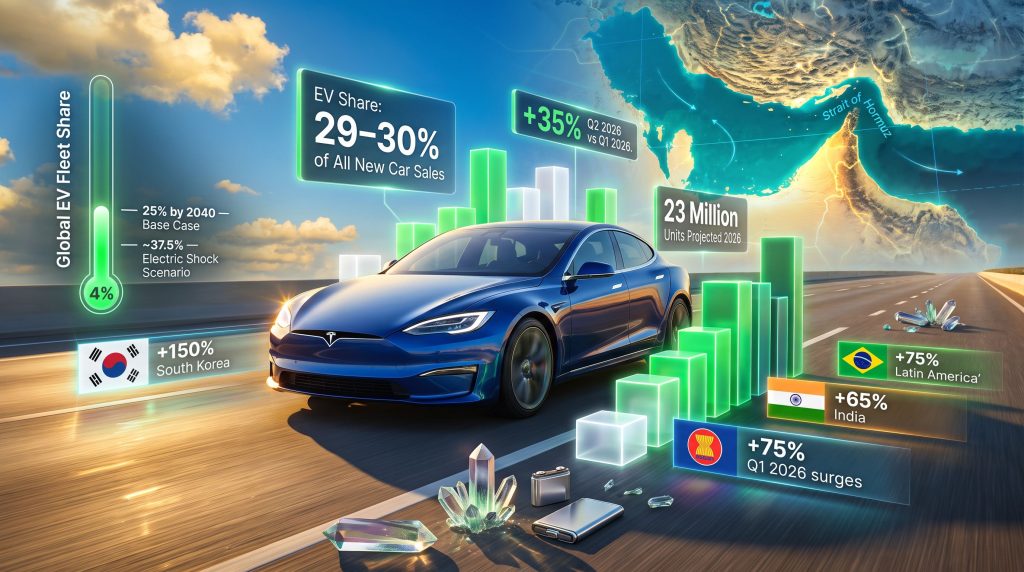
The scale of the acceleration is difficult to overstate. According to the International Energy Agency's Global EV Outlook 2026, total global EV sales are projected to reach approximately 23 million units in 2026, representing close to 29-30% of all new car sales worldwide. Five years ago, that figure sat at roughly 9%. BloombergNEF's Electric Vehicle Outlook 2026 places the global EV share at 27% of cars sold globally this year.
The quarterly data tells an even sharper story. Goldman Sachs data indicates global EV share reached 26.1% of all car sales in May 2026, a gain of 3.4 percentage points from the period before the Hormuz disruption intensified. EV sales then jumped 35% in the second quarter of 2026 compared to the first quarter, as the IEA confirmed in its July update, Electric Car Markets in a Time of Uncertainty.
| Metric | Data Point |
|---|---|
| Projected global EV sales (2026) | ~23 million units |
| EV share of new car sales (2026) | ~29-30% |
| Q2 2026 vs Q1 2026 EV sales growth | +35% |
| Countries with record-high Q2 2026 EV sales | 50 |
| Countries with annual EV growth (H1 2026) | 90 |
| EV share of all car sales, five years prior | ~9% |
| Current global EV fleet share | ~4% |
| Projected global EV fleet share by 2040 (base case) | 25% |
Record-high quarterly EV sales were recorded across 50 countries in Q2 2026 alone, and 90 countries registered annual EV sales growth in the first half of the year. The demand surge was broad-based, registering across 12 of the 15 largest EV markets globally, indicating this is not a regional phenomenon but a genuinely global reorientation. Furthermore, the battery metals investment landscape is shifting accordingly, as capital flows accelerate towards EV-related supply chains.
Regional Acceleration: Where the Shock Hit Hardest
The geographic distribution of the 2026 EV surge reveals a consistent pattern: markets with higher fuel price sensitivity and stronger existing policy infrastructure responded most aggressively.
Emerging Market Leaders
- South Korea: EV sales surged 150% year-on-year in Q1 2026, driven by acute consumer sensitivity to imported fuel costs and a well-developed domestic policy environment.
- India: Q1 2026 EV sales rose 65% year-on-year, a remarkable pivot for a market historically resistant to rapid EV adoption, where cost considerations have long dominated purchase decisions.
- Southeast Asia (excluding China): Regional EV sales grew 80% year-on-year in Q1 2026, reflecting the region's high degree of oil import dependency.
- Latin America: EV sales climbed 75% year-on-year in Q1 2026, with Brazil emerging as a notable standout.
- Europe: EV sales rose approximately 30% year-on-year in Q1 2026.
In Brazil, India, Australia, and Vietnam, electric car sales roughly doubled between March and June 2026 compared to the same period in 2025, according to the IEA's analysis.
The United States: A Notable Outlier
Against this backdrop of near-universal acceleration, the United States stands as a conspicuous exception. The withdrawal of federal EV tax incentives has materially suppressed adoption momentum, and the absence of a competitive domestic battery supply chain limits the cost competitiveness of vehicles available to American consumers. Wood Mackenzie has warned that the U.S. risks entrenching a structural disadvantage in the electric vehicle sector without targeted policy intervention and accelerated investment in advanced battery technology.
The U.S. situation illustrates a critical insight that applies globally: consumer demand and geopolitical urgency alone are not sufficient to drive adoption if policy frameworks and supply chain infrastructure are not aligned.
Step-by-Step: How a Geopolitical Shock Becomes an EV Catalyst
The transmission mechanism from geopolitical disruption to EV showroom demand is not instantaneous, but it is logical and replicable. Understanding this chain is essential for anticipating where adoption accelerates next.
- Hormuz disruption reduces crude throughput, tightening global supply and elevating benchmark oil prices.
- Crude price elevation flows through to retail gasoline and diesel prices in oil-importing nations within weeks.
- Consumer fuel cost pain intensifies awareness of energy import dependency and household budget exposure.
- EV operating cost advantage becomes immediately tangible rather than theoretical, compressing the TCO gap.
- Accelerated purchasing decisions pull forward planned EV acquisitions across multiple market segments.
- Policy response in fuel-exposed economies adds further incentive layers to reduce petroleum import bills.
- Supply chain and infrastructure investment receives renewed priority as governments treat EV deployment as an energy security measure.
- Compounding fleet shift gradually alters the overall composition of vehicles on the road over subsequent years.
The Electric Shock Scenario: Wood Mackenzie's High-Case Framework
Wood Mackenzie's base case already reflects the structural momentum behind electrification: EVs rising from approximately 4% of the global passenger fleet today to 25% by 2040. But the consultancy's high-case scenario, which it has labelled the Electric Shock scenario, models what happens when three forces converge simultaneously.
Those three forces are:
- Governments implement robust EV-supportive policies as a direct energy security response.
- Consumer behaviour shifts durably toward EVs as a result of sustained fuel price volatility.
- Battery and EV technology advances faster than current baseline projections.
Under this scenario, global EV adoption could accelerate to 50% above the base case trajectory. Wood Mackenzie's David Brown, Director of Energy Transition Research, has articulated that when policy, consumer behaviour, and technology align simultaneously, the adoption effect can be dramatic. The consultancy's Electric Shock report quantifies the downstream implications for both oil and power markets. In addition, the broader energy transition in mining sectors is accelerating in parallel, as resource industries adapt to the shifting demand environment.
Downstream Consequences for Oil Demand and Refining
The scenarios carry profound implications for fossil fuel infrastructure.
| Scenario | EV Fleet Share by 2040 | Projected Oil Demand (2040) | Refinery Closures |
|---|---|---|---|
| Wood Mackenzie Base Case | 25% of global fleet | ~104 million bpd | Minimal |
| Wood Mackenzie Electric Shock | ~37.5% of global fleet | ~99 million bpd | ~40 early closures |
| BloombergNEF (passenger vehicles by 2035) | 52% of passenger sales | Significant reduction | TBD |
Under the Electric Shock scenario, global oil demand could fall to approximately 99 million barrels per day by 2040, roughly 5 million bpd below the base case for that year. This reduction would erode refinery utilisation rates below economically viable thresholds, potentially forcing approximately 40 refineries worldwide into early closure. The compounding effect of fewer vehicles burning petroleum products does not require dramatic oil demand destruction to destabilise refinery economics; sustained marginal demand reduction over years is sufficient.
The next major ASX story will hit our subscribers first
China's Dual Position in the Global EV Transition
No analysis of global EV adoption can sidestep China, which remains the dominant force in both EV sales volumes and the policy architecture that shapes them. Annual Chinese EV sales stood at approximately 8.9 million units in 2025. Under an accelerated policy scenario, Wood Mackenzie projects this figure could reach 29.9 million units annually by 2040.
The policy levers available to Beijing are substantial. Additional measures including restrictions on gasoline consumption, full purchase tax exemptions, and expanded purchase credit schemes could collectively reduce the total cost of EV ownership in China by approximately 30%, dramatically compressing the adoption timeline. This degree of policy-driven cost reduction has no parallel in Western markets.
Yet China simultaneously pursues a dual-track strategy. Even as it leads global EV deployment, Beijing continues expanding domestic fossil fuel production capacity as an energy security buffer. This reflects a sophisticated understanding that fleet electrification operates on decadal timescales. China's solar export volumes also fell 21.4% in July 2026, indicating some softening in renewable manufacturing export cycles even as domestic EV demand accelerates, highlighting the complexity of China's energy transition management. Consequently, the lithium-ion battery recycling sector is drawing increased strategic attention as China seeks to close the loop on battery materials at scale.
Supply-Side Constraints: The Binding Limit on Transition Speed
Consumer demand and favourable economics can accelerate the EV adoption impulse, but physical supply-side constraints ultimately determine how fast the transition can actually occur. Two bottlenecks are particularly binding:
- Critical battery minerals supply chains: Lithium, cobalt, nickel, and manganese sourcing and processing capacity represent genuine physical constraints on how many battery packs can be manufactured. The critical minerals demand outlook for 2025 and beyond underscores how scaling these supply chains requires years of investment and development, not months.
- Charging infrastructure networks: Particularly in emerging markets where adoption is now accelerating fastest, charging infrastructure investment lags consumer demand signals significantly.
The Hormuz disruption is not a purely positive catalyst for EV manufacturers. The same geopolitical environment that elevates fuel prices and strengthens the consumer case for EVs also raises input and logistics costs for battery materials and EV components, partially compressing the margins of producers even as retail demand accelerates.
This paradox is underappreciated in mainstream coverage of the EV surge. Supply chain cost inflation, driven by elevated energy and shipping costs, flows directly into battery production economics. Manufacturers face simultaneous demand acceleration and production cost pressure. Moreover, tracking the battery raw materials market has become essential for understanding the true pace at which capacity constraints can be resolved.
Structural Shift or Cyclical Spike? Reading the Long-Term Signal
A critical analytical question hangs over the 2026 EV surge: is this a durable structural acceleration, or a cyclical demand spike that normalises once fuel prices stabilise?
Historical evidence from the 2022 energy crisis offers a partial answer. Consumers who switched to EVs during that period of elevated fuel prices showed very low rates of reversion to internal combustion engine vehicles. The switching cost psychology works asymmetrically: the pain of high fuel costs motivates the switch, but the experience of lower operating costs and home charging convenience reinforces the decision once made.
However, fleet composition changes operate on much longer timescales than annual sales data suggests. Vehicle replacement cycles average 7 to 12 years, meaning that even a dramatic surge in EV sales in 2026 translates into a gradual change in the overall fleet over the following decade. The IEA's July 2026 update confirmed that the Q2 rebound was genuine and geographically broad, while noting that production constraints and supply chain limitations mean the market transitions more gradually than headline quarterly figures imply.
Key Milestones for the Road Ahead
- 2026: EVs approach 30% of annual global new car sales globally.
- 2030: Policy frameworks across major economies expected to further tighten ICE vehicle regulations.
- 2035: BloombergNEF projects EVs could represent 52% of all passenger vehicle sales globally.
- 2040: Wood Mackenzie base case places EVs at 25% of the total global fleet, reflecting the multi-decade lag between sales share and fleet share.
The distinction between sales share and fleet share is among the most commonly misunderstood metrics in energy transition analysis. Even if EVs capture 50% of new car sales by 2035, the total global fleet will still be dominated by internal combustion vehicles for years beyond that date, because the existing stock of vehicles turns over slowly.
FAQ: Hormuz Oil Crisis and Global EV Adoption
How directly has the Strait of Hormuz crisis caused EV sales to increase?
The relationship is indirect but powerful. Reduced crude throughput elevated global fuel prices, which made the operating cost advantage of EVs immediately tangible to consumers across multiple continents. Q2 2026 EV sales rose 35% from Q1 as fuel price volatility intensified following the crisis. The Hormuz oil crisis accelerates global EV sales through precisely this kind of consumer cost psychology operating at continental scale.
Which regions are seeing the biggest EV acceleration in 2026?
South Korea recorded 150% year-on-year growth in Q1 2026, followed by Southeast Asia at 80%, Latin America at 75%, and India at 65%. Europe recorded approximately 30% year-on-year growth. The U.S. is the significant underperformer relative to its market size.
Will elevated EV adoption persist if the Hormuz crisis resolves?
Analysts generally anticipate some degree of permanent behavioural change. Consumers who transition to EVs during a fuel price shock rarely reverse the decision, and policy responses triggered by crisis conditions tend to outlast the immediate disruption.
What is the biggest obstacle to faster global EV adoption?
Supply chain constraints, particularly critical battery mineral availability and the pace of charging infrastructure buildout, remain the primary structural barriers regardless of how strong consumer demand signals become.
What does the Electric Shock scenario mean for oil markets?
If policy, consumer behaviour, and technology all align, global oil demand could fall to approximately 99 million barrels per day by 2040, roughly 5 million bpd below the base case, potentially forcing around 40 refineries into early closure as road transport fuel demand structurally declines. Furthermore, understanding BloombergNEF's EV outlook methodology offers additional context for interpreting these long-range projections.
Disclaimer: This article is for informational purposes only and does not constitute financial or investment advice. Forecasts, scenarios, and projections referenced are drawn from third-party analysts and carry inherent uncertainty. Readers should conduct independent research before making any investment or purchasing decisions.
Want to Invest Ahead of the Next Major Mineral Discovery Driving the EV Transition?
As critical battery minerals become central to the global shift toward electric vehicles, Discovery Alert's proprietary Discovery IQ model delivers real-time notifications on significant ASX mineral discoveries — instantly turning complex geological data into actionable investment insights. Explore historic discoveries and their exceptional returns, then start your 14-day free trial to position yourself ahead of the market.