July 29, 2026
The Invisible Barrier That Ceasefire Announcements Cannot Remove
When conflict disrupts a critical maritime chokepoint, the damage to commercial shipping confidence operates on a fundamentally different timeline than the conflict itself. Political announcements can pause hostilities within hours. Rebuilding the commercial trust that underpins normal cargo movement takes weeks or months of demonstrated, incident-free operations. This asymmetry between diplomatic speed and market recovery speed is one of the least understood dynamics in global energy markets, and nowhere is it more visible right now than in the Strait of Hormuz.
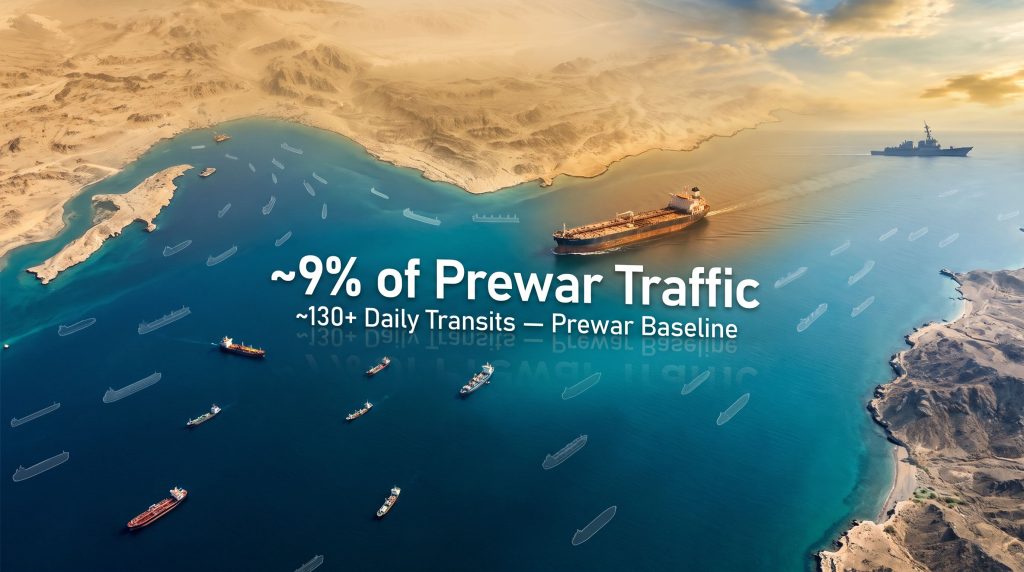
The data is unambiguous. Despite a pause in active fighting between the US and Iran, Hormuz transits still low despite pause in fighting conditions persist, with daily vessel crossings running at roughly 9% of prewar baseline levels. Understanding why this gap exists, and what it would take to close it, requires looking beyond the headlines and into the structural mechanics of maritime risk pricing.
When big ASX news breaks, our subscribers know first
A Chokepoint in Numbers: How Suppressed Has Traffic Actually Become?
The Strait of Hormuz typically handles around 130 or more vessel transits daily under normal operating conditions, channelling approximately 20 to 21% of global oil consumption through a waterway that is, at its narrowest point, only about 33 kilometres wide. The following table illustrates how dramatically that baseline has collapsed:
| Date | Vessels Transiting | Route Concentration |
|---|---|---|
| 25 July 2026 | 1 (outbound only) | 100% northern Iranian lane |
| 26 July 2026 | 7 (5 outbound, 2 inbound) | 100% northern routes |
| 27 July 2026 | 6 (evenly split) | 100% northern Iranian lane |
| 24 July 2026 | 12 combined | 88 to 100% northern lane |
| Prewar baseline | ~130+ daily | Mixed northern and southern |
Source: Windward vessel tracking data
The 25 July figure, a single outbound crossing, represents the lowest recorded daily transit total since the breakdown of the June memorandum of understanding between the US and Iran, according to Windward. The southern Omani corridor, which theoretically offers an alternative routing path, recorded no sustained increase in utilisation during this period, according to a 28 July advisory issued by the UK Trade Maritime Organization (UKTMO).
The "US-Assisted" Transit Figure and What It Actually Signals
A separate count from the UKTMO and the US Naval Cooperation and Guidance for Shipping (NCAGS) recorded 26 so-called US-assisted transits across the 26 to 27 July window. This figure sounds more encouraging until you consider what it actually reveals: commercial vessels requiring active military coordination to cross a waterway that should, under normal conditions, require nothing more than routine navigation.
The requirement for military-facilitated passage is itself a diagnostic indicator of how far the strait remains from operational normalcy. Unassisted commercial transit, the kind that underpins crude oil trade geopolitics and global energy flows, has not meaningfully resumed.
Four Structural Barriers Explaining Why the Ceasefire Has Not Restored Traffic
The persistence of suppressed vessel movement through Hormuz reflects compounding structural factors rather than simple caution. Each barrier reinforces the others, creating a multilayered commercial paralysis that diplomatic pauses alone cannot dissolve.
1. War-Risk Insurance Premiums Have Not Repriced
Marine underwriters do not reprice war-risk coverage in response to ceasefire announcements. They require a sustained empirical record of incident-free transits before adjusting premium structures. Until that record exists, the surcharges applied to Hormuz voyages remain prohibitive for many operators, particularly those carrying lower-margin commodity cargoes where freight economics are tight.
2. Iran's Asymmetric Interdiction Capability Remains Structurally Intact
Research from the Center for Naval Analyses (CNA) has assessed that Iran's capacity to disrupt commercial shipping relies on capabilities that are inherently difficult to neutralise through conventional airstrikes. These include:
- Fast attack craft capable of rapid swarming manoeuvres
- Shore-launched cruise missiles with significant range and accuracy
- Drone swarms that can be deployed in large numbers at relatively low cost
Maritime security data from Windward recorded 219 speed craft operating within the strait on 21 July alone, the highest single-day count since 15 May. The volume of force Iran needs to disrupt commercial shipping is fundamentally small relative to its available arsenal, which is precisely what makes military degradation of this capability so difficult.
As CNA research programme director Joshua Tallis assessed in July 2026, short of a massive ground invasion, no purely military solution exists to Iran's ability to disrupt and coerce commercial traffic through the strait. The only durable resolution, in this analytical framework, is a negotiated diplomatic outcome. Shipping association BIMCO has previously made a complementary observation: reducing Iran's motivation to attack through diplomatic engagement may be considerably more tractable than attempting to eliminate its capability to do so.
3. Lane Concentration as Evidence of Ongoing Coercion
The near-total consolidation of all vessel traffic onto the northern Iranian-adjacent traffic separation scheme, accounting for 88 to 100% of all transits between 20 and 24 July, is itself a form of evidence. Vessels are not simply exercising caution. They are actively avoiding the southern corridor because Iran has demonstrated the willingness and capability to target vessels using it. Traffic concentration in the northern lane is, paradoxically, a sign of Iranian influence over commercial navigation during a ceasefire pause.
4. The US Naval Blockade Operates Independently of the Ceasefire
A dimension of the current situation that receives insufficient attention in mainstream coverage is the continued operation of a US maritime blockade of traffic bound for Iranian ports. US Central Command confirmed on 28 July that since blockade enforcement resumed on 14 July following the breakdown of the US-Iran ceasefire, American forces had:
- Redirected 18 commercial vessels
- Boarded 2 vessels to verify compliance
- Disabled 2 additional vessels
On 24 July, US forces disabled the very large gas carrier Lavine, which also operated under the name Disha and was subject to US sanctions according to vessel information firm TankerTrackers.com. The following day, the MR2 tanker Charminar was boarded to confirm blockade compliance.
"The strait currently presents commercial operators with a genuinely unusual risk geometry: potential interference from Iranian forces in the northern lane, potential interception by US forces enforcing the blockade in adjacent waters, and no corridor that is demonstrably safe from either."
The Southern Corridor Puzzle: Why Alternative Routing Has Failed to Materialise
Under normal risk-mitigation logic, one might expect vessels to gradually shift toward the southern Omani-adjacent routing as an alternative to the Iranian-influenced northern lane. However, the absence of any sustained increase in southern corridor traffic, as confirmed by UKTMO's 28 July advisory, reveals something important about operator behaviour: the choice is not between the northern lane and the southern lane.
For the vast majority of operators, the choice is between transiting Hormuz at all or avoiding it entirely. Shipowners are electing to wait at anchorage, extend voyage duration through alternate routing around the Arabian Peninsula via the Cape of Good Hope, or simply delay shipments. The Cape of Good Hope diversion adds approximately 3,500 additional nautical miles to a voyage from the Persian Gulf to Europe, translating into significant time and fuel cost penalties but, crucially, no exposure to Hormuz risk at all.
How Maritime Risk Recovery Actually Works: A Four-Stage Framework
Understanding why Hormuz transits remain suppressed requires appreciating how shipping markets respond to geopolitical risk over time. The recovery cycle generally follows a predictable sequence:
-
Immediate Avoidance – Vessels divert away from the affected waterway entirely as soon as elevated threat signals emerge.
-
Cautious Re-entry Attempts – During pauses or ceasefires, a small number of operators test the route, typically under military escort or through flag-of-convenience arrangements that reduce reputational exposure.
-
Insurance Repricing – Marine underwriters begin reassessing war-risk premiums only after a sustained period of incident-free transits, typically measured in weeks to months rather than days.
-
Normalisation – Broad commercial traffic resumes only when insurance costs return toward pre-conflict levels and operators collectively perceive the risk as manageable without escort.
Based on current transit data and insurance market signals, Hormuz appears to be operating in Stage 2 at best, with cautious military-assisted re-entry attempts but no structural movement toward Stage 3 repricing. Furthermore, historical precedent reinforces the slowness of this process. During the 1980s Tanker War in the Persian Gulf, commercial traffic did not fully normalise until well after the formal cessation of hostilities. Following the Iranian tanker seizures of 2019, insurance premiums remained elevated for months despite no sustained escalation.
The Conditions Required for a Genuine Recovery
| Recovery Condition | Current Status | Estimated Timeline |
|---|---|---|
| Sustained absence of vessel incidents | Not yet achieved | Unknown |
| War-risk insurance premium normalisation | Premiums remain elevated | Weeks to months after incident-free period |
| Southern corridor utilisation resumption | No increase recorded | Dependent on security conditions |
| Diplomatic reduction of Iran's interdiction motivation | Ongoing negotiations only | Uncertain |
| US blockade suspension or modification | Actively enforced | Tied to broader US-Iran diplomacy |
The five conditions listed above are not independent. Each reinforces the others. War-risk premiums will not normalise until incidents stop. Incidents will not stop until Iran's motivation to interdict is reduced diplomatically or its capability is degraded militarily. CNA analysis suggests the military pathway faces fundamental constraints. BIMCO's position is that the diplomatic pathway, while uncertain, is the more tractable option. Consequently, the broader geopolitical risk landscape continues to weigh heavily on commercial operator decisions.
The next major ASX story will hit our subscribers first
Cascading Effects on Global Energy and Freight Markets
The continued suppression of Hormuz transits is not a regional shipping problem. It is a structural shock to global energy supply architecture.
Crude Oil and Refinery Feedstock
With Hormuz carrying roughly one-fifth of global oil consumption under normal conditions, a sustained reduction to single-digit daily crossings creates effective supply tightness across Brent and WTI benchmarks. Middle Eastern producers dependent on Hormuz for export access face mounting revenue pressure and increasingly constrained storage availability.
Into this supply gap, Latin American and West African producers are competing to redirect volumes. Brazilian and Guyanese crude output reached a combined 3.28 million barrels per day in 2026, up approximately 500,000 b/d from 2025, according to Vortexa trade analytics data. European and Asian refiners are increasingly evaluating these grades as structural substitutes for displaced Gulf supply, though the economics are complex. Brazilian Buzios grade has averaged approximately $5.50 per barrel cheaper than Nigerian Forcados on a delivered-northwest Europe basis over the past year, but Forcados carries a higher diesel yield that can offset the price differential in refinery gate value terms.
LNG and Gas Markets
Qatar, the world's largest LNG exporter, routes all of its export volumes through the Strait of Hormuz. Sustained restrictions on Hormuz transits create direct upward pressure on spot LNG prices, and these oil market disruptions are now rippling into gas markets for European and Asian buyers dependent on Qatari supply. In addition, alternative supply sources including US LNG export projects and global LNG supply from Australian projects gain meaningful pricing leverage in a constrained Hormuz environment.
Freight Rate Dynamics
The war-risk premium environment creates a two-tier tanker market. Operators willing to accept Hormuz exposure command significant freight rate premiums over risk-averse peers. For those opting for Cape of Good Hope diversion, extended voyage times and additional fuel consumption inflate delivered costs for all commodity classes, not just crude oil. This commodity market volatility is reshaping hedging strategies across the sector.
Frequently Asked Questions About Hormuz Transits
Why are Hormuz transits still low if a ceasefire is in place?
A cessation of active strikes reduces incident frequency but does not eliminate the underlying threat architecture. Shipowners and insurers require a demonstrated period of safe, unassisted operations before normalising commercial activity. The simultaneous operation of a US naval blockade and Iran's retained asymmetric interdiction capability means the practical risk calculus has not materially changed.
What is the northern Iranian lane?
The northern traffic separation scheme runs through the portion of the strait closest to Iranian territorial waters. Traffic has concentrated on this routing because Iran has effectively deterred vessel movement through the southern Omani corridor, making the northern lane the de facto path for any operator willing to transit at all. This concentration reflects Iranian influence over navigational choices, not safety.
Why can't military action simply reopen the strait?
Iran's asymmetric interdiction toolkit, encompassing fast attack craft, drone swarms, and coastal cruise missiles, requires only a small fraction of its available arsenal to threaten commercial shipping. CNA analysis has found this makes meaningful military degradation of Iran's interdiction capacity extremely difficult without a ground campaign of a scale that would represent a fundamental escalation of the conflict.
Three Forward Scenarios for Traffic Recovery
Scenario 1: Rapid Diplomatic Settlement (Low Probability)
A formal US-Iran agreement suspending both the blockade and Iranian interdiction operations could trigger a cautious resumption of transits. Insurance markets would likely require two to four weeks of verified, incident-free crossings before beginning to reprice war-risk coverage. Even under this scenario, full traffic normalisation would take months.
Scenario 2: Prolonged Stalemate (Highest Probability)
The most probable near-term trajectory involves continued low-level transit activity, sustained insurance surcharges, and periodic incidents that repeatedly reset commercial confidence each time it begins to build. Global energy markets would continue pricing in a structural supply discount from the Persian Gulf region, with Latin American and other non-Gulf producers continuing to capture displaced market share.
Scenario 3: Renewed Escalation (Moderate Probability, Tail Risk)
A breakdown of the current pause, whether triggered by a naval incident, a miscalculation, or deliberate escalation, would push daily transits back toward zero and generate a significant commodity price shock across crude oil, LNG, and tanker freight markets simultaneously. Under this scenario, the Cape of Good Hope diversion would become the near-universal default for Persian Gulf export flows.
"The fundamental lesson from the current data is that Hormuz transits still low despite pause in fighting conditions will persist for as long as the underlying structural barriers remain in place. A ceasefire announcement marks the beginning of a long recovery process, not its completion. Market participants who conflate diplomatic pauses with commercial normalisation risk misreading both the energy supply outlook and the freight market dynamics that flow from it."
This article contains forward-looking analysis and scenario projections that involve uncertainty and should not be construed as financial or investment advice. Readers should conduct their own due diligence and consult qualified advisers before making decisions based on commodity market forecasts.
Want to Stay Ahead of the Commodity Disruptions Reshaping Global Markets?
When geopolitical shocks like the Hormuz crisis ripple through energy and resource markets, timing is everything — Discovery Alert's proprietary Discovery IQ model delivers real-time alerts on significant ASX mineral discoveries, instantly translating complex market conditions into actionable opportunities for both traders and long-term investors. Explore historic discoveries and their returns to understand the scale of what early positioning can achieve, then start your 14-day free trial at Discovery Alert to ensure you're never last to act on the next major find.