
July 29, 2026
When the Safety Net Has Holes: Rethinking What Emergency Energy Reserves Actually Deliver
Emergency preparedness infrastructure is almost never tested under ideal conditions. By definition, strategic reserves exist to absorb shocks that arrive without warning, at scale, and often in rapid succession. The U.S. Strategic Petroleum Reserve infrastructure strain is now at the centre of a critical policy debate, as the system faces its most difficult operational environment since it was first built.
The reserve was designed as a physical buffer against the kind of geopolitical disruptions that can sever oil supply chains and send economies into recession. However, what happens when the buffer itself is structurally compromised? That is the question now confronting U.S. energy policymakers.
The challenge is not simply about how many barrels remain in storage. It runs deeper, into the mechanical arteries that move oil from underground caverns to the surface, through pipelines, and eventually into the commercial supply chain. Understanding the full picture requires examining both the volume problem and the velocity problem simultaneously.
When big ASX news breaks, our subscribers know first
Why Barrel Count Is Only Half the Story
The Distinction Between Inventory and Deployable Capacity
A common misconception about strategic petroleum reserves is that the headline inventory figure represents what is actually available in an emergency. In practice, the distinction between total stored volume and operationally deployable volume is significant and, in the case of the SPR, increasingly consequential.
According to a May 2026 Government Accountability Office report, more than one quarter of the SPR's inventory was unavailable for drawdown at the time of the assessment, due to a combination of cavern outages and construction outages. Applied to inventory levels as of mid-2026, this implies that a minimum of approximately 103 million barrels currently stored in the reserve cannot be rapidly deployed, regardless of political authorisation.
This creates a gap between what policymakers see on paper and what the system can actually deliver when the order to release is given. That gap is the operational core of the SPR's current vulnerability.
How Infrastructure Degradation Quietly Erodes Response Capability
The SPR's primary physical assets, including its network of salt cavern wells, surface pipelines, pumping equipment, and valve systems, were largely installed between the late 1970s and the mid-1980s. These components are now operating well beyond their original design service life, in some cases by decades.
Federal auditors have described the system's condition in stark terms, with Department of Energy officials telling investigators that key infrastructure components are being held together through improvised maintenance rather than systematic replacement. Furthermore, the crude oil price volatility that accompanies geopolitical crises creates exactly the conditions under which the SPR is most urgently needed.
As these conditions worsen, the maximum rate at which oil can be extracted and delivered falls, independent of how much oil is actually stored.
Infrastructure degradation in a reserve system is insidious precisely because it is invisible in inventory data. A reserve can appear robust on paper while its physical delivery capability quietly erodes to a fraction of its original design specification.
The Engineering Reality: Four Decades Underground
Salt Cavern Storage and Its Lifecycle Constraints
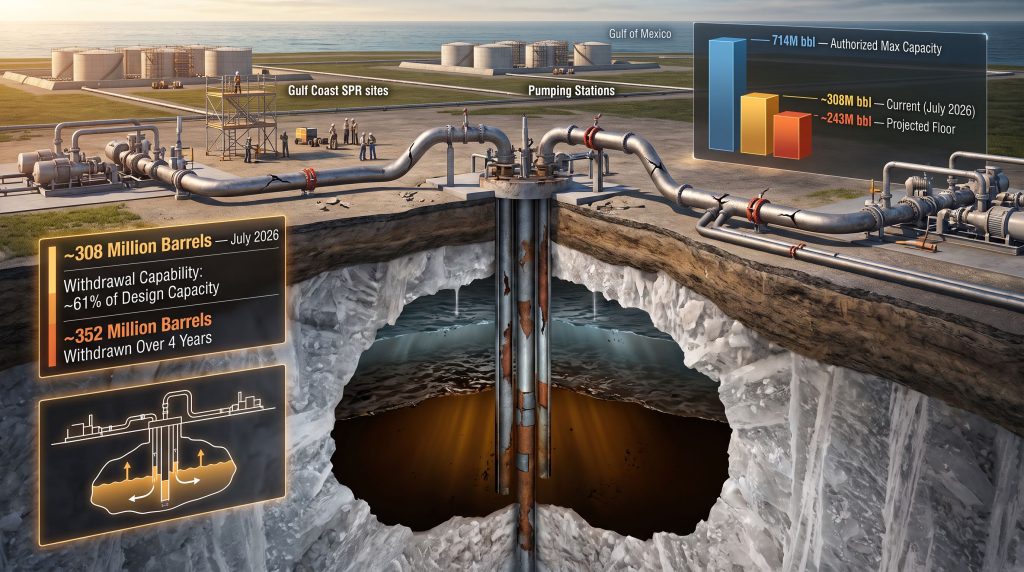
The SPR stores crude oil in 60 salt caverns distributed across four Gulf Coast sites, located thousands of feet underground. The physics of salt cavern storage are elegantly simple: oil is displaced upward by injecting water into the base of each sealed cavern, creating pressure differential that pushes petroleum through production wells to the surface.
Oil's role in the economy makes this delivery mechanism critically important. From the caverns, pipelines carry crude to distribution terminals connected to the broader commercial network.
Step-by-step, an SPR drawdown works as follows:
- Fresh water is pumped into the lower section of a sealed underground salt cavern
- Hydraulic pressure from the water column forces crude oil upward through the pressure differential
- Oil travels through production wells to surface-level collection points
- Surface pipeline infrastructure routes crude to Gulf Coast distribution terminals
- Oil enters commercial pipeline networks or is loaded onto marine tankers for export or domestic delivery
- The partially emptied cavern is maintained with a water column until restocking operations begin
Each step in this chain depends on ageing mechanical systems. A failure at any single point in this sequence reduces the effective drawdown rate, even if all other components are functioning normally.
What Happens After 40 Years of Salt Cavern Operation
Salt caverns are geologically stable over long timeframes, but the mechanical infrastructure surrounding them is not. Production well casings, surface valves, pump seals, and interconnecting pipelines all experience cumulative wear. High-volume drawdown operations accelerate this wear cycle, because moving large quantities of oil at speed stresses equipment that may have been sitting partially idle for years.
The 2022 release ordered in response to Russia's invasion of Ukraine functioned, in the assessment of federal auditors, as an unplanned stress test of the system's operational capabilities. The Department of Energy executed that release without major equipment failures or significant crude oil spills, but doing so required active triage of failing components throughout the operation, including leaking water pumps and pipeline failures that needed emergency repair while the drawdown was still underway.
Energy policy specialists with direct government experience have noted that intensive drawdown operations function similarly to heavy industrial equipment use: the more aggressively a system is operated, the more rapidly its maintenance requirements compound.
Quantifying the Damage: What the GAO Found
Performance Metrics Against Original Design Specifications
The GAO's assessment translated the cumulative infrastructure degradation into concrete performance figures that illustrate just how far the system has declined from its original engineering parameters.
| SPR Performance Metric | Original Design Capacity | Estimated Current Effective Capacity |
|---|---|---|
| Withdrawal Capability | 100% (design baseline) | ~61% |
| Refill Capability | 100% (design baseline) | ~56% |
| Inventory Available for Drawdown | Full stockpile | ~75% (remainder offline due to outages) |
| Maximum Withdrawal Rate | 4.4 million bbl/day | Degraded, effective rate lower |
| Refill Rate | ~785,000 bbl/day (baseline) | Reduced under current conditions |
These figures reveal a system operating at roughly three-fifths of its original withdrawal capability and barely more than half its refill capability. The refill degradation is particularly significant because it extends the recovery timeline after any major release, leaving the reserve exposed for longer periods following each emergency drawdown. According to the U.S. Department of Energy, understanding the reserve's full operational specifications is essential to evaluating its true emergency response capacity.
The Compounding Problem of Emergency Repairs During Active Operations
One underappreciated dimension of the U.S. Strategic Petroleum Reserve infrastructure strain is the operational paradox it creates during drawdowns. When a release is ordered, maintenance work cannot simply stop. However, conducting infrastructure repairs while simultaneously moving millions of barrels of crude oil through the same system creates additional risk and operational complexity.
During the 2022 release, energy officials reported that emergency repairs had to be prioritised in real time, essentially triaging which failing components needed immediate attention to keep the drawdown moving. This kind of improvised operational management works once, perhaps twice. Its repeatability under further degraded conditions is genuinely uncertain.
Four Years, 352 Million Barrels: The Drawdown Chronicle
Understanding the Scale of Recent Releases
The SPR has experienced two major emergency drawdowns within a four-year window, a frequency of large-scale releases unprecedented in the reserve's history.
| Drawdown Event | Barrels Released | Primary Trigger |
|---|---|---|
| Biden Administration Release | ~180 million barrels | Russia's invasion of Ukraine, 2022 |
| Trump Administration Release | ~172 million barrels | Iran conflict disrupting Strait of Hormuz, 2026 |
| Total 4-Year Withdrawal | ~352 million barrels | Combined geopolitical crises |
The 2022 release, at 180 million barrels, was at the time the largest in SPR history. The 2026 release, ordered in response to Iran choking off oil exports through the Strait of Hormuz, matched that scale and triggered what analysts have described as the largest supply disruption in history. Consequently, the oil price crash dynamics associated with these geopolitical events have added further complexity to energy security planning.
Where the Inventory Stands Now
The cumulative effect of these releases has pushed SPR inventory to territory not seen in more than four decades.
- Current stockpile as of late July 2026: approximately 308 million barrels
- Projected post-release floor once the 2026 drawdown is fully executed: approximately 243 million barrels
- Authorised maximum storage capacity: 714 million barrels
- Estimated non-deployable inventory based on GAO findings: minimum 103 million barrels
- DOE operational safety minimum: approximately 70 million barrels, or roughly 10% of total authorised capacity
At 308 million barrels, the SPR has reached its lowest level since March 1983, a period when the reserve was still being filled rather than drawn down. The projected floor of 243 million barrels would place the system at roughly 34% of its authorised capacity, with a meaningful portion of that remaining volume operationally inaccessible.
The $1.4 Billion Question: Is the Modernisation Plan Enough?
What the Department of Energy's Repair Programme Covers
The Department of Energy is currently implementing a $1.4 billion infrastructure repair and modernisation programme intended to address the most critical degradation issues across the SPR's four Gulf Coast sites. The programme targets ageing well casings, pipeline infrastructure, pumping systems, and cavern integrity assessments.
However, a critical detail in the GAO's findings is that the scope of this modernisation programme was narrowed specifically to remain within the allocated budget. This descoping means that certain infrastructure needs identified during the assessment process were excluded from the current programme, deferred to a future funding cycle that has not yet been authorised.
When a capital programme is scoped to fit a budget rather than budgeted to fit a need, the gap between what was planned and what was funded becomes a hidden liability. In the case of the SPR, that liability accrues directly to emergency response capability.
Timeline Pressures and Concurrent Operations
A further complication is that modernisation work is being conducted concurrently with active drawdown operations. This parallel execution is operationally challenging: construction outages temporarily remove caverns and pipeline segments from service while repairs are underway, directly contributing to the more-than-one-quarter inventory unavailability identified in the GAO report.
This creates a difficult trade-off. Delaying modernisation preserves short-term availability but allows infrastructure degradation to continue. Accelerating modernisation improves long-term capability but reduces near-term deployable inventory precisely during a period when the reserve may face continued pressure.
The next major ASX story will hit our subscribers first
Scenario Analysis: Could the SPR Handle Another Crisis?
Residual Capacity Assessment at Sub-300 Million Barrel Levels
Former State Department special envoy for international energy affairs David Goldwyn has indicated publicly that the reserve retains sufficient inventory to support another drawdown, and that near-term concerns about reserve stability are manageable. However, the more nuanced concern raised by energy policy experts relates not to volume but to operational speed and scale.
| Scenario | SPR Inventory Available | Effective Drawdown Rate | Duration of Coverage |
|---|---|---|---|
| Pre-2022 baseline | ~600M+ barrels | Near design capacity | Extended multi-year buffer |
| Post-Ukraine drawdown | ~370M barrels | Partially degraded | Moderate-term buffer |
| Post-Iran drawdown (projected) | ~243M barrels | ~61% of design capacity | Reduced buffer window |
| Hypothetical third crisis | ~140-170M barrels (est.) | Further degraded | Significantly constrained |
The scenario table above illustrates a compounding problem: each successive drawdown depletes both volume and operational capability simultaneously, leaving progressively less margin for the next disruption. In addition, the OPEC market influence on global supply dynamics means that external pressures on the SPR are unlikely to diminish in the near term.
The IEA Coordination Dimension
The SPR does not operate in isolation. The United States participates in the International Energy Agency's collective emergency response framework, under which member countries coordinate strategic reserve releases during supply crises. This coordination mechanism provides some additional buffer, as allied nations can release their own reserves in parallel to reduce the burden on any single country's system. However, the operational constraints of the SPR are a uniquely American problem that IEA coordination cannot fully offset.
The Policy Architecture: What Federal Law Does and Does Not Require
The Absence of a Statutory Minimum
One of the more surprising aspects of the SPR's governance framework is that federal law does not establish a mandatory minimum operating level. There is no legal floor below which drawdowns are prohibited. A Department of Energy spokesperson confirmed that the operational safety minimum sits at approximately 70 million barrels, or roughly 10% of total authorised capacity, below which safe management of the cavern systems becomes problematic.
This means that, in theory, political decisions could reduce SPR inventory to within a relatively narrow margin of the practical operational minimum, leaving almost no buffer for further emergencies. The trade war and oil markets relationship adds yet another layer of complexity to these policy decisions, as trade tensions can amplify supply disruptions that the SPR is intended to offset.
The Case for a Statutory Framework
Energy policy specialists have increasingly argued that the absence of a legally mandated minimum creates unnecessary vulnerability. A statutory floor would not prevent emergency releases but would require formal congressional action to authorise drawdowns below a defined threshold, introducing a deliberate decision-making process at the point where inventory levels become critically low.
Whether Congress moves to establish such a framework remains an open question. Furthermore, analysis from the Council on Foreign Relations highlights that the current policy architecture, designed for a reserve operating well above capacity constraints, was not built for the operational environment the SPR now inhabits.
SPR at a Glance: Key Data Summary
| Data Point | Figure |
|---|---|
| Current inventory (July 2026) | ~308 million barrels |
| Projected post-release floor | ~243 million barrels |
| Authorised maximum capacity | 714 million barrels |
| Total withdrawn over 4 years | ~352 million barrels |
| Estimated non-deployable inventory | Minimum ~103 million barrels |
| Effective withdrawal capability | ~61% of design capacity |
| Effective refill capability | ~56% of design capacity |
| DOE operational safety minimum | ~70 million barrels |
| Modernisation budget | $1.4 billion (scope-reduced) |
| Number of salt caverns | 60 across 4 Gulf Coast sites |
Frequently Asked Questions: U.S. Strategic Petroleum Reserve Infrastructure
What is causing the U.S. Strategic Petroleum Reserve infrastructure strain?
The primary drivers are decades of deferred maintenance on systems originally installed in the late 1970s and early 1980s, combined with the accelerated mechanical wear caused by two large-scale emergency drawdowns in four years. Federal auditors have found that pumps, pipelines, wells, and cavern systems are operating well beyond their original design lifespans, reducing both withdrawal speed and refill capability.
How much of the SPR is currently unavailable for use?
The GAO found that more than one quarter of SPR inventory was unavailable due to construction and cavern outages at the time of its May 2026 assessment. Based on current inventory levels, this implies a minimum of approximately 103 million barrels that cannot be rapidly deployed in an emergency.
What is the current SPR inventory level?
As of late July 2026, the reserve held approximately 308 million barrels, its lowest point since March 1983. Once the 2026 release authorised by the Trump administration is fully executed, inventory is projected to fall to approximately 243 million barrels.
Is there a legal minimum for SPR inventory?
No. Federal law does not set a mandatory minimum operating level. The Department of Energy has identified an operational safety floor of approximately 70 million barrels, representing roughly 10% of total authorised capacity, below which safe management of the cavern systems becomes problematic.
What does the $1.4 billion modernisation programme cover?
The DOE programme targets ageing infrastructure across the SPR's Gulf Coast sites, including well casings, pipeline segments, and pumping systems. However, the scope was reduced to remain within budget, meaning that not all identified infrastructure needs are addressed under the current programme.
Can the SPR handle another major supply disruption?
Energy policy experts indicate the reserve retains enough volume to support another drawdown. The more significant concern is operational: degraded infrastructure limits the speed and scale at which oil can be released, potentially reducing the SPR's effectiveness as a rapid-response tool during a fast-moving crisis where timing is critical.
This article contains forward-looking assessments and scenario projections based on publicly available data and government reports. Actual outcomes may differ materially from projections depending on geopolitical developments, maintenance timelines, and policy decisions. This content is intended for informational purposes only and does not constitute financial or investment advice.
Want to Stay Ahead of the Next Major Commodity Disruption?
When geopolitical shocks rattle global energy markets — as the SPR's mounting vulnerabilities make increasingly likely — the investors best positioned are those who receive real-time intelligence first. Discovery Alert's proprietary Discovery IQ model instantly identifies significant ASX mineral discoveries the moment they are announced, transforming complex commodity data into actionable opportunities; explore historic discoveries and their returns to understand the potential, then begin your 14-day free trial at Discovery Alert to secure your market-leading edge.