July 29, 2026
When Benchmark Data Breaks: Understanding the Northern Europe HRC Price Correction of July 2026
Commodity price benchmarks are among the most quietly powerful instruments in global industrial commerce. Millions of dollars in procurement contracts, hedging positions, and supplier agreements are settled against a handful of published numbers each day. When those numbers contain errors, the consequences ripple far beyond a simple data correction notice. The Northern Europe HRC price correction issued on July 28, 2026 is a textbook case study in how index methodology works, why it sometimes fails, and what it reveals about the underlying steel market it is designed to reflect.
When big ASX news breaks, our subscribers know first
What Hot-Rolled Coil Pricing Actually Measures
Hot-rolled coil is the foundational flat steel product from which a vast portion of the industrial economy is constructed. Produced by passing heated steel slabs through high-pressure rolling mills, HRC serves as the primary input for automotive body panels, structural framing in construction, agricultural machinery, white goods, and capital equipment manufacturing. Because of its position at the start of so many value chains, the Northern European domestic HRC price, assessed on an ex-works basis, functions as a regional economic barometer in its own right.
The ex-works (exw) basis means the price reflects the cost at the mill gate, excluding freight and logistics. This standardisation allows buyers across different geographies to make meaningful comparisons and embed the benchmark into long-term supply contracts. Price reporting agencies publish these assessments daily, drawing on transaction data, bids, offers, and market indications collected from a cross-section of buyers, sellers, and intermediaries active in the market.
What most procurement teams do not fully appreciate is how vulnerable these indices are to thin trading conditions. When market participation drops, such as during summer months when industrial activity slows, the sample of transactions underpinning an assessment can shrink to the point where a single participant's data exerts outsized influence on the final published number.
The 2026 Northern European HRC Price Trajectory
To contextualise the July correction, it helps to trace the price path that preceded it across the full year.
| Period | Price Level (€/tonne) | Market Condition |
|---|---|---|
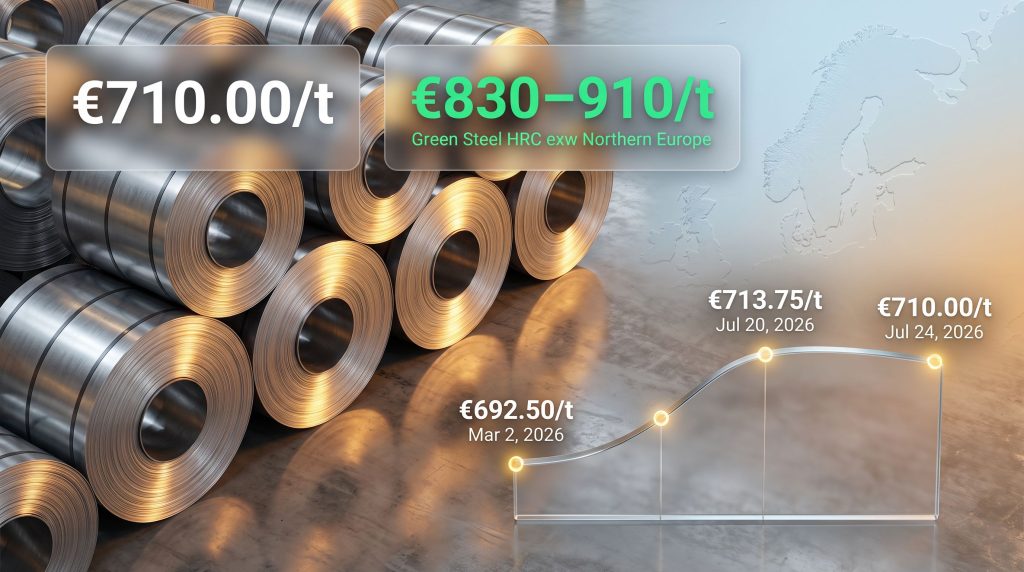
| March 2, 2026 | €692.50 | Strengthening market; firm mill order books |
| Mid-March 2026 | ~€710.00 | Deals in the €700-720 range; bullish sentiment |
| July 20, 2026 | €713.75 | Peak recent level; slow trading activity |
| July 21, 2026 | €712.29 | Early softening; summer demand lull emerging |
| July 24, 2026 (corrected) | €710.00 | Confirmed correction; methodology error resolved |
The arc here is consistent with a well-established seasonal pattern in European flat steel markets. A demand-led rally through the first quarter, supported by strong mill order books and restocking activity among service centres, gave way to a gradual softening as summer arrived. The price range of €700-720 per tonne that emerged by mid-year reflects a market consolidating around a relatively stable equilibrium rather than experiencing any structural breakdown. Furthermore, this trajectory aligns closely with broader observations from the global crude steel outlook for 2025, where seasonal softening patterns were well anticipated.
The 2026 Northern European HRC price trajectory followed a classic demand-led rally in Q1, followed by a gradual softening as summer trading volumes contracted and buyer urgency faded.
Anatomy of the July 24 Methodology Error
On July 24, 2026, the Northern European HRC domestic index was initially published at €706.67 per tonne. Four days later, a correction notice revised that figure upward to €710.00 per tonne, a difference of €3.33 per tonne.
The root cause was a concentration breach in the index construction process. In standard price reporting agency methodology, no single data source should account for more than 50% of an index's input. This rule exists to prevent any individual market participant from disproportionately shaping a benchmark that thousands of counterparties rely upon. On this occasion, thin market conditions during the July 22-23 window meant that insufficient new data was collected, and when the July 24 assessment was assembled, one source's data crossed the concentration threshold.
To resolve the error, price points from July 22 were carried forward and incorporated into the July 24 calculation. The corrected rationale also incorporated fresh market intelligence gathered during that period, including a buyer reporting confirmed deals at €710 per tonne ex-works for September delivery on orders of a couple of thousand tonnes, alongside a separate indication that achievable levels could reach €720 per tonne ex-works.
This carry-forward mechanism is a standard procedural tool in index administration when market participation is insufficient to construct a statistically robust daily assessment. It is worth understanding that this is not unusual during summer trading windows in European steel markets.
Why the 50% Concentration Rule Matters More Than Most Users Realise
- A single large buyer or seller submitting data during a thin market can be acting entirely in good faith while still distorting the index
- The concentration rule is designed to protect the benchmark from both inadvertent distortion and deliberate manipulation
- Regulators overseeing financial benchmarks, including those governed by the EU Benchmarks Regulation (BMR), place significant weight on concentration safeguards
- When an index is used as the reference for physically settled contracts, a €3.33 per tonne error on a 10,000-tonne purchase translates directly into a €33,300 discrepancy in settlement value
- Downstream users who rely on inferred or calculated prices face compounding errors, as any miscalculation in the base index propagates automatically through linked assessments
How the Error Cascaded Into Green Steel Pricing
The July 24 methodology error did not stop at the base HRC index. Two linked inferred price assessments were also published incorrectly and subsequently corrected.
| Price Assessment | Incorrect Publication | Corrected Price |
|---|---|---|
| Green steel base price, HRC exw Northern Europe (daily inferred) | €826.67-906.67/t | €830.00-910.00/t |
| Flat steel reduced carbon emissions, daily inferred, exw Northern Europe | €706.67-766.67/t | €710.00-770.00/t |
Inferred prices are not independently assessed. They are calculated by applying a fixed formula or premium to the base benchmark. This architectural dependency means that any error in the underlying index automatically propagates into every linked assessment, making the base Northern Europe HRC price correction a higher-order event than it might first appear. Understanding the green steel pricing dynamics at play helps contextualise just how far-reaching such corrections can become across the supply chain.
The corrected green steel inferred range of €830-910 per tonne implies a premium of roughly €120-200 per tonne above conventional HRC. This spread reflects the genuine incremental cost of producing steel through lower-emissions pathways, whether that involves hydrogen-based direct reduced iron, electric arc furnace operations running on renewable power, or carbon capture integration at blast furnace facilities.
The reduced-carbon flat steel range of €710-770 per tonne occupies a more modest premium band, suggesting that buyers are willing to pay a €0-60 per tonne increment for verified lower-emissions material above the standard HRC price, depending on the degree of emissions reduction and the certification framework applied.
The Broader Significance of European Green Steel Premiums
These inferred price differentials carry strategic importance well beyond any single correction notice. The EU Carbon Border Adjustment Mechanism is progressively extending its reach across steel and other carbon-intensive imports, creating a regulatory framework that rewards domestic low-carbon production and penalises high-emissions material at the border. In addition, the EU steel action plan underscores the political commitment to accelerating this structural transition across European steelmaking capacity.
As CBAM implementation matures through the late 2020s, the premium separating green steel from conventional HRC is widely expected to widen. The current spread of €120-200 per tonne for verified green HRC may represent the early phase of a structural repricing of carbon risk across the entire flat steel supply chain. Procurement teams that lock in long-term supply agreements now without accounting for carbon-adjusted pricing could find themselves facing materially higher costs as the regulatory environment tightens.
It is worth noting that while CBAM creates a framework that structurally supports green steel premiums over time, the exact pace and magnitude of this repricing remains subject to policy implementation timelines and market adoption rates. Any forward-looking assessment of green steel price trajectories carries inherent uncertainty.
Structural vs Cyclical Factors in the Current Price Environment
Understanding whether the Northern Europe HRC price correction reflects a temporary market pause or the beginning of a more sustained decline requires separating cyclical from structural forces.
Cyclical factors currently suppressing prices:
- Summer seasonality reducing trading volumes across European steel markets during July and August
- Subdued automotive sector demand, which accounts for a substantial share of flat steel consumption in Northern Europe
- Cautious buying behaviour from service centres and distributors who are managing inventory rather than building it
- Reduced restocking urgency given adequate current stock levels across the distribution network
Structural factors providing a price floor:
- Northern European mills have maintained disciplined production management throughout 2026, limiting the inventory overhang that would accelerate a more severe price correction
- EU trade defence measures continue to moderate import pressure from lower-cost Asian producers, particularly in flat products
- Scrap prices, the primary input cost for electric arc furnace producers that dominate Northern European steelmaking, have remained firm enough to underpin production costs in the €700+ per tonne range
- Green steel investment cycles are locking in long-term capital expenditure that limits producers' ability to chase volume at lower price points
The weight of evidence currently favours a cyclical interpretation. The Northern Europe HRC price correction to €710 per tonne represents consolidation within the established trading band rather than a structural breakdown in market fundamentals. However, broader headwinds from the China steel market and the iron ore tariff impact of US trade policy continue to inject uncertainty into the global flat steel price environment.
The next major ASX story will hit our subscribers first
How Northern European HRC Pricing Compares Across Benchmarks
One of the less understood complexities for industrial buyers is that multiple price reporting agencies assess Northern European flat steel simultaneously, and their published figures often diverge meaningfully.
| Data Provider | Assessment | Basis |
|---|---|---|
| Provider A | €712.29/t (July 21) | Daily index, exw Northern Europe |
| Provider B | €695.75/t (recent) | Northwest EU index, ex-works |
| Provider C | ~€570/t (June 30) | North European HRC, ex-works Ruhr |
The divergence between these assessments is not an error; it reflects genuine differences in methodology, geographic scope, the size and composition of each provider's transaction sample, and the weighting approaches applied to different types of market intelligence. For instance, the London Metal Exchange's ferrous assessments illustrate how exchange-backed benchmarks can differ structurally from agency-published indices even when referencing the same underlying product.
A procurement contract benchmarked to Provider C's assessment would produce entirely different settlement outcomes than one pegged to Provider A's index, even if both purport to measure Northern European HRC on an ex-works basis. This divergence has a practical implication that many buyers and sellers overlook: contract language specifying only the general concept of a Northern European HRC benchmark, without naming the specific price assessment code and provider, creates material ambiguity that can become commercially significant during periods of price volatility.
Practical Steps for Responding to a Price Correction Notice
When a commodity benchmark issues a correction notice, the appropriate response is not simply to note the revised number. A systematic review is warranted.
- Identify all affected benchmark codes in your contracts, hedging instruments, and procurement models, using the unique assessment identifiers assigned by the price reporting agency
- Quantify the magnitude of the correction and determine whether it crosses any contractual materiality thresholds
- Trace the root cause to distinguish between a methodology breach, a data entry error, and a procedural lapse, as each has different implications for data reliability
- Map downstream dependencies by identifying every linked or inferred price assessment that draws on the corrected benchmark
- Update all internal pricing models to reflect the corrected values, including any contract settlement calculations, hedging ratios, or procurement forecasts built on the erroneous data
- Engage with the price reporting agency through official channels if the correction raises questions about index integrity or if your organisation contributed data that may have been involved in the error
- Monitor for follow-on corrections since a single methodology breach occasionally reveals broader data quality issues that may require further investigation
What This Tells Steel Market Participants About Index Risk
The July 2026 Northern Europe HRC price correction is a reminder that commodity benchmarks are not infallible instruments. They are constructed processes, and like all processes, they are susceptible to failure when the conditions they were designed for, specifically robust multi-participant data environments, are absent.
Summer markets create precisely the conditions that stress-test index methodology. Thin participation, fewer transactions, and reduced market communication all increase the probability that a single data point crosses concentration thresholds. Sophisticated market participants who understand this dynamic treat published assessments during low-liquidity periods with an appropriate degree of critical scrutiny.
For steel buyers operating across the automotive, construction, and capital goods sectors, the corrected price environment of €710-720 per tonne for Northern European HRC represents a narrow but potentially important procurement window ahead of expected Q3/Q4 restocking activity. Whether that window remains open depends on how quickly end-user demand recovers as European industrial activity normalises following the summer period.
The green steel premium range of €830-910 per tonne for verified low-carbon HRC, meanwhile, represents an increasingly significant line item for manufacturers operating under corporate decarbonisation commitments or supply chain sustainability requirements. As these premiums become more granular and transparent through inferred pricing frameworks, the commercial case for engaging with green steel markets becomes progressively more quantifiable.
Disclaimer: This article contains forward-looking analysis regarding price trends, regulatory developments, and market trajectories. Such projections involve inherent uncertainty and should not be relied upon as the basis for investment or procurement decisions without independent verification. Past price performance is not indicative of future outcomes.
Want to Stay Ahead of the Next Major Commodity Discovery?
While steel benchmark corrections highlight the complexity of commodity markets, the real opportunity often lies in identifying significant mineral discoveries before the broader market reacts. Discovery Alert's proprietary Discovery IQ model delivers real-time ASX mineral discovery alerts across more than 30 commodities, transforming complex geological data into clear, actionable insights — start your 14-day free trial today and see why historic discoveries, like those from De Grey Mining and WA1 Resources, have generated extraordinary returns for early movers.