July 28, 2026
The Distillate Squeeze: Why European Marine Fuel Markets Are Experiencing a Structural Realignment
When global shipping routes fracture and refinery output contracts simultaneously, the consequences rarely distribute evenly across fuel grades. Distillate-based marine fuels operate within a fundamentally different supply architecture than residual fuel oils, and when the feedstock pipeline tightens, the price response at the MGO end of the spectrum can be disproportionately severe. MGO prices in Europe are now playing out with unusual force across European bunkering hubs, driven by a convergence of geopolitical disruption, logistical bottlenecks, and regulatory compliance mechanics that have little precedent in recent market history.
When big ASX news breaks, our subscribers know first
What Is MGO and Why Do European Marine Fuel Markets Price It Differently?
Defining Marine Gasoil: Fuel Specification, Sulphur Limits, and Grade Hierarchy
Marine Gasoil (MGO) sits at the top of the compliance hierarchy for sulphur-restricted maritime operations. Produced from lighter crude distillate fractions, it carries a maximum sulphur content of 0.1% by mass, making it the benchmark compliance fuel for vessels operating within Emission Control Areas (ECAs). Its production requires more sophisticated refinery processing than residual fuel grades, introducing an inherent supply constraint that doesn't apply to heavier fuel oils.
The contrast with Very Low Sulphur Fuel Oil (VLSFO) is instructive. VLSFO, introduced as the primary compliance pathway under IMO 2020 regulations, has a maximum sulphur threshold of 0.5% and can be produced by blending heavier residual streams with distillate cutter stock. It is more feedstock-flexible and therefore more liquid as a market product. High Sulphur Fuel Oil (HSFO), exceeding 0.5% sulphur, requires no such blending complexity and commands the lowest price tier.
| Fuel Grade | Max Sulphur Content | Primary Use Case | ECA Compliant? |
|---|---|---|---|
| MGO | 0.10% | ECA zones, short-sea shipping | Yes |
| ULSFO | 0.10% | ECA alternative (limited uptake) | Yes |
| VLSFO | 0.50% | Open ocean, post-IMO 2020 | No |
| HSFO | >0.50% | Scrubber-equipped vessels | No |
MGO's structural price premium over residual grades is therefore not simply a market artefact. It reflects genuine refinery complexity costs, tighter feedstock requirements, and the fact that European ECA compliance creates a largely inelastic demand base that persists regardless of broader energy price cycles. Furthermore, the broader trade and geopolitics in oil landscape continues to amplify these structural pressures in ways that are increasingly difficult for operators to absorb.
How Do European Emission Control Areas Shape MGO Demand Dynamics?
The Regulatory Architecture Behind ECA-Driven Fuel Demand
Europe operates three distinct ECAs under IMO MARPOL Annex VI: the North Sea, Baltic Sea, and Mediterranean Sea. Within these zones, any vessel burning conventional fuel must use a grade with sulphur content at or below 0.1%, or operate with certified exhaust gas cleaning systems (scrubbers) that reduce sulphur emissions to an equivalent level.
Scrubber adoption has not eliminated MGO demand to the degree some market participants anticipated when the technology gained traction in the early 2020s. Capital costs remain prohibitive for smaller vessel classes, several ports have introduced restrictions on open-loop scrubber discharge, and the operational complexity of switching between fuel grades mid-voyage creates logistical burdens that many operators prefer to avoid. As a result, short-sea shipping operators, ferry companies, and coastal cargo carriers continue to function as structurally committed MGO consumers across all three European ECA zones.
Why ULSFO Has Failed to Displace MGO as the Preferred ECA Compliance Fuel
Ultra Low Sulphur Fuel Oil (ULSFO) meets the 0.1% sulphur threshold technically but has struggled to capture meaningful market share in European ECA bunkering. Three barriers consistently limit its uptake:
-
Quality consistency risk: ULSFO is produced through more variable blending pathways than distillate MGO, and vessel operators have documented cases of fuel instability and compatibility issues when ULSFO mixes with residual fuel remnants in onboard tanks.
-
Geographic availability gaps: ULSFO supply infrastructure is concentrated in European ports. Vessels operating global routes cannot rely on ULSFO availability at non-European bunkering hubs, creating planning complexity that many operators resolve by defaulting to MGO for all ECA-zone operations.
-
Onboard compatibility risk: Blending ULSFO with other fuel grades already present in vessel fuel systems can produce incompatible mixtures, a risk that MGO with its distillate composition does not present to the same degree.
Key Insight: Despite ULSFO trading at a consistent discount to MGO, its share of European ECA bunkering volumes remains marginal. This reflects quality risk aversion and geographic supply constraints rather than a lack of price sensitivity among vessel operators.
What Is Driving the MGO Price Surge in Europe? A Supply-Side Structural Analysis
The Collapse in Russian Diesel Export Volumes and Its Downstream Effect on MGO Supply
The most acute supply-side driver underpinning elevated MGO prices in Europe has been the dramatic contraction in Russian distillate export volumes. According to vessel tracking data from Vortexa, loadings of Russian diesel at domestic ports averaged approximately 22,560 tonnes per day during 1–21 July 2026, down from roughly 62,000 tonnes per day in June 2026. This reduction represents the lowest monthly average daily export figure recorded in at least a decade.
The structural connection between Russian distillate exports and European MGO supply is direct. Russian gasoil has historically served as a feedstock and blending component within the European distillate supply chain. When those flows compress sharply, the knock-on effect tightens the availability of gasoil and MGO-grade distillate across Northwest European distribution networks, with the ARA hub bearing the most immediate impact.
European Gasoil Inventory Deterioration: A Key Price Catalyst
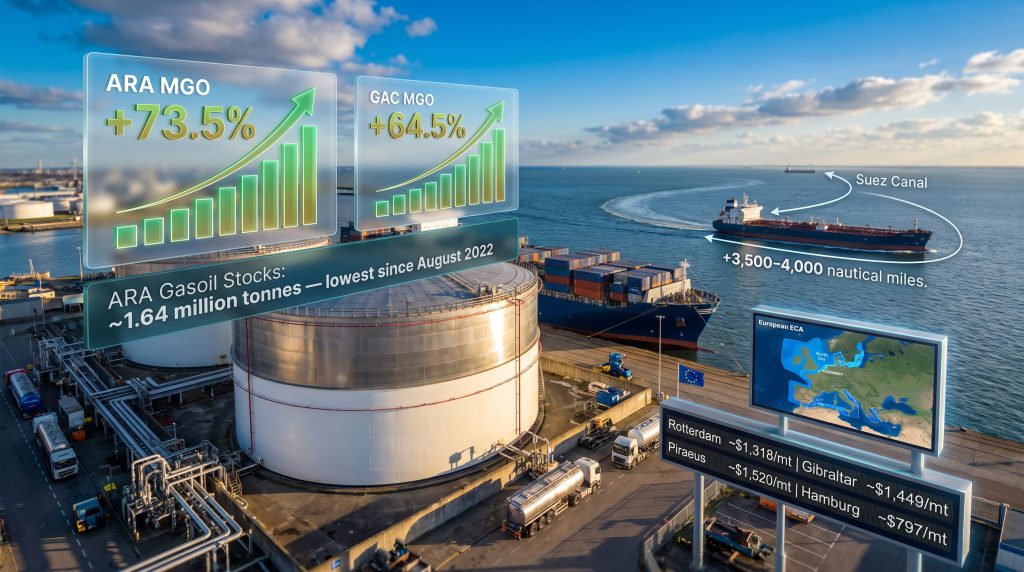
Independently held gasoil and diesel stocks at the Amsterdam-Rotterdam-Antwerp (ARA) hub declined by approximately 2.6% to around 1.64 million tonnes during the reference period, reaching their lowest level since August 2022. Critically, the drawdown coincided with a week recording zero import arrivals, amplifying the inventory depletion effect beyond what reduced upstream supply alone would have generated.
ARA inventory-to-demand ratios function as a leading indicator for European MGO spot price escalation. When stock levels fall below seasonal averages without compensating import flows, prompt supply tightness translates rapidly into spot price premiums. The current ARA inventory position sits materially below the five-year seasonal average, providing limited buffer against further demand increases or supply disruptions. You can track Rotterdam bunker prices directly for the latest ARA hub movements.
Refinery Output Constraints Compounding the Supply Deficit
Beyond Russian export compression, European refinery throughput constraints have added a secondary layer of supply pressure. Maintenance cycles, reduced feedstock availability, and the economics of crude processing under current margin conditions have collectively limited the volume of MGO-grade distillate entering the market from domestic European refinery production.
Separately, the Rhine river in Germany has seen persistently low water levels during the same period, impairing barge logistics and raising inland delivery costs for blending components and refined products, further stressing the regional supply chain.
MGO vs. VLSFO vs. HSFO: How Has the European Price Divergence Unfolded?
Comparative Price Performance Across Key European Bunkering Hubs
The divergence in price performance between MGO and residual fuel grades since late February 2026 has been substantial and consistent across multiple European bunkering locations. The price escalation cycle began with the outbreak of US-Iran hostilities on 28 February 2026, and the cumulative gains to 27 July 2026 reveal a clear tiering effect linked to distillate supply constraints. In addition, the trade war impact on oil markets has layered additional uncertainty onto an already fragile pricing environment.
| Fuel Grade | ARA Hub Price Change | GAC Hub Price Change |
|---|---|---|
| MGO | +73.5% | +64.5% |
| VLSFO | +38% | +42% |
| HSFO | +27% | +27% |
Source: Argus Media price data, 28 February to 27 July 2026.
The magnitude of MGO outperformance relative to VLSFO and HSFO reflects the distillate-specific nature of the supply tightness. VLSFO and HSFO are both produced from heavier crude fractions with broader feedstock flexibility. Their price increases largely track the broader crude oil market uplift from Middle East disruption. MGO's additional premium layered on top of that crude-driven baseline reflects the structural feedstock constraints unique to distillate-grade marine fuel production.
Current approximate spot MGO prices across key European ports illustrate the geographic dispersion of this premium:
| Port / Hub | Region | Approximate MGO Price (USD/mt) | ECA Zone Proximity |
|---|---|---|---|
| Piraeus | Mediterranean | ~$1,520 | Mediterranean ECA |
| Gibraltar | Atlantic/Med Junction | ~$1,449 | ECA boundary |
| Istanbul | Black Sea/Med | ~$1,445 | Mediterranean ECA |
| Rotterdam | Northwest Europe | ~$1,318 | North Sea ECA |
| Antwerp | Northwest Europe | ~$855 | North Sea ECA |
| Hamburg | Northwest Europe | ~$797 | North Sea/Baltic ECA |
| Amsterdam | Northwest Europe | ~$670 | North Sea ECA |
Note: Prices are approximate spot market reference points and are subject to intraday variation. Buyers should obtain live quotes from bunkering suppliers for commercial transactions.
Why are MGO prices rising faster than VLSFO in Europe? MGO prices are outpacing VLSFO and HSFO because distillate-grade marine fuel faces a structurally constrained supply chain. Reduced Russian gasoil exports, declining European refinery output, and falling ARA distillate inventories have created a tighter supply environment specifically for MGO, while residual fuel grades retain broader feedstock flexibility and face less acute production constraints.
How Is Middle East Conflict Reshaping European Bunkering and Cargo Flows?
The Geopolitical Supply Shock: Conflict-Driven Trade Route Disruption
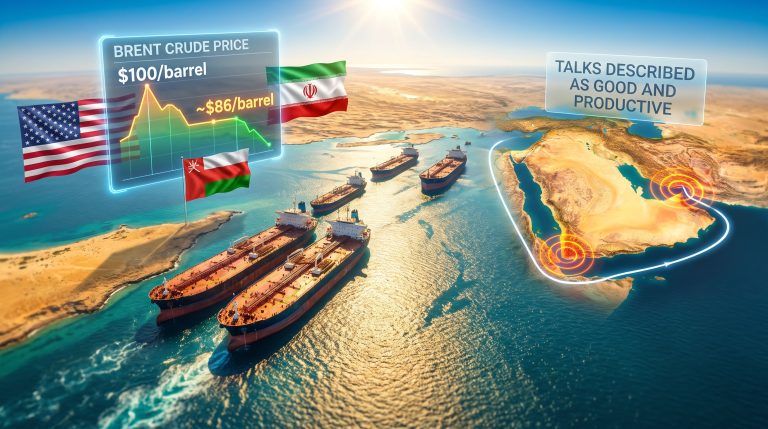
The price escalation cycle across European marine fuel markets traces its origins to the outbreak of US-Iran hostilities in late February 2026. The associated disruption to the Strait of Hormuz effectively compressed crude and distillate flows from the Persian Gulf, removing a significant volume of Middle Eastern supply from global circulation and placing immediate upward pressure on distillate benchmarks worldwide. Consequently, geopolitical tensions reshaping trade patterns have contributed directly to the volatility now embedded in European distillate pricing.
Simultaneously, renewed Houthi militant activity in the Red Sea has forced vessel operators to reconsider transits through the Bab el-Mandeb strait. Tankers originally routed south through Saudi Arabian Red Sea ports have been redirected north through the Suez Canal or further around the Cape of Good Hope, fundamentally altering the economics and logistics of multiple trade lanes. The Houthis announced a maritime ban against Saudi Arabia on 20 July 2026, triggering immediate route reassessments across the tanker fleet.
The Cape of Good Hope Diversion Effect on MGO Demand
Routing via the Cape of Good Hope rather than the Suez Canal adds approximately 3,500 to 4,000 nautical miles to a typical Asia-Europe voyage, increasing total fuel consumption per voyage by an estimated 15 to 25% depending on vessel class and operational speed. For a laden VLCC or large product tanker, those additional sea days translate directly into meaningfully higher bunker fuel expenditure.
Critically, when these diverted vessels enter European waters, ECA compliance requirements immediately activate MGO consumption mandates. A vessel that may have planned to run on VLSFO for the bulk of its voyage must switch to MGO upon entering the North Sea or Mediterranean ECAs. With diversion-extended voyages already expanding the global demand pool for marine bunkers, the mandatory switch to ECA-compliant fuel at journey's end creates incremental demand pressure on a market where supply is simultaneously contracting.
Marine fuel suppliers have characterised the intersection of supply tightness and demand uplift from diversions as a potential convergence of pressures that could create extremely difficult operating conditions for vessel operators managing fixed-cost voyage budgets.
Mediterranean Re-Routing and ECA Compliance Demand
Mediterranean ECA designation means that vessels re-routing through the region as an alternative to the Red Sea must consume MGO or compatible biofuel blends rather than residual fuel grades. This creates a structural demand uplift for MGO specifically at Gibraltar, Piraeus, and Istanbul, all of which sit on or near the most heavily trafficked diversion routes. The positioning of these hubs on ECA boundary zones directly explains why their MGO spot prices carry the highest premiums in the current market.
The next major ASX story will hit our subscribers first
What Does the MGO Price Outlook Mean for Vessel Operators and Shipping Economics?
Fuel Cost Escalation and Its Impact on Voyage Economics
A 73.5% increase in ARA MGO prices over approximately five months represents a fundamental challenge to voyage cost budgets for ECA-compliant operators. Bunker Adjustment Factor (BAF) mechanisms allow carriers to pass a portion of fuel cost increases through to freight rates, but the speed and magnitude of the current escalation outpaces the adjustment cycles built into most BAF frameworks, creating interim margin compression for operators locked into existing freight contracts.
Scenario: A ferry operator running a fixed North Sea ECA route with a vessel consuming 15 tonnes per day of MGO faces the following escalation:
- Baseline MGO cost (pre-escalation): approximately $750/mt, daily fuel cost approximately $11,250
- Post-escalation MGO cost: approximately $1,300/mt, daily fuel cost approximately $19,500
- Annual additional fuel cost (365-day operation): approximately $3 million per vessel
For operators with regulated fare structures or fixed-rate freight agreements, this cost escalation cannot be immediately recovered through pricing adjustments, creating significant margin compression during the adjustment period.
Operational Responses Available to Vessel Operators
Vessel operators facing elevated MGO costs have a limited toolkit of short-term mitigation strategies:
-
Slow steaming: Reducing vessel speed lowers fuel consumption in a roughly cubic relationship to speed reduction, offering meaningful cost savings but extending voyage times and reducing fleet utilisation efficiency.
-
Biofuel blending: MGO-compatible biofuel blends are increasingly available at European ports and can reduce the effective carbon intensity of ECA-zone fuel while partially substituting for the highest-cost pure MGO volumes.
-
Scrubber utilisation: Vessels equipped with open-loop or closed-loop exhaust gas cleaning systems can substitute HSFO for MGO in ECA zones, capturing the price differential between the two grades. However, scrubber penetration across the broader European short-sea and ferry fleet remains limited, and port restrictions on open-loop discharge reduce the operational flexibility of scrubber-equipped vessels in sensitive coastal environments.
-
Route optimisation: Voyage planners can minimise the proportion of total voyage distance spent within ECA boundaries, reducing the volume of MGO consumed relative to VLSFO. However, for short-sea operators whose entire trade route falls within ECA zones, this option is structurally unavailable.
Frequently Asked Questions: MGO Prices in Europe
What is MGO and how does it differ from VLSFO?
MGO is a distillate-based marine fuel with a maximum sulphur content of 0.1%, making it the standard compliance fuel for vessel operations within European Emission Control Areas. VLSFO has a maximum sulphur content of 0.5% and is used for open ocean operations outside ECA boundaries. MGO is produced from lighter crude fractions through more refinery-intensive processes and commands a structural price premium over VLSFO in all market conditions.
Why are MGO prices in Europe so high right now?
European MGO prices have risen sharply due to a simultaneous contraction on the supply side and expansion on the demand side. Russian gasoil export volumes have fallen to decade lows, European refinery throughput has contracted, and ARA distillate inventories sit at multi-year lows. At the same time, Middle East geopolitical disruption and Red Sea instability have extended voyage distances for a significant portion of the global fleet, increasing total fuel consumption and placing additional demand on an already tight MGO market. The broader tariff and trade war impacts on energy supply chains have further compounded these existing structural pressures.
Which European port has the cheapest MGO bunker prices?
Based on current market data, Amsterdam and Hamburg offer lower MGO spot prices compared with Mediterranean hubs such as Piraeus and Gibraltar. This reflects proximity to ARA hub distillate distribution infrastructure, higher competitive intensity among bunkering suppliers, and lower strategic positioning costs relative to ECA boundary points. For live indicative pricing across global ports, resources such as Bunker Index provide regularly updated benchmark data.
Is ULSFO a viable alternative to MGO in European ECAs?
ULSFO meets the 0.1% sulphur specification for ECA compliance but has not achieved significant market penetration due to quality consistency concerns, limited availability outside European waters, and onboard fuel compatibility risks. Most vessel operators continue to use MGO as their preferred ECA compliance pathway because of its established quality standards and broader geographic availability. Furthermore, movements in WTI and Brent futures continue to influence the upstream cost basis for all distillate-grade marine fuels, including MGO.
Key Takeaways: Understanding the European MGO Price Environment
The current MGO prices in Europe environment reflects a structural realignment rather than a temporary market dislocation. The forces driving this repricing are layered and mutually reinforcing:
-
MGO prices across European hubs have risen 73.5% at ARA and 64.5% at GAC since late February 2026, materially outpacing VLSFO and HSFO gains driven primarily by broader crude market movements.
-
The ARA hub's distillate inventory position at multi-year lows, combined with zero import arrivals during the reference week, signals that the upstream supply compression from Russian export reductions is transmitting fully into prompt European availability.
-
ECA regulatory requirements across the North Sea, Baltic Sea, and Mediterranean create structurally inelastic MGO demand that amplifies price sensitivity to any supply disruption, leaving operators with limited substitution optionality.
-
Geopolitical disruption in the Middle East and Red Sea is simultaneously tightening upstream supply and extending voyage distances, producing a demand uplift effect that compounds the supply-side pressure.
-
Mediterranean bunkering hubs command the highest current MGO premiums, reflecting their positioning on active vessel diversion routes and the mandatory ECA compliance requirements that activate upon entry to that sea zone.
-
Vessel operators face compounding cost pressures with limited short-term mitigation pathways beyond slow steaming and selective biofuel blending, with BAF mechanisms providing only partial and lagged cost recovery relief.
This article contains forward-looking analysis and references to market scenarios that involve inherent uncertainty. Price data references approximate spot market assessments and are subject to change. The information presented is intended for informational purposes only and does not constitute financial or commercial advice.
Want to Stay Ahead of the Next Major Resource Discovery Driving These Market Shifts?
The same geopolitical disruptions and supply chain pressures reshaping European marine fuel markets are creating significant opportunities across ASX-listed resource and energy companies — and Discovery Alert's proprietary Discovery IQ model delivers real-time alerts the moment a significant mineral discovery is announced, turning complex market data into actionable insights for both short-term traders and long-term investors. Explore historic discoveries and the returns they generated to understand the opportunity, then begin your 14-day free trial to position yourself ahead of the broader market.