July 28, 2026
The Strait That Controls Everything: Why Hormuz Has Become the World's Most Dangerous Negotiating Table
Few geographic features carry the economic weight of a 21-mile-wide channel between the Arabian Peninsula and Iran. The Strait of Hormuz is not simply a body of water. It is the arterial pressure point of the global energy system, a passage through which approximately 20% of the world's seaborne oil trade moves on any given day. When that passage is threatened, the consequences ripple from Asian manufacturing floors to European fuel pumps to American gas stations within weeks. Understanding what is currently at stake in the Trump Iran Hormuz talks requires starting not with politics, but with geography and the extraordinary leverage it creates.
The strait connects the Persian Gulf to the Gulf of Oman, serving as the exclusive maritime exit for crude exports from Saudi Arabia, Iraq, Kuwait, the UAE, and Iran itself. There is no practical substitute at scale. The existing pipeline alternatives, such as Saudi Arabia's East-West pipeline terminating at Yanbu on the Red Sea coast, carry only a fraction of the volume that transits the waterway daily.
Any sustained disruption at Hormuz does not merely inconvenience global markets. It structurally removes supply optionality and forces a repricing of energy risk across every asset class. Our crude oil volatility guide outlines precisely why these disruption events create such outsized price movements across the energy complex.
When big ASX news breaks, our subscribers know first
From Military Flashpoint to Diplomatic Instrument: How Hormuz Became the Core Bargaining Chip
The strait's role in U.S.-Iran tensions is not new. For decades, Iran has intermittently threatened to close Hormuz as a response to sanctions or military pressure, and the U.S. Navy's Fifth Fleet has maintained a regional presence partly in response to that threat. What has changed in the current conflict cycle is the explicit formalisation of Hormuz access as a precondition for broader diplomatic engagement, rather than simply a background security concern.
In the current five-month conflict, both sides conducted rounds of tit-for-tat strikes before pausing hostilities. The ceasefire pause arrived not through formal agreement but through mutual exhaustion and the recognition that continued escalation was producing diminishing strategic returns for both parties. Since that pause took effect, the diplomatic focus has concentrated almost entirely on restoring commercial shipping through the strait as the threshold requirement before any substantive nuclear talks can resume.
Iran's capacity to threaten Hormuz gives it asymmetric leverage relative to its conventional military capabilities. A handful of mines or coordinated vessel harassment operations can produce oil price spikes exceeding those caused by far larger military engagements elsewhere in the world.
This asymmetry explains why Tehran has shifted from treating Hormuz as a defensive threat to using it as a proactive negotiating instrument. The strait is no longer just something Iran might close in retaliation. It has become the primary concession Iran can offer in exchange for broader geopolitical relief, whether through sanctions relaxation, nuclear program recognition, or reduced U.S. naval pressure on its ports. Furthermore, the OPEC market influence on pricing decisions becomes considerably more complicated when the world's most critical transit point is caught in active diplomatic brinkmanship.
Inside the Negotiating Architecture: Three Layers, One Chokepoint
The Trump Iran Hormuz talks are not a single-issue negotiation. They operate across at least three distinct layers, each dependent on progress in the one below it.
- Layer 1 – Maritime Access: The immediate operational objective is restoring consistent commercial vessel transit through the Strait of Hormuz. This requires Iranian acknowledgment of international shipping rights, the suspension of active interference threats, and agreed transit protocols acceptable to both U.S. naval command and Iranian maritime authority.
- Layer 2 – Ceasefire Formalisation: Converting the current conditional pause in military exchanges into a durable cessation of hostilities. The current pause is not a formal agreement. Both sides retain the capability and stated willingness to resume strikes if diplomacy collapses.
- Layer 3 – Nuclear Program Oversight: The strategic endgame that neither side can reach without first stabilising Layers 1 and 2. A renewed nuclear framework would need to satisfy not only U.S. and Iranian requirements but also the security calculations of Israel and Gulf Cooperation Council member states.
Oman's Indispensable Role as Mediator
Oman has served as a quiet diplomatic bridge between Washington and Tehran for decades, facilitating back-channel communications that neither government can publicly acknowledge without triggering domestic political blowback. Muscat's unique positioning derives from its neutral foreign policy tradition, its geographic proximity to the strait itself, and its longstanding commercial relationships with both parties.
Omani and Iranian negotiators met in Tehran over the final weekend of July 2026, with discussions described as ongoing by people familiar with the situation. Omani officials were reportedly targeting an announcement signalling progress within days, though no formal outcome had been confirmed as of late July 2026. The distinction between an announcement of progress and an actual agreement matters considerably for market participants attempting to price diplomatic momentum. Reuters reported that both sides agreed to continue talks, though the precise terms of any interim arrangement remained unclear.
The Public Statements Gap: Why Ambiguity Is the Strategy
Washington and Tehran are currently telling very different stories about the state of the Trump Iran Hormuz talks. The U.S. administration has described progress as real and the diplomatic environment as constructive. Iranian public statements have emphasised that no direct negotiations are underway, preferring the framing of mediated dialogue through Oman.
This divergence is not accidental. Public ambiguity provides domestic political cover for both governments. Tehran cannot be seen domestically as negotiating directly with Washington under military pressure. Washington cannot appear to be offering concessions to a government it has been bombing. The gap between public framing and back-channel reality is itself a feature of the negotiation, not a failure of communication.
How Oil Markets Are Pricing the Uncertainty
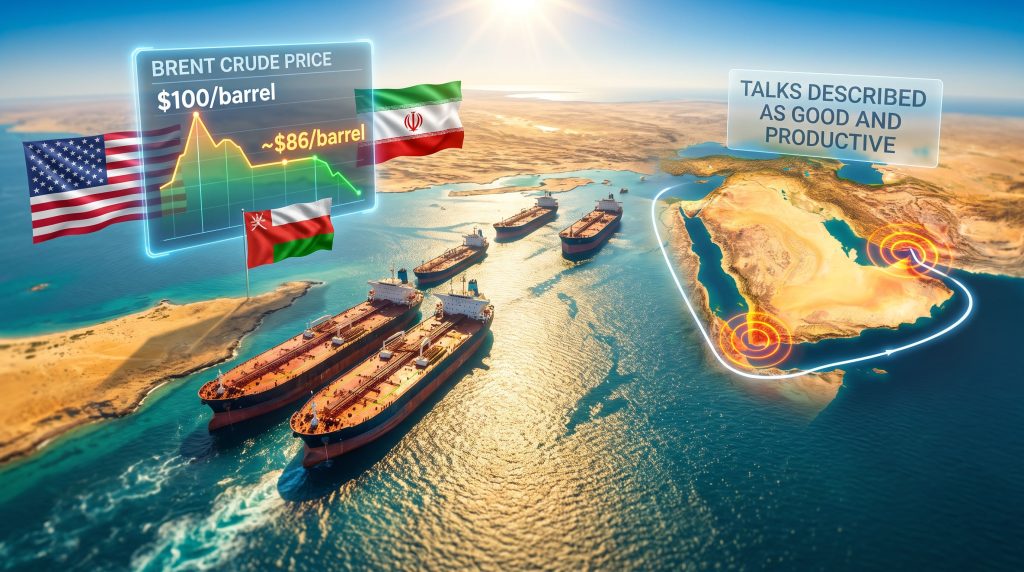
The price of Brent crude has functioned as a real-time geopolitical sentiment index throughout this conflict cycle. The progression tells its own story:
| Event | Brent Crude Response |
|---|---|
| Escalation in U.S.-Iran military exchanges | Surged above $100/barrel |
| Ceasefire pause announced (late July 2026) | Declined to approximately $86/barrel |
| Hormuz shipping traffic remains suppressed | Sustained floor risk; no recovery in transit volumes |
| Full strait reopening (scenario) | Projected further downward pressure toward mid-$80s or below |
| Talks collapse / renewed strikes (scenario) | Risk premium re-escalation toward $100+ territory |
The move from above $100 to $86 represents approximately a $14/barrel risk premium deflation within days of the ceasefire pause. That single data point illustrates how much of the prevailing crude price at the peak was pure geopolitical risk pricing rather than fundamental supply-demand balance.
For the U.S. administration, the politics of oil prices are straightforward. Falling crude translates to lower gasoline prices at U.S. pumps within two to four weeks, and gasoline prices correlate strongly with presidential approval ratings. With midterm elections scheduled for November, the administration has a tangible domestic political incentive to sustain diplomatic momentum that keeps Brent from returning to triple digits. Consequently, the oil market trade war dynamics already weighing on sentiment add another layer of complexity to an already strained energy pricing environment.
The Hidden Signal: What Vessel Tracking Data Reveals
While official statements describe talks as constructive, the most unfiltered indicator of actual conditions is real-time ship-tracking data. As of late July 2026, transponder-active vessel movements through the Strait of Hormuz had fallen to near-zero. The practical implication is that commercial shipping confidence has not recovered despite the ceasefire pause.
The rerouting response has been significant. At least eight crude carriers were signalling Egypt's Mediterranean terminal at Sidi Kerir by late July, with arrivals spread across the period through mid-August. These vessels are redirecting to collect Saudi crude that would normally load at Yanbu on the Red Sea, itself disrupted by Houthi activity. The compounding effect of simultaneous disruptions at Hormuz and the Bab el-Mandeb strait means the rerouting costs are not simply additive. They are multiplicative.
The Three Scenarios: Strategic Pathway Analysis
Scenario 1: Negotiated Strait Reopening
The base case involves an Omani-brokered agreement establishing defined transit protocols, Iranian permission frameworks for commercial vessels, and a corresponding adjustment in U.S. naval posture. If Omani officials succeed in their reported target of announcing progress within days of late July 2026, markets would likely extend Brent's decline, shipping confidence would begin recovering incrementally, and the pathway to formal nuclear talks would reopen.
Scenario 2: Prolonged Stalemate
The elevated risk scenario assumes talks stall on Iranian demands for concessions that the U.S. is unwilling or politically unable to offer in the current domestic environment. The U.S. naval blockade preventing vessels from docking at Iranian ports remains in place. Oil prices stabilise in an elevated range, supply chain disruption persists, and the dual-chokepoint problem at Hormuz and Bab el-Mandeb deepens over time.
Scenario 3: Renewed Military Escalation
The tail risk scenario is not purely theoretical. Both sides demonstrated willingness to strike and counter-strike within a two-week window before the current pause. The U.S. administration has explicitly preserved the threat of resumed airstrikes, including against Iranian infrastructure, as a negotiating instrument. A breakdown of Omani mediation combined with resumed Iranian proxy activity across multiple fronts could trigger re-escalation with Brent re-testing $100 and global recession risks reactivating across financial markets.
The critical distinction between the current ceasefire and a genuine peace is that the current arrangement is explicitly conditional. It rests on continued diplomatic progress rather than any binding commitment from either party.
The Bab el-Mandeb Dimension: Why Hormuz Is Only Half the Problem
The Houthi campaign operating from Yemen adds a second front that significantly complicates any resolution framework. In late July 2026, the Houthis issued warnings prohibiting vessel calls at Saudi Arabian ports, claimed drone strikes against Saudi oil infrastructure, and continued operations in the southern Red Sea. Saudi Arabia confirmed intercepting multiple drones launched from Iraq targeting petroleum facilities, illustrating the cross-border complexity of the proxy network involved.
The economic arithmetic of rerouting becomes severe when both chokepoints are simultaneously disrupted:
- Cape of Good Hope diversion: Adds approximately 10 to 14 days of transit time per voyage versus the Hormuz/Suez route
- Additional fuel cost per supertanker voyage: Estimated at several hundred thousand dollars per round trip depending on vessel class and bunker prices
- LNG delivery schedule impact: Particularly acute for Asian importers with limited storage buffer capacity
- Petrochemical feedstock exposure: Asian manufacturers dependent on Gulf naphtha face both supply uncertainty and elevated input cost risk
The next major ASX story will hit our subscribers first
What a Viable Hormuz Agreement Would Actually Require
Translating diplomatic progress into an operational agreement requires more than political goodwill. The structural requirements of any minimum viable deal include:
- Iranian acknowledgment of international shipping rights through the strait under existing maritime law frameworks
- Defined transit protocols that both U.S. naval command and Iranian maritime authority can operationally implement
- Suspension of mine-laying threats and active interference with commercial vessels
- Independent verification mechanisms capable of confirming compliance without requiring direct U.S.-Iranian cooperation
The verification problem is historically one of the most difficult elements in any Iran-related agreement. Prior nuclear verification frameworks have struggled with inspection access, timelines, and the definition of compliance thresholds. A maritime agreement would face analogous challenges, since Iranian interference capabilities including mines, fast boats, and electronic disruption are difficult to monitor from external positions without intrusive access Iran is unlikely to grant voluntarily. In addition, the broader geopolitical mining landscape signals how resource security concerns extend well beyond oil whenever regional instability of this magnitude takes hold.
The Israel Factor and the Nuclear Overhang
The Trump Iran Hormuz talks cannot be fully understood without accounting for Israeli strategic interests. An interim peace deal reached in mid-June 2026 subsequently collapsed, leaving multiple critical issues unresolved. Israeli Prime Minister Netanyahu has stated his intention to press the U.S. on maintaining continuous oversight of Iran's nuclear programme.
The timing of a scheduled Trump-Netanyahu meeting in Washington during late July 2026 adds a further complicating variable to U.S. negotiating flexibility, since any concessions toward Tehran that appear to relax nuclear monitoring pressure will face immediate Israeli pushback. The BBC has reported on the broader diplomatic dimensions of this triangle and the challenges each party faces in managing domestic political pressures alongside external negotiations.
This triangular dynamic, Washington-Tehran-Jerusalem, means that even a successful Hormuz agreement carries significant downstream risk. A transactional deal restoring maritime access without a credible pathway toward nuclear resolution simply relocates the fundamental tension rather than resolving it. The nuclear programme overhang will continue to generate the conditions for future escalation cycles unless a durable, verifiable, and internationally accepted framework can be constructed around it.
Key Indicators to Monitor in the Coming Weeks
For market participants and strategic analysts tracking this situation, the following signals provide the most actionable real-time intelligence:
- Omani announcement timing: Any formal signal of diplomatic progress from Muscat is the first concrete indicator of forward movement in the Trump Iran Hormuz talks
- Brent crude price trajectory: Sustained movement below $86 suggests markets are pricing in resolution; a return toward $95-100 signals deterioration
- Vessel transponder activity at Hormuz: Real-time ship-tracking data remains the most unfiltered indicator of actual strait conditions independent of official statements
- Trump-Netanyahu meeting outcomes: Israeli positions on nuclear oversight will directly influence the U.S. negotiating ceiling with Tehran
- Houthi activity at Bab el-Mandeb: Escalation or de-escalation in the Red Sea indicates whether the broader regional conflict architecture is contracting or expanding
Disclaimer: This article contains forward-looking analysis, scenario projections, and market observations based on information available as of late July 2026. It does not constitute financial or investment advice. Geopolitical scenarios involve inherent uncertainty and actual outcomes may differ materially from any projections presented. Readers should conduct independent research before making any investment decisions related to energy markets or geopolitically exposed assets.
Want to Stay Ahead of Commodity Disruptions Driven by Geopolitical Events Like Hormuz?
When regional instability reshapes energy markets overnight, Discovery Alert's proprietary Discovery IQ model scans ASX announcements in real time, identifying significant mineral discoveries and actionable opportunities across 30+ commodities before the broader market catches on — explore historic discovery returns that illustrate why timing matters, and begin your 14-day free trial today to position yourself ahead of the next major market shift.