July 28, 2026
The Pricing Power Problem: Why Africa Sends Wealth Away Before It Begins
Every tonne of unprocessed copper concentrate that leaves an African port carries with it something less visible than the metal itself: the margin. The smelting margin. The refining margin. The manufacturing margin. The value embedded in each subsequent transformation of that raw material into wire, motor components, or battery interconnects flows to facilities in China, Germany, South Korea, and elsewhere, not to the communities sitting above the ore bodies that made it all possible.
This is not a new observation, but it is one that African governments are increasingly unwilling to accept as an immutable feature of the global commodity system. The proposed pan-African metals exchange in Zambia represents the most architecturally ambitious response to this dynamic yet articulated at the policy level, and understanding why it matters requires examining the structural mechanics of how mineral value currently escapes the continent.
When big ASX news breaks, our subscribers know first
Africa's Share of Its Own Wealth: The IEA's Uncomfortable Statistic
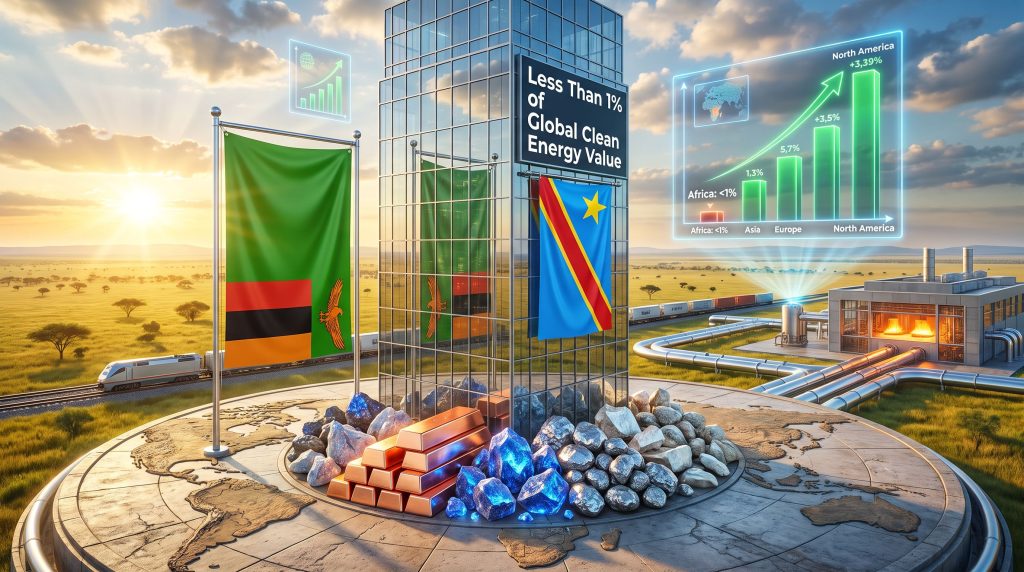
The International Energy Agency has documented one of the starkest asymmetries in the global economy: Africa supplies a disproportionately large share of the unprocessed critical minerals used in clean-energy technology manufacturing, yet captures less than 1% of the total global value generated by that manufacturing.
To put that figure in perspective, consider what it means in practice:
- Zambia and the Democratic Republic of Congo together represent a globally significant share of copper and cobalt production, two minerals foundational to electric vehicle motors and battery chemistry.
- The DRC alone accounts for approximately 70% of global cobalt production, a near-monopoly position that in a rational value-allocation framework would translate into extraordinary economic leverage.
- Despite this, cobalt refined in China, assembled into battery cells in South Korea or Japan, and sold into European or North American automotive supply chains generates value that accumulates almost entirely outside Africa.
The structural reasons for this are layered but interconnected:
- Minerals are exported in raw or semi-processed form, with downstream processing occurring elsewhere.
- Prices are set against external benchmarks, primarily the London Metal Exchange, limiting the pricing agency of African producers.
- Domestic refining, smelting, and manufacturing capacity across most of the continent remains too limited to intercept processing margins before they migrate abroad.
Furthermore, the critical minerals demand driven by the global energy transition is only intensifying these imbalances. The core problem is not that Africa lacks resources. It is that the architecture of the global commodity system was not designed to retain value at the point of extraction, and no African nation acting alone has yet mustered the scale to change that architecture.
What a Pan-African Metals Exchange Would Actually Do
The concept behind a pan-African metals exchange in Zambia and across the continent is frequently described in aspirational terms, but its technical function is specific. It would operate as a centralised or networked trading and price-discovery platform, enabling African nations to conduct pricing, trading, and settlement of their own mineral commodities without routing those transactions through external benchmarks.
This is meaningfully different from existing national commodity exchanges. ZAMACE, the Zambia Agricultural Commodity Exchange, established a regulated legal framework but has remained limited in operational depth and does not currently handle metals. The Lusaka Securities Exchange handles equities and fixed income. Neither is designed for cross-border physical or derivatives trading in metals at the scale a pan-African platform would require.
A fully functional exchange of this kind would need to deliver:
- Cross-border price discovery with sufficient liquidity to generate signals that miners, traders, and buyers treat as credible benchmarks.
- Shared or interoperable settlement infrastructure allowing transactions between producers in multiple jurisdictions to clear efficiently.
- Physical commodity logistics integration, including warehousing, assay certification, and chain-of-custody verification.
- Derivatives capability allowing producers to hedge forward positions, which is a basic risk management tool that most African state mining entities currently cannot access domestically.
Zambia as the Natural Anchor and the Mercuria Connection
Zambia's positioning as the driving force behind this initiative is not incidental. As Africa's second-largest copper producer, with established state-linked commercial trading infrastructure already in place, it occupies a logical anchor position for any copper-centric exchange architecture. Shifts in copper market trends globally also strengthen the case for Zambia to act decisively now.
The Zambia-Mercuria metals trading joint venture is the most concrete building block currently in existence. The arrangement gives Zambia's state-linked entities direct access to copper offtake from producing mines, addressing what had previously been an almost invisible but critical barrier: state entities could not access minerals that private mining companies produced. Without that access, any exchange would have an empty order book.
The DRC has constructed a parallel architecture. It has secured offtake agreements from large mines in which the state holds minority equity stakes and has established a similar trading arrangement with Mercuria. This means the two nations most central to a viable exchange already have product supply pipelines being built simultaneously.
| Component | Participants | Function | Current Status |
|---|---|---|---|
| Zambia-Mercuria Metals JV | Zambia, Mercuria | Copper offtake and trading | Operational |
| DRC-Mercuria Arrangement | DRC, Mercuria | Cobalt and copper offtake | Established |
| Zambia-DRC EV Battery Value Chain | Zambia, DRC | Joint battery supply chain development | Limited progress |
| Pan-African Metals Exchange | Zambia, DRC, others | Continental price discovery and trading | Concept/policy stage |
| ZAMACE | Zambia | Commodity exchange legal framework | Active, limited scope |
The 2022 Zambia-DRC agreement to develop a shared electric vehicle battery value chain using their copper and cobalt resources is instructive precisely because it stalled. The reason it made limited progress was that neither government had reliable access to the minerals produced by private companies operating on their soil. The exchange concept is designed to solve the upstream access problem that prevented the bilateral agreement from advancing.
Comparing Exchange Models: What Africa Can Learn From the LME and SHFE
How Does the LME Shape African Pricing Today?
The London Metal Exchange remains the dominant global benchmark for base metals including copper, setting reference prices that flow through virtually every mining contract, transfer pricing arrangement, and offtake agreement on the continent. Zambia's own mineral transfer pricing framework already applies the LME as a reference under what is known as the "sixth method", which uses exchange-based pricing to assess whether royalties and taxes reflect market value.
You can review the Resource Governance Institute's analysis of Zambia's sixth method pricing rules for further technical detail on how this framework operates in practice. This is both an endorsement of the exchange model's legitimacy within Zambian governance and an indicator of how deeply embedded external pricing is in the existing system.
The more instructive comparison for what a pan-African exchange might achieve over time is China's Shanghai Futures Exchange. The SHFE developed genuine pricing influence by combining large domestic production volumes with an equally large domestic consumption base. Africa's equation is different: production volumes are globally significant, but domestic consumption is currently limited.
The exchange model would consequently need to either attract international participation or develop regional processing and manufacturing demand to substitute for the domestic consumption side of the equation.
| Exchange | Operational Basis | Metals Covered | Global Pricing Influence |
|---|---|---|---|
| London Metal Exchange | International, UK-based | Copper, aluminium, nickel, zinc, lead, tin | Primary global benchmark |
| Shanghai Futures Exchange | Domestic Chinese production and consumption | Copper, aluminium, gold | Significant regional and growing global influence |
| Multi Commodity Exchange (India) | Domestic Indian market | Gold, silver, copper | Nationally significant |
| East Africa Exchange | Regional agricultural focus | Limited metals | Minimal metals influence |
| Pan-African Exchange (Proposed) | African production base | Copper, cobalt, critical minerals | Concept stage |
The Cobalt Concentration Factor: A Speculative but Significant Leverage Point
A dimension of this proposal that tends to be underweighted in conventional analysis is the cobalt factor. The DRC's approximately 70% share of global cobalt production represents a degree of supply concentration with few parallels in any critical mineral. In most commodity markets, a producer controlling 70% of global supply would be expected to exercise significant pricing power.
Cobalt's pricing has historically been highly volatile, driven by speculative positioning as much as by fundamental supply-demand dynamics, partly because the market is relatively small in volume terms and prone to sentiment-driven swings. A pan-African metals exchange that successfully brought DRC cobalt volumes into a regulated pricing mechanism could, in theory, reduce this volatility while simultaneously providing African producers with greater transparency and leverage over price discovery.
Whether this would benefit or disadvantage cobalt consumers in the battery manufacturing industry is a separate question, but it represents genuine structural pricing power that does not currently exist. This is speculative at this stage. The more widely accepted view within the industry is that cobalt prices are likely to remain constrained by growing recycled cobalt supply and the ongoing substitution trend toward lower-cobalt battery chemistries such as lithium iron phosphate. However, for the exchange concept's long-term viability, cobalt remains one of the strongest commodities to anchor, precisely because no other region comes close to matching the DRC's production base.
The next major ASX story will hit our subscribers first
The Five Obstacles That Will Define Whether This Succeeds
The Natural Resource Governance Institute has noted in research that regional cooperation among African mineral-producing nations meaningfully improves the prospects for successful value addition. Individual nations attempting to build downstream processing capacity in isolation consistently encounter the same set of problems: insufficient scale, limited domestic demand, and difficulty attracting industrial investment. A coordinated regional approach addresses the scale constraint that undermines unilateral efforts.
However, the practical obstacles to building a functioning pan-African exchange are substantial:
- Sovereign coordination complexity. Discussions have confirmed involvement of Zambia, the DRC, and at least two other unnamed nations. Aligning regulatory, fiscal, legal, and currency frameworks across multiple sovereign states is a multi-year undertaking with no guarantee of successful conclusion.
- Private sector access to minerals. The majority of African mineral production is controlled by multinational mining companies. Compelling or incentivising these producers to route sales through a new exchange requires either regulatory mandates, export restrictions, or sufficiently competitive pricing and liquidity.
- Liquidity and price credibility. A new exchange without broad participation will generate thin order books. Prices set on a thinly traded exchange are easily arbitraged against LME benchmarks, and miners will prefer the deeper, more established market unless there is a compelling reason to do otherwise.
- Physical infrastructure requirements. Warehousing facilities with independent assay capability, logistics networks capable of handling large metal volumes across multiple countries, and financial settlement systems that operate across currency zones all require significant capital investment before trading can begin.
- Geopolitical fragility. Building a continent-wide institution requires political continuity across multiple jurisdictions simultaneously. Understanding the broader mining geopolitics at play is essential context here. The Sahel region provides a sobering recent example, with military governments in several nations having seized mining assets or revoked operating licences in ways that directly reduce investor confidence across the broader region.
In addition, producers operating within this framework may seek to employ commodity hedging strategies to manage the price risks inherent in transitioning away from established LME-linked contracts.
Democratic Stakes: Why the Institutional Framing Goes Beyond Economics
What distinguishes this proposal from previous commodity exchange concepts is the explicit framing around political and democratic stability. Africa has the world's fastest-growing youth population and is projected to represent an increasing share of the global workforce over the coming decades.
The argument advanced by Zambian officials is that failure to convert mineral wealth into domestic employment, industrial capacity, and broadly distributed economic growth does not merely represent a missed economic opportunity. It represents an existential threat to the functioning of democratic governance on the continent.
The military coups and state seizures of mining assets across the Sahel region illustrate what happens when the social contract between resource-rich governments and young populations breaks down. From this perspective, the pan-African metals exchange is not simply a financial market infrastructure project. It is framed as a mechanism for demonstrating that democratic governments can deliver tangible economic outcomes from the mineral wealth beneath their citizens' feet.
Whether that framing ultimately accelerates or complicates the exchange's development is an open question. It places the initiative in a politically urgent context that could mobilise government commitment across the continent. It also raises the stakes of any failure or delay in ways that could generate the very instability it is designed to prevent.
The Long-Term Trajectory: Irreversible Direction, Uncertain Timeline
The pan-African metals exchange in Zambia is included in the ruling party's election manifesto, with formal engagement planned as a cabinet priority should the current administration be returned to government. At this stage, the initiative remains firmly at the concept and policy stage. No exchange infrastructure exists, no regulatory framework has been finalised, and the multi-sovereign coordination required to build it has barely begun.
What is not in doubt is the direction. The combination of the IEA's value capture statistics, the NRGI's research on regional cooperation, the practical infrastructure being built through state-Mercuria trading arrangements, and the demographic and political pressures converging across the continent creates a durable policy trajectory regardless of the timeline of any specific institutional development.
For further context on how African states are positioning themselves within commodity trading infrastructure, Zambia's state mining company has also been weighing the establishment of its own metals trading unit, which speaks directly to the upstream access challenge described throughout this analysis.
The global commodity system has experienced one transformative restructuring in the past three decades: China's emergence as both the dominant consumer and the dominant downstream processor of virtually every critical mineral. A second restructuring, in which African producing nations develop the institutional capacity to price and trade their own resources, would represent a shift of comparable significance.
The pan-African metals exchange is the most concrete expression of that ambition yet to reach the policy agenda of a major producing nation. Organisations such as First Africa Metals reflect the broader ecosystem of entities positioning themselves around this emerging continental framework, however it ultimately develops.
Disclaimer: This article contains forward-looking analysis, scenario projections, and speculative assessments regarding proposed policy initiatives and market structures. None of the content constitutes financial or investment advice. Readers should conduct independent research before making any investment decisions.
Want to Track the Next Major Mineral Discovery Before the Market Does?
Discovery Alert's proprietary Discovery IQ model scans ASX announcements in real time, instantly identifying significant mineral discoveries across copper, cobalt, and more than 30 other commodities — turning complex data into actionable insights the moment they hit the exchange. Explore historic discoveries and their exceptional returns, then begin your 14-day free trial at Discovery Alert to position yourself ahead of the broader market.