May 19, 2026
## The numbers behind a difficult public-health debate
Environmental disputes rarely turn on a single number. They unfold when different systems for judging risk collide: one built around legal compliance, another around long-term health protection, and a third shaped by community trust. That tension sits at the centre of the debate over Horne Smelter arsenic levels in Rouyn-Noranda, where the latest reported result can be read as progress, compliance, or continuing concern.
For readers trying to make sense of the issue, the key point is simple: a site can stay under a provincial limit and still remain above a stricter health-based reference value. In Rouyn-Noranda, that gap explains why the conversation has not ended, even as measured arsenic concentrations have fallen materially over time.
Key insight: Meeting a permit limit is not the same as matching a health-oriented reference level.
This article examines the 2025 arsenic result, what the monitoring network suggests about local exposure, how weather and plant operations affect readings, and which policy questions matter more than a single annual headline. Furthermore, future outcomes discussed here should be treated as scenario analysis rather than certainty.
## The numbers that define the Rouyn-Noranda arsenic debate
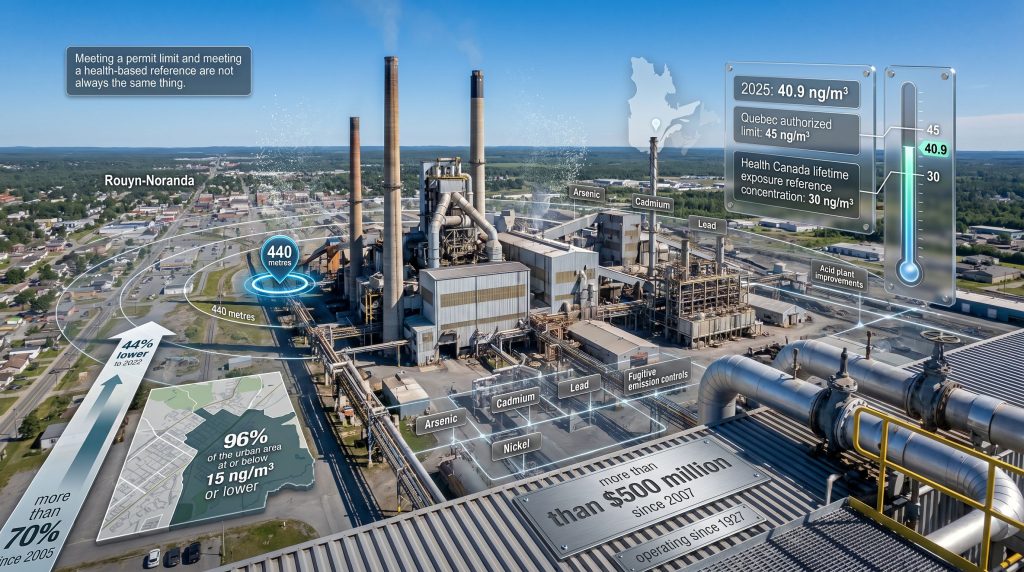
The main figure reported for 2025 was an annual average arsenic concentration of 40.9 ng/m³ at the legal monitoring station associated with the Horne Smelter.
That number matters because it sits between two important reference points:
- Quebec authorised limit: 45 ng/m³
- Health Canada lifetime exposure reference concentration: 30 ng/m³
In practical terms, the 2025 result was below the provincial cap, but still about 36.3% above Health Canada’s long-term reference level.
The broader data points cited alongside that reading are also important:
- Arsenic concentrations were reported as 44% lower than in 2022
- They were reported as more than 70% lower than in 2005
- The smelter has operated in Rouyn-Noranda since 1927
- Environmental upgrade spending since 2007 was reported at more than $500 million
- At a point near Glencore Arena, roughly 440 metres from the site boundary, arsenic readings were said to be 75% lower than at the legal station
- Reported monitoring indicated 96% of Rouyn-Noranda’s urban area was at or below 15 ng/m³
According to recent reporting on smelter results, the company also reported that other measured metals, including cadmium, lead, and nickel, remained within current provincial targets.
## Why being below the provincial limit does not end the issue
A facility can comply with a legal ceiling while still exceeding a stricter, health-based benchmark. That matters even more for arsenic because international public-health frameworks often treat exposure as something that should be minimised as far as reasonably possible.
Readers often mix up three very different concepts:
- Legal authorisation limit: 45 ng/m³
- Health-based reference value: 30 ng/m³
- Zero-safe-threshold framing: no fixed universal number
This is why the dispute is best understood as a policy adequacy debate, not just a permit compliance debate. In addition, the unresolved question is whether the existing framework is sufficiently precautionary for long-term public-health confidence.
### How can the same result support different narratives?
The same data point supports three very different interpretations:
- Regulatory view: the site remained under the current 45 ng/m³ limit
- Corporate view: emissions performance improved materially from 2022 and over the long run since 2005
- Public-health view: the result remains above Health Canada’s 30 ng/m³ long-term reference
This is why terms like improved, compliant, and safe should not be treated as interchangeable.
- Improved means lower than before
- Compliant means under the legal ceiling
- Lower risk is a health judgement shaped by benchmark choice and exposure duration
Reader warning: Annual averages are useful, but they can obscure shorter episodes of elevated concentration if peak-event reporting is limited.
## What the monitoring network says about local exposure
One of the most significant details in the reported data is that arsenic concentrations were said to decline with distance from the facility. That pattern is consistent with how air pollution from a major industrial point source usually behaves.
The monitoring result near Glencore Arena, around 440 metres from the site boundary, was reported to be 75% lower than the legal monitoring station. The company also indicated that 96% of the city’s urban area was at or below 15 ng/m³.
Those figures suggest that exposure is not uniform across Rouyn-Noranda. Geography matters. However, geography alone does not settle the health debate around Horne Smelter arsenic levels in Rouyn-Noranda.
### Why station placement matters
Different monitoring stations can tell very different stories:
-
Legal monitoring station
Usually tied to regulatory compliance and formal reporting requirements. -
Perimeter or near-site station
Helps show how concentrations behave close to the facility boundary. -
Neighbourhood station
More directly relates to what nearby residents may experience.
A city-wide framing can understate the burden on households nearest to the source. By contrast, a single near-source reading may not reflect conditions across the broader municipality.
For that reason, strong environmental communication should include:
- maps
- neighbourhood-level readings
- explanations of how station location affects interpretation
## Why weather and operations can shift arsenic readings
Air monitoring is never only about emissions leaving a site. It is also about what the atmosphere does with those emissions afterwards.
Key meteorological factors include:
- wind direction
- wind speed
- temperature inversions
- seasonal conditions
The company noted that wind patterns and other weather conditions influenced annual variation in 2025, while also stating that authorised targets were still met. More detail on its environmental monitoring approach appears in Glencore’s information on air quality at the Horne site.
### Stack emissions versus fugitive emissions
This distinction is central to understanding smelter air quality:
- Stack emissions come from controlled exhaust systems
- Fugitive emissions arise from material handling, transfer points, leaks, dust movement, and plant openings
Fugitive emissions are often harder to manage because they vary by operating practice, maintenance quality, enclosure effectiveness, and daily site discipline. Consequently, further reductions can become more technically demanding over time.
This is also where broader conversations around mining waste management and responsible mining practices become relevant, especially when communities want more transparency around site controls.
## What the long-term reduction trend does and does not prove
The reported trend is meaningful. A decline of 44% from 2022 and more than 70% since 2005 is substantial by any normal industrial standard.
That progress deserves acknowledgement. Nevertheless, reduction from a higher baseline does not automatically prove that current exposure levels are low enough to end concern.
This is the core nuance: a steep reduction from historically worse pollution can still leave a community debating whether the destination is protective enough, even if the direction of travel is positive.
For search users asking whether Horne Smelter arsenic levels in Rouyn-Noranda are safe, that distinction matters more than the trend alone. It also links to wider discussions about natural capital in mining and how industrial operators balance environmental footprints over time.
## Where the money has gone and why deeper cuts may cost more
More than $500 million has reportedly been invested in environmental upgrades since 2007. The categories specifically cited include:
- acid plant improvements
- fugitive emission controls
These are not cosmetic changes. In smelting operations, acid plant performance can materially affect sulfur-bearing process streams and capture efficiency, while fugitive controls address one of the hardest parts of emissions management.
### Why the next stage can be harder
Early improvement programmes often capture the most obvious opportunities first. After that, every further reduction may demand more capital, tighter operations, or both.
This is a familiar pattern in mining sustainability transformation. Likewise, deeper cuts often depend on broader sustainability in mining operations rather than one-off equipment upgrades.
The company has indicated that further reductions would likely require new investment and operational improvements, while also emphasising the value of a stable regulatory framework.
## How health frameworks shape ongoing concern
International comparisons can be informative, but they should be used carefully. A comparison to another smelter does not automatically prove equal health protection because jurisdictions may differ on monitoring placement, averaging rules, population density, and local meteorology.
Two health-oriented references are central to this discussion:
- the reported WHO framing that no fully safe arsenic threshold exists
- Health Canada’s 30 ng/m³ lifetime reference concentration
These do not function the same way as a provincial permit cap. Instead, they shape why residents may remain unconvinced by compliance arguments alone.
## What stronger environmental governance could look like
If the objective is long-term public confidence, annual compliance reporting is probably not enough on its own. A stronger governance model would focus on transparency, verification, and a clearer path for future standards.
### A stronger framework in six steps
- Define the policy goal clearly
- Publish the benchmark hierarchy
- Expand monitoring transparency
- Link upgrades to outcomes
- Review standards on a fixed schedule
- Report more than annual averages
Additional trust-building measures could include independent third-party verification, public advisory mechanisms, and clearer health follow-up where supported by authorities.
## FAQ on the Rouyn-Noranda readings
### What were the 2025 arsenic readings?
The reported annual average arsenic concentration was 40.9 ng/m³ at the legal monitoring station.
### Is 40.9 ng/m³ below Quebec’s limit?
Yes. It was reported as below the authorised provincial limit of 45 ng/m³.
### Why are residents still concerned?
Because the reported 2025 reading remains above Health Canada’s 30 ng/m³ lifetime reference concentration, and arsenic exposure is generally treated as something that should be minimised wherever possible.
### Has pollution improved over time?
Yes. Reported figures indicate arsenic concentrations were 44% lower than 2022 and more than 70% lower than 2005.
## The clearest takeaway
The most accurate conclusion is not that the issue has been solved, nor that nothing has improved. Both extremes miss the real story.
The 2025 result shows measurable progress under the current rules. At the same time, the debate over Horne Smelter arsenic levels in Rouyn-Noranda continues because compliance with a provincial cap does not automatically answer whether the cap itself is sufficiently protective for long-term public-health confidence.
That makes this an argument about regulatory adequacy, monitoring transparency, and acceptable risk, not merely a dispute over one annual data point.
Want Faster Insight Into Market-Moving Mining News?
Discovery Alert’s proprietary Discovery IQ model delivers real-time ASX mineral discovery alerts that help investors cut through complex mining developments and spot actionable opportunities sooner; explore how major discoveries have historically driven exceptional returns on the Discovery Alert discoveries page. Subscribers can begin a 14-day free trial at the Discovery Alert home page to stay ahead of the market with faster, clearer signals.