July 20, 2026
The Hidden Cost That Defines Remote Mining Competitiveness
Across the global mining industry, a structural tension has quietly shaped project economics for decades. The further a mine sits from established infrastructure, the more its energy supply transforms from an operational input into a strategic liability. Diesel fuel, the default power source for off-grid mining operations, carries a cost burden that extends well beyond the pump price. Transport logistics, on-site storage requirements, supply chain vulnerability, and occupational health risks associated with fuel truck movements to remote sites all compound into an energy cost profile that can consume 15–40% of total operating expenditure at diesel-dependent operations.
This is the foundational problem that hybrid renewable microgrids in mining are now structurally positioned to solve, and the economics are shifting faster than many operators anticipated.
When big ASX news breaks, our subscribers know first
Understanding the Diesel Dependency Problem at Scale
The financial exposure created by diesel reliance is not simply a matter of fuel price. It is a multi-layered risk architecture. Remote mines often depend on road freight for fuel delivery, meaning that weather events, road closures, or logistical disruptions can create operational shutdowns that are entirely disconnected from the mine's geological or processing performance.
Beyond logistics, fuel price volatility introduces a form of commodity exposure that sits alongside the mine's primary commodity risk. An operator running a gold or copper project is effectively taking a secondary position on oil markets, with no hedging mechanism and no operational flexibility to respond to price spikes in the short term.
The occupational health dimension adds further weight. Frequent heavy vehicle movements to remote sites carrying hazardous materials represent a measurable safety exposure. In jurisdictions with rigorous workplace health and safety frameworks, including Australia, this exposure carries both regulatory and reputational consequences.
Furthermore, the mining energy transition is accelerating precisely because these compounding risks have made diesel dependency increasingly untenable for long-life operations.
Context: Energy expenditure as a proportion of total mine operating costs varies significantly by operation type, but at diesel-dependent remote sites, it routinely represents one of the top two or three cost line items, sitting alongside labour and reagents in processing-intensive operations.
What a Hybrid Renewable Microgrid Actually Is
The term is used loosely in industry discussions, but the engineering reality is precise. A hybrid renewable microgrid in a mining context is a self-contained power generation and distribution network that combines multiple energy sources, typically solar photovoltaic generation, battery energy storage, and a thermal backup such as diesel or gas, governed by an intelligent control layer that determines in real time how each asset contributes to meeting load.
Critically, this is not a solar farm with a generator parked nearby as insurance. The defining characteristic is the software layer, the Energy Management System (EMS) or SCADA-integrated controller, that orchestrates dispatch decisions across the entire generation portfolio simultaneously. Without that controller, a multi-technology generation asset portfolio is simply a collection of independent power sources. With it, the system becomes a responsive, optimising infrastructure asset.
The Four Core Components and Their Mining-Specific Functions
| Component | Primary Function | Mining-Specific Consideration |
|---|---|---|
| Solar PV and/or Wind Generation | Low-cost primary energy generation | Variable output requires active management across shift cycles |
| Battery Energy Storage System (BESS) | Smooths renewable intermittency; provides synthetic inertia | Enables thermal generators to be cycled off during peak solar windows |
| Thermal Backup (Diesel, Gas, or Hydrogen) | Reliability backstop during low renewable output or demand spikes | Transitioning from diesel to gas or green hydrogen reduces Scope 1 emissions |
| Microgrid Controller (EMS/SCADA) | Optimises dispatch logic across all generation assets | Advanced platforms can target 85–90% renewable energy fractions in real time |
The controller sophistication is the variable most frequently underestimated in early feasibility discussions. Open-source simulation frameworks, including tools built on platforms such as Py-Microgrid, allow engineers to model renewable penetration scenarios before physical deployment, stress-testing dispatch logic against seasonal variability and peak demand profiles. The difference between a system that achieves 60% renewable energy fraction and one that reaches 90% often comes down to controller architecture rather than generation capacity.
The Economic Case: Where the Numbers Actually Land
The financial argument for hybrid renewable microgrids in mining has matured considerably over the past five years. The combination of declining solar PV costs, falling battery storage costs, and rising diesel prices has compressed the payback horizon from a marginal investment into a compelling one. Consequently, the mining decarbonisation benefits are now being recognised not just at the operational level, but at the corporate strategy level.
Documented performance benchmarks from operating configurations show:
- Fuel consumption reductions of 30–50% versus diesel-only baselines in hybrid configurations
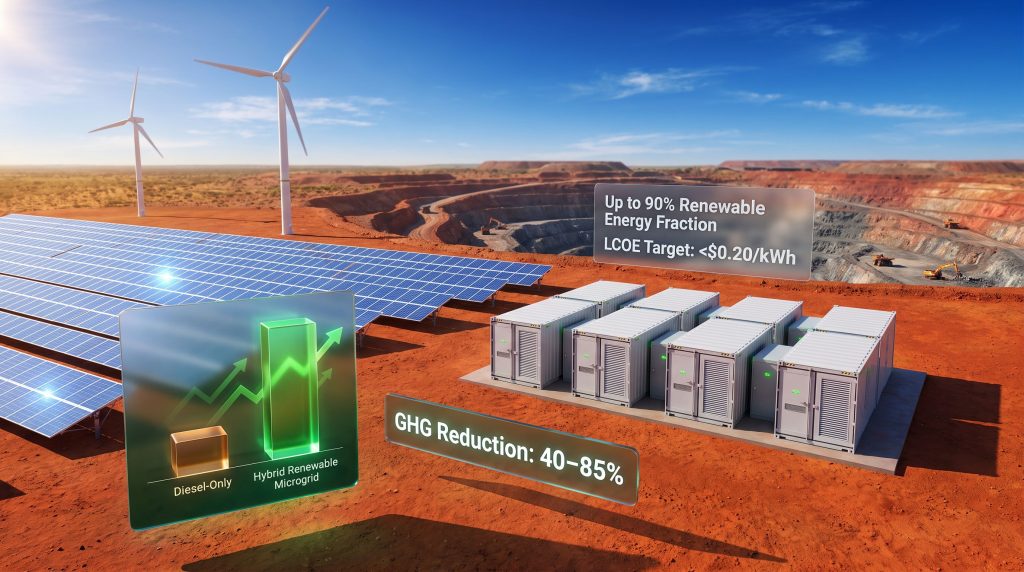
- Levelised Cost of Electricity (LCOE) in optimised systems targeting below $0.20/kWh
- Internal Rate of Return (IRR) on solar PV integration into hybrid power plants exceeding 10% in documented project configurations
- Payback periods that are highly sensitive to mine operational life, energy demand intensity, and proximity to gas infrastructure
The cost-benefit framework extends beyond direct fuel savings. The avoided cost dimension is often underweighted in initial analysis:
- Carbon liability reduction: As emissions reporting obligations tighten across major mining jurisdictions, the financial exposure associated with high Scope 1 energy emissions grows
- Supply chain risk mitigation: Reducing diesel dependency reduces vulnerability to logistics disruptions and fuel price shocks
- OH&S incident exposure: Fewer fuel deliveries means fewer heavy vehicle movements and reduced incident risk
- ESG premium considerations: Institutional investor screening increasingly weights operational decarbonisation in equity valuation frameworks
Ten-Year Performance Comparison: Diesel-Only vs. Hybrid Microgrid
| Metric | Diesel-Only System | Hybrid Renewable Microgrid |
|---|---|---|
| Annual Fuel Consumption | Baseline (100%) | Reduced by 30–50% |
| GHG Emissions Reduction | Baseline | 40–85% lower |
| LCOE | High; fully fuel-price exposed | Stabilised; target below $0.20/kWh |
| IRR on Energy Investment | Negligible | Above 10% in optimised configurations |
| Renewable Energy Fraction | 0% | Up to 90% with advanced EMS |
Financial Benchmark: Systems achieving renewable energy fractions above 70% while maintaining LCOE below $0.20/kWh represent the current performance frontier for hybrid mining microgrids.
Emissions Reductions: The Scope 1 Energy Decarbonisation Pathway
Greenhouse gas emission reductions of 40–85% are achievable versus diesel-only baselines, with the range determined primarily by renewable penetration depth and storage capacity. The mechanism behind the upper end of this range is worth understanding precisely.
When a BESS system with sufficient capacity is integrated, thermal generators can be fully cycled off during peak solar or wind generation windows. This is not a partial reduction in generator output but a complete operational shutdown of combustion-based generation for periods that can extend several hours per day. The cumulative emissions impact of these cycling events, aggregated across an annual operating calendar, drives disproportionate reductions relative to the renewable energy fraction alone.
The gap between a low-penetration configuration achieving 30–50% renewable fraction and a high-penetration system at 85–90% is not linear in emissions terms. A system with sophisticated BESS integration and an advanced EMS can achieve emissions reductions well above what its nameplate renewable capacity would suggest, precisely because the controller can use stored energy strategically to extend generator-off periods.
Scope 1 emissions from mine site energy generation represent the primary and most tractable target for near-term decarbonisation in mining. Corporate net-zero commitments are increasingly being translated into specific renewable fraction targets for mine site power, making EMS performance a direct input to corporate emissions milestone compliance. In addition, the broader renewable energy solutions being deployed across the sector are raising the performance benchmark year on year.
Regional Deployment: Where the Technology Is Proving Itself
Australia: The Critical Minerals Decarbonisation Frontier
Western Australia and the Northern Territory represent the most active deployment environment for hybrid renewable microgrids in mining globally, driven by the combination of exceptional solar irradiance, large remote mine populations, and a critical minerals sector expanding rapidly.
Ausgold's Katanning gold project in Western Australia is a current-cycle reference point. The project's hybrid gas-solar-battery power facility is targeting approximately 50% renewable energy supply, a configuration that reflects the practical engineering threshold at which the economics become clearly positive while grid stability risks remain manageable.
A more technically detailed Australian reference case involves a documented configuration at a copper operation comprising 4MW solar, 18MW wind, and a 13MW/4MWh battery storage system, with a total capital cost of approximately A$113 million. Pre-deployment modelling using open-source simulation tools was applied to optimise the generation mix, a methodology that is becoming standard practice for greenfield hybrid microgrid sizing in the Australian critical minerals sector.
The lessons from this copper project are directly transferable to the wave of lithium, nickel, and rare earths operations under development across remote Western Australia, where similar solar irradiance profiles and comparable logistical challenges create analogous energy economics.
Africa: Infrastructure Leapfrogging at Scale
The African mining sector presents a different but equally compelling deployment story. Industrial microgrid capacity in the range of 300MW to 500MW has been deployed across the continent's mining sector, driven primarily by energy security imperatives in environments where grid reliability is insufficient for continuous industrial operations.
African mining operations are, in many cases, bypassing conventional grid extension entirely. The economic and logistical barriers to grid infrastructure development in remote African mining regions make self-contained power systems not simply a decarbonisation preference but an operational necessity. This creates a deployment dynamic where microgrid investment is evaluated against the full cost of grid extension rather than against a grid-connected alternative, a comparison that overwhelmingly favours the microgrid.
The infrastructure legacy implications extend beyond the mine gate. Mining microgrids in remote African regions can anchor energy access for surrounding communities, creating a social licence dimension to energy investment that adds a further layer of strategic value beyond the operational economics.
The next major ASX story will hit our subscribers first
Technical Challenges That Determine Real-World Performance
The Grid Stability Problem in Renewable-Heavy Isolated Networks
High renewable penetration in isolated mining microgrids introduces a physics-based challenge that is not present in grid-connected industrial operations. Conventional thermal generators contribute rotating mass to the power network, which provides inertia that naturally resists rapid frequency changes when demand fluctuates. Remove those generators from the network, and the frequency stability that industrial loads depend on must be maintained through alternative means.
Battery energy storage systems address this through synthetic inertia, using the inverter control systems of the BESS to respond to frequency deviations at millisecond timescales, effectively mimicking the grid-stabilising behaviour of rotating machinery. This is technically achievable, but it places demanding requirements on BESS inverter specifications and EMS response logic.
The engineering threshold at which renewable penetration begins to create meaningful network stability challenges typically sits around 50–60% instantaneous penetration. Above this level, without adequately specified synthetic inertia provisions, voltage and frequency excursions can trigger protective relays and cause load shedding events at exactly the wrong moment for continuous-process mining operations.
The Sizing Optimisation Challenge
Microgrid sizing is a multi-objective problem that does not yield to single-variable optimisation. Engineers must simultaneously minimise capital cost, maximise emissions reduction, and maintain reliability standards, objectives that are frequently in direct tension. The broader mine energy design discipline has evolved substantially to address this challenge across diverse site configurations.
Design Principle: The optimal configuration is rarely the one that minimises capital expenditure or the one that maximises renewable fraction. It is the configuration that achieves the lowest total cost of ownership across the mine's operational life while meeting reliability and emissions constraints simultaneously.
Key sizing decisions include:
- BESS capacity vs. diesel generator retention: Configurations that reduce diesel generator capacity but increase battery bank size can achieve near-equivalent reliability at lower long-run costs, but require careful modelling of worst-case renewable output scenarios
- Load profiling accuracy: Shift patterns, processing cycles, and ventilation demand create load profiles with sharp peaks that must be matched to generation dispatch capability
- Seasonal resource variability: Minimum thermal backup capacity must be sized against low-irradiance or low-wind periods, not average conditions
Seasonal variability is particularly important and often underweighted. In favourable conditions, solar-dominant systems can achieve instantaneous renewable fractions of 85% or higher. The system design challenge is ensuring that the minimum required thermal backup capacity is correctly sized for the low-resource periods without over-specifying in a way that increases costs and undermines the emissions reduction case.
A Practical Feasibility Framework for Mining Operators
Translating the conceptual case for hybrid microgrids into a deployment decision requires a structured feasibility process. The following framework reflects current industry practice:
- Site Energy Audit: Establish baseline load profiles across all operational systems, including processing, ventilation, lighting, and camp services
- Renewable Resource Assessment: Conduct solar irradiance mapping, wind speed analysis, and seasonal variability modelling specific to the site location
- Technology Selection: Evaluate solar PV versus wind versus combined generation based on resource availability and load profile characteristics
- Storage Sizing: Determine BESS capacity requirements based on target renewable fraction, synthetic inertia requirements, and reliability thresholds
- Thermal Backup Specification: Size diesel, gas, or hydrogen backup generation to cover worst-case renewable output shortfalls without over-specifying
- EMS and Controller Selection: Choose or configure dispatch optimisation software capable of managing the specific generation mix and load profile
- Financial Modelling: Run LCOE, IRR, and payback period analysis across multiple system configurations to identify the optimal investment case
- Regulatory and Permitting Review: Assess environmental approvals, grid connection exemptions, and emissions reporting obligations applicable to the jurisdiction
Key Configuration Decision Variables
| Decision Variable | Lower Renewable Case | Higher Renewable Case |
|---|---|---|
| Mine operational life | Shorter remaining life limits IRR | Longer life justifies higher CapEx |
| Gas infrastructure access | Unavailable; diesel backup only | Available; significantly improves economics |
| Processing intensity | Lower energy demand; simpler sizing | High-intensity processing requires larger BESS |
| Corporate decarbonisation targets | Less urgent driver | Internal carbon pricing accelerates case |
Renewable Configuration Performance Comparison
| System Configuration | Renewable Energy Fraction | Estimated LCOE | GHG Reduction vs. Diesel | Key Limitation |
|---|---|---|---|---|
| Diesel-Only | 0% | Highest; fully fuel-exposed | Baseline | Fuel price volatility; high emissions |
| Solar PV + Diesel | 30–50% | Moderate reduction | 30–50% | Limited storage; curtailment at high penetration |
| Solar + BESS + Diesel | 50–75% | Significant reduction | 50–70% | BESS CapEx; sizing complexity |
| Solar + Wind + BESS + Gas/H₂ | Up to 90% | Target below $0.20/kWh | 70–85% | Highest CapEx; requires advanced EMS |
Frequently Asked Questions
What distinguishes a microgrid from a standard off-grid mining power system?
A conventional off-grid mining power system typically relies on diesel generators operating in parallel, with redundancy achieved through additional generator capacity. A microgrid integrates multiple generation technologies, energy storage, and a centralised control layer that continuously optimises dispatch across all assets. The EMS is the defining element, enabling the system to prioritise low-cost renewable generation while maintaining the reliability that industrial processes require.
Can hybrid microgrids fully replace diesel at mine sites today?
Current technology supports renewable fractions of up to 90% in well-designed configurations, but complete diesel elimination remains technically challenging for most operations. The practical and increasingly common industry target is reducing diesel to a reliability backstop used only when renewable generation and storage are insufficient to meet load. Green hydrogen as a thermal backup fuel represents the most credible pathway to near-zero fossil fuel dependence over the medium term, though hydrogen infrastructure and cost economics are still maturing.
What are realistic deployment timelines?
- Greenfield deployments: typically 18 to 36 months from feasibility to commissioning
- Brownfield retrofits into existing power infrastructure: 12 to 24 months, depending on integration complexity
- BESS procurement lead times have emerged as a critical path constraint in recent project timelines, particularly for larger capacity configurations
What is the typical capital cost range?
System costs vary significantly based on scale, location, and technology mix. The documented Australian copper project reference point of 4MW solar, 18MW wind, and 13MW/4MWh BESS was capitalised at approximately A$113 million. Smaller configurations appropriate for junior mining operations can be structured in the A$5 to A$30 million range depending on generation capacity requirements and site-specific logistics costs.
The Strategic Horizon: Energy Sovereignty as Competitive Advantage
The trajectory of hybrid renewable microgrids in mining is not primarily driven by regulatory compulsion or ESG optics, though both are contributing factors. It is driven by the convergence of declining technology costs and a structural improvement in the economics of energy self-sufficiency relative to diesel dependency. However, the mining electrification trends shaping the sector suggest that regulatory drivers will intensify alongside the economic ones in the years ahead.
As battery storage costs continue to fall and solar PV efficiency improves, the economic case for higher renewable fractions strengthens continuously. The green hydrogen pathway, while still in commercial development as a thermal backup application, offers a credible route to near-complete Scope 1 energy decarbonisation for mines that achieve it.
The broader strategic implication is significant. Mines with low-cost, low-emission power infrastructure have a structural cost advantage over diesel-dependent competitors that compounds over time. In commodity markets where marginal cost curves determine which operations remain viable through price cycles, energy cost structure is not a secondary consideration.
Strategic Outlook: As renewable energy fractions approach 90% and battery storage economics continue to improve, the argument for hybrid microgrids in mining has moved beyond ESG positioning. It is now a fundamental operational cost and risk management imperative for any remote mining operation planning its energy strategy beyond a five-year horizon.
Key Performance Benchmarks at a Glance
| Dimension | Current Performance Benchmark |
|---|---|
| Fuel Consumption Reduction | 30–50% versus diesel-only baseline |
| GHG Emissions Reduction | 40–85% depending on renewable fraction |
| Maximum Renewable Energy Fraction | Up to 90% with advanced EMS and BESS |
| LCOE Target | Below $0.20/kWh in optimised configurations |
| IRR on Solar PV Integration | Above 10% in documented configurations |
| African Industrial Microgrid Deployment Scale | 300MW to 500MW capacity ranges |
| Australian Reference Project (Copper) | 4MW solar + 18MW wind + 13MW/4MWh BESS; approximately A$113 million |
Disclaimer: Financial benchmarks, IRR figures, LCOE targets, and performance statistics referenced in this article are drawn from documented industry configurations and published research. They represent performance achieved in specific project contexts and should not be interpreted as guaranteed outcomes for any individual project. Investors and operators should conduct independent feasibility analysis tailored to their specific site conditions, operational profiles, and financial parameters before making investment decisions. Forward-looking statements regarding technology trajectories and cost trends involve inherent uncertainty.
Want To Know Which ASX Mining Companies Are Capitalising On The Energy Transition?
Discovery Alert's proprietary Discovery IQ model scans ASX announcements in real time, instantly identifying significant mineral discoveries — including the critical minerals and remote-operations companies driving the renewable microgrid revolution in mining — and delivers actionable alerts directly to subscribers. Explore Discovery Alert's dedicated discoveries page to understand how major mineral discoveries have historically generated substantial returns, and begin a 14-day free trial to position yourself ahead of the broader market.