July 24, 2026
When Three Signals Arrive in the Same Year, the Pattern Is Worth Reading
In the long history of large-scale gold and silver development projects, the difference between a project that advances and one that stalls is rarely a single announcement. It is almost always a sequence. An engineering firm gets commissioned. An economic baseline gets published. An operator with a specific skill set gets hired. When those three things happen within a single calendar year, and when all three point toward the same technical question, the pattern itself becomes the signal.
That is precisely the situation that has taken shape around the Hycroft Mine development shift across 2026. Each individual disclosure, viewed in isolation, might appear routine. Viewed as a coordinated sequence, however, they describe something more deliberate: a company narrowing its decision window around a specific development pathway and building the organisational capacity to execute on it.
When big ASX news breaks, our subscribers know first
What the Hycroft Mine Actually Represents at This Scale
Hycroft Mining Holding Corporation (Nasdaq: HYMC) holds one of the largest undeveloped gold and silver resource bases in the United States, situated in northern Nevada within a jurisdiction that has historically offered established permitting pathways, existing infrastructure networks, and a deep talent pool of experienced mining personnel.
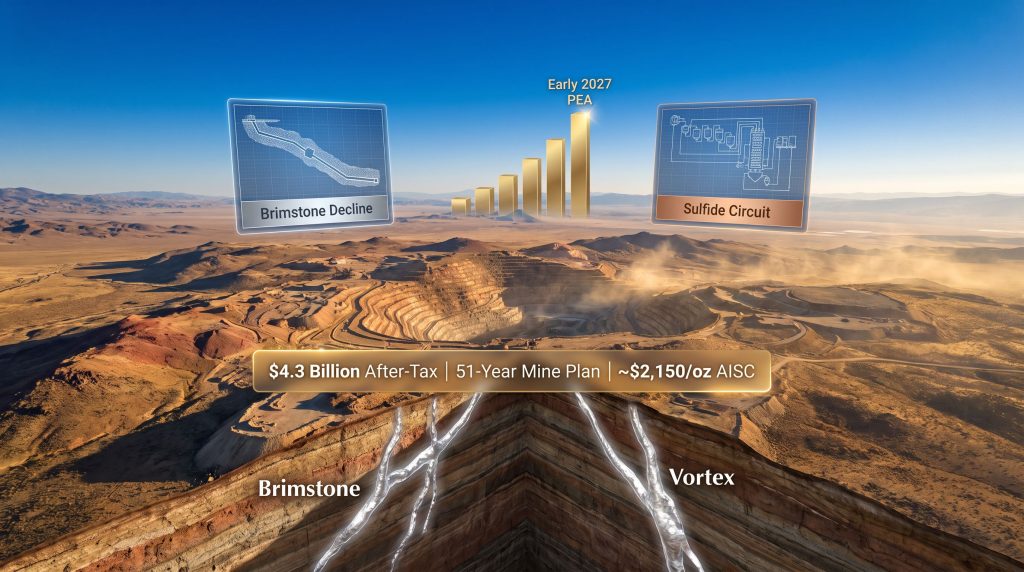
The asset's scale is not conceptual. The June 2026 technical study established a 51-year mine plan and an after-tax project valuation of $4.3 billion under planning-level gold and silver prices. That figure more than doubles when assessed against recent spot market prices, which by mid-2026 had moved materially above the planning-level assumptions embedded in the study.
What makes this valuation particularly significant from an investor perspective is what it deliberately excludes:
- Underground mining contributions from the Brimstone and Vortex silver systems
- Less-certain gold and silver mineral estimates not yet converted to higher-confidence categories
- Recent drilling intercepts not yet incorporated into the resource model
- Stockpiled lower-grade material with potential processing value under elevated metal prices
The published $4.3 billion figure functions as an economic floor rather than a ceiling. The project's full potential scope extends beyond what any single study at this stage of development is designed to capture.
The study also established a total production cost of approximately $2,150 per ounce across the mine life when all ongoing operational costs are incorporated into the calculation. With gold trading well above $3,000 per ounce through much of 2025 and into 2026, the margin implied by that cost structure is material. Furthermore, the gold and silver market trends observed throughout this period have reinforced the significance of cost-competitive projects at scale.
The Geological Backstory: From Heap Leach to Sulfide Ore
Understanding the Hycroft Mine development shift requires understanding why the operation's earlier production model reached its limits. Hycroft was historically operated as a heap leach facility, a processing method well-suited to oxide ores found near the surface. In heap leach operations, crushed ore is stacked on impermeable pads and irrigated with a dilute cyanide solution that dissolves gold and silver, which is then recovered from the solution.
The method is relatively capital-light and operationally straightforward, but it is only effective for oxide and partially oxidised ore types.
The ore found at greater depths within the Hycroft deposit is sulfide-hosted. Sulfide ores contain gold and silver locked within iron sulfide mineral structures, and standard heap leach chemistry cannot liberate the metals efficiently. Processing sulfide ore requires milling infrastructure: crushing the material to fine particle sizes, then applying flotation or other concentration techniques to separate the sulfide minerals from the gangue material before the metals can be recovered.
This ore-type transition is the central technical challenge of the Hycroft development story. Sulfide milling demands significantly higher capital investment than heap leaching, but it unlocks access to the bulk of the deposit's resource base. The June 2026 study addresses this transition directly by modelling a processing pathway that moves from a transitional feed blend toward full sulfide milling capacity across the 51-year mine life.
Brimstone and Vortex: The Systems Changing the Development Calculus
First disclosed in 2023, the Brimstone and Vortex silver systems represent a material addition to the Hycroft asset profile that was not part of the original long-term development narrative. Both systems are high-grade silver zones located within the existing land position, and both remain open to further drilling, meaning their defined limits have not yet been established.
The geological feature that makes Brimstone particularly significant from a development-sequencing perspective is its proximity to the existing open pit surface. Because the system starts a relatively short distance beneath the current pit floor, a decline connecting the surface to the orebody is technically viable without requiring an entirely new access corridor to be established from scratch.
| Feature | Broader Hycroft Resource | Brimstone and Vortex Systems |
|---|---|---|
| Processing method (current plan) | Sulfide milling (transitional) | Underground mining (under review) |
| Mine plan inclusion | Yes, 51-year plan | Possible future opportunity only |
| Resource definition status | Established | Open to further drilling |
| Development timeline | Longer-term buildout | Standalone PEA targeted early 2027 |
| Economic study inclusion | Included in $4.3B figure | Excluded from current study |
The standalone underground Preliminary Economic Assessment (PEA) targeting Brimstone and Vortex specifically is scheduled for completion in early 2027. The timeline was extended from an earlier target to accommodate a larger resource base and additional engineering requirements, which itself signals that the systems have grown considerably in scope since first discovery.
The External Engineering Review: Why RESPEC Was Brought In
Earlier in 2026, Hycroft engaged RESPEC, an external engineering firm, to evaluate underground mining methods for the Brimstone and Vortex systems. The scope of that review encompasses mining method selection, conceptual mine design, and schedule development.
The decision to commission an independent external review rather than conduct the assessment internally carries a specific technical and strategic implication. External engineering reviews are typically sought when a company needs independent technical validation before committing capital to an irreversible infrastructure decision. The findings of such a review carry greater credibility with potential financing counterparties and provide a defensible evidentiary basis for a board-level development decision.
A decline connecting the surface to a near-surface high-grade silver system serves two simultaneous functions: it accelerates infill drilling access while also establishing the physical infrastructure required for ore extraction. That dual utility makes early decline development a capital-efficient option in phased underground scenarios, particularly where the orebody's full extent has not yet been defined.
As of the Chief Operating Officer appointment announcement in July 2026, the findings of the underground engineering review had not been separately published. The sequencing suggests those findings are expected to feed directly into the standalone PEA process targeting early 2027. In addition, interpreting drill results from ongoing programmes at these systems will be critical to refining the resource model ahead of that study.
Three Possible Development Pathways: Scenario Modelling for Hycroft
The Hycroft Mine development shift does not resolve to a single predetermined outcome. The technical and economic logic supports at least three distinct development pathways, each with a different risk profile and capital timeline.
Scenario A: Underground First, Sulfide Processing Later
This pathway prioritises Brimstone and Vortex as an early production vehicle. The appeal of this sequence is a lower initial capital requirement and the potential to generate cash flow from high-grade silver before committing to the full capital intensity of sulfide milling infrastructure. The primary risk is dependence on underground grade consistency across systems that remain open to further drilling.
Scenario B: Integrated Simultaneous Development
This pathway advances both the sulfide milling infrastructure and the underground silver systems on overlapping timelines. It maximises resource utilisation and potentially accelerates the point at which the project reaches its full production profile. The trade-off is significantly higher execution complexity and a larger upfront capital requirement.
Scenario C: Extended Resource Delineation Before Commitment
This pathway extends drilling at Brimstone and Vortex before committing to either development direction, allowing the 2027 PEA to incorporate a more complete resource picture. The risk is timeline extension, but the potential benefit is a development decision made on a substantially more complete evidentiary base. Consequently, the incoming COO's mandate aligns with evaluating all three pathways, with primary emphasis on Brimstone and Vortex.
The next major ASX story will hit our subscribers first
What the New COO Appointment Actually Signals
Michael Deal was appointed Senior Vice President and Chief Operating Officer of Hycroft Mining Holding Corporation, with a start date of August 24, 2026. His prior role as Vice President, Operations at First Majestic Silver is the credential that draws the most direct relevance to Hycroft's current priorities. At First Majestic, Deal oversaw a portfolio of producing mines and led the operational integration of a major acquisition.
His earlier career experience spans Nevada Gold Mines, OceanaGold, Romarco Minerals, and Newmont Corporation, providing familiarity with large-scale mine operations across multiple jurisdictions and commodity profiles.
The mandate publicly described for Deal's role focuses specifically on reviewing development options with primary emphasis on the Brimstone and Vortex high-grade silver systems. That mandate mirrors precisely the scope of the RESPEC underground engineering review already underway. When a new executive's stated priorities align exactly with the technical work already commissioned, it is reasonable to interpret that alignment as deliberate rather than coincidental. Furthermore, the gold-silver ratio analysis relevant to mid-2026 market conditions reinforces why high-grade silver exposure is increasingly a strategic priority for operators in this space.
What the June 2026 Study Does and Does Not Establish
A planning-level study sits below a Pre-Feasibility Study and well below a Bankable Feasibility Study in the standard progression of mining project technical work. It establishes a credible economic baseline using reasonable price assumptions and defined engineering parameters, but it does not carry the precision required for formal project financing or a final investment decision. A definitive feasibility study represents the more rigorous technical threshold that formal financing counterparties typically require before committing capital.
| Economic Component | Included in June 2026 Study |
|---|---|
| 51-year open pit and sulfide mine plan | Yes |
| Planning-level gold and silver price assumptions | Yes |
| Underground Brimstone and Vortex contribution | No |
| Recent drilling results | No |
| Inferred and less-certain mineral estimates | No |
| Stockpiled lower-grade material | No |
The implication of this exclusion list is that the study's published economics represent a partial accounting of the project's total potential scope. If the standalone Brimstone and Vortex PEA targeted for early 2027 incorporates those systems into a formal development scenario, the project's cumulative published economics will require material revision. Moreover, gold price and mining equities have historically re-rated sharply when projects of this scale publish updated economic studies under elevated metal price environments.
Key Risk Factors Investors Should Evaluate
The Hycroft Mine development shift carries a range of risks that require clear-eyed assessment alongside the project's upside optionality.
- Development confirmation risk: The underground pathway for Brimstone and Vortex remains a potential future opportunity, not a confirmed element of the current mine plan.
- Capital intensity risk: A sulfide milling operation at this scale requires substantial upfront investment. The financing structure for that buildout has not been publicly defined.
- Resource delineation risk: Both silver systems remain open to further drilling, meaning current resource estimates may not represent the full mineralised extent in either direction.
- Timeline risk: The standalone underground PEA has been extended to early 2027 due to the expanded resource base and additional engineering work required.
- Processing transition risk: Moving from heap leach operations to sulfide milling introduces significant technical and operational complexity that has no direct precedent in Hycroft's recent operating history.
A project with a $4.3 billion after-tax baseline that explicitly excludes multiple upside categories carries asymmetric optionality. That optionality only converts to value if technical studies, capital formation, and permitting processes align on a workable and fundable timeline. Investors should evaluate progress against each of those milestones rather than treating the valuation figure as a static indicator.
For further context on how the asset's brownfield infrastructure and high-grade silver position influence peer comparisons, this independent analysis provides useful framing for investors assessing the project's relative standing within the development-stage peer group.
This article is intended for informational purposes only and does not constitute financial advice. Investing in mining equities involves material risks, including capital loss. Forecasts, valuations, and development timelines referenced herein are subject to change based on technical, operational, and market conditions. Readers should conduct independent due diligence before making any investment decision.
Frequently Asked Questions: Hycroft Mine Development Shift
What is the current after-tax valuation of the Hycroft Mine?
The June 2026 planning-level study established an after-tax valuation of $4.3 billion under planning-level gold and silver prices, across a 51-year mine plan. This figure increases materially when assessed against more recent spot market prices.
Why are Brimstone and Vortex excluded from the current mine plan?
The June 2026 study treats underground mining at Brimstone and Vortex as a possible future development opportunity. A standalone underground PEA covering these two systems specifically is targeted for completion in early 2027.
What is the all-in production cost established by the June 2026 study?
The study indicates a total production cost of approximately $2,150 per ounce when all ongoing costs across the mine life are incorporated into the calculation.
What role does RESPEC play in the Hycroft development process?
RESPEC is the external engineering firm engaged to evaluate underground mining methods for the Brimstone and Vortex silver systems, including mining method selection, conceptual mine design, and development scheduling. The mine's assessed value and life have been covered extensively by industry publications, providing additional context on the scale of what RESPEC's findings will ultimately inform.
What is the significance of the transition from heap leach to sulfide milling?
Sulfide milling is required to process the ore type found at greater depth within the Hycroft deposit. The transition demands higher capital investment than heap leach operations but unlocks access to the majority of the resource base not accessible through surface leaching methods.
When is the standalone Brimstone and Vortex underground PEA expected?
Hycroft has indicated the standalone underground PEA is targeted for early 2027, with the timeline extended to accommodate the expanded resource base and additional engineering requirements identified during the review process.
Want to Know When the Next Major Mineral Discovery Hits the ASX?
Discovery Alert's proprietary Discovery IQ model delivers real-time alerts the moment significant ASX mineral discoveries are announced, turning complex geological and economic data into actionable investment insights for both short-term traders and long-term investors — explore historic discoveries and their returns to understand the scale of opportunity, then begin your 14-day free trial to position yourself ahead of the broader market.