
June 29, 2026
When Published Numbers Tell Only Part of the Story
Large-scale mineral deposits operate under a valuation paradox that most investors rarely consider. The formal number attached to a project at any given point in its development lifecycle is not a ceiling — it is a snapshot. Preliminary economic assessments, by their very design, are built on conservative metal price assumptions, constrained resource boundaries, and mine plans that reflect what is known with confidence rather than what may ultimately exist. The gap between a study's published value and a project's true potential ceiling can be substantial, and in some cases, transformative.
Understanding this gap is not just an academic exercise. For investors tracking large-scale development assets, the ability to identify value layers that sit outside the published estimate is often where the most significant return opportunities are found. The Hycroft Nevada mine value upside story is a compelling case study in exactly this dynamic.
When big ASX news breaks, our subscribers know first
Understanding the Hycroft Mine's Strategic Foundation
Why Northern Nevada Changes the Risk Equation
Few mining jurisdictions in the world carry the same combination of geological endowment, regulatory maturity, and infrastructure density as northern Nevada. The state has produced precious metals continuously for more than 150 years, and its regulatory frameworks reflect that institutional depth. Permitting processes are well-established, political risk is low by global standards, and the physical infrastructure needed to support large-scale mining operations is often already in place.
For Hycroft Mining Holding Corporation (Nasdaq: HYMC), these jurisdictional characteristics are not incidental. They are load-bearing components of the investment thesis. Operating in a Tier-1 jurisdiction compresses development risk in ways that are difficult to replicate in less established mining environments, and for a project of Hycroft's scale and duration, that compression matters enormously.
What further distinguishes Hycroft from comparable development assets is the physical infrastructure already present on site from prior production periods. This includes:
- A processing plant and refinery capable of handling large ore volumes
- Crushing equipment and associated material handling systems
- Established road access to the property
- An existing connection to the regional power grid
This inherited infrastructure base reduces the capital intensity calculation relative to a greenfield project of equivalent scale. For a deposit with a projected 51-year mine life and estimated gross revenues of $54.2 billion over its operating duration, that starting-point advantage carries significant financial weight.
The Scale of the Resource Base in Context
The deposit's dimensions place it in a narrow category of US-domiciled precious metals assets capable of sustaining genuinely multi-generational mine operations. The formal resource base includes:
| Resource Category | Gold | Silver |
|---|---|---|
| Measured and Indicated | 16.4 million oz | 562.6 million oz |
| Inferred (excluded from study) | 5.0 million oz | 132.8 million oz |
The annual production profile outlined in the June 2026 technical study targets 204,000 oz of gold and 6.8 million oz of silver per year across the mine life. Few development-stage assets in North America can project that kind of sustained output over five decades, and fewer still sit in a jurisdiction where the pathway to achieving it is as clearly defined.
Decoding the June 2026 Technical Study
Three Independent Firms, Two Very Different Valuations
The formal economic study released in June 2026 was produced by three independent engineering firms, lending credibility to its findings. The study generated two headline valuation scenarios that reflect different views on where precious metal prices will settle over the long term.
| Scenario | Metal Price Basis | Post-Tax NPV | Payback Period |
|---|---|---|---|
| Base Case | Conservative long-term assumptions | $4.3 billion | 4.7 years |
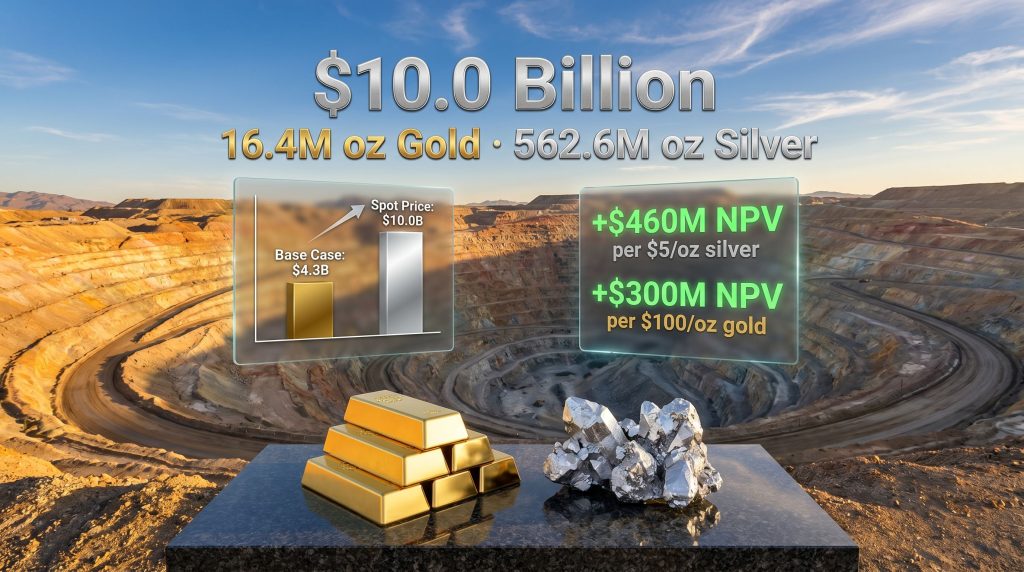
| Spot Price Case | Current market prices (June 2026) | $10.0 billion | Not specified |
The $5.7 billion gap between these two scenarios is driven almost entirely by commodity price sensitivity. This is not unusual for precious metals development projects, but the magnitude of the differential at Hycroft reflects just how large the underlying asset is. A modest shift in price assumptions produces billions of dollars in NPV movement, not millions.
Hycroft's Executive Chairman and Chief Executive Officer stated that the study confirms the deposit's scale, quality, and long-term potential, while reinforcing the project's leverage to rising gold and silver prices. That leverage characterisation is worth examining in detail, because the mechanics behind it are asymmetric in a way that most investors do not immediately appreciate. You can review Hycroft's investor case directly on their website for additional context on how management frames this leverage.
Silver as the Dominant Financial Lever
The counterintuitive reality at Hycroft is that silver, not gold, is the more powerful driver of project valuation. The sensitivity figures from the study illustrate this clearly. Furthermore, understanding silver's dual demand as both a precious and industrial metal helps explain why these dynamics are structurally durable rather than cyclical.
| Metal | Price Change | NPV Impact |
|---|---|---|
| Gold | +$100/oz | +$300 million |
| Silver | +$5/oz | +$460 million |
| Gold | +$200/oz | +$600 million |
| Silver | +$10/oz | +$920 million |
| Gold | +$300/oz | +$900 million |
| Silver | +$15/oz | +$1.38 billion |
For every equivalent percentage move in precious metal prices, silver price changes generate approximately 53% more NPV impact than gold price changes at Hycroft. This structural characteristic distinguishes the asset from conventional gold-dominant Nevada projects and means silver market dynamics carry disproportionate weight in how the project's value evolves.
The reason for this asymmetry lies in the sheer volume of silver contained in the deposit. With 562.6 million oz of measured and indicated silver, even modest per-ounce price improvements compound across an enormous ounce base. Investors who track silver supply deficits and growing industrial demand from solar panel manufacturing, electronics, and battery materials processing have a specific and quantifiable reason to watch this project.
Five Value Layers Sitting Outside the Published Estimate
The Inferred Resource Gap: Ounces Awaiting Formal Recognition
The 5 million oz of gold and 132.8 million oz of silver classified as inferred resources are excluded from the economic model entirely. This is standard practice under mining industry reporting codes, which require inferred material to meet higher confidence thresholds before it can be incorporated into a formal mine plan.
The conversion pathway from inferred to indicated is straightforward in principle but requires systematic drilling investment. Each successful drill campaign that upgrades inferred ounces into the measured or indicated category opens the possibility of extending the mine life, increasing annual production rates, or restructuring early-year cash flow profiles to front-load returns. Historical precedents across comparable long-life Nevada deposits show that inferred-to-indicated upgrades have consistently shifted NPV outcomes by meaningful margins. Consequently, interpreting drill results accurately is a critical skill for investors tracking this conversion process.
Brimstone and Vortex: High-Grade Silver Zones Changing the Economic Hierarchy
Perhaps the most immediately compelling value catalyst sits in two silver zones identified in 2023, called Brimstone and Vortex. Both zones were discovered after the formal study's geological boundaries were established, and neither has been incorporated into the June 2026 economic model. The reported grades from these zones exceed 2,000 g/t silver, placing them in a materially different grade category than the bulk-tonnage open-pit resource that forms the backbone of the current mine plan.
Several characteristics make these zones particularly significant:
- Both remain open at depth and along strike, meaning drilling has not yet defined their outer boundaries
- High-grade zones discovered within or adjacent to a bulk-tonnage deposit can be sequenced for early extraction, front-loading cash flow
- Prioritising high-grade material in early mine years compresses the payback period below the current 4.7-year base-case estimate
- The zones are positioned within a property that already has established surface infrastructure, reducing the capital cost of accessing them
If Brimstone and Vortex are eventually incorporated into a revised mine plan, the ability to prioritise high-grade silver extraction ahead of bulk-tonnage processing could fundamentally restructure the project's cash flow timeline in ways that the current published NPV does not reflect.
For investors tracking near-term catalysts, drilling intercept widths, mineralisation continuity, and proximity to existing infrastructure are the three metrics most likely to determine how quickly these zones translate into formal economic value.
Underground Mining Integration: Accessing Geometry the Open Pit Cannot Reach
The June 2026 study is constructed around an open-pit mining methodology, which is appropriate for the bulk-tonnage, shallow-dipping portions of the deposit. However, steep, high-grade zones within the ore body are more efficiently accessed through underground methods. A hybrid open-pit and underground configuration would allow simultaneous extraction of lower-grade bulk material and high-grade underground zones, potentially improving both the revenue profile and the overall project economics without a proportional increase in operating costs.
Hybrid mine configurations of this type are well-established in Nevada's mining history. Several producing operations in the state have used combined methodologies to optimise extraction sequences, particularly where high-grade lenses sit within or beneath larger open-pitable ore bodies. The presence of existing surface infrastructure at Hycroft reduces the incremental capital required to explore this approach.
Oxide and Heap Leach Targets: The Case for Accelerated Early Cash Flow
Additional oxide mineralisation identified on the Hycroft property has not yet been incorporated into the formal study. Oxide ore responds well to heap leach processing, a method characterised by lower capital intensity and significantly faster construction timelines than conventional milling circuits. A heap leach operation can often be brought into production in a fraction of the time required for a full processing plant, generating early cash flow that can then fund subsequent development phases.
In a capital markets environment where financing costs remain elevated, the strategic value of self-funded development phases is substantial. An early heap leach operation that generates positive cash flow could reduce reliance on external financing for the broader project, improving the economics of eventual full-scale production.
Sulfuric Acid as a Third Revenue Stream
Pending roasting test work may unlock sulfuric acid as a commercial by-product of the ore processing circuit. This is not a widely discussed aspect of the Hycroft story, but it carries genuine financial significance. Sulfuric acid demand is driven by fertiliser production and, increasingly, by battery materials processing for lithium-ion applications. Both are structural growth markets with long-duration demand profiles.
If roasting test work confirms commercially viable sulfuric acid production, the project would gain a third revenue stream entirely independent of precious metal prices. That diversification has portfolio-level implications for how the project is valued relative to single-commodity peers, and it would add a layer of economic resilience that the current formal model does not capture.
The Land Package: Why Less Than 15% Coverage Is a Strategic Variable
What 64,000 Acres of Largely Unexplored Ground Represents
The June 2026 technical study covers less than 15% of the company's total 64,000-acre land position. This is not a minor footnote. It means that the formal economic model, with its $4.3 to $10.0 billion NPV range, is built on a fraction of the geological territory that Hycroft controls.
The remaining land represents several distinct categories of potential value:
- Untested geological extensions of the known deposit, where mineralisation may continue beyond current drilling boundaries
- Potentially new and separate mineralised systems within the broader land package
- Exploration optionality value, which analysts assign probabilistically based on the geological setting and historical discovery rates in comparable Nevada terrains
Nevada's precious metals geology is characterised by large mineralised corridors where multiple deposits of significant scale can coexist within the same regional structural framework. The Carlin Trend and Battle Mountain corridor are the most cited examples, having yielded sequential discoveries over multi-decade exploration programs. Hycroft sits in a geological environment where this kind of sequential discovery history is plausible, though not guaranteed.
Financial Position and the Development Pathway
Balance Sheet Strength at a Critical Development Stage
As of May 2026, the company holds $175 million in unrestricted cash and carries zero debt. For a development-stage asset of this scale, this combination is genuinely unusual. Most projects of comparable ambition arrive at the preliminary economic assessment stage carrying some form of debt or dilutive financing from earlier development work.
A debt-free balance sheet changes the financing calculus for subsequent development phases. It preserves optionality around how the next stages are funded, whether through additional equity, project-level debt, streaming agreements, or royalty structures, and it removes the immediate pressure of debt service from the operating timeline.
The Milestones Between Here and Construction
Investors should calibrate expectations clearly on development timelines. The June 2026 study is a preliminary economic assessment, which is the first formal analytical milestone in a multi-stage development process. Before any construction decision can be made, the following steps are required:
- Completion of a prefeasibility study, and subsequently a definitive feasibility study, both of which provide higher confidence in cost and production assumptions
- Securing all necessary environmental and operating permits from relevant Nevada and federal regulatory bodies
- Arranging project-level financing, which for a project of this scale will likely involve a combination of debt, equity, and potentially streaming or royalty structures
- Finalising mine plan sequencing to incorporate Brimstone, Vortex, and any upgraded inferred resources
Important context for investors: The distance between a preliminary economic assessment and a construction decision typically spans several years of additional technical, permitting, and financing work. The published NPV figures represent potential value, not near-term cash flow. Investment decisions should be made with this development timeline fully in view.
The next major ASX story will hit our subscribers first
Macro Conditions That Would Most Accelerate Value Recognition
Several external variables could materially compress the timeline between current development stage and formal value recognition in market pricing:
- A sustained precious metals bull market driven by real yield compression, currency concerns, or institutional safe-haven demand
- Acceleration in industrial silver demand from solar manufacturing, which is expanding rapidly and represents a structurally growing consumption base for silver
- Renewed merger and acquisition activity across the Nevada gold-silver sector, which tends to compress valuation discounts applied to development-stage assets as producing companies compete for resource inventory
- Rotation of institutional capital from higher-cost producing miners into high-optionality development projects offering greater leverage to commodity price moves
Each of these macro conditions interacts with the Hycroft asset's specific characteristics differently, but all of them point toward the same outcome: a narrowing of the gap between the project's published formal value and its market valuation. The gold-silver ratio is one additional macro metric worth monitoring closely, as shifts in relative metal pricing have historically preceded major revaluations of silver-weighted assets like Hycroft.
Furthermore, independent analysis from outlets such as Crux Investor has characterised Hycroft as a sleeping giant beginning to awaken, reinforcing the view that the project's market recognition may still be in its early stages relative to its underlying scale.
Frequently Asked Questions
What is the Hycroft Mine's current estimated value?
The June 2026 technical study places the post-tax NPV at $4.3 billion under conservative metal price assumptions and $10.0 billion at current spot prices. Both figures exclude several identified value sources, including the Brimstone and Vortex high-grade silver zones, the inferred resource body, and the unexplored majority of the land package.
Why does silver matter more than gold for Hycroft's valuation?
Each $5/oz increase in silver adds approximately $460 million to the project's NPV, compared to $300 million added by a $100/oz increase in gold. The deposit's massive silver endowment means that silver price movements carry disproportionately large impact across the full ounce base.
What are Brimstone and Vortex?
Brimstone and Vortex are two high-grade silver zones identified in 2023, with reported grades exceeding 2,000 g/t silver. Neither zone has been incorporated into the formal economic study because drilling remains ongoing. Both zones remain open along strike and at depth, meaning their full extent has not yet been established.
How much of the Hycroft land has been formally studied?
Less than 15% of the 64,000-acre land position has been covered by formal resource estimation work. The large majority of the property has not yet been the subject of systematic resource assessment.
Is the Hycroft Mine ready to begin construction?
No. The June 2026 study is a preliminary economic assessment. Advancing to a construction decision requires completing higher-confidence feasibility studies, obtaining all required permits, and securing project financing.
What is Hycroft's financial position?
As of May 2026, the company holds $175 million in unrestricted cash and carries zero debt, providing meaningful balance sheet strength for funding ongoing drilling programmes and advancing the next stage of technical studies.
Key Takeaways for Investors Tracking Hycroft Nevada Mine Value Upside
- The $10 billion spot-price NPV is the current formal valuation ceiling, not the project's ultimate potential
- Three independent value layers sit entirely outside that figure: Brimstone and Vortex, the inferred resource body, and the largely unexplored land package
- Silver price sensitivity is the single most powerful financial lever in the model, generating more NPV impact per unit move than gold
- A 51-year mine life, zero debt, and $175 million in cash create a foundation for advancing multiple workstreams simultaneously
- Each drilling update from Brimstone and Vortex, each resource category upgrade, and each step forward in roasting by-product test work represents a discrete and trackable catalyst for value recognition
- The development pathway from preliminary study to construction spans multiple years of additional technical and regulatory work, and investor expectations should reflect that timeline
This article is intended for informational purposes only and does not constitute financial advice. Mining development projects involve material risks including commodity price volatility, permitting uncertainty, financing risk, and the possibility that exploration results may not support the economic assumptions in preliminary studies. Investors should conduct independent due diligence before making investment decisions.
Want to Spot the Next Major Mineral Discovery Before the Market Does?
Discovery Alert's proprietary Discovery IQ model scans ASX announcements in real time, instantly converting complex mineral data into actionable insights for investors tracking high-potential opportunities across gold, silver, and beyond — visit the Discovery Alert discoveries page to explore how historic mineral discoveries have generated exceptional returns, and begin your 14-day free trial today to position yourself ahead of the broader market.