July 22, 2026
Hydro Q2 earnings aluminium prices: why this quarter matters beyond one company
Commodity industries rarely move in straight lines. What changes quickly is investor interpretation of the same variables: metal prices, energy costs, foreign exchange, operating rates, and product mix. In aluminium, that interaction can be especially sharp because a producer can benefit from stronger metal pricing at one point in the value chain while simultaneously taking margin pain somewhere else.
That dynamic was visible in Hydro's second quarter of 2026. The company delivered stronger group earnings, but the result is more useful as an industry case study than as a one-off headline. It shows how rising aluminium prices can lift downstream and primary metal profitability, how lower alumina prices can help one segment while hurting another, and why long-duration power contracts are becoming central to European smelter competitiveness.
For readers tracking Hydro Q2 earnings aluminium prices, the more important question is not simply whether earnings rose. It is which levers moved most, which gains may prove durable, and which pieces remain highly cyclical.
When big ASX news breaks, our subscribers know first
Key financial metrics from Hydro's Q2 2026
Hydro reported a stronger year-on-year quarter, with improvements in earnings, cash generation, and per-share profitability. Hydro's official Q2 2026 results provide the full breakdown of these figures for investors and analysts.
| Metric | Q2 2026 | Q2 2025 |
|---|---|---|
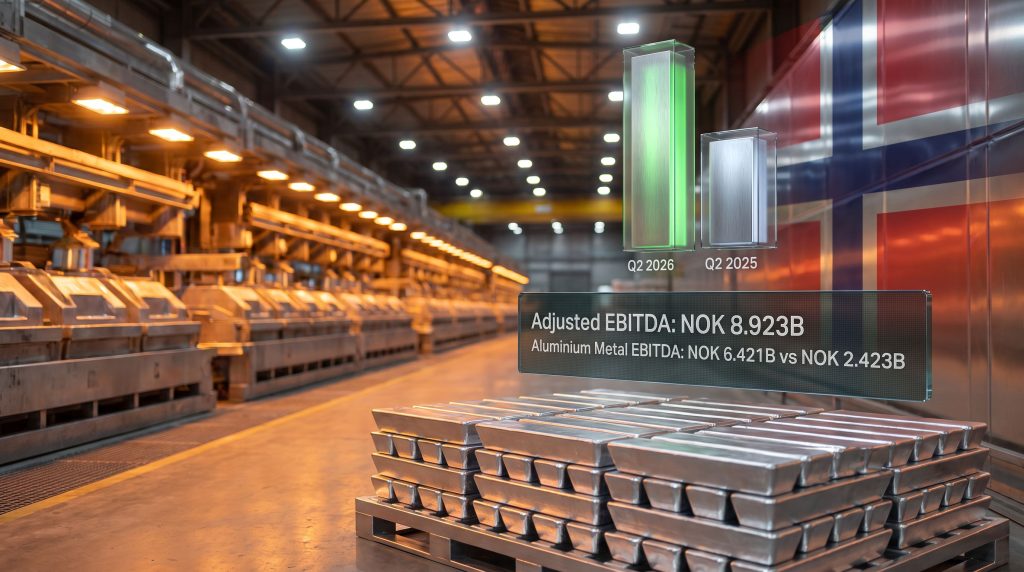
| Adjusted EBITDA | NOK 8.923 billion | NOK 7.790 billion |
| Adjusted EPS | NOK 2.2 | NOK 1.7 |
| Free cash flow | NOK 4.0 billion | Not stated in source |
| 12-month adjusted RoaCE | 10.9% | Not stated in source |
In US dollar terms as reported in the source coverage, adjusted EBITDA equated to approximately USD 927.39 million, versus USD 809.6 million in the prior-year period. Adjusted EPS was roughly USD 0.23 compared with USD 0.18 a year earlier.
These figures matter because they provide a practical benchmark for how an integrated aluminium producer responds when pricing improves but costs and segment performance remain uneven.
A strong group quarter did not come from every business line rising together. It came from major strength in Aluminium Metal and recycling offsetting weakness in alumina and energy.
How aluminium prices moved during Q2 2026
The London Metal Exchange three-month aluminium price was volatile through the quarter. It started around USD 3,532 per tonne and ended near USD 3,086 per tonne, after reaching an approximate intraperiod high close to USD 3,750 per tonne based on the outline reference.
The broad pattern looked like this:
- Prices began the quarter at an elevated level.
- Supply concern supported an early spike.
- Risk premium eased later in the quarter.
- Aluminium prices fell back as Middle East shipments resumed and smelter production recovered after the US-Iran ceasefire and the partial reopening of the Strait of Hormuz.
That matters for earnings analysis because producers do not simply book the closing spot price. Reported profitability tends to reflect an average realised price over shipments, contract structures, regional premiums, timing lags, and product mix.
| Aluminium pricing comparison | Q2 2025 | Q2 2026 |
|---|---|---|
| Quarter start LME price | USD 2,507/mt | USD 3,532/mt |
| Quarter end LME price | USD 2,598/mt | USD 3,086/mt |
| Approximate intraperiod peak | ~USD 2,650/mt | ~USD 3,750/mt |
| Realised aluminium price | ~USD 2,548/mt | Higher, with all-in price up 14% vs Q1 2026 |
The quarter therefore combined two conditions that often create strong producer results:
- A high absolute metal price environment
- Stronger value-added premiums on top of the base metal price
Furthermore, understanding the aluminium tariff impacts of recent trade policy shifts provides useful context for why regional pricing premiums have been elevated in certain markets.
Why realised all-in prices can beat headline LME moves
For non-specialist readers, one of the least understood parts of aluminium earnings is the difference between the exchange price and the producer's realised all-in selling price.
A realised all-in price can include:
- The LME reference price
- Regional physical delivery premiums
- Product fabrication or conversion premiums
- Mix effects from higher-value products such as wire rod, extrusion billet, and specialty casthouse output
- Contract timing differences
This helps explain why Hydro said realised all-in metal prices were up 14% quarter on quarter from Q1 2026, even though spot market pricing within Q2 itself softened from its early highs. For integrated producers, the earnings signal often comes less from the quarter-end price and more from the average captured selling environment across contracts and product categories.
Aluminium Metal was the main earnings engine
The clearest proof of price leverage was in the Aluminium Metal segment, where adjusted EBITDA rose to NOK 6.421 billion from NOK 2.423 billion a year earlier.
That is a year-on-year increase of nearly NOK 4.0 billion, making it the most important driver of the group result.
What drove the surge
Four major tailwinds shaped the segment outcome:
- Higher realised all-in aluminium prices, including stronger premiums
- Lower alumina input costs, which reduced pressure on smelting margins
- Ramp-up at Norwegian smelters after previously curtailed capacity restarted
- Record casthouse production in Norway, indicating strong conversion activity and product flow
What held back an even stronger result
Three factors partly offset the upside:
- Lower total sales volumes during the period
- Higher energy and carbon costs
- A weaker US dollar against the Norwegian krone, which diluted NOK translation of dollar-linked revenue
This is a useful reminder for investors: aluminium producers have operational leverage to prices, but they also carry substantial exposure to energy, emissions, and currency. Strong metal pricing can dominate the quarter, but not eliminate those risks. Indeed, aluminium power sourcing strategies adopted by major producers illustrate how central energy decisions have become to long-run competitiveness.
Recycling is becoming more than a side business
Hydro's recycling operations generated more than NOK 900 million in adjusted EBITDA, one of the strongest quarters for that business according to the source material.
That result is strategically important because recycling has a different earnings profile from primary aluminium. It is usually less exposed to direct power intensity and may benefit more from scrap spreads, regional premiums, and demand for lower-carbon material.
| Dimension | Primary aluminium | Recycled aluminium |
|---|---|---|
| LME price sensitivity | High | Moderate |
| Energy cost exposure | Very high | Lower |
| Carbon cost risk | High | Significantly lower |
| Margin predictability | Cyclical | More stable |
| Growth driver | Capacity and volume | Scrap availability and premiums |
The company linked the recycling improvement mainly to:
- Favourable market conditions
- Stronger value-added product premiums in North America
Geography matters here. North American aluminium markets often trade with distinct physical premiums and semi-fabricated product economics compared with Europe. For a recycler, that can create pockets of resilience even when primary markets become uneven.
From an industry structure perspective, this is one of the biggest signals in Hydro Q2 earnings aluminium prices analysis. Recycling is increasingly acting as a margin stabiliser rather than just a sustainability narrative.
The next major ASX story will hit our subscribers first
What the Slovalco restart says about Europe's smelter economics
A major development in the quarter was Hydro's plan to restart 75,000 tonnes of aluminium capacity at the Slovalco smelter in Slovakia during the second half of 2026.
The decision followed an agreement with the Slovak government covering long-term operating conditions, including indirect carbon cost compensation. That detail matters and should be described carefully. It indicates a defined framework relevant to operating economics, but it should not be overstated as broad project-specific political sponsorship beyond what has been reported.
Why this restart is strategically significant
European primary aluminium has been under structural strain due to:
- High electricity costs
- Carbon cost exposure
- Tighter competitiveness versus lower-cost regions
- Prior curtailments and idled capacity across the continent
Restarting even 75,000 tonnes is modest on a global scale, yet still meaningful in a tight regional supply context. It suggests that smelter restarts in Europe depend not just on metal prices, but on a workable combination of power visibility, policy design, and margin confidence. In addition, the European alumina strategy being pursued by other major players underlines how upstream supply security is equally critical to European smelter viability.
The key lesson is structural: in Europe, aluminium restarts usually require more than a cyclical rally in LME prices. They need an enduring operating framework that can absorb energy and carbon volatility.
Low-carbon aluminium is increasingly tied to grid investment
Hydro also signed a five-year agreement with Nexans to supply around 85,000 tonnes of low-carbon aluminium wire rod. The contract follows the expansion of wire rod capacity at Karmøy.
This matters because aluminium demand is not just being pulled by transport and packaging. Grid upgrades, power cables, and electricity infrastructure are becoming a stronger demand layer, especially where lower embedded emissions are valued. The growing low-carbon metals demand across infrastructure sectors is reshaping how producers position their product mix.
Low-carbon product strategies can strengthen margins in several ways:
- They can improve customer stickiness through multi-year offtake agreements
- They may support premium pricing in selected applications
- They reduce reliance on purely spot-driven commodity revenue
- They align with procurement preferences in infrastructure and electrification supply chains
This does not make the business immune to commodity cycles. However, it may help partially decouple certain product lines from pure LME volatility.
Power contracts are becoming a competitive moat
Hydro signed a 10-year power agreement with Eviny for 0.5 TWh annually from 2031 to 2040. After this deal, the company said it had secured around 85% of projected electricity requirements in Norway during the 2030s.
For aluminium producers, that is not a mere procurement update. It is a strategic advantage.
Why long-term power matters so much
Smelting economics are highly sensitive to electricity because aluminium production is one of the most power-intensive industrial processes. A long-duration renewable power portfolio can provide:
- Better cost visibility
- Reduced exposure to spot market volatility
- Stronger planning confidence for capacity utilisation
- Improved positioning for low-carbon metal offerings
Hydro also indicated that additional renewable power generation will still be needed to support future industrial growth in Europe. So while 85% coverage is substantial, it does not mean power risk has disappeared. It means a large part of future Norwegian exposure is better controlled than at many peers.
Which segments weakened and why
Not every division benefited from the quarter's setup.
Bauxite and Alumina
Adjusted EBITDA in Bauxite and Alumina fell to NOK 522 million from NOK 1.521 billion a year earlier.
The core reasons were:
- Lower alumina prices
- Currency movements
- This occurred despite improved sales volumes and better productivity at Alunorte versus a year earlier
This is a classic integrated-producer trade-off. Lower alumina prices can boost smelter margins because alumina is a key input cost, yet the upstream alumina business itself earns less.
Energy
The Energy segment reported adjusted EBITDA of NOK 499 million, down from NOK 1.069 billion in Q2 2025.
Two main pressures were identified:
- Lower hydropower production
- Unfavourable price area differences in Norwegian power markets
Reservoir data highlights the challenge. Norwegian hydropower reservoirs stood at 61.9% capacity at quarter-end, below the seasonal average of 67.9%. For investors, that is a reminder that even producers with strong renewable footprints still face hydrology risk and regional pricing dispersion.
Global demand context and what it could mean next
Hydro said global primary aluminium consumption increased slightly during the quarter, driven by 2.2% growth in China, while demand outside China remained weaker.
That split is important for any market outlook:
- China remains the dominant volume engine
- Ex-China weakness limits the breadth of the demand recovery
- Middle East shipment normalisation can ease supply concerns in the near term
- Integrated producers with stronger product mix can handle volatility better than single-exposure operators
A speculative but reasonable market view is that aluminium prices may remain more sensitive to supply disruptions and energy shocks than to broad-based demand acceleration in the short run. Consequently, a more bullish thesis would require stronger ex-China industrial demand or a renewed tightening in supply availability. A more cautious thesis would assume easing geopolitical risk and softer downstream orders cap further upside. For context on how the broader competitive landscape is evolving, reviewing the top aluminium producers globally helps frame where Hydro sits relative to its peers.
This article includes analytical interpretation and scenario-based commentary. It is not financial advice, and forward-looking views are inherently uncertain.
Frequently asked questions
What was Hydro's adjusted EBITDA in Q2 2026?
Hydro reported NOK 8.923 billion in adjusted EBITDA for Q2 2026.
How did aluminium prices change during Q2 2026?
The LME three-month aluminium price fell from USD 3,532 per tonne at the start of the quarter to USD 3,086 per tonne by quarter-end after earlier peaking near USD 3,750 per tonne.
Why did the Aluminium Metal segment improve so sharply?
The main drivers were higher realised all-in aluminium prices, lower alumina costs, restart-driven smelter ramp-up in Norway, and record casthouse production.
What is happening at Slovalco?
Hydro plans to restart 75,000 tonnes of capacity at Slovalco in Slovakia during the second half of 2026, following an agreement covering long-term operating conditions including indirect carbon cost compensation.
How much future Norwegian power has Hydro secured?
The company said it has secured around 85% of its projected electricity requirements in Norway during the 2030s.
Why did the Bauxite and Alumina segment decline?
Its earnings fell mainly because of lower alumina prices and currency effects, despite improved sales volumes.
Why is recycling gaining attention?
Because it delivered more than NOK 900 million in adjusted EBITDA and appears to offer a steadier earnings profile than primary aluminium alone. Furthermore, independent analysis of Norsk Hydro's market position suggests recycling is central to the company's long-term competitive advantage.
What Hydro's Q2 2026 results really tell us
Five broader conclusions stand out from the quarter:
- Price leverage remains powerful. Hydro Q2 earnings aluminium prices analysis shows how sharply metal earnings can respond when realised prices and premiums rise.
- Integration cuts both ways. Lower alumina prices helped smelting but hurt upstream alumina profitability.
- Recycling is becoming structurally important. It is no longer just an adjacent business line.
- Energy security is a strategic asset. Long-term renewable contracts increasingly shape cost leadership in Europe.
- European restarts require durable economics. Slovalco suggests that capacity recovery depends on more than a temporary commodity rally.
For investors and industry observers, the quarter is best read as a template for modern aluminium economics: commodity price exposure still dominates, but the winners are increasingly differentiated by recycling scale, premium product mix, and long-term power access. Quarterly reports from Hydro offer the most authoritative source for tracking how these strategic themes develop over time.
Want to Catch the Next Major ASX Mineral Discovery Before the Market Does?
Discovery Alert's proprietary Discovery IQ model scans ASX announcements in real time, instantly identifying high-potential mineral discoveries across more than 30 commodities and converting complex data into clear, actionable insights — so subscribers can act decisively ahead of the broader market. Explore Discovery Alert's discoveries page to see the historic returns major mineral discoveries have generated, and begin your 14-day free trial today to secure your market-leading edge.