July 28, 2026
The global steel industry stands at a technological crossroads where traditional carbon-intensive production methods face unprecedented challenges from emerging hydrogen-based alternatives. While conventional blast furnace technology has dominated steelmaking for over a century, rising carbon pricing mechanisms, tightening environmental regulations, and volatile fossil fuel costs are fundamentally reshaping the economic landscape for steel producers worldwide. This transformation extends beyond simple technology substitution, representing a complete reimagining of how iron ore transforms into finished steel products through revolutionary chemical processes that eliminate carbon dioxide emissions at their source through hydrogen-based green steel production.
Understanding the Hydrogen Steel Revolution
The emergence of hydrogen-based green steel production represents a paradigmatic shift from carbon-dependent metallurgical processes toward clean chemical reduction methods. This technological evolution centres on replacing carbon monoxide with hydrogen gas as the primary reducing agent in direct reduction iron (DRI) processes, fundamentally altering the chemistry of steelmaking while maintaining product quality standards.
European capacity dominance in hydrogen steel development reflects significant policy momentum rather than cost competitiveness. Approximately 80% of global hydrogen-based DRI-EAF capacity is projected to emerge from European producers by 2030, demonstrating the scale of projects currently under construction or in advanced investment decision phases. This concentration represents Europe's regulatory environment and capital deployment capacity rather than underlying economic advantages in hydrogen steel production.
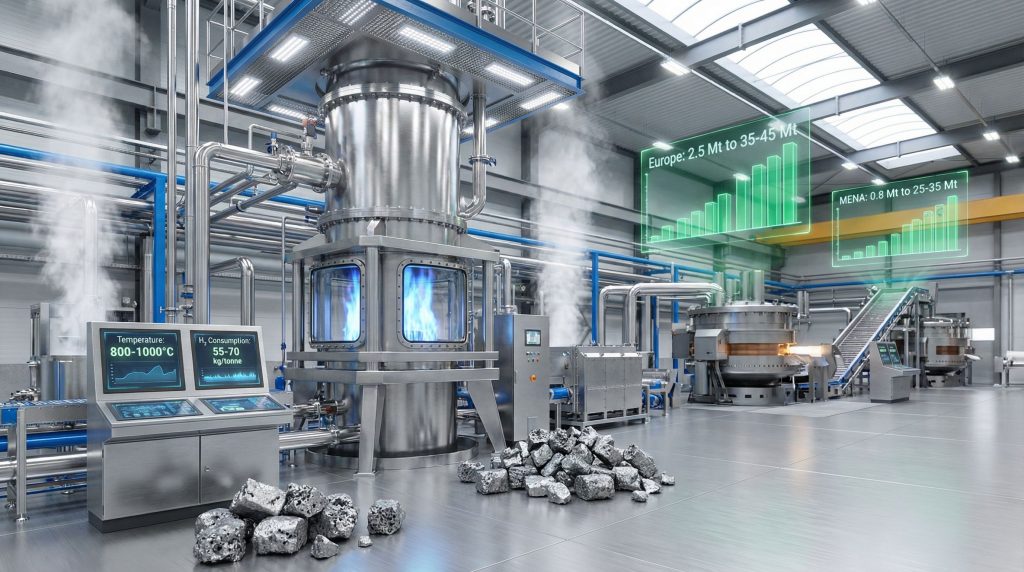
Current capacity baselines reveal the nascent stage of hydrogen steel deployment globally. Europe maintains approximately 2.5 million tonnes of hydrogen-based DRI-EAF capacity in 2025, with aggressive expansion targets reaching 15-20 million tonnes by 2030 and 35-45 million tonnes by 2035. These projections indicate capacity expansion rates of 500-800% over the decade, reflecting accelerating investment velocity driven by decarbonisation mining benefits and carbon pricing pressures.
Regional capacity development patterns demonstrate emerging competition from lower-cost production regions. The Middle East and North Africa (MENA) region shows developing capacity with 0.8 million tonnes in 2025, projected to reach 8-12 million tonnes by 2030 and 25-35 million tonnes by 2035. North American development lags with 0.3 million tonnes in 2025, expected to grow to 5-8 million tonnes by 2030 and 15-25 million tonnes by 2035.
The Science Behind Hydrogen Direct Reduction
Hydrogen direct reduction eliminates carbon dioxide formation through fundamental changes in reduction chemistry. Traditional blast furnace processes rely on carbon monoxide to strip oxygen from iron ore, producing CO₂ as an inevitable byproduct. Hydrogen-based systems substitute H₂ gas as the reducing agent, creating water vapour (H₂O) instead of carbon dioxide, fundamentally eliminating process emissions at the chemical level.
The reduction reaction follows the equation: Fe₂O₃ + 3H₂ → 2Fe + 3H₂O, where iron oxide transforms directly into metallic iron without carbon involvement. This chemical pathway produces sponge iron (DRI) with metallisation rates typically exceeding 90%, providing high-quality feedstock for electric arc furnace steelmaking processes.
Furthermore, this hydrogen for iron making approach demonstrates the potential to revolutionise traditional steelmaking processes through clean chemistry applications. Research institutions continue advancing understanding of optimal reaction conditions and process integration requirements.
How Green Hydrogen Transforms Iron Ore Processing
Green hydrogen integration requires coordinated renewable energy infrastructure and electrolysis systems to achieve carbon-neutral steel production. Electrolysis processes split water molecules into hydrogen and oxygen using renewable electricity, creating the hydrogen feedstock necessary for iron ore reduction. This integration necessitates substantial renewable energy capacity, often requiring dedicated wind or solar installations to power both electrolysis and downstream steel production processes.
The hydrogen supply chain involves production, storage, compression, and delivery systems that significantly impact overall process economics. Storage requirements depend on production scheduling flexibility, with compressed hydrogen tanks, underground caverns, or liquid hydrogen systems providing different cost-capacity trade-offs for industrial-scale operations.
Electric Arc Furnace Integration with DRI Technology
Electric arc furnaces provide the melting and refining stage for hydrogen-produced DRI, creating finished steel products through high-temperature electrical heating. EAF systems must accommodate DRI's different physical and chemical characteristics compared to scrap steel, requiring modifications to charging systems, power delivery, and slag chemistry management.
The DRI-EAF route enables greater flexibility in raw material sourcing compared to integrated blast furnace-basic oxygen furnace operations. Hot-briquetted iron (HBI) allows DRI transport over long distances, enabling geographic separation between iron ore reduction and steel melting operations based on comparative regional advantages in hydrogen costs, electricity prices, and market access.
When big ASX news breaks, our subscribers know first
How Does Hydrogen-Based DRI Technology Work?
Hydrogen-based direct reduction operates through controlled chemical reactions in specialised reactor vessels designed to maximise hydrogen-iron oxide contact while maintaining optimal temperature and pressure conditions. The process begins with iron ore pellets or lump ore entering shaft furnaces or fluidised bed reactors where preheated hydrogen gas reduces iron oxides to metallic iron through sustained chemical interaction.
The Chemical Process of Hydrogen Iron Reduction
The reduction process occurs through multiple sequential reactions as hydrogen progressively removes oxygen from iron ore. Initial reduction converts hematite (Fe₂O₃) to magnetite (Fe₃O₄), followed by further reduction to wustite (FeO), and finally to metallic iron (Fe). Each reduction stage requires specific temperature and hydrogen concentration conditions to achieve optimal reaction kinetics and minimise energy consumption.
Process efficiency depends on maintaining proper hydrogen-to-iron ratios throughout the reaction sequence. Excess hydrogen ensures complete reduction while minimising reverse oxidation reactions, though optimal hydrogen utilisation requires careful balance between reduction completeness and gas consumption efficiency.
Shaft Furnace vs. Fluidised Bed Reactor Systems
Shaft furnace systems provide continuous countercurrent operation where iron ore descends through the reactor while preheated hydrogen flows upward, maximising heat and mass transfer efficiency. These systems typically operate at 800-1000°C with residence times of 6-8 hours, providing thorough reduction but requiring larger capital investment and steady-state operation.
Fluidised bed reactors suspend iron ore particles in flowing hydrogen gas, creating turbulent mixing conditions that enhance reaction rates and heat transfer. Operating temperatures of 750-900°C with residence times of 2-4 hours enable more compact reactor designs and flexible operation, though achieving uniform reduction across all particles requires careful flow control and temperature management.
| Parameter | Shaft Furnace | Fluidised Bed | Optimal Range |
|---|---|---|---|
| Temperature | 800-1000°C | 750-900°C | Process dependent |
| H₂ Consumption | 55-70 kg/tonne | 60-75 kg/tonne | Varies by ore grade |
| Residence Time | 6-8 hours | 2-4 hours | Technology specific |
Temperature and Pressure Requirements for Optimal DRI Production
Temperature control represents the most critical parameter in hydrogen reduction processes, directly affecting reaction kinetics, energy consumption, and final product quality. Insufficient temperature results in incomplete reduction and poor metallisation rates, while excessive temperature increases energy costs and potential equipment degradation without proportional quality improvements.
Pressure management influences hydrogen flow patterns, reaction zone stability, and gas utilisation efficiency throughout the reduction process. Higher pressures can accelerate reaction rates but require more robust equipment design and increased compression energy, creating trade-offs between process intensity and operating costs.
Quality Control Measures for Sponge Iron Output
Metallisation degree measurement determines the completeness of iron ore reduction, typically targeting levels above 90% for optimal EAF performance. Carbon content monitoring ensures minimal carburisation during the reduction process, maintaining the low-carbon advantage of hydrogen-based production routes.
Gangue mineral management involves controlling silica, alumina, and other non-metallic components that affect downstream steelmaking processes. Proper temperature profiles and residence time optimisation minimise gangue melting and ensure clean separation between metallic iron and waste minerals.
What Are the Key Advantages of Hydrogen Steel Production?
Hydrogen-based green steel production delivers substantial environmental benefits while maintaining steel quality standards and enabling flexible raw material utilisation. The primary advantage lies in eliminating carbon dioxide emissions at the source through chemical process redesign rather than relying on post-production carbon capture technologies.
Carbon Emissions Reduction Potential
Direct emissions elimination occurs through the substitution of hydrogen for carbon-based reducing agents, removing CO₂ formation from the fundamental chemistry of iron ore reduction. Lifecycle emissions approach zero when renewable energy powers both electrolysis for hydrogen production and electric arc furnace operations for steel melting.
Indirect emissions benefits extend to reduced mining pressure on coking coal resources and elimination of coke oven operations with their associated environmental impacts. This shift reduces the steel industry's dependence on metallurgical coal supply chains while supporting renewable energy sector growth through increased electricity demand.
Flexibility in Raw Material Processing
Hydrogen reduction systems demonstrate superior tolerance for varying iron ore grades and compositions compared to blast furnace operations. Lower-grade ores containing higher gangue mineral content can be processed effectively, expanding the range of economically viable iron ore resources and potentially reducing mining waste generation.
Alternative iron-bearing feedstocks including iron ore fines, concentrates, and even certain waste materials become viable inputs for hydrogen reduction processes. This flexibility supports circular economy principles by enabling steel production from previously unusable iron-bearing materials through sustainability transformation initiatives.
Quality Improvements in Final Steel Products
Reduced impurity levels in hydrogen-produced DRI result from the absence of carbon-based reducing agents that introduce sulfur, phosphorus, and other tramp elements into the iron. Clean reduction chemistry produces higher-purity iron suitable for premium steel grades requiring stringent chemical composition control.
Consistent chemical composition emerges from the controlled nature of hydrogen reduction compared to the variable chemistry of blast furnace operations. This consistency enables more precise steel chemistry control and reduced alloy addition requirements in downstream steelmaking processes.
Integration with Renewable Energy Systems
Renewable energy integration creates synergies between variable electricity generation and industrial demand patterns through flexible hydrogen production scheduling. Electrolysis systems can operate during periods of excess renewable generation, storing energy in the form of hydrogen for later use in steel production processes.
Grid stability benefits arise from industrial electrolysis systems providing demand response capabilities that help balance renewable energy intermittency. Large-scale hydrogen production facilities can modulate electricity consumption based on grid conditions, supporting renewable energy mining transformation while maintaining steel production flexibility.
Which Technologies Enable Green Hydrogen Steel Production?
The technological foundation for green hydrogen steel production rests on coordinated systems spanning renewable energy generation, electrolysis for hydrogen production, specialised reduction reactors, and modified electric arc furnaces designed for DRI processing. Each component requires optimisation for industrial-scale operations while maintaining cost competitiveness with conventional steel production routes.
Electrolysis Systems for Green Hydrogen Generation
Alkaline electrolysis represents the most mature technology for large-scale hydrogen production, utilising potassium hydroxide electrolyte solutions to split water molecules through electrical current application. These systems demonstrate proven reliability and lower capital costs but require careful water purification and electrolyte management to maintain efficiency and equipment longevity.
Proton exchange membrane (PEM) electrolysis offers higher efficiency and faster response times to variable renewable energy inputs, making it suitable for integration with intermittent wind and solar generation. Higher capital costs and platinum catalyst requirements currently limit widespread deployment, though technological improvements continue reducing cost barriers.
Solid oxide electrolysis (SOEC) technology operates at elevated temperatures using waste heat from steel production processes, potentially achieving higher electrical efficiencies than alternative electrolysis methods. Commercial deployment remains limited due to materials challenges and system complexity, though development programmes target industrial-scale applications.
Advanced EAF Designs for DRI Processing
Electric arc furnace modifications for DRI processing focus on accommodating the different physical and chemical characteristics of sponge iron compared to traditional scrap steel feedstocks. Charging system redesigns enable efficient handling of DRI particles or hot-briquetted iron while minimising oxidation and heat losses during material transfer.
Power delivery systems require adjustment for DRI's different electrical conductivity and melting characteristics. Higher electrical power requirements compared to scrap-based operations necessitate upgraded transformers, electrode systems, and cooling infrastructure to maintain productivity levels.
Hot Briquetting Systems for DRI Transport
Hot briquetting presses compact warm DRI into dense briquettes (HBI) that resist re-oxidation during storage and transport, enabling geographic separation between reduction and melting operations. Compression forces exceeding 15 tonnes per square centimetre create mechanically stable briquettes suitable for international shipping.
Transport advantages of HBI include reduced bulk density, improved handling characteristics, and resistance to oxidation during extended storage periods. These properties enable economic transport over long distances, allowing optimal location of reduction facilities in regions with low-cost renewable energy and hydrogen production.
Process Integration and Automation Technologies
Advanced process control systems coordinate hydrogen flow rates, temperature profiles, and residence time optimisation across reduction reactor operations. Real-time monitoring of gas composition, temperature distribution, and product quality enables automated adjustments that maintain consistent DRI quality while minimising hydrogen consumption.
Safety automation systems for hydrogen handling include leak detection, flame monitoring, and emergency shutdown procedures specifically designed for industrial hydrogen applications. These systems integrate with existing steel plant safety infrastructure while addressing the unique hazards associated with hydrogen storage, transfer, and utilisation.
What Are the Current Economic Challenges?
Economic viability remains the fundamental challenge facing widespread hydrogen steel adoption, with cost structures significantly different from traditional steel production routes. Despite policy support and environmental benefits, hydrogen-based systems face substantial cost disadvantages primarily driven by energy expenses and hydrogen production costs.
Green Hydrogen Cost Structure Analysis
Hydrogen costs represent the dominant factor determining international competitiveness for hydrogen-based steel production. MENA average producers achieve hydrogen input costs approximately half that of European facilities, with this differential alone accounting for 82% of the total 17% cost advantage MENA possesses over European hydrogen steel producers in 2030 projections.
Electrolysis electricity consumption drives hydrogen production economics, typically requiring 50-70 kWh per kilogram of hydrogen depending on system efficiency and operating conditions. Industrial electricity rates exceeding €100 per MWh in Europe create hydrogen production costs two to four times higher than regions with abundant renewable energy resources and lower electricity prices.
Regional hydrogen cost variations reflect differences in renewable energy availability, electricity pricing, and energy infrastructure development. Countries with excellent solar or wind resources combined with supportive policy frameworks achieve hydrogen production costs below $2-3 per kilogram, while regions dependent on expensive electricity face costs exceeding $5-7 per kilogram.
Capital Investment Requirements for Plant Conversion
Existing steel plant conversion to hydrogen-based production requires substantial capital investment in new reduction reactors, hydrogen supply infrastructure, and electric arc furnace modifications. Complete conversion costs typically exceed 70-80% of new plant construction costs while maintaining existing site constraints and integration challenges.
Greenfield hydrogen steel facilities enable optimised plant layouts and equipment selection but require longer development timelines and higher total investment compared to brownfield conversions. New plant development costs range from $800-1200 per tonne of annual capacity depending on location, technology selection, and infrastructure requirements.
Financing challenges emerge from technology risk perceptions, uncertain long-term hydrogen costs, and competitive pressures from conventional steel production. Limited operating history for commercial-scale hydrogen steel plants increases perceived investment risks and potential financing costs compared to proven technologies.
Operating Cost Comparisons with Traditional Methods
Hydrogen-based green steel production demonstrates fundamentally different cost structures compared to blast furnace-basic oxygen furnace operations, with higher energy costs partially offset by reduced raw material requirements and operational flexibility benefits.
| Cost Component | Traditional BF-BOF | H₂-DRI-EAF | Cost Differential |
|---|---|---|---|
| Raw Materials | €350-400/tonne | €280-320/tonne | -15% to -20% |
| Energy Costs | €120-150/tonne | €200-280/tonne | +65% to +85% |
| Labour & Overhead | €80-100/tonne | €85-110/tonne | +5% to +10% |
Raw material cost advantages in hydrogen steel production emerge from eliminating coking coal requirements and accepting lower-grade iron ore feedstocks. These savings partially offset higher electricity and hydrogen costs, though the net effect varies significantly based on regional input prices and availability.
Regional Cost Variations and Competitiveness Factors
European hydrogen steel production faces structural cost disadvantages across multiple input categories while benefiting from carbon pricing advantages through the EU Emissions Trading System. Industrial electricity rates frequently exceeding €100 per MWh represent two to four times higher costs than equivalent rates in the United States and China, driven primarily by elevated natural gas prices and energy import dependency.
MENA hydrogen-based DRI-EAF production demonstrates 17% lower costs than European counterparts through multiple advantage sources including lower labour costs (approximately 30%), cheaper power (7%), and substantially lower hydrogen costs representing the dominant factor. These structural advantages persist despite transport costs and other offsetting factors that partially reduce MENA's competitive position.
North American cost competitiveness benefits from lower electricity prices and domestic renewable energy resources, though labour costs exceed MENA levels while remaining below European standards. Access to low-cost natural gas provides alternative production routes and competitive positioning against both European and MENA hydrogen steel producers.
How Do Different Regions Compare in Hydrogen Steel Competitiveness?
Global competitiveness in hydrogen steel production reflects fundamental differences in energy costs, renewable resource availability, labour expenses, and policy support frameworks. Regional advantages cluster around specific combinations of low-cost renewable electricity, favourable geographic conditions, and supportive regulatory environments that drive energy transition insights for industrial transformation.
European Market Dynamics and Policy Support
European leadership in announced hydrogen steel capacity reflects aggressive decarbonisation policies rather than underlying cost competitiveness. The EU Emissions Trading System creates carbon pricing advantages for low-emission steel producers while regulatory mandates drive investment decisions despite unfavourable production economics.
Large capital-intensive projects in Scandinavia including Stegra, Hybrit, and Blastr green steel initiatives benefit from access to low-carbon electricity infrastructure and comprehensive government support mechanisms. These projects demonstrate regulatory momentum while acknowledging that commercial viability remains challenging without continued policy support.
Policy recognition of structural disadvantages appears in industry commentary that decarbonisation shifts in Europe remain quite challenging for steelmakers despite state funding availability. This framing suggests that European policymakers understand fundamental cost disadvantages while pursuing strategic objectives beyond pure economic optimisation.
MENA Region Advantages in Low-Cost Hydrogen
Middle Eastern and North African producers leverage exceptional solar and wind resources to achieve hydrogen production costs substantially below global averages. Access to low-cost renewable energy enables electrolysis operations at scale while maintaining competitive electricity pricing for direct steel production processes.
Natural gas-based DRI production in MENA maintains competitive advantages independent of hydrogen routes, with gas-DRI-EAF production costs expected to be 31% lower than European equivalents by 2030. Lower MENA raw material costs contribute 43% toward this differential, with gas and power costs adding another 25%, positioning the region for multiple competitive steel production pathways.
Geographic advantages include proximity to major steel consumption markets in Asia and Africa while maintaining cost competitiveness for exports to European markets despite transport costs and potential trade restrictions. Strategic location enables market diversification and reduced dependence on any single regional demand centre.
North American Development Strategies
North American hydrogen steel development benefits from abundant renewable energy resources and lower electricity costs compared to Europe, though lacking the exceptional resource advantages of MENA regions. Domestic market size and trade protection potential provide development incentives while technology partnerships with European equipment providers accelerate deployment.
Canada demonstrates particular advantages through hydroelectric capacity and supportive federal policies for clean technology deployment. Provincial-level incentives and carbon pricing mechanisms create favourable development conditions while maintaining access to United States markets through integrated North American trade arrangements.
United States market dynamics balance domestic resource advantages against higher labour costs and complex regulatory environments across multiple jurisdictions. Federal policies supporting clean technology deployment compete with existing domestic steel industry protection measures in shaping hydrogen steel investment decisions.
Asian Market Adoption Patterns
Asian hydrogen steel development reflects diverse national strategies ranging from aggressive decarbonisation commitments to cautious technology assessment approaches. Japan and South Korea pursue technology leadership through demonstration projects and international partnerships while managing domestic energy cost constraints.
China's approach emphasises domestic technology development and pilot project deployment while maintaining cost competitiveness priorities. Limited domestic renewable energy relative to industrial demand creates constraints on large-scale hydrogen steel deployment without significant infrastructure investment and energy supply diversification.
The next major ASX story will hit our subscribers first
What Are the Technical Implementation Challenges?
Technical implementation of hydrogen-based steel production requires coordinated solutions across hydrogen supply chains, plant design modifications, metallurgical process control, and safety management systems. Each challenge area presents specific engineering requirements that significantly impact deployment timelines and investment costs.
Hydrogen Supply Chain Infrastructure Requirements
Industrial-scale hydrogen supply necessitates dedicated infrastructure for production, compression, storage, and distribution that often exceeds existing facility capabilities. Hydrogen's low volumetric energy density requires high-pressure storage systems or cryogenic facilities that represent substantial capital investments and operational complexity.
Pipeline distribution systems for hydrogen require specialised materials and design considerations due to hydrogen embrittlement risks and unique safety requirements. Retrofitting existing natural gas infrastructure presents technical challenges while new construction involves significant permitting and regulatory approval processes.
Critical implementation steps for hydrogen infrastructure development include:
- Conduct feasibility studies for existing plant conversion potential and site-specific constraints
- Secure renewable energy supply agreements for electrolysis operations with long-term price stability
- Design hydrogen storage and distribution infrastructure meeting safety codes and operational requirements
- Modify or replace DRI and EAF equipment for hydrogen compatibility and optimal performance
- Implement advanced process control systems for integrated hydrogen and steel production operations
- Train operational staff on hydrogen safety protocols and emergency response procedures
- Establish quality assurance procedures for DRI production and steel chemistry control
Plant Design Modifications for Existing Facilities
Existing blast furnace sites require extensive modifications to accommodate hydrogen-based DRI systems, often necessitating complete replacement of reduction equipment while utilising existing infrastructure where possible. Space constraints, utilities capacity, and environmental permitting create site-specific challenges that significantly impact conversion feasibility and costs.
Integration challenges include coordinating hydrogen delivery systems with existing material handling, waste heat recovery, and environmental control systems. Modifications must maintain production continuity during transition periods while ensuring worker safety and environmental compliance throughout conversion processes in line with mining industry evolution requirements.
Quality Control and Metallurgical Considerations
Metallurgical control systems for hydrogen-based DRI require different approaches compared to blast furnace operations, with emphasis on reduction completeness, carbon content management, and gangue mineral behaviour. Real-time monitoring of metallisation degree, residual oxygen content, and physical properties enables process optimisation and consistent product quality.
Steel chemistry control in EAF operations using DRI feedstock requires adjusted procedures for deoxidation, desulfurisation, and alloy addition practices. The clean chemistry of hydrogen-produced DRI enables production of high-quality steel grades while requiring modified melting and refining procedures compared to scrap-based operations.
Safety Systems for Hydrogen Handling
Hydrogen safety management encompasses leak detection systems, ventilation design, ignition source control, and emergency response procedures specifically developed for industrial hydrogen applications. Hydrogen's wide flammability range and low ignition energy require comprehensive safety approaches that exceed conventional industrial gas safety protocols.
Training programmes for operational personnel must address hydrogen-specific hazards including invisible flame characteristics, rapid leak dispersion, and embrittlement risks to equipment materials. Integration with existing steel plant safety systems requires careful coordination to maintain overall facility safety performance while managing new hydrogen-related risks.
Which Companies Are Leading Hydrogen Steel Development?
Global hydrogen steel development involves diverse participants ranging from established integrated steel producers to specialised technology providers and emerging clean steel companies. Leadership positions reflect different strategic approaches including technology development, demonstration project operation, and commercial-scale deployment.
European Pioneer Projects and Partnerships
Scandinavian initiatives represent the most advanced commercial-scale hydrogen steel projects globally, with Stegra, Hybrit, and Blastr green steel projects demonstrating different approaches to hydrogen-based steel production. These projects benefit from favourable electricity costs, government support, and access to high-quality iron ore resources while addressing technical and commercial challenges at industrial scale.
Strategic partnerships between steel producers, technology providers, and energy companies characterise European development approaches. Collaboration models enable risk sharing while combining expertise across different technology domains required for successful hydrogen steel implementation.
Technology Providers and Equipment Manufacturers
Direct reduction technology providers including Midrex Technologies and Energiron develop hydrogen-compatible reactor systems based on existing natural gas DRI experience. Equipment modifications focus on hydrogen handling capabilities, reaction optimisation, and integration with renewable energy-powered operations.
Electric arc furnace manufacturers adapt EAF designs for DRI processing while electrolysis equipment providers develop industrial-scale systems optimised for steel industry applications. Technology integration across multiple suppliers creates coordination challenges while enabling specialised optimisation in each process step.
Integrated Steel Producers' Transition Strategies
Major steel producers pursue different transition strategies reflecting varying market positions, financial capabilities, and geographic constraints. Some focus on brownfield conversions at existing sites while others invest in greenfield facilities designed specifically for hydrogen-based production.
Investment timing varies significantly among producers based on carbon pricing exposure, market positioning requirements, and access to low-cost hydrogen supplies. Early movers seek competitive advantages through technology learning and market positioning while later adopters await cost reduction and technology maturation.
Startup Innovations in Green Steel Technology
Emerging companies focus on novel approaches to hydrogen steel production including alternative reduction technologies, process optimisation, and integration with renewable energy systems. Startup innovations often target specific technical challenges or niche market applications where incumbents face constraints.
Venture capital and government funding support startup development while strategic partnerships with established industry participants provide commercialisation pathways. Innovation areas include advanced materials for hydrogen applications, process control optimisation, and circular economy integration.
What Does the Future Hold for Hydrogen Steel Production?
The trajectory of hydrogen steel development depends on resolving fundamental economic challenges while scaling technology deployment across multiple geographic regions. Future scenarios range from gradual adoption in premium market segments to widespread displacement of conventional steel production methods based on technology cost reduction and policy support evolution.
Production Capacity Projections Through 2035
Global capacity expansion reflects concentrated development in regions with favourable policy environments and resource availability, though geographic distribution may shift based on economic competitiveness evolution over the projection period.
| Region | 2025 Capacity | 2030 Target | 2035 Projection |
|---|---|---|---|
| Europe | 2.5 Mt | 15-20 Mt | 35-45 Mt |
| MENA | 0.8 Mt | 8-12 Mt | 25-35 Mt |
| North America | 0.3 Mt | 5-8 Mt | 15-25 Mt |
European capacity leadership reflects current project momentum and policy support rather than long-term competitive positioning. MENA region growth acceleration toward 2035 suggests potential market share shifts based on underlying cost advantages and technology maturation.
Technology Improvements and Cost Reduction Pathways
Electrolysis cost reductions through scale deployment, technology advancement, and manufacturing learning curves represent the primary pathway for hydrogen steel cost competitiveness. Target hydrogen production costs below $2-3 per kilogram enable competitive positioning against conventional steel production in many market scenarios.
Process efficiency improvements in hydrogen reduction systems focus on reaction optimisation, heat integration, and hydrogen utilisation efficiency. Combined improvements across the full production chain from renewable electricity to finished steel products determine overall competitiveness against established technologies.
Furthermore, green steel production research continues advancing understanding of optimised integration pathways and cost reduction opportunities through technological innovation.
Market Adoption Scenarios and Demand Drivers
Premium market segments including automotive, aerospace, and construction applications demonstrate willingness to pay price premiums for verified low-emission steel products. Customer sustainability commitments create demand pull that supports early market development despite higher production costs.
Carbon pricing mechanism expansion through systems like CBAM creates cost advantages for low-emission steel while imposing penalties on high-emission imports. Policy-driven market creation supports hydrogen steel deployment while fundamental cost reduction determines long-term market penetration.
Integration with Circular Economy Principles
Hydrogen-based green steel production enables processing of alternative iron-bearing feedstocks including waste materials and lower-grade ores that expand resource utilisation efficiency. Flexibility in feedstock acceptance supports circular economy objectives while potentially reducing mining pressure on high-grade iron ore deposits.
End-of-life steel recycling integration with hydrogen-based primary production creates hybrid systems that optimise resource utilisation while maintaining production flexibility. Combined primary and secondary steel production approaches may offer optimal environmental and economic performance.
How Will Hydrogen Steel Impact Global Supply Chains?
The emergence of hydrogen-based steel production fundamentally alters global trade patterns, supply chain logistics, and market dynamics across the international steel industry. These changes extend beyond production technology to encompass raw material flows, product differentiation, and regional competitive positioning.
Trade Flow Implications for DRI and HBI
Hot-briquetted iron exports from low-cost hydrogen production regions enable geographic separation between iron ore reduction and steel melting operations. MENA regions with exceptional renewable energy resources can export HBI to steel producers in Europe, Asia, or other high-demand markets while capturing value from their resource advantages.
Traditional iron ore trade patterns face disruption as hydrogen-based DRI production potentially occurs closer to iron ore sources rather than steel consumption centres. This shift may reduce seaborne iron ore trade while increasing semi-finished steel product flows between regions with different competitive advantages.
The emergence of hydrogen-based steel production will fundamentally reshape global trade patterns, with low-cost hydrogen regions becoming major exporters of semi-finished steel products to high-demand markets seeking low-emission alternatives.
Carbon Border Adjustment Mechanism Effects
CBAM implementation significantly alters competitive dynamics by imposing carbon costs on high-emission steel imports while providing partial protection for European producers despite their cost disadvantages. The mechanism reduces but does not eliminate cost gaps, with MENA natural gas-based production maintaining 24% cost advantages after CBAM application compared to 35% advantages without CBAM.
Low-emission hydrogen steel faces smaller but notable CBAM penalties, creating graduated competitive advantages based on emission intensity levels. This framework rewards continuous emission reduction while maintaining market access for efficient producers across different technology routes.
Supply Security Considerations for Steel Buyers
Diversified supply sources become increasingly important as hydrogen steel deployment creates new regional production centres with different risk profiles compared to traditional steel supply chains. Geographic concentration of hydrogen production capacity in specific regions may create new supply security concerns requiring strategic planning by steel-intensive industries.
Technology risk management involves balancing early adoption advantages against potential technology obsolescence or performance shortfalls. Steel buyers must evaluate supplier technology maturity, financial stability, and long-term viability when establishing supply relationships with hydrogen steel producers.
Premium Pricing Structures for Green Steel Products
Green steel premium markets emerge through customer sustainability commitments and regulatory requirements that create value for verified low-emission steel products. Premium levels vary based on emission reduction extent, certification standards, and market supply-demand balance across different geographic regions and steel grades.
Price differentiation mechanisms require robust verification and tracking systems that establish credible emission reduction claims throughout the supply chain. Blockchain technology, third-party certification, and integrated monitoring systems enable premium capture while preventing greenwashing concerns.
Frequently Asked Questions About Hydrogen Steel Production
How Much Green Hydrogen Is Required Per Tonne of Steel?
Hydrogen consumption for direct reduction typically ranges from 55-70 kilograms per tonne in shaft furnace systems and 60-75 kilograms per tonne in fluidised bed reactors, though actual consumption varies based on iron ore characteristics, metallisation targets, and process efficiency optimisation. These figures represent the hydrogen required specifically for the reduction process and exclude hydrogen needed for heating, utilities, and other auxiliary processes.
Total green electricity requirements for hydrogen steel production include both electrolysis for hydrogen generation and electric arc furnace operation for steel melting. Combined electricity consumption often exceeds 3,000-4,000 kWh per tonne of finished steel, representing a significant increase compared to conventional steel production methods.
Can Existing Steel Plants Be Converted to Hydrogen Technology?
Blast furnace site conversions require extensive modifications including complete replacement of reduction equipment while potentially utilising existing infrastructure for material handling, utilities, and finishing operations. Conversion feasibility depends on site layout, available space, utility capacity, and environmental permitting constraints.
Conversion costs typically exceed 70-80% of greenfield construction costs while maintaining operational constraints from existing site configurations. However, conversions benefit from shorter development timelines, existing workforce capabilities, and established market relationships compared to entirely new facilities.
What Are the Environmental Benefits Beyond Carbon Reduction?
Water consumption patterns differ significantly between hydrogen and conventional steel production, with hydrogen systems potentially reducing overall water requirements through elimination of coke quenching and modified cooling systems. However, electrolysis operations require substantial water inputs that must be balanced against water savings in other process areas.
Air quality improvements include elimination of particulate emissions from coke ovens and sintering operations while reducing sulfur dioxide and nitrogen oxide emissions associated with coal combustion. Local air quality benefits may provide additional regulatory and community acceptance advantages for hydrogen steel facilities.
How Does Hydrogen Steel Quality Compare to Traditional Steel?
Hydrogen-produced steel typically demonstrates superior cleanliness due to reduced impurity levels from elimination of coal-based reducing agents. Lower sulfur, phosphorus, and tramp element concentrations enable production of high-quality steel grades suitable for demanding applications in automotive, aerospace, and other precision industries.
Mechanical properties of hydrogen steel match or exceed conventional steel standards when produced under optimal conditions, with potential advantages in fatigue resistance, corrosion performance, and consistency. Quality advantages may justify premium pricing independent of environmental benefits, creating multiple value propositions for hydrogen steel products.
Disclaimer: This analysis contains forward-looking projections and cost estimates that involve inherent uncertainties and assumptions. Actual technology performance, cost development, and market adoption may differ significantly from projections presented. Investment decisions should consider comprehensive due diligence including technical, commercial, and regulatory risk assessment.
Ready to Invest in the Next Revolutionary Steel Technology?
The hydrogen steel transformation represents one of the most significant industrial shifts of our generation, creating unprecedented opportunities for investors who can identify companies positioned at the forefront of this technological revolution. Discovery Alert's proprietary Discovery IQ model delivers instant alerts on significant ASX mineral discoveries, helping subscribers identify actionable opportunities in companies developing critical minerals and technologies essential for hydrogen-based green steel production. Begin your 14-day free trial today to position yourself ahead of this transformative market shift.