July 15, 2026
The Industrial Logic Behind Synthetic Graphene's Rise in North America
Advanced materials manufacturing rarely announces its own turning points. The shift from laboratory curiosity to industrial commodity typically unfolds across years of incremental scale-up, regulatory navigation, and supply chain construction before any single facility becomes a meaningful data point. Graphene's trajectory in North America fits this pattern almost precisely, and the decisions being made right now about where and how to produce it at scale will shape the domestic supply landscape for decades.
What separates the current moment from earlier waves of graphene optimism is the convergence of two forces: industrial buyers who have moved past proof-of-concept testing and now require consistent, high-purity material in commercially meaningful volumes, and the parallel recognition that Asia-concentrated supply chains for advanced nanomaterials carry meaningful procurement risk for sectors where supply continuity is non-negotiable. The broader battery raw materials market is increasingly feeling the pressure of these dynamics.
The HydroGraph Texas graphene site being developed in Bellville represents one of the most structurally detailed responses to both of these pressures that has emerged from a North American producer.
When big ASX news breaks, our subscribers know first
Why Graphene Purity Is a Manufacturing Problem, Not Just a Chemistry Problem
The Fundamental Tension in Graphene Production
Most commercially available graphene is derived from mined graphite, processed through methods such as liquid-phase exfoliation or chemical reduction of graphite oxide (commonly known as the Hummers method). These approaches are scalable and relatively cost-effective, but they introduce a persistent challenge: achieving batch-to-batch consistency at purity levels above 95% becomes increasingly difficult as output volumes rise.
This is not a minor technical footnote. Industrial customers in composites manufacturing, battery materials development, and advanced coatings applications are discovering that graphene's performance in their systems is highly sensitive to contaminant levels, oxygen content, and structural defect density. A material that performs well at laboratory scale can behave unpredictably when integrated into a production line if the input graphene varies between batches.
Synthetically produced graphene, manufactured from a gaseous carbon precursor rather than mined graphite, sidesteps this problem by design. The feedstock is chemically uniform, the reaction environment is controlled, and the output does not carry the mineralogical variability inherent to natural graphite sources. Furthermore, growing concerns around graphite supply shortage are pushing industrial buyers to explore synthetic alternatives more seriously.
What Makes Detonation Synthesis Technically Distinctive
HydroGraph's production method uses acetylene gas as its carbon source, processing it through a controlled detonation (explosion synthesis) reaction to produce graphene nanomaterials. This approach differs fundamentally from the two most widely discussed graphene production routes:
- Chemical vapour deposition (CVD): Produces high-quality graphene films on substrate surfaces, primarily for electronics applications. It is not suited to bulk powder production and requires significant energy input at high temperatures.
- Liquid-phase exfoliation: Mechanically separates graphene layers from graphite in a liquid medium. It is scalable but yields materials with variable layer counts, lateral dimensions, and defect densities.
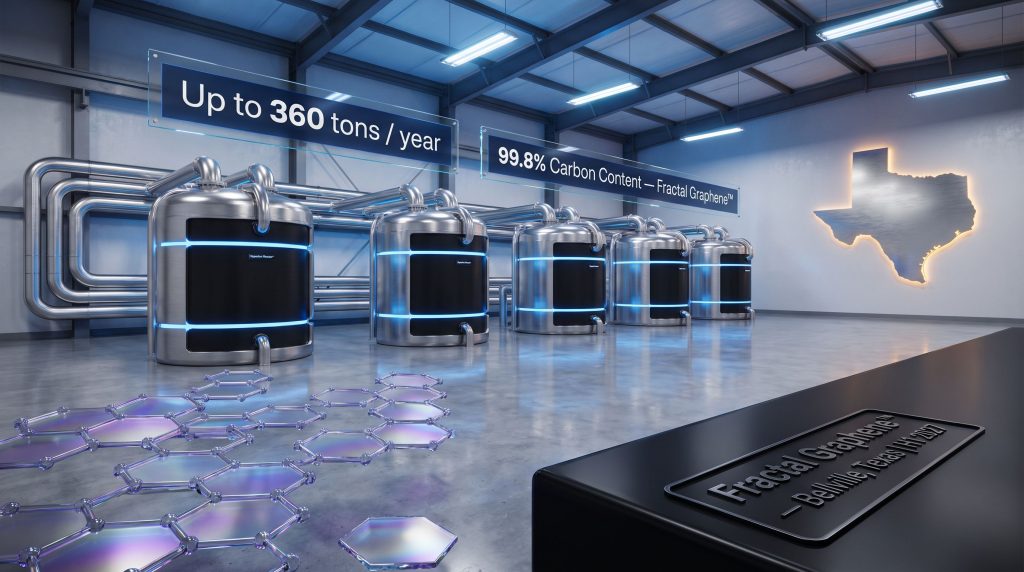
Detonation synthesis occupies a different position in the production landscape. It generates graphene in bulk powder form, operates at comparatively low energy intensity, and because the feedstock is a pure gas rather than a mineral, the output purity profile is far more controllable. HydroGraph characterises its resulting material, branded as Fractal Graphene, as reaching approximately 99.8% carbon content, with a fractal morphology that the company argues enhances dispersibility and surface interaction in composite applications.
| Production Method | Feedstock | Purity Level | Scalability | Energy Intensity |
|---|---|---|---|---|
| Detonation Synthesis (HydroGraph) | Acetylene gas | ~99.8% carbon | Modular, scalable | Low |
| Chemical Vapour Deposition (CVD) | Methane/hydrogen | Very high | Limited | High |
| Liquid-Phase Exfoliation | Mined graphite | Variable | Moderate | Moderate |
| Hummers Method (Oxide Reduction) | Mined graphite | Moderate | High | Moderate-High |
The fractal morphology of the material is a detail worth understanding beyond the marketing terminology. Fractal structures have a higher effective surface area per unit mass than geometrically regular particles of equivalent size, which matters considerably in applications where interfacial contact between graphene and a host material — a polymer matrix, an electrolyte, or a coating resin — drives performance. Greater surface area per gram translates to more interaction sites, which can improve conductivity, mechanical reinforcement, or barrier properties depending on the application.
The Bellville Site: Why Location and Infrastructure Are Inseparable
Acetylene Supply as a Structural Moat
The selection of Bellville, Texas as the location for HydroGraph's first large-scale U.S. manufacturing facility is not primarily a real estate decision. It is a feedstock decision. The facility is being co-located directly alongside the production, storage, transportation, and distribution infrastructure of Western International Gas and Cylinders, described as the largest wholesale acetylene supplier in the U.S. market.
Under the terms of the agreement executed in July 2026, Western International will deliver acetylene to HydroGraph through a dedicated pipeline under a 10-year purchase agreement, with renewal options extending beyond that initial term. The pipeline delivery model removes the logistical layer that most advanced materials manufacturers must manage: procurement scheduling, cylinder management, transport risk, and the working capital tied up in feedstock inventory buffers.
For graphene producers relying on acetylene, consistent and uninterrupted gas supply is not a convenience, it is a production prerequisite. Pipeline delivery at industrial scale essentially converts a variable procurement input into a utility-style resource, fundamentally changing the operational risk profile of the manufacturing operation.
This structural arrangement is uncommon in the advanced materials sector, where most producers source specialty gas feedstocks through standard distribution channels with all the associated variability. The Bellville co-location gives HydroGraph a feedstock security position that would be difficult to replicate at a greenfield site without a pre-existing relationship with a major gas producer.
Texas Industrial Geography and Market Access
Bellville sits within Austin County in Southeast Texas, placing the facility within practical logistics range of the Gulf Coast industrial corridor — one of the highest-concentration manufacturing and petrochemical processing regions in North America. This geographic positioning supports distribution to industrial end-users in polymer compounding, coatings manufacturing, and energy sector applications without the extended transport chains that constrain producers located in less industrially dense regions.
The Texas business environment also offers established infrastructure for industrial gas handling, a workforce with relevant manufacturing experience, and regulatory pathways for industrial facilities that are generally well-understood by developers of this type of project.
Phase 1 Facility Specifications and Capital Structure
What the Numbers Actually Mean
The Phase 1 Bellville facility represents a 40,000-square-foot building with an estimated construction cost of US$5 million to US$6 million, plus an additional approximately US$2 million for the initial installation of six Hyperion Reactors. Total Phase 1 capital expenditure is therefore estimated at US$7 million to US$8 million.
| Attribute | Details |
|---|---|
| Facility Location | Bellville, Texas |
| Building Size (Phase 1) | 40,000 square feet |
| Estimated Construction Cost | US$5 million – US$6 million |
| Initial Reactor Configuration | 6 Hyperion Reactors |
| Reactor Installation Cost | ~US$2 million |
| Phase 1 Annual Production Capacity | Up to 360 tons of Fractal Graphene |
| Targeted Opening | First half of 2027 (H1 2027) |
| Facility Ownership | HydroGraph USA |
At 360 tons of projected annual capacity, the implied capital cost per ton of annual production capacity is approximately US$19,000 to US$22,000. For context, advanced nanomaterial manufacturing facilities frequently require capital intensity multiples higher than this, particularly for processes involving high-temperature or high-pressure operations at comparable output scales. The detonation synthesis approach and the modular Hyperion Reactor architecture are the primary drivers of this favourable cost structure.
The Hyperion Reactor: Modularity as a Strategic Asset
Each Hyperion Reactor unit is rated to produce approximately 10 tons of graphene per year. The modular design means individual units can be manufactured within a matter of months, and capacity additions do not require the same lead times or capital commitments that characterise traditional industrial plant expansions.
For Phase 1, six reactors are planned, producing up to 360 tons annually across the initial building footprint. HydroGraph has also indicated it intends to engage third-party manufacturers for reactor production to compress delivery timelines for both the first six-unit cluster and a planned second cluster of equal size. This outsourced manufacturing strategy effectively decouples reactor supply velocity from the company's internal engineering capacity.
The full-site expansion potential at Bellville is considerably larger:
| Attribute | Details |
|---|---|
| Maximum Site Footprint | ~80,000 square feet (covered) |
| Long-Term Production Capacity | 750+ tons per year |
| Expansion Mechanism | Modular Hyperion Reactor additions |
This staged rollout architecture has a specific advantage for a company building toward commercial scale: capital deployment can be matched to confirmed demand rather than committed in advance of it, reducing financial exposure at each phase transition.
The Two-Site Strategy: Austin and Bellville as Complementary Functions
HydroGraph's U.S. presence operates across two facilities with distinct roles. The Austin, Texas headquarters, opened in early 2026, is being equipped with three Hyperion Reactors targeting operational commencement in September 2026. With up to 30 tons of annual output capacity, Austin functions as a development and limited production platform rather than a large-scale manufacturing hub.
| Attribute | Austin HQ | Bellville Facility |
|---|---|---|
| Primary Role | R&D, development, limited production | Large-scale commercial manufacturing |
| Facility Size | ~20,000 sq ft | 40,000 sq ft (Phase 1) to 80,000 sq ft |
| Reactor Count | 3 Hyperion Reactors | 6 (Phase 1) to 12+ (expansion) |
| Annual Capacity | Up to 30 tons | Up to 360 tons (Phase 1) to 750+ tons |
| Operational Timeline | September 2026 | H1 2027 |
| Feedstock Supply | Standard procurement | Dedicated pipeline from Western International |
The Austin site serves a bridging function, allowing HydroGraph to supply smaller commercial volumes and support customer qualification programmes while Bellville is under construction. This sequencing is strategically sound: customers moving from sample evaluation to production-scale purchasing typically require confidence that a supplier can sustain output continuity, and the Austin facility provides that assurance during the Bellville build-out period.
Regulatory Positioning and International Market Access
HydroGraph has secured regulatory approvals for Fractal Graphene across three major jurisdictions: the United States, United Kingdom, and European Union. This multi-jurisdictional clearance is significant because it positions HydroGraph Texas graphene site-produced material for export to industrial customers across two of the world's largest advanced manufacturing markets without requiring separate product registration processes for each shipment destination.
For industrial buyers in the EU in particular, regulatory compliance for nanomaterials is a non-trivial requirement under the REACH framework, and having pre-existing clearance removes a procurement barrier that has historically slowed adoption of novel nanomaterials from non-European producers. In addition, rising critical minerals demand across the energy transition is prompting governments and procurement teams to prioritise suppliers with clear regulatory standing.
The combination of U.S.-based production, multi-jurisdictional regulatory clearance, and pipeline-secured feedstock creates a supply profile that addresses several concerns simultaneously for industrial procurement teams: origin, consistency, regulatory compliance, and supply continuity.
The next major ASX story will hit our subscribers first
Construction Timeline and Key Milestones
| Milestone | Target Date |
|---|---|
| Land lease and supply agreements executed | July 2026 |
| Permitting and site preparation | H2 2026 |
| Construction commencement | Post-permitting (H2 2026) |
| Facility opening (Phase 1) | H1 2027 |
| Phase 1 full reactor installation | Post-opening, demand-driven |
| Phase 1B expansion (second 6-reactor cluster) | TBD – demand-contingent |
| Full site build-out (750+ tons/year) | Long-term |
Construction is contingent on permitting completion, which introduces the standard timing uncertainty associated with any industrial facility development. The H1 2027 target for facility opening reflects reasonable lead times for a project of this scale in the Texas industrial development environment, though investors and observers should treat this as a planning target rather than a guaranteed milestone.
What 750 Tons Per Year Would Mean for North American Graphene Supply
North American graphene production capacity remains limited relative to Asian producers, particularly those in China where the graphene industry has benefited from integrated graphite mining and processing infrastructure built over decades. The global graphene market, while still maturing, is increasingly bifurcating between commodity-grade material produced at low cost from graphite and ultra-pure, application-specific material produced synthetically for performance-critical end uses.
At full Bellville build-out, production of more than 750 tons per year would represent a substantial contribution to North American synthetic graphene supply. The key qualifier is synthetic: this is not a direct competition with bulk graphite-derived graphene on price, but rather a positioning in the higher-value segment where purity, consistency, and supply chain traceability command premium pricing from industrial and potentially defence-adjacent customers. Innovations such as recycled graphite product development are also reshaping how the broader market thinks about material sourcing and sustainability.
HydroGraph CEO Kjirstin Breure has described the Bellville investment as driven by demand from both corporate and government counterparties globally, framing the facility as a response to validated market pull rather than speculative supply-side positioning. Whether that demand converts to contracted offtake at the volumes the facility is designed to serve remains the central commercial question as the project moves through construction and toward operation. The graphite industry outlook more broadly suggests that producers offering supply chain certainty will be well positioned regardless of how individual market segments evolve.
Frequently Asked Questions: HydroGraph Texas Graphene Site
What product will the Bellville facility produce?
The facility will manufacture Fractal Graphene, a synthetically produced graphene nanomaterial with approximately 99.8% carbon content, produced via HydroGraph's patented detonation synthesis process using acetylene gas as feedstock rather than mined graphite.
When is the facility expected to open?
The HydroGraph Texas graphene site has a targeted opening in the first half of 2027, following permitting, site preparation, and construction of the 40,000-square-foot building.
How much graphene will Phase 1 produce?
The Phase 1 configuration featuring six Hyperion Reactors is projected to produce up to 360 tons of Fractal Graphene per year. The broader site supports more than 750 tons of annual capacity across approximately 80,000 square feet at full build-out.
Who supplies acetylene to the facility?
Western International Gas and Cylinders, described as the largest wholesale acetylene supplier in the U.S. market, will supply acetylene directly via a dedicated pipeline under a 10-year purchase agreement with renewal options.
What does the total Phase 1 investment look like?
Construction of the 40,000-square-foot facility is estimated at US$5 million to US$6 million, with an additional approximately US$2 million for six Hyperion Reactors, bringing total Phase 1 capital expenditure to approximately US$7 million to US$8 million.
Does HydroGraph operate any other U.S. facilities?
Yes. HydroGraph's Austin, Texas headquarters is being equipped with three Hyperion Reactors targeting operation in September 2026, providing up to 30 tons of annual capacity as a development and limited production facility ahead of the Bellville build-out.
Disclaimer: This article contains forward-looking statements, production targets, and timeline projections based on publicly available company announcements. Actual outcomes may differ materially from those described. Nothing in this article constitutes financial or investment advice. Readers should conduct their own due diligence before making any investment decisions.
For further coverage of graphene manufacturing, battery materials, and critical mineral supply chains, visit Metal Tech News.
Want to Stay Ahead of the Next Major Materials or Mineral Discovery?
Discovery Alert's proprietary Discovery IQ model scans ASX announcements in real time, instantly identifying significant mineral discoveries across more than 30 commodities — from graphite and battery materials to critical minerals driving the energy transition — and delivering actionable alerts directly to subscribers. Explore Discovery Alert's dedicated discoveries page to see how historic mineral discoveries have generated substantial returns, and begin a 14-day free trial to position yourself ahead of the broader market.