
June 6, 2026
The Valuation Gap That Capital Alone Cannot Close
In gold development, the transition from financing story to operational proof point is where most ambitious multi-asset programs encounter their most consequential resistance. Capital raises attract attention, but they do not resolve geology, accelerate regulatory timelines, or eliminate the statistical uncertainty embedded in inferred resource categories. The market understands this distinction clearly, and it prices accordingly.
For i-80 Gold Corp (NYSE: IAUX | TSX: IAU), the closure of a substantial recapitalisation in early 2026 marked the end of one chapter and the beginning of a far more demanding one. The company exited Q1 2026 with approximately US$513.5 million in cash, assembled through four capital instruments: roughly US$300 million in equity, a US$250 million royalty financing with Franco-Nevada Corporation, approximately US$288 million in convertible senior notes, and a US$150 million gold prepayment facility with National Bank of Canada and Macquarie Bank. Approximately US$165 million in legacy debt was simultaneously retired, removing a structural overhang that had complicated the investment thesis for years.
The financing architecture is now in place. What follows is harder to engineer: executing underground mine development against active water ingress, navigating multi-year environmental permitting processes, converting 7.5 million inferred ounces into bankable reserve categories, and delivering a US$430 million autoclave refurbishment on schedule. These are the i-80 Gold de-risking hurdles in Nevada that will determine whether a compelling portfolio-level PEA translates into a functioning mid-tier producer.
When big ASX news breaks, our subscribers know first
Understanding the Valuation Discount: What US$4.9 Billion NPV at US$1.3 Billion Market Cap Really Means
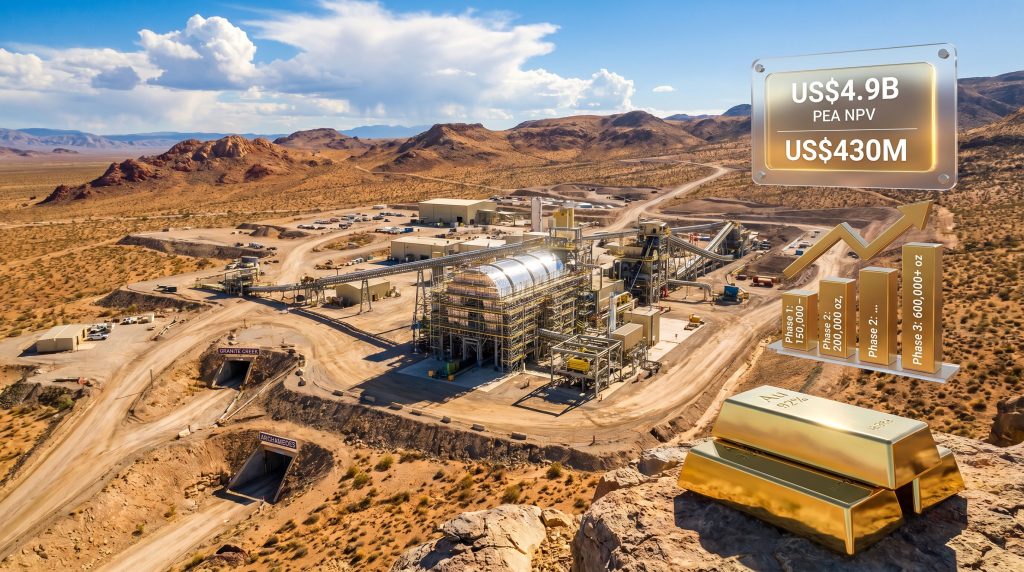
A combined PEA-level after-tax NPV of US$4.9 billion at a US$3,000/oz gold price assumption, priced against a market capitalisation of approximately US$1.3 billion, does not signal overlooked value in isolation. It signals that institutional investors are applying a substantial execution, permitting, and resource-conversion discount that can only be systematically reduced through demonstrated operational milestones.
This is a critical distinction for investors assessing the portfolio. PEA-stage economic models are constructed on a combination of measured, indicated, and critically, inferred resources. Under both NI 43-101 and Regulation S-K Subpart 1300, inferred resources cannot underpin feasibility studies or mineral reserve declarations. They carry materially higher geological uncertainty than measured and indicated categories, and institutional project lenders will not advance construction financing against them.
The implication is structural. Until infill drilling converts a sufficient portion of the inferred base to indicated or measured status, the economics published in the PEA for each asset remain aspirational rather than bankable. Furthermore, closing the discount between the current market capitalisation and the portfolio's theoretical NAV requires completing definitive feasibility studies, commissioning the Lone Tree autoclave, and advancing permitting across multiple assets simultaneously. Consequently, these factors combine to explain why undervalued gold miners like i-80 continue to trade at significant discounts to their theoretical NAV.
The Five Core De-Risking Hurdles: A Framework Overview
Before examining each risk category in depth, the table below maps the primary hurdles across the portfolio, the assets most directly affected, and the key milestones that would reduce each risk.
| De-Risking Category | Primary Asset Affected | Key Milestone | Target Timeline |
|---|---|---|---|
| Underground water management | Granite Creek Underground | Second water treatment plant commissioning | June 2026 |
| Feasibility study and reserve declaration | Granite Creek + Cove Underground | First formal reserve declarations | Q2 2026 |
| Lone Tree plant permitting | Lone Tree Processing Hub | Water rights + pollution control permits | Q2–Q4 2026 |
| Lone Tree construction execution | Lone Tree Processing Hub | Mechanical completion | Q4 2027 |
| BLM EIS permitting | Cove Underground + Granite Creek Open Pit | EIS completion | ~3 years each |
| Resource-to-reserve conversion | Archimedes + Mineral Point | Infill drill program completion | 2026–2027 |
| PFS delivery | Mineral Point Open Pit | Pre-feasibility study | 2027 |
Hurdle One: Water Ingress at Granite Creek Underground
Why Groundwater Is the Most Immediate Near-Term Operational Risk
Granite Creek Underground is currently the only producing asset in the portfolio, making its operational continuity the most time-sensitive variable in the near-term investment thesis. The mine delivered 8,857 ounces of gold in Q1 2026, tracking towards full-year 2026 guidance of 30,000 to 40,000 ounces. It successfully met its 2025 guidance of 22,977 ounces, demonstrating a credible baseline operating capability.
However, escalating water inflows into the active underground working areas have placed increasing strain on the mine's pumping infrastructure. This is not an unusual challenge in Nevada's geology. Refractory gold deposits hosted in carbonate sequences, which characterise much of the Battle Mountain trend, frequently intersect aquifer zones during decline development. What makes this technically complex is the unpredictability of inflow rates as development advances into new geological domains.
The Infrastructure Response
The direct mitigation measure is the installation of a second, expanded water treatment plant targeted for commissioning in June 2026, building on dewatering upgrades completed during 2025. Q1 2026 operational data indicated that existing measures were producing measurable progress, with main decline development reported as on plan and water-related operational disruption reduced.
The company has allocated US$10 million to US$15 million in 2026 growth capital specifically to this water treatment infrastructure, which represents a relatively modest investment against the operational risk it is designed to address. The June 2026 commissioning date functions as a binary near-term catalyst: timely delivery supports the development rates needed to sustain 2026 production guidance, while any delay compresses the operational runway before the Q2 2026 feasibility study.
Cove Underground: A Parallel Water Challenge at an Earlier Development Stage
The water management problem at Granite Creek has a more challenging predecessor at Cove Underground. The Cove open pit is reported to be substantially full of water, creating a prerequisite dewatering requirement before underground development can meaningfully advance. What makes this risk vector particularly notable is its interdependence with the regulatory timeline: Cove's dewatering program is partially constrained by the BLM permitting process, meaning operational and regulatory delays are not independent variables. Construction at Cove is targeted for 2028, with production in 2029, but both dates are contingent on dewatering and EIS completion progressing in parallel.
Hurdle Two: The Lone Tree Autoclave and the Single Largest Capital Commitment in Company History
Why the Processing Hub Is Non-Negotiable to the Production Thesis
The hub-and-spoke processing model that underpins the entire Phase 1 through Phase 3 production roadmap concentrates all refractory ore processing at the Lone Tree facility. Until the autoclave is refurbished and commissioned, every upstream asset — Granite Creek, Archimedes, and Cove — must route refractory material through third-party toll milling arrangements at a payability factor of approximately 55% to 60%.
Once owner-operated processing is established at Lone Tree, the company targets a gold recovery rate of approximately 92%, representing a margin improvement of 32 to 37 percentage points per ounce. At current gold prices above US$3,000/oz, this recovery gap translates into a substantial per-ounce revenue differential that affects the economics of every asset feeding the hub.
The Lone Tree Plant has a nameplate processing capacity of approximately 827,800 tonnes per annum, with a total refurbishment cost confirmed at US$430 million, including approximately US$43 million in contingency, US$25 million in owner's costs, and US$18 million in capital spares.
Outstanding Permits and Construction Sequencing Risk
The Board has granted a construction decision, but multiple permit categories remain outstanding. Each represents a potential sequencing risk to the overall timeline. Indeed, permitting in mining is consistently one of the most underestimated sources of project delay across the sector.
Risk Callout: The Lone Tree refurbishment cannot achieve mechanical completion without securing air quality permits, mercury control approvals, water pollution control permits, reclamation programs, and structural permits. Any single permit category experiencing a delay carries the potential to cascade through the project schedule.
The permit sequencing timeline is as follows:
- Water rights permit: targeted Q2 2026
- Water pollution control permit: targeted Q4 2026
- All environmental and structural permits: targeted Q2 2027
- Targeted demolition: Q2 2026
- Main construction commencement: H2 2026
- Mechanical completion: Q4 2027
- First gold pour: late December 2027
- Phase 1 production ramp-up: Q1 2028
Approximately 50% of total capital commitment was targeted by mid-2026. At US$430 million, even a 10% cost overrun would require either additional financing or reallocation from other program budgets. Nevada's environmental permitting environment and the inherent complexity of autoclave refurbishment projects historically carry above-average execution risk, which makes the US$43 million contingency allocation an important but not unlimited buffer.
Hurdle Three: Multi-Year BLM Environmental Impact Statements
How the EIS Process Shapes Phase 2 and Phase 3 Production Timelines
Both the Cove Underground and Granite Creek Open Pit require completion of a full Environmental Impact Statement through the Bureau of Land Management. Each EIS is estimated to take approximately three years under current regulatory frameworks. For investors modelling the production trajectory, the EIS process is the binding constraint on Phase 2 and Phase 3 output, not capital availability or resource size.
The EIS process involves multiple sequential and sometimes iterative stages:
- Initiation and scoping with public comment periods
- Baseline environmental and cultural resource studies
- Draft EIS preparation and agency review cycles
- Public comment period on the draft EIS
- Final EIS preparation incorporating agency and public responses
- Record of Decision issuance
Each stage can introduce delays, additional mitigation requirements, or scope modifications that alter project capital cost assumptions. For Phase 2 and Phase 3 assets, where construction capital commitments have not yet been made, these requirements can be absorbed into project design. However, they cannot be abbreviated.
Mineral Point: Portfolio's Largest Asset, Furthest From Production
Mineral Point Open Pit carries the most significant long-term re-rating potential in the portfolio whilst simultaneously representing the furthest capital deployment horizon.
| Metric | Mineral Point Open Pit |
|---|---|
| Indicated Resource | 3.4 million ounces |
| Inferred Resource | 2.1 million ounces |
| PEA After-Tax NPV (at US$3,000/oz Au + US$35/oz Ag) | US$2.3 billion |
| Pre-Feasibility Study Target | 2027 |
| Construction Target | 2030 |
| 2026 Allocated Capital | US$50 million |
The company has directed US$50 million from the Franco-Nevada royalty financing toward Mineral Point infill drilling, engineering, and early-stage permitting activities during 2026. The strategic rationale is to initiate the EIS earlier than originally scheduled, with the objective of potentially compressing the construction timeline by one to two years. Bringing the EIS commencement date forward is the highest-leverage permitting action currently available to the company.
The next major ASX story will hit our subscribers first
Hurdle Four: Converting 7.5 Million Inferred Ounces Into Reserve-Eligible Categories
The Resource Classification Gap and Why It Matters to Lenders
The portfolio currently holds 6.5 million ounces in the measured and indicated categories and 7.5 million ounces classified as inferred, meaning the unclassified base is numerically larger than the classified base. Under NI 43-101 and Regulation S-K Subpart 1300, inferred resources cannot form the basis of a feasibility study or be converted into mineral reserves. This distinction is not academic; it directly determines access to construction debt financing from institutional project lenders.
The resource classification gap is most pronounced at two assets:
| Asset | Indicated Resource | Inferred Resource | Inferred Grade | FS / PFS Target |
|---|---|---|---|---|
| Archimedes Underground | 436,000 oz at 7.6 g/t Au | 988,000 oz at 7.3 g/t Au | 7.3 g/t | Q1 2027 FS |
| Cove Underground | 310,000 oz at 8.2 g/t Au | 1,160,000 oz at 8.9 g/t Au | 8.9 g/t | Q2 2026 FS |
At both Archimedes and Cove, the inferred resource is more than double the indicated resource by contained ounce count. These are exceptionally high-grade assets by Nevada standards, particularly Cove's inferred base at 8.9 g/t gold, but grade alone does not satisfy regulatory requirements for reserve classification. In addition, understanding cut-off grade economics is essential context for appreciating why this conversion work carries such significant implications for project viability.
The 2026 Drill Program: Scale and Conversion Objectives
The 2026 drill program is the largest in company history, with two primary conversion targets:
- Lower Archimedes Underground: approximately 55,000 metres across 140 holes, targeting measured and indicated conversion to support a Q1 2027 feasibility study
- Mineral Point Open Pit: approximately 131,000 metres of infill drilling to convert inferred resources ahead of the 2027 PFS
Upper Archimedes drilling completed in Q2 2026 returned intercepts including 24.6 grams per tonne gold over 23.6 metres, consistent with the geological assumptions embedded in the 2025 PEA model. Proper drill results interpretation of these intercepts suggests the conversion program is tracking broadly in line with expectations, though systematic infill density remains the critical requirement.
Successful conversion of inferred ounces to indicated status at Archimedes is a prerequisite for the Q1 2027 feasibility study, which is itself a prerequisite for arranging construction financing at that asset. The dependency chain is sequential and non-compressible.
Hurdle Five: Feasibility Studies and the PEA-to-Reserve Transition
What the Q2 2026 Feasibility Studies Must Deliver
The feasibility studies for Granite Creek Underground and Cove Underground, targeted for Q2 2026, will represent the company's first formal mineral reserve declarations across the entire portfolio. The significance of this milestone extends beyond the geological and engineering confirmation it provides; it fundamentally changes the risk profile that institutional investors and project lenders assign to these assets.
The PEA economics provide a useful reference framework:
| Asset | PEA After-Tax NPV5% at US$2,175/oz | PEA After-Tax NPV5% at US$3,000/oz |
|---|---|---|
| Granite Creek Underground | US$155 million | US$373 million |
| Cove Underground | US$271 million | US$626 million |
| Combined (2 assets) | US$426 million | US$999 million |
If feasibility study outcomes confirm or exceed these PEA assumptions at prevailing gold prices above US$3,000/oz, the re-rating potential from these two assets alone is substantial. If the FS reveals materially higher capital costs, reduced recoveries, or lower reserve tonnage than PEA models assumed, the market discount applied to the broader portfolio could widen rather than narrow. The Q2 2026 FS delivery is therefore not simply a reporting milestone; it is a directional signal for the entire investment thesis and for the i-80 Gold de-risking hurdles in Nevada as a whole.
The Phase Production Roadmap: What Each Milestone Unlocks
Scaling from 30,000 Ounces Annually to 600,000 Ounces
The three-phase production plan is architecturally dependent on the Lone Tree autoclave as the enabling infrastructure. Without it, no phase of the production scale-up can be achieved at the targeted economics. Franco-Nevada's backing of i-80's US$250 million royalty financing underscores the institutional confidence in the programme's underlying asset quality, even as execution risk remains elevated.
- Phase 1 (post-Lone Tree commissioning, targeting Q1 2028): average annual output of 150,000 to 200,000 ounces, sourced from Granite Creek Underground, Archimedes Underground, and Cove Underground processed through the Lone Tree autoclave
- Phase 2: average annual output of 300,000 to 400,000 ounces, incorporating Granite Creek Open Pit and expanded underground throughput, contingent on BLM EIS completion
- Phase 3: average annual output of 600,000 ounces or more, contingent on Mineral Point Open Pit construction, not targeted until 2030
The hub-and-spoke model concentrates capital efficiency at Lone Tree whilst creating a transitional vulnerability: every upstream asset remains exposed to the 55% to 60% toll-milling payability discount until the autoclave is commissioned. This makes Q4 2027 mechanical completion the single most consequential operational milestone in the entire i-80 Gold de-risking hurdles in Nevada programme.
Bull and Bear Scenario Framework
Milestones That Close the Valuation Discount
- Q2 2026 FS delivery confirming reserve-backed economics at or above PEA levels for Granite Creek and Cove
- June 2026 water treatment plant commissioning sustaining 2026 Granite Creek production guidance of 30,000 to 40,000 ounces
- Water rights permit secured in Q2 2026, keeping Lone Tree on schedule
- Lower Archimedes infill drilling confirming sufficient M&I conversion for Q1 2027 FS
- Mineral Point EIS initiated ahead of original schedule, compressing the 2030 construction target
- Lone Tree mechanical completion in Q4 2027 eliminating the toll-milling payability drag
Risks That Could Widen the Discount
- Water ingress at Granite Creek exceeding pumping capacity and disrupting development rates
- Lone Tree permit delays pushing mechanical completion beyond Q4 2027
- BLM EIS timelines extending beyond three years for Cove or Granite Creek Open Pit
- Infill drilling at Archimedes or Mineral Point returning grades below PEA model assumptions
- Lone Tree construction costs exceeding the US$430 million budget, requiring additional capital allocation
- Franco-Nevada royalty financing tranches subject to conditions not satisfied on schedule
This article is intended for informational purposes only and does not constitute financial advice. Mining development projects involve material execution, permitting, geological, and financing risks. Forward-looking statements regarding production timelines, capital costs, resource conversion, and NPV figures are subject to change and should not be relied upon as guarantees of future outcomes. Investors should conduct independent due diligence and consult a qualified financial adviser before making investment decisions.
Want to Track the Next Major ASX Gold Discovery Before the Market Moves?
Discovery Alert's proprietary Discovery IQ model delivers real-time alerts on significant ASX mineral discoveries, cutting through complex geological and resource data to surface actionable opportunities the moment they are announced — explore historic discoveries and their returns to see what early positioning can mean, then begin your 14-day free trial at Discovery Alert to gain a market-leading edge.