Iceni Gold Ltd
- ASX Code: ICL
- Market Cap: $10,678,087
Iceni Gold Diamond Drilling at Goose Well Gold Target
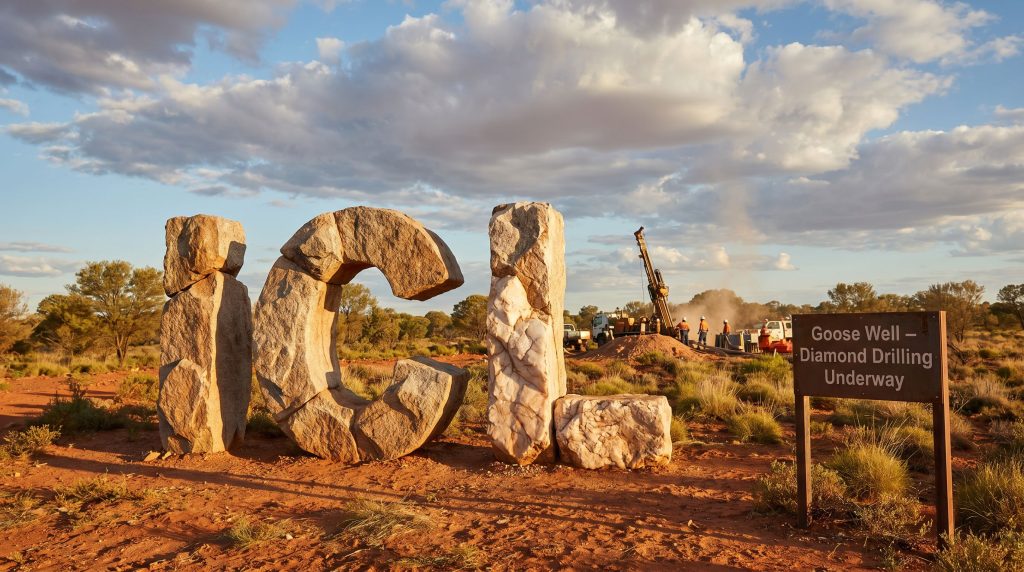
Iceni Gold diamond drilling at Goose Well gold target marks a significant step in the company's staged exploration strategy in Western Australia. Iceni Gold Ltd (ASX: ICL) has commenced a 350 metre angled diamond drill hole at the high priority Goose Well target within the 14 Mile Well Gold Project. According to the ASX announcement dated 24 June 2026, this single hole is designed to refine the geological framework of the Goose Well Intrusive Complex (GWIC) and to test key structural controls on gold mineralisation, including the interpreted Gander Fault. The program is scheduled for completion in June, with assay results expected in July 2026.
When big ASX news breaks, our subscribers know first
A Methodical Approach to a Complex Gold System
Since acquisition of the Goose Well tenements from prospectors in 2022 and 2024, Iceni Gold Ltd has been implementing a staged program of geochemical sampling, field mapping and drilling to evaluate the area.
Independent review and subsequent company work identified several lines of evidence for gold potential at Goose Well:
- A six-line soil sampling program on 400 metre spacing, returning elevated gold and silver values of 1 to 35 ppb Au.
- High grade rock chips above 10 g/t gold from old workings at the Laccos shaft, with associated silver (Ag), bismuth (Bi) and tellurium (Te) anomalism.
- Historical small RC drill campaigns by Normandy Mining (1994–96) and later prospectors (2008, 2014).
The 2014 RC program reportedly intersected gold mineralisation, but Iceni Gold Ltd has stated that original assay data are not publicly available. As a result, the company has taken a cautious stance, treating those results as indicative only and undertaking validation work, including collar location checks and systematic resampling of preserved drill spoil.
A tenement-wide soil sampling program was then completed using the same methodology as the original discovery work. According to Iceni Gold Ltd, this confirmed anomalous gold in soils coincident with the GWIC and an interpreted structural framework developed by Southern Geoscience Consultants.
In 2024, diamond drill hole FMDD0057 (approximately 200 metres) targeted the down-dip extent of a north-dipping quartz-sulphide lode and lamprophyre dyke observed at Laccos shaft. The hole intersected:
- Quartz stockwork in altered monzogranite and quartz-syenite.
- Multiple lamprophyre dykes.
- A narrow (less than 1 metre) quartz lode.
- Altered diorite porphyry and sheared basalt at depth.
This work supported the concept of a multi-phase intrusive system with associated structural complexity, consequently forming the basis for the current program.
RC Results That Set Up the Current Diamond Hole
A 19 hole Reverse Circulation (RC) program at the Goose Well Main target area, reported on 15 April 2026, provided key input to the present diamond drill design. Geochemical analysis suggested two mineralisation styles:
- Discrete high grade quartz vein hosted gold.
- A broader low grade disseminated system.
Gold assays also indicated a clear eastward increase in gold tenor towards the interpreted north-south trending Gander Fault.
Key RC intercepts reported by Iceni Gold Ltd from April 2026:
| Hole ID | Interval (from) | Grade (Au) | Highlight |
|---|---|---|---|
| FMRC0032 | 10 m from 37 m | 0.96 g/t Au | Incl. 1 m at 7.53 g/t Au from 38 m |
| FMRC0039 | 14 m from 226 m | 0.60 g/t Au | Incl. 2 m at 2.30 g/t Au from 234 m |
| FMRC0038 | 8 m from 63 m | 0.62 g/t Au | Incl. 3 m at 1.38 g/t Au from 68 m |
| FMRC0022 | 32 m from 6 m | 0.44 g/t Au | Incl. 1 m at 3.78 g/t Au from 26 m |
Field work following this RC campaign identified what the company interprets as the surface expression of the Gander Fault. Quartz stockwork veining and alteration were described as more prolific on the western side of the interpreted structure and to the north-east of the main target area.
Vein orientations measured in the field were integrated into the Goose Well geological model to finalise the diamond hole collar position and drilling direction.
Educational Focus: What Diamond Drilling Does for a Gold Discovery Model
For investors, understanding why diamond drilling is being used is central to assessing the intent of the Goose Well program.
What Is Diamond Drilling?
Diamond drilling uses a rotating drill bit embedded with industrial diamonds to cut a cylindrical core of rock. This core is brought to surface in sequence, preserving:
- The rock type.
- Vein structures.
- Orientation of fractures and faults.
- Alteration and mineralisation textures.
In contrast, RC drilling produces rock chips that are excellent for geochemical sampling but do not retain fabric, veining geometry or exact structural orientation.
Why Is It Important at Goose Well?
The GWIC is described as a multi-phase monzogranite / quartz-syenite intrusion that has contact-metamorphosed surrounding rocks, forming a magnetite-rich rim visible in aeromagnetic data. In such a setting, the geometry of intrusions and faults strongly influences where gold is deposited.
Diamond core from Goose Well is expected to allow Iceni Gold Ltd to:
- Measure vein density at key target zones, giving a clearer sense of how many gold-bearing veins are present and how closely spaced they are.
- Log mineralogy and alteration in detail, helping to identify proximity to the main parts of the hydrothermal system.
- Identify relationships between multiple intrusive phases within the GWIC and the timing of gold-bearing fluids.
- Define the geometry of the Gander Fault and any subsidiary splays, including their dips, orientations and relative movement.
- Examine lamprophyre dykes, which in many intrusive-related gold systems can be spatially associated with gold pathways.
For a structurally complex intrusive system, this type of information helps convert scattered data into a more coherent 3D structural model. That model then guides the orientation, spacing and depth of subsequent RC or diamond holes.
Glossary: key technical terms at Goose Well
Intrusive complex: A group of igneous rocks that formed when molten rock moved into older rocks and then cooled underground.
Monzogranite / quartz-syenite: Types of intrusive rocks with different proportions of quartz and feldspar, often present in gold systems.
Lamprophyre: A dark, fine-grained intrusive rock that can occur along structures and may be associated with mineralising fluids.
Quartz stockwork: A network of intersecting quartz veins, sometimes carrying gold.
Gander Fault: An interpreted north-south trending fault at Goose Well that is thought to influence the movement of gold-bearing fluids.
g/t Au: Grams of gold per tonne of rock, the standard unit for reporting gold grades.
What the Current Diamond Hole Is Designed to Achieve
According to the June 2026 ASX announcement, the single 350 metre angled diamond drill hole at Goose Well has several clearly defined objectives:
-
Test continuity of flat-lying high grade structures
The hole is positioned to assess whether interpreted flat-lying, high grade mineralised zones continue between RC intercepts. Confirming continuity would provide a stronger basis for planning additional drilling and for assessing potential scale. -
Define vein density at main target areas
With intact core, the company can count and measure veins over defined intervals. Higher vein density can indicate more potential gold-bearing structures in a given volume of rock. -
Characterise mineralised veins
Detailed core logging enables assessment of:- Vein mineralogy (quartz, sulphides, accessory minerals such as Bi and Te-bearing phases).
- Textures (massive, brecciated, banded).
- Structural orientation (strike and dip).
-
Clarify relationships between intrusive phases and gold
By observing cross-cutting relationships between different intrusive rocks and veins, geologists can infer which intrusive events are most closely associated with gold mineralisation. -
Investigate lamprophyre dykes and structural relationships
Lamprophyres logged in previous RC drilling will be examined for:- Their position relative to faults and shear zones.
- Any direct association with gold grades.
-
Intersect and confirm the Gander Fault and splays
The hole is targeted to intersect the interpreted north-south Gander Fault. The nature of this intersection will inform:- Fault width and rock type.
- Degree of alteration and veining.
- Presence or absence of associated gold mineralisation.
According to Iceni Gold Ltd, information from this hole is expected to improve the understanding of the geological, structural and mineralisation framework of the GWIC, refine exploration models and help vector towards areas considered more prospective within the intrusive complex.
Management commentary
"The commencement of diamond drilling at Goose Well marks an important step in advancing our understanding of what is emerging as a significant intrusive hosted gold system. While our primary objective is not necessarily to intersect economic mineralisation, it has been specifically designed to answer several key geological questions that will guide our ability to effectively target across the larger Goose Well Intrusive Complex,"
"This is a strategic investment in understanding the system, reducing exploration risk and positioning Iceni to effectively target new discoveries within the Goose Well Intrusive Complex."
said Wade Johnson, Managing Director, Iceni Gold Ltd.
The Goose Well Story: Systematic Work Since 2022
Activity at Goose Well has followed a staged pattern over several years, rather than moving directly to large-scale drilling.
Key steps reported across Iceni Gold Ltd announcements:
| Year / period | Activity | Reported outcome |
|---|---|---|
| 2022–2024 | Acquisition of Goose Well tenements from prospectors | Secured ground with historical workings and nugget patches |
| Early programs | Six-line soil sampling (400 m spacing) | Elevated gold and silver: 1–35 ppb Au identified |
| 2023–2026 | Rock chip sampling at Laccos shaft and other sites | High grade samples above 20 g/t Au with Ag, Bi, Te anomalism |
| Historical validation | Review and resampling of 2014 RC drill spoil | Historical mineralisation treated as indicative, with field validation |
| Tenement-wide soils | Expanded soil sampling across 14 Mile Well | Confirmed anomalous gold in soils aligned with GWIC and structures |
| 2024 | Diamond hole FMDD0057 (~200 m) | Intersected quartz stockwork, multiple lamprophyres and intrusive phases |
| April 2026 | 19 hole RC program at Goose Well Main | Identified high grade quartz veins and broader disseminated gold; tenor increases east towards Gander Fault |
| June 2026 | 350 m diamond hole commenced | Aimed at structural and geological framework definition across GWIC |
For investors, this timeline indicates an emphasis by Iceni Gold Ltd on building a robust geological model before advancing to more resource-focused drilling.
Goose Well Within the Wider 14 Mile Well Gold Project
Goose Well is one of several high priority targets in the 14 Mile Well Gold Project, which covers approximately 645 km² in the Leonora-Laverton district of Western Australia. According to company disclosures:
- The project lies between Leonora and Laverton, west of Lake Carey.
- It is located west of plus 1 million ounce gold deposits at Mount Morgan, Granny Smith, Sunrise Dam and Wallaby.
- The project is within 75 kilometres of multiple high capacity operating gold mills.
Key target areas within the 14 Mile Well package include:
| Target / project | Status | Key feature |
|---|---|---|
| Goose Well | Diamond drilling underway | Intrusive hosted gold target focussed on GWIC and Gander Fault |
| Everleigh | Priority target area | Identified as a high priority gold target |
| Keep It Dark | Active target | Part of the multi-target exploration focus |
| Guyer Trend (15 km) | Farm-In Agreement with Gold Fields Australia | JV partner is second-largest shareholder in Iceni Gold Ltd |
| Welcome Creek | Exploration licences | Au-Cu target in the Paterson Province |
The Guyer Trend Farm-In and potential Joint Venture with Gold Fields Australia, announced in December 2024, has resulted in Gold Fields becoming the second largest shareholder in Iceni Gold Ltd, with Yandal Investments Pty Ltd also listed among the top five shareholders.
What Happens Next at Goose Well
According to the 24 June 2026 ASX announcement, the immediate timetable is:
| Activity | Target timing | Expected outputs |
|---|---|---|
| Completion of 350 m diamond hole | June 2026 | Full core recovery, structural and geological logging |
| Assay results received | July 2026 | Gold and multi-element assays across key intervals |
| Data integration | Following receipt of assays | Refined structural model, updated GWIC interpretation |
| Future targeting | Post-interpretation | Design of follow up drilling across GWIC, subject to results |
If the Gander Fault is confirmed in core and is shown to be associated with gold mineralisation, Iceni Gold Ltd is likely to have a more clearly defined structure to target along strike and at depth. If the fault is not strongly mineralised but hosts favourable alteration and veining, it may still act as a useful guide to adjacent higher grade zones.
For investors assessing near-term catalysts, the July 2026 assay results and subsequent interpretation updates are central reference points.
The next major ASX story will hit our subscribers first
Why This Matters to Investors Following Iceni Gold Ltd
From an investor perspective, the current Iceni Gold diamond drilling at Goose Well gold target is not a production decision, but a technical program aimed at improving confidence in the exploration model.
Key considerations include:
- Scale of landholding: Iceni Gold Ltd controls approximately 645 km² in a district with multiple plus 1 million ounce deposits, positioning the company as one of the larger landholders in the Leonora-Laverton region.
- Evidence of mineralisation at surface and in drilling: Rock chips above 20 g/t Au and RC intercepts such as 1 m at 7.53 g/t Au from 38 metres suggest that gold-bearing structures are present within the GWIC.
- Model-driven exploration: The decision to invest in a single, information-focused diamond hole rather than a dispersed pattern of RC holes indicates a focus on understanding controls on mineralisation before expanding drilling.
- Infrastructure proximity: The presence of multiple operating gold mills within 75 kilometres reduces the theoretical barrier to future toll treatment or development pathways, subject to any viable discovery.
- External validation through partnerships: The Farm-In Agreement with Gold Fields Australia on the Guyer Trend, and Gold Fields' position as the second largest shareholder, signals that a major industry participant regards parts of the 14 Mile Well package as having potential merit, although this does not guarantee exploration outcomes.
Furthermore, for those monitoring Iceni Gold Ltd, the Goose Well diamond drilling program provides:
- A near term data point via July 2026 assays.
- A test of the Gander Fault hypothesis as a key structural control.
- A basis for future decisions on where and how intensively to drill across the broader GWIC.
Want to Know More About Iceni Gold's 14 Mile Well Gold Project?
With diamond drilling now underway at the Goose Well target and assay results expected in July 2026, Iceni Gold Ltd (ASX: ICL) is at a pivotal stage in defining what could prove to be a significant intrusive-hosted gold system in Western Australia's Leonora-Laverton district. To learn more about the company's exploration strategy, project portfolio, and the progress at Goose Well, visit icenigold.com.au and stay up to date with the latest developments.