
July 24, 2026
The Automotive Industry's Quiet Revolution: Beyond the Electric Motor
The story of the modern vehicle is no longer primarily about what powers it. Across every major market, a more fundamental architectural shift is unfolding beneath the surface of headline EV sales figures. The question driving the next decade of automotive competition is not simply whether a vehicle runs on electricity, but how deeply software has penetrated its operational core. This distinction, subtle at first glance, carries enormous implications for investors, supply chain strategists, and policymakers alike.
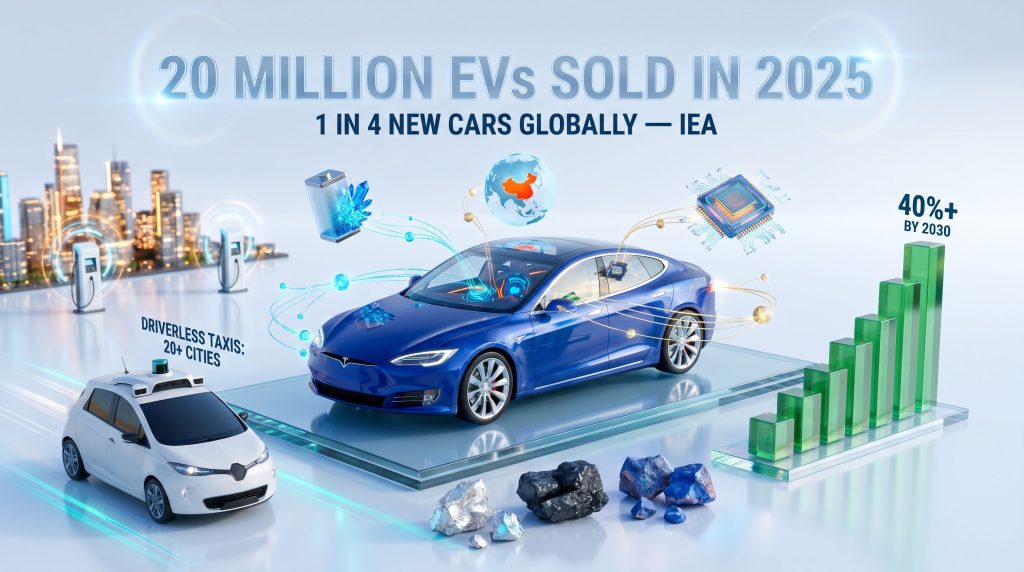
The IEA Global EV Outlook and software-defined vehicles represent two converging forces reshaping the automotive sector. The IEA's 2026 outlook confirms that global electric vehicle sales have crossed a historic threshold, surpassing 20 million units in 2025 for the first time. One in every four new passenger vehicles sold worldwide was electric last year, representing roughly 20% year-on-year growth from 2024. However, behind that headline sits a more complex and commercially significant transformation: the convergence of electrification with software-defined vehicle architecture. Understanding both forces together is essential for anyone tracking where value in the automotive sector will be created through 2030 and beyond.
When big ASX news breaks, our subscribers know first
What Exactly Is a Software-Defined Vehicle?
The term software-defined vehicle (SDV) describes a vehicle in which the majority of functional capabilities — from braking responsiveness and battery thermal management to driver assistance and entertainment — are governed through centralised software systems rather than hardwired into fixed mechanical configurations.
In a traditional vehicle, adding a new safety feature typically required physical modifications to hardware. In an SDV, new capabilities can be deployed remotely through over-the-air (OTA) software updates, in much the same way a smartphone receives operating system upgrades. This architectural shift fundamentally changes how a vehicle generates value across its operational lifetime.
The table below illustrates the key distinctions between a conventional EV and a fully software-defined vehicle:
| Dimension | Electric Vehicle (EV) | Software-Defined Vehicle (SDV) |
|---|---|---|
| Primary Definition | Propulsion via electric motor | Functions governed via software |
| Hardware Dependency | Battery, motor, inverter | Centralised compute platform |
| OTA Updates | Common but not universal | Core requirement |
| Applicable to ICE vehicles? | No | Yes, partially |
| Convergence Point | High — EV platforms suit SDV architecture | High — SDV features scale on EV hardware |
A critical and often overlooked point is that SDVs and EVs are not synonymous, though they are deeply complementary. An internal combustion engine vehicle can technically incorporate some software-defined features, but its distributed electronic control unit (ECU) architecture creates substantial barriers to full implementation. EV platforms, by contrast, are built around centralised electrical systems from the outset, making them structurally better suited to software-layer expansion.
The IEA's Global EV Outlook 2026 explicitly identifies battery electric vehicles as the leading category of software-defined vehicles, noting that their centralised architecture accelerates the deployment of AI-enabled and remotely updatable features in ways that legacy drivetrains fundamentally cannot match.
The Numbers Behind the 2025 EV Milestone
Global EV sales exceeding 20 million units is not merely a round-number milestone. It signals that electrification has moved decisively beyond early adopter markets into the mainstream of consumer vehicle purchasing. Furthermore, the broader battery metals investment landscape is shifting rapidly in response to these volumes.
Key figures from the IEA's 2026 outlook include:
- Global EV sales reached over 20 million units in 2025, up approximately 20% from 2024
- One in four new cars sold globally in 2025 was electric
- The IEA projects that EVs will account for more than 40% of global new car sales by 2030 under current policy trajectories
- EVs displaced approximately 1.7 million barrels of oil demand per day in 2025, a figure forecast to compound materially through the decade
That oil displacement figure is particularly significant and receives far less attention than vehicle sales metrics. As cumulative EV fleet penetration deepens, the daily barrel displacement effect does not grow linearly but compounds, creating accelerating pressure on fossil fuel revenue models while simultaneously expanding electricity demand across grids that are still largely unprepared for the load.
Regional Breakdown: Where the SDV-EV Convergence Is Happening Fastest
| Region | 2025 EV Sales Share | 2030 Projected Share (IEA) | SDV Readiness |
|---|---|---|---|
| China | ~55% of new car sales | ~80% | High — integrated software ecosystems |
| Europe | 30%+ growth in 2025 | ~35–40% | Moderate-High — regulatory push |
| Southeast Asia | Growing rapidly | ~1 in 4 cars by 2030 | Emerging |
| Australia | ~15% of new car sales | Developing | Early-stage |
| Norway | ~97% | Near-saturation | Advanced |
China's Position: Platform Exporter, Not Just Manufacturer
China's dominance across the global EV market is extensive and extends well beyond vehicle assembly. The country accounted for approximately 75% of global EV production in 2025 and around 60% of worldwide EV sales. More than 13 million EVs were sold domestically, representing roughly 55% of all new vehicle sales in China.
What is less widely appreciated is how deeply China's competitive advantage extends into the software and integration layers of the vehicle stack. Chinese original equipment manufacturers (OEMs) are not simply exporting cars. They are exporting integrated platforms that include proprietary battery management software, connected vehicle ecosystems, charging infrastructure protocols, and upstream mineral processing capacity.
Chinese-manufactured EVs captured more than 50% of EV sales across Southeast Asia in 2025, and global exports from Chinese manufacturers reached a record 2.5 million vehicles. This export momentum reflects platform-level competitiveness, not merely price advantage. In addition, advances in Chinese battery recycling are further strengthening China's position across the full EV value chain.
Europe's Regulatory-Driven Acceleration
European EV sales grew by more than 30% in 2025, driven by tightening fleet emissions standards and an expanding range of lower-cost models entering the market. The regulatory environment in Europe is functioning as a structural demand-pull mechanism, creating EV uptake that operates partially independently of near-term consumer preference.
However, a regulatory gap is emerging that deserves attention. Most existing automotive safety and liability frameworks were designed for hardware-defined vehicles. SDV-specific governance covering OTA update accountability, cybersecurity standards, and AI decision-making liability remains underdeveloped across most European and global jurisdictions. This lag creates both risk for early adopters and genuine competitive opportunity for regulatory systems that move first to establish clear frameworks.
Artificial Intelligence and the Three-Layer SDV Stack
The integration of AI into vehicle platforms is proceeding along three distinct architectural layers, each with different maturity timelines and commercial implications:
- Battery Management Systems (BMS): AI-driven algorithms are now actively managing charge cycle optimisation, thermal load balancing, and predictive degradation modelling. This layer is already commercially deployed at scale and directly affects battery longevity and range performance.
- Advanced Driver Assistance Systems (ADAS): Machine learning models processing sensor fusion data from cameras, radar, and LiDAR are enabling lane-keeping assistance, adaptive cruise control, automatic emergency braking, and increasingly sophisticated highway autopilot functionality.
- Autonomous Vehicle Decision Engines: Full self-driving inference stacks running on automotive-grade semiconductors represent the frontier layer. Driverless electric taxis are already operating commercially across more than 20 cities globally, concentrated in China and the United States.
The hardware enablers for this AI integration are themselves undergoing rapid change. More capable automotive-grade chips are enabling real-time AI inference directly at the vehicle edge rather than relying on cloud connectivity. Simultaneously, the cost of LiDAR sensors has declined dramatically over the past five years, expanding ADAS accessibility well beyond the premium vehicle segment into mainstream consumer price points.
A less commonly discussed implication of this transition is the challenge ultra-fast charging creates as a software coordination problem. New high-voltage EV platforms capable of achieving effective full charges in under 10 minutes require sophisticated real-time software negotiation between the vehicle's battery management system, the charging infrastructure's power delivery hardware, and the broader electricity grid. The charging interface is increasingly a software product in its own right, with significant implications for both grid operators and charging network operators seeking to differentiate their offerings.
Australia's Strategic Position in the EV Transition
Australia's domestic EV sales reached approximately 15% of new car sales in 2025, representing meaningful progress but remaining well below leading markets. The gap to China, Europe, and the Nordic countries reflects a combination of infrastructure limitations, historically constrained model availability, and relatively high vehicle prices in the EV segment.
However, measuring Australia's role in the EV transition purely through retail vehicle sales misreads where the country's strategic leverage actually sits. Australia's primary position in the global electrification ecosystem is upstream, not at the consumer end. The critical minerals demand surge driven by EV growth is, consequently, directly relevant to Australia's economic outlook.
The critical minerals required to build EV batteries and electrification hardware include:
- Lithium — the foundational element of lithium-ion battery chemistries
- Graphite — used in battery anodes, with natural graphite still dominant in most commercial battery formats
- Rare earth elements — essential inputs for electric motor magnets, particularly neodymium and dysprosium
- Cobalt and manganese — cathode material components in various battery chemistries
Australia holds substantial deposits of several of these materials. Furthermore, critical minerals and energy security considerations are increasingly shaping how governments and investors evaluate upstream mineral assets tied to EV supply chains.
Beyond passenger vehicles, heavy freight electrification represents a structurally distinct opportunity within the Australian context. Given the country's reliance on long-haul road transport across large distances, the electrification of existing heavy vehicle fleets through drivetrain conversion technology is emerging as a capital-efficient pathway that sidesteps some of the limitations of greenfield EV manufacturing. Australia's lithium industry is, in addition, benefiting from renewed policy attention as downstream EV demand trajectories become clearer.
The next major ASX story will hit our subscribers first
The Investor Lens: Where Value Is Migrating in the Electrification Stack
The IEA's data strongly suggests that the investment opportunity in electrification is progressively shifting away from vehicle manufacturing itself and toward the enabling technology layers that make modern EVs and software-defined vehicles function.
The expanded technology and materials stack that underpins this transition includes:
- Battery chemistry innovation, including solid-state and next-generation lithium architectures
- Charging infrastructure and grid-edge management software
- Automotive-grade semiconductors and centralised compute platforms
- AI and machine learning frameworks embedded in vehicle operating systems
- Critical minerals supply chains with limited geographic concentration outside China
Three structural shifts are worth monitoring closely:
- Software monetisation replacing hardware margins: Vehicle OEMs are actively building recurring software revenue models, including subscription-based feature unlocking and predictive maintenance services, as a primary profit driver to offset commoditising hardware margins.
- Critical minerals supply security: Geopolitical competition around lithium, rare earths, graphite, and battery materials is intensifying as EV demand trajectories point toward a 40%+ market share by 2030.
- Grid infrastructure investment: EV fleet growth at IEA-projected rates will require substantial electricity network upgrades, creating parallel investment opportunities in grid-edge technology, energy storage, and demand management software.
The scenario that receives the least attention but carries significant downside risk is regulatory fragmentation. If major jurisdictions adopt incompatible SDV technical standards, the likely outcome is accelerated platform lock-in by the dominant Chinese and US automotive software ecosystems, with serious consequences for European and other regional manufacturers attempting to compete on software capability. Analysts tracking the IEA Global EV Outlook and software-defined vehicles convergence have noted this regulatory risk as an underappreciated variable in long-term modelling.
This article is intended for informational purposes only and does not constitute financial or investment advice. All projections and forecasts referenced are sourced from the IEA Global EV Outlook 2026 and are subject to the assumptions and scenario conditions described in that report. Readers should conduct their own research and seek independent financial advice before making investment decisions. Past trends do not guarantee future outcomes.
Further data and scenario modelling from the IEA is available at iea.org/reports/global-ev-outlook-2026.
Want to Know When the Next Major ASX Mineral Discovery Hits the Market?
As the global EV transition accelerates demand for lithium, rare earths, graphite, and other critical minerals, Discovery Alert's proprietary Discovery IQ model instantly notifies subscribers of significant ASX mineral discoveries — turning complex data across 30+ commodities into clear, actionable insights. Explore historic discoveries and their exceptional returns or start your 14-day free trial today to position yourself ahead of the market.