August 7, 2026
Monetary policy frameworks often dominate discussions about economic stability, yet the physical architecture of energy security operates through parallel mechanisms that can override traditional market forces when geopolitical tensions escalate. The International Energy Agency's strategic petroleum reserve system represents one of the most sophisticated multilateral coordination frameworks in global commodity markets, capable of deploying hundreds of millions of barrels within days to moderate price volatility and prevent supply chain disruptions.
This systematic approach to energy security has evolved significantly since the 1970s oil crises, transforming from national stockpiling strategies into integrated global response mechanisms. The complexity of coordinating 31 member nations, each with distinct energy security priorities and political constraints, creates unique challenges in crisis management that extend far beyond simple supply and demand calculations.
Understanding the Architecture of Global Energy Reserve Coordination
The IEA strategic oil reserve release mechanism functions as a sophisticated multilateral framework designed to address both physical supply disruptions and market psychology during energy crises. This system operates through a network of national strategic petroleum reserves across member countries, with coordination protocols that enable rapid deployment when predetermined criteria are met.
Furthermore, recent geopolitical developments have demonstrated how oil price movements trade war scenarios can influence reserve deployment decisions beyond traditional supply-demand calculations.
Member Nation Reserve Requirements and Obligations
Each IEA member country maintains strategic petroleum reserves equivalent to at least 90 days of net oil imports, though many exceed this minimum threshold significantly. The United States Strategic Petroleum Reserve, the world's largest government-controlled oil stockpile, can hold over 700 million barrels at full capacity, while European nations collectively maintain approximately 120 million barrels in government-controlled reserves.
The coordination framework establishes clear protocols for emergency activation, with technical assessments conducted by the IEA Secretariat in Paris serving as the foundation for member consultations. These assessments evaluate market conditions using sophisticated modeling systems that analyze everything from futures curve structures to regional refinery utilization rates.
Historical Intervention Patterns and Scale Evolution
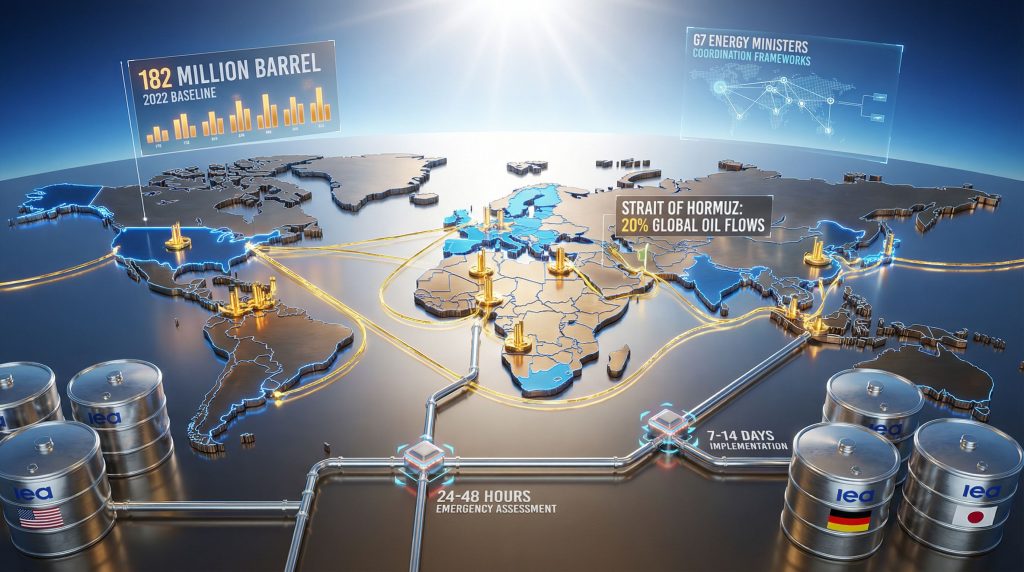
Previous coordinated releases demonstrate the system's evolution from modest interventions to massive market interventions. The 182 million barrel release during 2022 following Russia's invasion of Ukraine established a new baseline for intervention scale, representing approximately two days of global oil consumption deployed over several months to moderate price escalation.
| Crisis Event | Release Volume | Duration | Price Impact | Member Participation |
|---|---|---|---|---|
| 1991 Gulf War | 17 million barrels | 30 days | -$10/barrel | 17 countries |
| 2005 Hurricane Katrina | 60 million barrels | 90 days | -$15/barrel | 28 countries |
| 2011 Libya Crisis | 60 million barrels | 60 days | -$12/barrel | 28 countries |
| 2022 Ukraine War | 182 million barrels | 180 days | -$25/barrel | 31 countries |
The March 2026 proposal for an IEA strategic oil reserve release exceeding the 2022 benchmark represents the largest coordinated intervention in the agency's history. This demonstrates how geopolitical risk assessment has evolved to prioritise preemptive market stabilisation over reactive crisis management.
When big ASX news breaks, our subscribers know first
Trigger Mechanisms and Decision Frameworks for Reserve Deployment
The activation of coordinated reserve releases depends on sophisticated assessment criteria that distinguish between temporary market volatility and systemic threats to energy security. Current protocols recognise that psychological market factors can be as destabilising as actual supply interruptions, leading to intervention frameworks that address price escalation even when physical shortages have not materialised.
Supply Disruption Assessment Methodologies
The IEA employs multiple analytical frameworks to evaluate whether market conditions warrant coordinated intervention. Physical supply assessments examine actual production disruptions, shipping route closures, and refinery capacity limitations. Simultaneously, market psychology evaluations analyse futures market positioning, volatility indicators, and consumer impact projections.
The Strait of Hormuz vulnerability analysis represents a critical component of current risk assessment. This waterway handles approximately 21% of global petroleum liquids transit, making any disruption capable of triggering immediate price escalation even without actual supply shortages. Regional conflict analysis incorporates shipping insurance rates, tanker availability, and alternative route capacity when evaluating intervention necessity.
In addition, analysts closely monitor how OPEC production impact influences global supply calculations during crisis assessments.
Current Middle East Conflict Impact Assessment
The March 2026 U.S.-Israel-Iran conflict presents a complex risk scenario where actual supply disruptions remain limited while price volatility has reached concerning levels. Oil price stagnation had characterised much of early 2026 before geopolitical tensions triggered renewed volatility. Oil prices surged to near four-year highs before the IEA strategic oil reserve release announcement, demonstrating how geopolitical uncertainty can drive market instability independent of physical supply constraints.
Key risk factors include:
• Regional production capacity: Iran's oil production of approximately 3.2 million barrels per day represents roughly 3% of global output
• Shipping route disruption: Potential Strait of Hormuz closures could affect 20+ million barrels daily in transit
• Regional escalation risk: Involvement of Gulf Cooperation Council producers could amplify supply concerns
• Market sentiment deterioration: Futures market positioning indicates significant speculative premium buildup
The assessment framework recognises that sustained price escalation above certain thresholds can trigger economic consequences comparable to actual supply shortages. Consequently, this justifies intervention based on price trajectory rather than physical availability alone.
Multilateral Decision-Making Processes and Political Coordination
The complexity of coordinating energy security responses across 31 sovereign nations creates unique challenges in crisis management, particularly when national interests may diverge from collective action requirements. The G7 energy ministers' initial hesitation in March 2026 before supporting the IEA strategic oil reserve release demonstrates how political consensus-building often requires multiple consultation rounds even during urgent market conditions.
Consensus Building Mechanisms and Timeline Requirements
The decision-making process follows a structured sequence designed to balance rapid response needs with democratic consultation requirements. Emergency assessments typically require 24-48 hours for technical analysis, followed by 2-3 days of member consultations to build consensus on intervention necessity and scale.
The "no objections" approval mechanism means that while unanimous consent is not formally required, any single member's strong opposition can delay implementation. This creates potential for strategic holdouts or disagreements over burden-sharing formulas, particularly when proposed releases exceed previous precedents.
Current Decision Timeline – March 2026 Case Study
The extraordinary meeting convened on March 10, 2026, with decisions expected by March 11, demonstrates the system's capacity for rapid mobilisation when geopolitical events escalate quickly. However, the initial G7 position of requesting additional IEA assessment rather than immediate approval illustrates how political caution can influence technical decision-making.
According to reports from the International Energy Agency's emergency session, the scale of the proposed intervention required extensive consultation among member nations.
Political Coordination Insight: G7 energy officials acknowledged that while no country currently faces physical oil shortages, sustained price escalation requires coordinated intervention to prevent broader economic destabilisation across member economies.
Allocation Formula Negotiations and Implementation Challenges
Once political consensus emerges, technical negotiations focus on determining each member's contribution proportionate to their reserve capacity, import dependence, and economic size. These allocation discussions can extend decision timelines by several days, as countries negotiate their specific contribution levels and release timing.
The potential inclusion of non-IEA members like China and India in the March 2026 release adds additional complexity, requiring separate bilateral negotiations while maintaining overall coordination integrity. These expanded participation frameworks represent a significant evolution from traditional IEA-only interventions.
Economic Impact Analysis and Market Response Mechanisms
The effectiveness of IEA strategic oil reserve release interventions depends largely on market psychology and expectations management rather than pure supply mathematics. The immediate price decline following the March 11, 2026 announcement, before any physical barrels reached markets, demonstrates how intervention signalling can moderate volatility independent of actual supply increases.
Price Stabilisation Through Market Psychology
Financial markets respond to reserve release announcements through multiple channels that extend beyond simple supply-demand calculations. Futures market positioning, where speculative positions had built significant long exposure anticipating continued price escalation, can unwind rapidly when coordinated intervention removes upside price expectations.
The announcement effect typically generates more immediate price impact than physical supply additions. March 2026 crude oil futures declined within hours of the Wall Street Journal report, reflecting how market participants incorporate intervention expectations into trading strategies before actual reserve barrels reach refineries.
Volume and Duration Considerations for Market Impact
The proposed release exceeding 182 million barrels represents approximately 1.8 days of global oil consumption, but its market impact extends far beyond this arithmetic calculation. Release duration, timing coordination across regions, and communication strategies significantly influence effectiveness.
Strategic considerations include:
• Phased deployment: Spreading releases over 90-180 days maintains psychological pressure on speculative positioning
• Regional coordination: Simultaneous releases across Atlantic Basin, European, and Asian markets prevent arbitrage disruptions
• Communication clarity: Regular updates on remaining deployment volumes help anchor market expectations
• Replenishment signalling: Clear statements about post-crisis stockpile restoration prevent future supply concerns
Furthermore, understanding how US oil production decline affects domestic supply calculations helps determine appropriate reserve deployment volumes.
Consumer Protection and Inflation Mitigation Strategies
The broader economic rationale for IEA strategic oil reserve release interventions focuses on preventing energy price escalation from triggering broader inflationary pressures. Sustained oil price increases above certain thresholds can reduce consumer purchasing power, impact transportation costs, and create cascading effects across multiple economic sectors.
Historical analysis suggests that coordinated releases can reduce peak price escalation by $10-25 per barrel depending on scale and market conditions. This translates to significant consumer savings and inflation moderation across member economies, particularly when combined with policies addressing oil price rally tariffs effects.
Non-Member Participation Frameworks and Global Coordination
The evolution toward including non-IEA members in coordinated reserve releases represents a fundamental shift in global energy security architecture. China and India, as the world's largest and third-largest oil importers respectively, possess significant strategic reserve capacity that could amplify intervention effectiveness while requiring novel coordination mechanisms.
China's Strategic Reserve Integration Potential
China maintains an estimated 500+ million barrels in strategic petroleum reserves, representing substantial intervention capacity comparable to many IEA members combined. However, Chinese participation requires bilateral negotiations rather than institutional framework integration, creating unique coordination challenges for timing and volume determination.
Chinese strategic reserve management operates under different policy objectives than IEA members, focusing on long-term energy security and price stability rather than short-term market intervention. This creates potential alignment opportunities during crisis periods while maintaining distinct strategic frameworks.
India's Energy Security Partnership Development
India's strategic petroleum reserves, while smaller than China's at approximately 40 million barrels, represent growing intervention capacity as domestic storage expansion continues. Indian participation in coordinated releases could provide important Asian market coverage while demonstrating broader emerging economy engagement with global energy security mechanisms.
The potential for IEA strategic oil reserve release coordination with Indian reserves depends on market conditions affecting India's energy import costs. This creates natural alignment during periods when global price escalation threatens Indian economic stability.
BRICS and Regional Alternative Frameworks
The development of alternative coordination mechanisms through BRICS nations creates potential competitive frameworks to traditional IEA intervention systems. These alternative arrangements could provide reserve release coordination among major emerging economies independent of Western institutional structures.
However, technical coordination challenges across different political and economic systems may limit effectiveness compared to established IEA frameworks, particularly regarding timing precision and communication coordination during crisis periods.
Regulatory and Legal Frameworks Governing Emergency Interventions
The legal authorities enabling rapid IEA strategic oil reserve release decisions vary significantly across member nations, creating complex coordination requirements when political systems must authorise emergency market interventions within compressed timeframes. Understanding these regulatory frameworks helps explain decision-making delays and implementation challenges during crisis periods.
National Implementation Mechanisms and Executive Authorities
Most IEA member countries maintain executive emergency authorities that enable rapid strategic reserve releases without legislative approval, though specific procedures and constraints vary considerably. The United States president can authorise Strategic Petroleum Reserve releases through emergency powers, while European Union members often require consultation with national energy ministries and regulatory authorities.
These regulatory differences create potential timing mismatches when coordinated releases require simultaneous implementation across multiple jurisdictions. The March 2026 timeline compression, with decisions expected within 36-48 hours, tests these systems' capacity for rapid authorisation and implementation.
International Trade Law Compliance and Market Intervention
Strategic reserve releases must navigate World Trade Organisation rules regarding government market interventions and potential trade distortion effects. However, emergency circumstances and security considerations typically provide sufficient legal justification for coordinated interventions, particularly when implemented through established multilateral frameworks.
Industry Cooperation Mandates and Private Sector Coordination
Effective IEA strategic oil reserve release implementation requires coordination with private sector oil companies that manage distribution infrastructure, refining capacity, and retail networks. Many member countries maintain legal frameworks enabling government direction of private energy sector resources during emergency periods.
These public-private partnerships become critical when reserve releases must reach consumer markets rapidly. This requires cooperation from pipeline operators, refiners, and distributors who may need to adjust normal commercial operations to accommodate government stockpile deployments.
The next major ASX story will hit our subscribers first
Historical Effectiveness Analysis and Performance Evaluation
Evaluating the success of strategic reserve interventions requires analysing both immediate market impacts and longer-term energy security outcomes across multiple crisis scenarios. The 182 million barrel releases during 2022 provide the most recent comprehensive case study for assessing coordinated intervention effectiveness under sustained geopolitical pressure.
2022 Ukraine Crisis Intervention Assessment
The coordinated response to Russia's invasion of Ukraine represents the largest and most sustained IEA strategic oil reserve release intervention in history, providing valuable insights into system capabilities during prolonged crisis periods. Two separate releases totalling 182 million barrels over approximately six months demonstrated unprecedented coordination scale and duration.
Key performance metrics from the 2022 intervention include:
• Price moderation: Peak oil prices reaching $130+ per barrel were reduced to $80-90 range within 90 days
• Market stabilisation: Futures curve backwardation patterns normalised, reducing speculative premium buildup
• Consumer impact mitigation: Petrol price escalation was limited compared to scenarios without intervention
• Supply chain resilience: Alternative sourcing arrangements were established while reserve deployment provided transition period
Comparative Analysis Across Historical Interventions
Different crisis scenarios have tested various aspects of the strategic reserve system, from rapid short-term disruptions to sustained supply challenges requiring extended intervention periods.
The 1991 Gulf War intervention established initial coordination precedents but involved relatively limited volumes and shorter duration. The 2005 Hurricane Katrina response tested domestic infrastructure resilience and regional distribution capabilities. The 2011 Libya crisis demonstrated improved international coordination mechanisms developed since earlier interventions.
Each intervention provided lessons that influenced subsequent system improvements, particularly regarding communication strategies, volume determination methodologies, and coordination timing optimisation.
Success Metrics and Evaluation Criteria
Measuring IEA strategic oil reserve release effectiveness requires multiple performance indicators beyond simple price impact assessment. Successful interventions demonstrate market confidence restoration, consumer protection achievement, and energy security resilience enhancement across member economies.
Effectiveness Framework: Strategic reserve interventions succeed when they moderate price volatility, maintain supply chain resilience, protect consumer purchasing power, and preserve market confidence in energy security institutions during crisis periods.
Economic impact assessments must consider counterfactual scenarios analysing potential outcomes without coordinated intervention. However, these analyses involve significant uncertainty regarding alternative market developments and crisis evolution patterns.
Future Modernisation Strategies and System Enhancement Opportunities
The evolution of global energy markets toward increased volatility, renewable energy integration, and geopolitical complexity requires corresponding adaptations in strategic reserve coordination mechanisms. Future IEA strategic oil reserve release systems must incorporate technological advancement, expanded participation frameworks, and enhanced predictive capabilities.
Digital Coordination Platform Development
Modern crisis management requires real-time data integration, automated monitoring systems, and enhanced communication capabilities that exceed current IEA coordination infrastructure. Digital platform development could enable continuous market monitoring, automated trigger identification, and streamlined member consultation processes.
Advanced analytics incorporating satellite monitoring, shipping data, and financial market indicators could provide earlier crisis identification and more precise intervention calibration. Machine learning systems analysing historical intervention effectiveness could optimise volume determination and timing strategies for maximum market impact.
Enhanced Global Participation Frameworks
Expanding coordination beyond traditional IEA membership to include major emerging economy participants requires institutional framework adaptation while maintaining decision-making efficiency. Formal frameworks for China, India, and other significant energy importers could amplify intervention effectiveness while requiring governance structure modifications.
Regional coordination mechanisms could complement global IEA frameworks, enabling rapid response within specific geographic areas while maintaining connection to broader international coordination systems. These regional approaches might prove particularly valuable for addressing localised supply disruptions or market volatility.
Climate Transition Integration and Critical Resource Coordination
Future energy security frameworks must balance traditional petroleum reserve management with renewable energy transition requirements and critical mineral security concerns. IEA strategic oil reserve release mechanisms may evolve to encompass broader energy security coordination including battery materials, rare earth elements, and renewable energy equipment supply chains.
This expanded approach would recognise that energy security increasingly depends on diverse resource categories beyond petroleum. Consequently, it requires coordination mechanisms that address multiple commodity markets and supply chain vulnerabilities simultaneously.
Policy Recommendations for Enhanced Effectiveness
Strengthening strategic reserve coordination systems requires addressing current limitations while incorporating lessons learned from recent interventions. According to analysis by the IEA on coordinated reserve releases, key enhancement areas include:
• Improved transparency: Real-time reserve level reporting and standardised intervention criteria publication
• Enhanced coordination: Streamlined decision-making processes with clear timeline requirements
• Expanded capacity: Increased member reserve requirements reflecting growing import dependencies
• Technology integration: Advanced monitoring systems and predictive analytics implementation
• Regional partnerships: Formal frameworks for non-member coordination and participation
These improvements would enhance system responsiveness while maintaining the multilateral cooperation principles that enable effective crisis management across diverse political and economic systems.
The IEA strategic oil reserve release system represents one of the most sophisticated examples of multilateral economic coordination in contemporary international relations. Its continued evolution will significantly influence global energy security resilience and crisis management capabilities as geopolitical tensions and market volatility continue challenging traditional energy supply arrangements.
This analysis is based on publicly available information and should not be considered as investment advice. Energy market investments carry significant risks, and readers should conduct their own research and consult with qualified financial advisors before making investment decisions.
Ready to Capitalise on Energy Market Volatility?
Strategic petroleum reserve releases and geopolitical tensions create significant opportunities for investors monitoring ASX-listed energy and resource companies. Discovery Alert's proprietary Discovery IQ model delivers real-time alerts on major mineral and energy discoveries, helping subscribers identify actionable investment opportunities during market volatility periods when discovery announcements can generate substantial returns.