
July 10, 2026
The Oil Market's Most Dangerous Illusion: Mistaking a Ceasefire for a Recovery
Every major commodity cycle carries within it a hidden fault line, a structural weakness that only becomes visible under stress. In global oil markets, that fault line has always been the assumption of uninterrupted physical supply. When infrastructure works, when tankers sail without threat, and when refinery loadings proceed on schedule, supply models function precisely. When those assumptions break down, the carefully constructed architecture of forward curves, inventory projections, and demand forecasts can unravel within days.
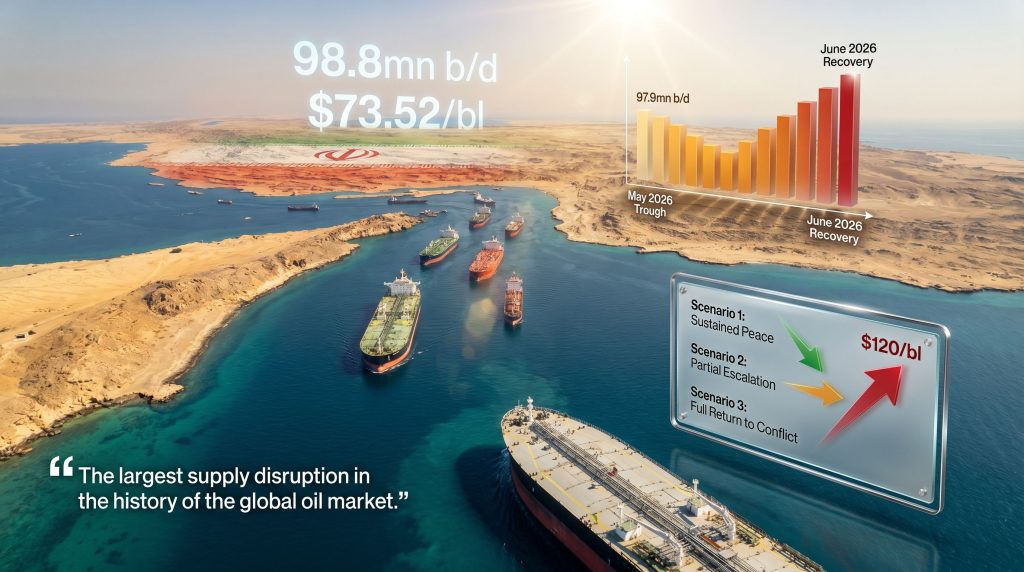
The IEA warns return to war will upend oil market recovery — and this stark assessment forms the centrepiece of the agency's July 2026 Oil Market Report. Its findings are not simply a revised set of supply and demand figures. They represent a conditional assessment of a market that has experienced what the agency itself characterised as the largest supply disruption in the history of global oil trade, and which now faces the genuine possibility of a full reversal of its tentative recovery.
Understanding what the IEA warns, and why those warnings carry such unusual weight, requires examining not just the numbers but the fragile geopolitical scaffolding on which they rest.
When big ASX news breaks, our subscribers know first
How the 2026 Disruption Became a Historic Benchmark
The Strait of Hormuz as a Single Point of Failure
The Strait of Hormuz is, in purely physical terms, a remarkably narrow passage. At its most constrained point, the navigable shipping lane is only a few kilometres wide, flanked by Iranian territorial waters on one side and Omani waters on the other. Yet through this corridor flows roughly 20% of the world's seaborne oil supply, along with significant volumes of liquefied natural gas. The LNG supply outlook for Asian markets remains heavily dependent on this corridor remaining open.
No alternative routing can replicate this volume. Saudi Arabia's East-West Pipeline and the UAE's Habshan-Fujairah pipeline offer partial bypass capacity, but even at full utilisation these overland and alternative maritime routes cannot absorb anywhere near the throughput volumes that Hormuz handles on a normal operational day. When the strait closes, the global oil system does not reroute; it haemorrhages.
When conflict escalated in early 2026 and tanker movements through Hormuz became severely disrupted, the consequences moved rapidly through the system. Brent crude surged past $120 per barrel. Global strategic petroleum reserve releases accelerated at a record pace. Furthermore, over the months that followed, the market absorbed more than 1 billion barrels of supply from global inventories, depleting the buffer that had previously given policymakers and traders a degree of confidence in managing disruptions.
From Crisis to Conditional Recovery: The June 2026 Turning Point
The signing of a US-Iran interim framework on 18 June 2026 created the conditions for a partial supply restoration. The agreement called for a phased reopening of the Strait to commercial traffic in exchange for limited sanctions relief extended to Tehran. The market responded immediately, with crude prices declining and supply flows beginning to recover.
The scale of that recovery, while meaningful, remains incomplete:
| Metric | Pre-Conflict Level | May 2026 Trough | June 2026 Recovery |
|---|---|---|---|
| Global Oil Demand | ~103.5mn b/d (est.) | 97.9mn b/d | Recovering |
| Global Oil Supply | ~106mn+ b/d | Severely constrained | 98.8mn b/d |
| Mideast Gulf Exports | ~24.4mn b/d (Feb est.) | Heavily disrupted | 16.1mn b/d |
| Brent Crude Price | ~$75-80/bl range | Surged past $120/bl | Declining toward $73/bl |
Global oil demand fell to a trough of 97.9 million barrels per day in May 2026, a decline of 5.3 million b/d year-on-year. Supply rebounded by approximately 4.1 million b/d to reach 98.8 million b/d in June as Middle East Gulf producers partially restored output. Regional exports recovered to 16.1 million b/d, though this figure remains 8.3 million b/d below the February 2026 pre-conflict baseline.
The twin engines of the demand-side recovery have been pent-up Asian purchasing activity and the incentive effect of lower crude prices on consumption. Both are welcome developments. Neither, however, is structurally secure.
What the IEA's Base Case Actually Projects
Revised Demand Forecasts and the 2027 Conditional Outlook
The IEA's 2026 global oil demand forecast calls for a net decline of approximately 1 million b/d, bringing full-year consumption to around 103.5 million b/d. This represents a modest downward revision of 70,000 b/d from the prior month's estimate, directionally significant even if numerically small. The agency retained its projection of a 2 million b/d demand increase in 2027, contingent on sustained geopolitical stability and continued macroeconomic improvement.
On the supply side, the IEA projects a 3.7 million b/d decline in 2026 global output to approximately 102.6 million b/d, roughly 210,000 b/d higher than the previous OMR's estimate. If recovery conditions hold, the agency forecasts a 7.5 million b/d supply rebound in 2027, which would push global output toward 110 million b/d.
The implied market balances are stark:
| Year | Implied Market Balance |
|---|---|
| 2026 | Supply deficit of approximately 900,000 b/d |
| 2027 | Supply surplus of approximately 4.6 million b/d |
According to the IEA's April Oil Market Report, global oil markets face a supply deficit of approximately 900,000 b/d in 2026, transitioning to a projected surplus of 4.6 million b/d in 2027. Both figures are entirely conditional on the Strait of Hormuz remaining accessible to commercial shipping throughout the forecast period.
The Product Market Lag: A Hidden Bottleneck
One of the least widely understood aspects of the current recovery is the disconnect between crude oil flow restoration and refined product availability. Crude moving through the Strait does not immediately translate into diesel, jet fuel, or gasoline available at the pump or in storage terminals.
Key Mideast Gulf refinery loading operations had not yet resumed as of the July OMR, creating a downstream bottleneck that is slowing product market normalisation even as upstream crude production recovers. This distinction, between crude flow recovery and refined product availability, is critical for understanding why energy importing regions may continue to face supply tightness even after headline oil price declines suggest the worst is over.
Adding further pressure to global product markets, Ukrainian attacks on Russian refinery infrastructure and export terminals have continued to constrain product availability from a second major supply source, compounding an already strained downstream environment.
Three Scenarios That Could Define Markets Through 2027
Scenario 1: Sustained Peace and Full Hormuz Restoration (Base Case)
Conditions required: The US-Iran ceasefire holds, commercial navigation through the Strait normalises progressively, and the diplomatic process toward a comprehensive peace framework advances ahead of the 21 August 2026 deadline.
Market outcome: The approximately 900,000 b/d supply deficit narrows through the second half of 2026, with a surplus potentially emerging by Q4 2026 or early 2027. Price trajectory points toward continued gradual decline toward pre-conflict ranges, supporting demand recovery in price-sensitive Asian markets.
Key risks: Unresolved nuclear program negotiations between Washington and Tehran, domestic political pressures in both capitals, and the demonstrated fragility of the interim agreement terms in the weeks following the 18 June signing.
Scenario 2: Partial Escalation Without Full Closure (Stress Case)
Conditions: Sporadic attacks on commercial vessels persist, shipping insurance premiums remain elevated, and alternative routing through non-Hormuz channels continues at significant additional cost.
Market outcome: Supply recovery stalls near current levels, the deficit widens beyond the base case, and product market tightness intensifies. The IEA has specifically identified the July-August 2026 period as a critical demand-peak window where depleted inventories and constrained supply could intersect with dangerous consequences for import-dependent economies.
Compounding factors: Ukrainian strikes on Russian refinery capacity continue tightening product markets from a separate direction, creating a twin-pressure environment on refined product availability globally. This mirrors broader concerns about crude oil volatility that analysts have been tracking across multiple conflict zones.
Scenario 3: Full Return to Active Conflict (Tail Risk)
Conditions: The US-Iran ceasefire formally collapses, a naval blockade is reinstated, and the Strait of Hormuz becomes fully closed to commercial traffic.
Market outcome: A supply shock equal to or greater than the initial February 2026 disruption occurs, but this time with strategic petroleum reserves already significantly depleted. There is no equivalent buffer available to absorb the shock.
Critical Warning: A return to full-scale conflict would unfold in a fundamentally different risk environment than any previous Hormuz disruption. Strategic reserves that historically provided 90 days or more of import cover for major economies have been substantially drawn down. The buffer that prevented the 2026 initial shock from becoming an immediate economic catastrophe no longer exists at the same scale.
Historical parallel: The severity of a full re-escalation under these conditions would rival or exceed the structural market disruption caused by the 1970s oil embargo, with the key difference being that modern economies carry far higher baseline energy consumption and far deeper exposure to just-in-time supply chain dependencies.
Why the Strait Cannot Simply Be Secured by Military Presence
The Mine-Clearing Timeline Problem
One of the less widely discussed aspects of Hormuz risk is the gap between military capability and commercial navigation safety. Even a robust US naval presence cannot guarantee safe passage for civilian tankers in a mining environment. The Iranian military has historically demonstrated sophisticated mine-laying capabilities in the Gulf, and the clearing of naval mines is a slow, methodical process that cannot be accelerated to match the pace of diplomatic announcements.
Even after a genuine ceasefire, full restoration of safe commercial navigation may require months of mine-clearance operations, creating a supply recovery lag that extends well into 2027 regardless of diplomatic progress. This technical reality is frequently absent from market commentary, which tends to treat ceasefire announcements as effectively simultaneous with supply restoration. As the Guardian reported, the IEA moved to release oil reserves precisely because physical transit risk remained severe even during nominal ceasefires.
The Geography of Risk Along the Southern Corridor
Iranian forces have concentrated their attacks on vessels transiting the southern corridor of the Strait, in a section adjacent to the Omani coast where international maritime organisations had encouraged alternative transit routing. This strategic targeting pattern suggests a deliberate effort to disrupt even the safest available passage routes, compressing the navigable space available to commercial shipping and raising the risk calculus for every tanker captain attempting transit.
How Markets Are Responding: Price Signals and Trading Structure
Crude Futures as a Continuous Geopolitical Risk Barometer
The price response to the renewed escalation of US-Iran hostilities on 8 July was immediate and measurable. August Nymex WTI rose by $3.08 per barrel to settle at $73.52/bl on that date, with intraday movement reaching as high as $75.30/bl, representing approximately a 7% surge, as the market processed the implications of Trump's declaration that the ceasefire was effectively over.
This price behaviour illustrates an important market dynamic: conflict escalation produces sharp, rapid upward price spikes while peace developments generate slower, more gradual price normalisations. The asymmetry has compounded the difficulty for policymakers attempting to communicate stable energy cost trajectories to domestic consumers. Consequently, OPEC market influence has become even more scrutinised as producers attempt to calibrate output decisions against an unusually uncertain demand picture.
The US administration has been notably focused on retail fuel price dynamics. Federal prosecutors were directed to investigate potential consumer price gouging by oil companies, and state officials were invited to participate in a joint federal review. This political dimension adds an additional layer of complexity to market behaviour, as the risk of regulatory intervention creates uncertainty about downstream pricing mechanisms.
The 24/7 Trading Debate: A Market Structure Response to Weekend Risk
A less visible but structurally significant development has emerged from the 2026 conflict: a serious debate about whether oil futures markets need to operate continuously to adequately price geopolitical risk.
The core problem is straightforward:
- Major attacks on Mideast Gulf infrastructure and shipping have repeatedly occurred over weekends, when US futures markets are closed.
- When markets reopen Monday, they must absorb multiple days of geopolitical developments simultaneously, producing disorderly price gaps.
- CME Group proposed a 24/7 WTI crude futures contract equivalent to 10 barrels of crude as a mechanism for continuous price discovery.
- The CFTC intervened, staying the listing pending a thorough regulatory review under its authority to assess novel contracts.
The CFTC's concerns include the risk of heightened volatility during thinly traded off-hours, the potential for market manipulation when liquidity is limited, and the operational complexity of collateral demands being triggered when traditional payments infrastructure is unavailable.
Industry opposition has been significant. Senior executives from major energy companies including BP America, ExxonMobil, Shell Energy North America, Energy Transfer, Kinder Morgan, and Vitol Americas held at least nine meetings with CFTC Chairman Michael Selig in the two weeks preceding the stay decision, raising concerns about the costs, risks, and operational challenges of around-the-clock energy trading.
Whether 24/7 trading would genuinely improve price discovery or simply amplify volatility during geopolitically sensitive periods remains an open and contested question within market structure circles.
The next major ASX story will hit our subscribers first
The First Stock Build and What It Does, and Does Not, Signal
Global observed oil inventories rose by 21 million barrels in June 2026, the first increase since the conflict began. The build was driven primarily by higher oil-in-transit volumes, specifically crude on tankers at sea, which more than offset continued draws from onshore storage facilities.
This inventory signal is directionally encouraging but structurally fragile. A sustained inventory rebuild would require:
- Consistent and uninterrupted Hormuz throughput over multiple months
- Resumed loading operations at key Mideast Gulf refineries
- Continued moderation in demand growth relative to supply recovery
- Resolution of the downstream product market lag
Onshore tank levels remain deeply depressed relative to pre-conflict norms. The June build represents the beginning of a potential replenishment cycle, not evidence that rebalancing has been achieved.
Long-Term Structural Implications for Global Energy Security
Strategic Reserve Architecture Has Been Found Inadequate
The 2026 conflict has exposed a fundamental gap in global energy security infrastructure. The drawdown of more than 1 billion barrels of supply from global stocks over the course of the disruption creates a multi-year replenishment challenge. Buying into a recovering market to rebuild reserves risks supporting the very price levels that policymakers want to see decline. Delaying replenishment, however, leaves the world vulnerable to the next disruption without adequate buffer capacity.
This tension has no clean resolution and will likely drive policy discussions within the IEA membership about expanded SPR targets, diversified reserve locations, and more sophisticated coordinated release mechanisms for future crises.
Does the 2026 Shock Accelerate or Delay the Energy Transition?
The relationship between major oil supply disruptions and the pace of energy transition is more complex than it initially appears. High energy prices do create powerful economic incentives for electrification and renewable deployment, particularly in transportation, where the operating cost advantage of electric vehicles becomes compelling when petrol and diesel prices are elevated.
However, energy security concerns triggered by a prolonged supply shock simultaneously drive renewed investment in domestic fossil fuel production in importing nations, a countervailing force that can delay decarbonisation commitments. Furthermore, the trade war and oil pricing dynamics playing out across major economies add another layer of uncertainty to any long-term energy planning framework. The net effect depends substantially on which response dominates in the policy environments of major consuming economies over the 2026 to 2030 period.
Frequently Asked Questions
What did the IEA warn in its July 2026 Oil Market Report?
The IEA's July 2026 OMR cautioned that the partial recovery in global oil supply and demand, underway since mid-June following a US-Iran interim agreement, remains entirely dependent on continued safe passage through the Strait of Hormuz. The IEA warns return to war will upend oil market recovery and risk a severe supply shock against a backdrop of already-depleted strategic reserves.
How much has global oil supply recovered since the conflict began?
Global oil supply rebounded by approximately 4.1 million b/d in June 2026 to reach 98.8 million b/d, as Middle East Gulf producers partially restored output. Regional exports at 16.1 million b/d remain 8.3 million b/d below their February 2026 pre-conflict levels.
What is the IEA's oil demand forecast for 2026?
The IEA projects global oil demand will decline by approximately 1 million b/d to around 103.5 million b/d in 2026, with a recovery of 2 million b/d projected for 2027. Both forecasts are conditional on sustained geopolitical stability and continued macroeconomic improvement.
Why is the product market recovering more slowly than crude supply?
Key refinery loading operations across the Middle East Gulf have not yet resumed despite partial recovery in crude flows, creating a downstream bottleneck where crude is available but refined products remain constrained. Ukrainian strikes on Russian refinery infrastructure have compounded the tightness in global product markets from a separate geographic direction.
What is the significance of the June 2026 global stock build?
The 21 million barrel increase in global observed oil inventories in June 2026 was the first stock build since the conflict began. While directionally positive, it was driven primarily by higher oil-in-transit volumes rather than onshore tank replenishment, and does not yet signal a fundamental rebalancing of the market.
The Three Variables That Will Determine Where Markets Go Next
The IEA's core position is unambiguous: the oil market recovery is real, meaningful, and entirely conditional. The upside scenario, a supply surplus emerging by late 2026 or early 2027, requires sustained and uninterrupted peace. The downside scenario requires only a resumption of active hostilities. In this context, Canadian energy executives tracking the oil price shock developments of recent years will recognise the structural vulnerability now confronting global producers.
Market participants, energy planners, and policymakers should be monitoring three specific variables above all others:
- Strait of Hormuz throughput volumes on a week-by-week basis, as the leading indicator of whether the physical supply recovery is holding or deteriorating.
- Mideast Gulf refinery restart progress, which determines when the product market bottleneck begins to ease and when downstream price pressures normalise.
- The trajectory of US-Iran diplomatic engagement ahead of the 21 August 2026 deadline for a comprehensive peace framework, which represents the next major binary risk event for the market.
The 2026 disruption has delivered a structural lesson that will reshape global energy security thinking for years. Strategic reserve volumes, bypass infrastructure capacity, and supply diversification frameworks that appeared adequate before February 2026 have been tested to their limits and, in some cases, found insufficient. How governments and institutions respond to that finding will define energy security architecture for the next decade.
This article contains forward-looking projections and scenario analysis based on publicly available data and IEA forecasts current as of July 2026. All supply, demand, and price figures are subject to material revision as geopolitical conditions evolve. Nothing in this article constitutes financial or investment advice.
Want to Track the Commodity Opportunities Emerging From Global Energy Market Volatility?
While oil market disruptions reshape global energy security, significant mineral discovery opportunities continue to emerge across the ASX — and Discovery Alert's proprietary Discovery IQ model delivers real-time alerts the moment those discoveries are announced, translating complex data into actionable insights for investors at every experience level. Explore historic discovery returns on Discovery Alert's dedicated discoveries page and begin a 14-day free trial to position ahead of the broader market.