

July 10, 2026
The Hidden Cost of Deindustrialisation: Why Western Aluminium Capacity Hollowed Out Over Decades
For most of the past three decades, Western manufacturers treated aluminium like any other globally traded commodity. Abundant, affordable, and reliably available from offshore suppliers, there was little commercial incentive to maintain expensive domestic smelting infrastructure. Energy costs climbed, environmental regulations tightened, and one by one, primary smelters across the United States and Europe were idled, mothballed, or permanently shuttered.
That strategic complacency is now carrying a steep price. The aluminium supply shock revives Western smelters debate has moved from academic concern to urgent industrial reality, exposing what years of deindustrialisation quietly created: a dangerous structural dependency on foreign primary metal at precisely the moment geopolitical disruption has made that supply unreliable.
Understanding how this vulnerability developed, and what it means for Western industrial capacity going forward, requires looking well beyond the current crisis.
From Domestic Powerhouse to Import Dependency
The United States once operated one of the world's most significant primary aluminium industries. At its peak, American smelters supplied the bulk of domestic demand across aerospace, automotive, construction, and packaging sectors. Europe maintained a comparable base, with smelters concentrated in energy-rich northern and central European countries.
The slow erosion of that capacity was driven by a consistent set of pressures:
- Rising electricity costs, given that aluminium smelting is extraordinarily energy-intensive, typically consuming 13 to 15 megawatt-hours per tonne of metal produced
- Competition from lower-cost Gulf and Chinese producers operating with subsidised energy or lower regulatory burdens
- Cyclical price downturns that rendered marginal operations uneconomical
- The 2022 energy price spike triggered by Russia's invasion of Ukraine, which administered the final blow to many already-struggling European smelters
Furthermore, Europe has lost approximately half of its primary aluminium smelting capacity since 2022 alone, a contraction that would have been unthinkable in earlier industrial planning frameworks. The us aluminium tariffs introduced in 2025 added additional complexity to an already strained market structure.
When big ASX news breaks, our subscribers know first
What a Commodity Supply Shock Actually Does to a Metal Market
A supply shock in industrial metals differs fundamentally from a cyclical price movement. Cyclical fluctuations are gradual, predictable within broad ranges, and allow supply chains time to adjust procurement strategies. A geopolitically-driven supply shock is abrupt, non-linear, and creates immediate physical shortages that no amount of financial hedging can fully offset.
The mechanics follow a recognisable pattern:
- A sudden, unexpected reduction in physical supply removes metal from accessible market channels
- Downstream manufacturers, unable to source adequate volumes, begin drawing down exchange inventories
- London Metal Exchange (LME) warehouse stocks fall toward critical thresholds, triggering alarm signals for traders and procurement teams
- Spot premiums inflate sharply, layering additional cost onto the LME basis price
- Idled capacity that was previously uneconomical becomes viable almost overnight
In the current cycle, LME aluminium inventories, including off-warrant metal, have fallen below 400,000 tonnes — a level widely interpreted within the trading community as signalling a market in genuine physical deficit rather than merely a paper price spike.
A market can shift from structural oversupply to acute deficit far faster than most industrial buyers anticipate. Aluminium's 2026 trajectory is a textbook example of how quickly geopolitical disruption can overwhelm years of accumulated surplus inventory.
The Iran Conflict as Catalyst: Two Million Tonnes Removed From Global Supply
When hostilities involving Iran escalated in February 2026, the immediate industrial consequences were felt most acutely in Gulf aluminium production. The region had grown into one of the world's most significant primary aluminium production hubs, leveraging abundant and affordable natural gas for power generation.
The disruption was not limited to a single facility. A combination of direct infrastructure damage from missile strikes and severe logistics paralysis across Gulf shipping and transportation networks combined to remove an estimated two million tonnes per year of annualised production from the global market. Major facilities affected included Qatalum in Qatar and Aluminium Bahrain (Alba), among others.
Consequently, this scale of output loss is not easily absorbed. To put it in context, two million tonnes represents roughly 4% of total global primary aluminium production, which runs at approximately 70 million tonnes annually. Removing that volume abruptly, without warning, from a market already running tight creates a structural supply gap that cannot be papered over quickly. Reuters columnist Andy Home has noted how this supply disruption is reviving long-idled Western smelters in ways not seen for decades.
Why China's Capacity Ceiling Changes the Equation
In previous commodity disruptions, China's vast and nimble manufacturing base often served as a pressure-release valve, ramping up exports to fill Western supply gaps. That mechanism is significantly constrained in this instance.
China operates its domestic primary aluminium sector against a government-imposed annual production ceiling of 45 million tonnes, a policy measure introduced to manage energy consumption, environmental impact, and domestic industrial planning priorities. With Chinese smelters already operating at or near that ceiling, there is no meaningful headroom to absorb additional Western demand through increased primary metal production.
Beijing has instead pivoted toward maximising exports of semi-manufactured aluminium products including bars, rods, billets, and foil. This is an imperfect substitute for primary metal in many applications, and the volume data tells a nuanced story. Chinese semi-manufactured product exports declined 9.4% in 2025 relative to the prior year, but recovered strongly, growing 10% across the first five months of 2026. May 2026's monthly export tally of 595,000 tonnes represented the highest single-month figure recorded since November 2024.
This pattern suggests Beijing is deliberately capitalising on Western supply shortfalls through semi-fabricated exports while carefully avoiding any breach of its domestic primary capacity ceiling. In addition, the china steel and iron ore market faces its own structural pressures that compound the complexity of global metals supply chains.
Western Smelter Restarts: New Madrid and Slovalco Lead the Recovery
Against this backdrop of acute supply pressure, two long-idled Western smelters have moved toward recommissioning. Their combined restart volume is modest relative to the scale of the supply gap, but their significance extends well beyond the tonnage involved.
New Madrid, Missouri: America's Industrial Phoenix
The New Madrid smelter in Missouri has one of the more turbulent operational histories in American primary metals. Founded in 1971 originally under Noranda's ownership, with a nameplate capacity of 263,000 tonnes per year, the facility spent much of its later life cycling between production and extended idling.
Key milestones in its operational timeline include:
- 2016: Facility idled amid low aluminium prices and challenging energy costs
- 2018: Reactivated by privately owned Magnitude 7 Metals
- Early 2024: Closed again with little warning as market conditions deteriorated
- 2026: Phase one restart announced, targeting one potline producing 75,000 t/y by year-end
- 2027: Potential for further capacity ramp-up depending on market conditions
The smelter also carries a notable environmental legacy, having been identified as the worst-polluting aluminium facility in the United States in 2019 data. Regulatory obligations during the recommissioning process represent a non-trivial constraint on the operator's timeline and cost structure.
The economics driving the restart are best understood through the convergence of two distinct price components:
| Economic Driver | Figure |
|---|---|
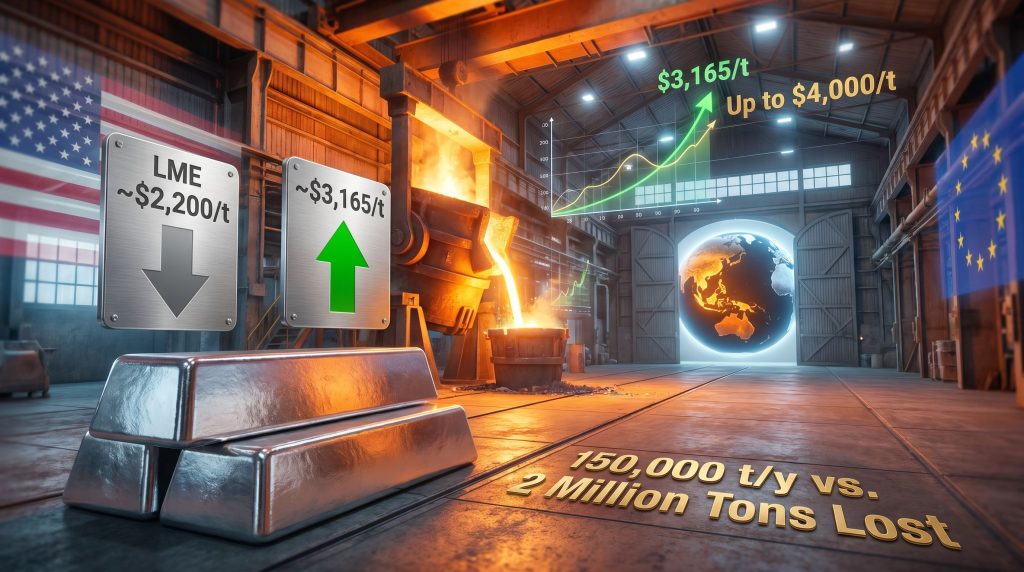
| LME Aluminium Price (start of 2024) | ~$2,200/t |
| LME Aluminium Price (mid-2026) | ~$3,165/t |
| US Delivery Premium (post-tariff) | $2,375/t over LME basis |
| Import Tariff Rate (Trump administration) | 50% (doubled from prior level) |
| Analyst Price Forecast (sustained disruption) | Up to $4,000/t |
The Trump administration's decision to double aluminium import tariffs to 50% has created a structural price floor for US domestic producers by inflating the delivered cost of imported metal. However, industry observers note that tariff protection alone is insufficient to make a smelter restart viable. The underlying LME basis price recovery from $2,200/t to $3,165/t is equally important, as it reflects genuine physical market tightness rather than simply a policy-constructed premium. The broader trade wars and tariffs environment of 2025 set the conditions for this dramatic shift in domestic production incentives.
Slovalco, Slovakia: Europe's Tentative Step Toward Smelting Sovereignty
Across the Atlantic, the Slovalco smelter in Slovakia represents Europe's most significant primary aluminium restart attempt since the post-2022 capacity collapse. The facility is jointly owned by Hydro, which holds a 55.3% controlling stake, and Penta Investments Group, which holds the remaining 44.7%.
The planned restart covers 75,000 tonnes per year of the facility's total capacity. A further 100,000 tonnes per year of remaining capacity has been explicitly conditioned on the evolution of EU Emissions Trading System (ETS) framework conditions beyond 2030, combined with additional power supply agreements being secured.
The enabling conditions for the initial restart rest on two pillars:
- A new power supply agreement with Vodohospodarska Vystavba, Slovakia's state-owned hydropower utility, providing the necessary energy cost structure
- A compensation mechanism for indirect carbon costs under the EU Emissions Trading System, which remains subject to European Commission approval
The Slovalco case illustrates a broader European dilemma with uncomfortable clarity. The continent shed roughly half its primary aluminium smelting capacity after 2022, yet the fundamental energy pricing and regulatory environment that drove those closures has not been structurally reformed. The restart is viable only because of bespoke, facility-specific arrangements, not because underlying market conditions have normalised for European smelters.
The contrast with the US restart model is instructive. American smelter economics rest primarily on tariff-driven price protection layered over a genuine LME price recovery. European smelter economics depend on state-facilitated energy deals and carbon cost compensation, fragile frameworks that must be negotiated individually and remain subject to regulatory approval processes. The Alcoa downgrade impact on aluminium markets further illustrates how precarious the broader aluminium sector remains even amid this partial recovery.
The Indonesian Wildcard: Chinese Capital Building the Next Supply Surplus
While Western policymakers celebrate the symbolic return of 150,000 tonnes per year of combined smelting capacity, a far larger structural force is assembling on the other side of the global supply ledger.
Chinese capital is funding an ambitious build-out of greenfield primary aluminium smelting capacity in Indonesia, effectively creating a new low-cost production hub that sits outside China's domestic capacity ceiling while leveraging Chinese technical and financial resources.
| Project | Capacity | Status |
|---|---|---|
| Juwan (Indonesia) | 270,000 t/y | Reached full capacity January 2026 |
| Adaro Joint Venture (Indonesia) | 500,000 t/y (scaling to 1.5Mt/y) | First exports shipped June 2026 |
| Broader Indonesia pipeline | 10+ million t/y (long-term) | Under development |
The Adaro joint venture, which made its first export shipments in June 2026, has stated ambitions to scale from its initial 500,000 t/y toward 1.5 million tonnes annually. Indonesia's broader national production pipeline could potentially deliver over ten million tonnes of new annual capacity over the coming years, according to industry tracking data from Macquarie Bank and trade data platform Export Genius.
The timeline asymmetry here is critical for market participants to understand. Western restarts are delivering modest near-term relief measured in tens of thousands of tonnes. Indonesian greenfield capacity is building toward a structural oversupply condition from 2027 onward measured in millions of tonnes. Mining.com's analysis of how Iran's conflict has exposed the fragility of the Western aluminium market offers further context on why this structural realignment matters so profoundly.
Three Scenarios for the Aluminium Market Through 2028
The trajectory of global aluminium markets from this point hinges primarily on what happens next in the Middle East. Three distinct scenarios merit consideration:
Scenario 1: Prolonged Conflict, Sustained Deficit
Gulf smelters remain constrained beyond 2026, LME prices test the $4,000/t level, and additional Western smelter restarts become economically viable. Indonesian capacity ramp-up partially offsets but cannot immediately replace Gulf volumes.
Scenario 2: Rapid De-escalation, Sharp Price Reversal
Gulf facilities return to partial or full operation within 12 to 18 months. The war premium unwinds abruptly, LME prices retreat, and further Western restarts stall. Indonesian capacity enters a market that no longer requires it, creating a new oversupply cycle reminiscent of pre-2026 conditions.
Scenario 3: Partial Normalisation with Structural Realignment
Gulf production recovers partially but permanently loses pre-conflict market share. Western policy frameworks around tariffs, carbon compensation, and green energy agreements mature into more durable structures. Indonesia emerges as the dominant swing producer, and LME prices stabilise in a $2,800 to $3,200 per tonne range that sustains a narrow but viable operating window for Western smelters.
It is worth noting that the LME aluminium price has already demonstrated sensitivity to de-escalation signals, selling off meaningfully on reports of potential peace negotiations before recovering as renewed US bombing campaigns and Iranian retaliation reasserted the conflict premium. The green steel pricing and low-carbon metals market trends will also shape the longer-term policy environment around Western smelter viability.
Implications for Industrial Buyers and Procurement Strategy
Short-Term Pressures Cascading Through Supply Chains
The US delivery premium of $2,375 per tonne above the LME basis price is not an abstraction for downstream manufacturers. For automotive suppliers, aerospace fabricators, and construction product manufacturers, it represents a direct input cost increase that is difficult to pass through to end customers in competitive markets.
Key short-term risks for procurement teams include:
- Margin compression for fabricators and manufacturers with fixed-price customer contracts
- Inventory depletion at the LME warehouse level reducing the buffer available to manage short-term supply gaps
- Spot market premiums remaining elevated even if the LME basis price softens, given the structural tariff component in the US market
Long-Term Strategic Considerations
For procurement professionals and supply chain strategists, the current disruption offers several longer-term lessons worth internalising:
- The case for locking in multi-year supply agreements with domestic or near-shore producers while restart capacity is available and before Indonesian volumes reshape the competitive landscape
- Evaluating the durability of the US tariff regime as a structural feature of trade policy rather than a transient political tool, given the bipartisan political appetite for industrial sovereignty
- Monitoring EU ETS framework evolution beyond 2030 as a leading indicator of whether European smelters can sustain operations or will face renewed closures
- Building scenario-based procurement models that account for the possibility of rapid price reversal if Gulf supply normalises faster than current market pricing assumes
The next major ASX story will hit our subscribers first
Frequently Asked Questions: Aluminium Supply Shock and Western Smelter Restarts
What caused the current aluminium supply shock?
The primary trigger is the disruption to Gulf aluminium production resulting from the Iran conflict, which escalated in February 2026. Direct damage to smelting infrastructure and logistics constraints have removed an estimated two million tonnes of annualised production from the global market, converting a previously oversupplied market into a deficit condition.
How much has the aluminium price increased?
The LME aluminium price rose from approximately $2,200 per tonne at the start of 2024 to around $3,165 per tonne by mid-2026. Analyst projections, including assessments from Macquarie Bank, suggest prices could approach $4,000 per tonne if Gulf supply disruptions persist without resolution.
Why are Western smelters only now restarting if prices have risen?
Smelter restarts require a confluence of conditions beyond elevated prices. Viable energy supply agreements, regulatory clearances, environmental compliance pathways, and in some cases policy support such as tariff protection or carbon cost compensation must all align simultaneously. These enabling conditions have only recently converged for facilities like New Madrid and Slovalco.
Will Indonesian capacity undermine the Western smelter revival?
In the medium to long term, the scale of Chinese-backed Indonesian smelting investment, potentially exceeding ten million tonnes per year of new capacity, represents a structural counterweight to Western restart ambitions. The critical question is timing: Indonesian capacity delivery extends beyond the current supply crisis window, but its medium-term effect on global pricing cannot be ignored.
What happens to Western smelters if the Iran conflict de-escalates?
US smelters benefit from tariff protection that partially insulates them from a price reversal. European smelters are more exposed to LME price movements and remain dependent on bespoke energy and carbon arrangements. A rapid de-escalation would likely stall further European restart activity while US operations retain a narrower but viable margin floor.
Aluminium as a Barometer of Industrial Sovereignty: The Bigger Picture
The fact that aluminium supply shock revives Western smelters as a mainstream policy discussion is itself significant. It is demonstrating, in real time and at considerable economic cost, the strategic price of decades of deindustrialisation in Western primary metals production.
The combined New Madrid and Slovalco restarts total just 150,000 tonnes per year. Against the two million tonnes of Gulf capacity lost and the ten-plus million tonnes of Indonesian capacity in the pipeline, that figure is volumetrically insignificant. Its significance is political, strategic, and symbolic: a signal that the calculus around domestic industrial capacity is shifting in Washington and Brussels alike.
Whether that shift produces durable policy frameworks capable of sustaining Western smelting through the next cycle, or merely represents an opportunistic response to a temporary crisis, will be answered not by the current price rally but by the legislative and regulatory decisions made in the next two to three years.
The aluminium supply shock revives Western smelters narrative in 2026 is less an anomaly than an accelerant of structural forces that were already building. For investors, policymakers, and industrial buyers, the current window offers a rare opportunity to observe those forces in their most visible and unambiguous form.
Disclaimer: This article contains forward-looking statements, price forecasts, and scenario analyses drawn from publicly available market data and industry reporting. These projections involve inherent uncertainty and should not be construed as financial or investment advice. Readers should conduct independent due diligence before making procurement, investment, or strategic decisions based on commodity market conditions.
Want to Stay Ahead of the Next Major Commodity Disruption?
Discovery Alert's proprietary Discovery IQ model scans ASX announcements in real time, instantly identifying significant mineral discoveries across aluminium, copper, and 30+ other commodities — turning complex market signals into clear, actionable investment opportunities. Explore how historic discoveries have generated substantial returns on Discovery Alert's dedicated discoveries page, and begin your 14-day free trial today to position yourself ahead of the next major market shift.