
July 10, 2026
The Geopolitics of Capital: Why the Race for Critical Minerals Is Redrawing Trade Maps
The global energy transition has quietly become one of the most consequential forces reshaping diplomatic and commercial relationships in the modern era. Nations that once engaged purely on the basis of ideology or security alliances are now recalibrating their partnerships around something far more tangible: access to the raw materials that underpin batteries, electric vehicles, clean energy infrastructure, and advanced manufacturing.
This shift is producing unexpected alignments. Countries with vast mineral wealth are finding new relevance, while those holding financial capital are actively seeking pathways into resource supply chains they previously had little reason to pursue. Against this backdrop, the deepening of Canada-Saudi mining and energy ties represents one of the more strategically significant bilateral developments of 2026, and one that carries implications well beyond the two nations involved.
When big ASX news breaks, our subscribers know first
What Is Actually Driving Canada's Outward Trade Push?
The Tariff Pressure Forcing a Strategic Rethink
For decades, Canada's trade architecture was built on the assumption of relatively stable access to its largest neighbour's market. That assumption has been tested repeatedly in recent years by shifting US trade policy, and Canadian exporters across multiple sectors have absorbed the consequences of tariff volatility.
The response from Ottawa has been deliberate: a structured effort to diversify trade relationships across the Middle East, Asia, and Europe, reducing the concentration risk embedded in Canada's economic relationship with the United States. Prime Minister Mark Carney's visit to Saudi Arabia, the first by a Canadian head of government in 26 years, sits within this broader strategic reorientation.
What makes the Saudi pivot particularly notable is the combination of factors converging simultaneously: a receptive Gulf partner actively seeking to diversify its own economy, a bilateral relationship recently restored after a serious rupture, and a global race for critical mineral supply chain positioning that gives Canadian resource expertise real market value.
Canada's Export Profile: Where the Opportunity Lies
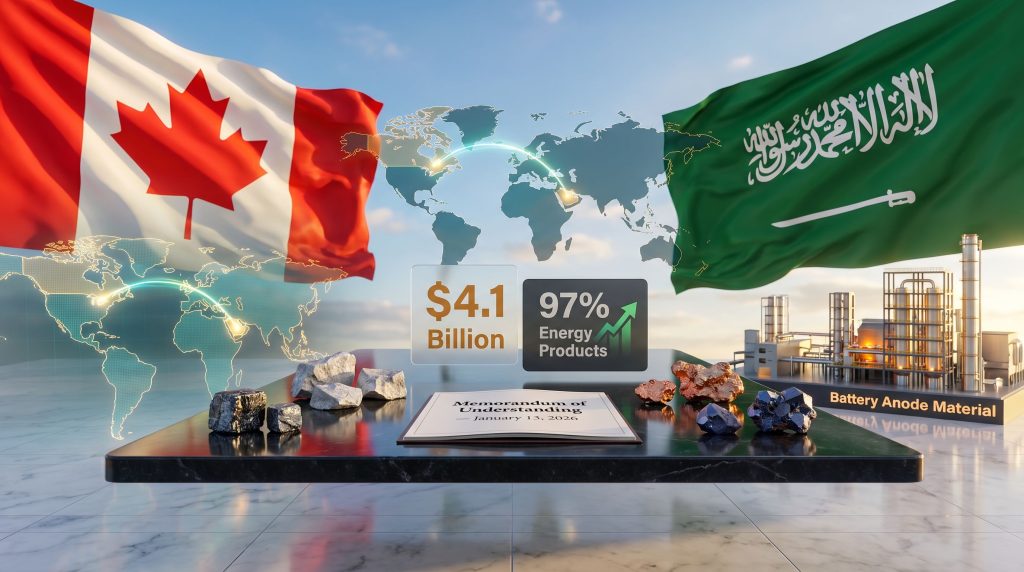
The existing trade relationship between the two countries is significant but structurally lopsided. Two-way merchandise trade reached approximately $4.1 billion in 2024, with Saudi Arabia ranking as Canada's largest trading partner across the entire Middle East and North Africa region. Yet the composition of that trade reveals the untapped potential clearly.
| Canadian Export Category | Current Role in Saudi Trade |
|---|---|
| Defence products | Established export stream |
| Aircraft and aerospace components | Active trade relationship |
| Motor vehicles | Existing bilateral flow |
| Pharmaceuticals | Growing export category |
| Industrial machinery | Emerging opportunity |
| Critical minerals and processing | Strategic development focus |
Energy products account for more than 97% of Canadian imports from Saudi Arabia, predominantly crude oil. This concentration highlights a structural imbalance that both governments appear motivated to address. The new bilateral framework explicitly targets critical mineral cooperation and capital flows as the mechanism for rebalancing. Furthermore, the broader context of critical minerals and energy security makes this rebalancing effort particularly timely for both nations.
The 2018 Rupture and the Long Road Back to Engagement
Understanding the significance of the current engagement requires context. A serious diplomatic dispute erupted in 2018, triggered by Canada's public criticism of Saudi Arabia's human rights record. The fallout was swift and damaging: Saudi students were recalled from Canadian universities, Saudi investments were redirected, and bilateral trade flows were disrupted.
Full diplomatic ties were not formally restored until 2023, a five-year gap that cost both sides meaningful economic opportunity. The reactivation of the relationship since then has been deliberate and measured, culminating in Carney's visit and the institutional frameworks announced in early 2026.
This history matters for investors and businesses assessing the durability of the current engagement. The 2018 episode demonstrated how rapidly bilateral relations can deteriorate when political flashpoints emerge. Carney publicly acknowledged that Saudi Arabia does not fully share what he described as Canadian values, a candid recognition of the ideological distance between the two governments. Both sides have nonetheless adopted a pragmatic, interest-based framework, prioritising economic progress over normative alignment.
This approach reflects a broader pattern among Western middle powers navigating relationships with Gulf states, finding workable structures that advance national economic interests without requiring full convergence on political values.
What the January 2026 MoU Framework Actually Establishes
Institutional Architecture for a New Phase of Cooperation
The formal Memorandum of Understanding signed on January 13, 2026, at the Future Minerals Forum in Riyadh established something more substantive than a declaration of intent. It created a structured cooperation framework with specific institutional mechanisms designed to generate and manage bilateral economic activity over the medium to long term.
Key elements of the framework include:
- A Foreign Investment Promotion and Protection Agreement (FIPA) negotiation process, which would provide legal certainty and investor protections for companies deploying capital across both jurisdictions
- Reactivation of the Joint Economic Commission (JEC), a previously dormant bilateral body being revived to provide an ongoing institutional platform for project coordination
- Explicit alignment of Canadian mineral supply chain capabilities with Saudi Arabia's Vision 2030 industrial diversification programme
- A focus on ESG-compliant resource development, an area where Canada's mining sector has established international credibility that aligns with Saudi Arabia's growing attentiveness to international sustainability standards
In addition, Saudi exploration licences are increasingly being structured to attract exactly this kind of international partnership, making the MoU's timing strategically well-aligned with Riyadh's own liberalisation agenda.
Why a FIPA Matters More Than Most Coverage Acknowledges
Foreign Investment Promotion and Protection Agreements are often treated as administrative footnotes in bilateral trade coverage, but for mining investors they carry substantial practical significance. A FIPA provides binding legal protections against expropriation, ensures fair treatment for investors from both countries, and establishes dispute resolution mechanisms that operate outside of either nation's domestic courts.
For a Canadian mining company considering capital deployment into a Saudi project, the absence of a FIPA creates meaningful risk. The negotiation of one signals genuine intent by both governments to create conditions where private capital can move with greater confidence. That said, FIPA negotiations are typically multi-year processes involving complex legal frameworks, and the agreement's actual conclusion remains a near-term milestone to watch rather than a completed outcome.
The Northern Graphite and Obeikan Deal: A Commercial Blueprint
Battery Anode Material and Why It Matters
Perhaps the most concrete signal of where Canada-Saudi mining and energy ties are heading is the commercial agreement between Canada's Northern Graphite and Saudi Arabia's Obeikan Investment Group to develop a Battery Anode Material (BAM) processing facility in Saudi Arabia.
Battery anode material deserves explanation for those outside the battery supply chain. In a lithium-ion battery, the anode is the electrode that absorbs and releases lithium ions during charging and discharging cycles. Natural and synthetic graphite are the dominant anode materials currently used at commercial scale, with natural graphite accounting for a significant share of global anode supply. The processing of raw graphite into battery-grade anode material is technically demanding, energy-intensive, and currently dominated by Chinese producers.
A Saudi-based BAM processing facility, drawing on Canadian graphite expertise, would represent a genuinely new node in global battery material supply chains, one positioned outside of China's current dominance of anode material production.
What Each Party Gains Strategically
The strategic logic of the Northern Graphite and Obeikan collaboration is instructive because it illustrates how the broader bilateral framework is designed to function. However, it is worth noting that the battery metals investment landscape globally is shifting rapidly, adding further urgency to securing new processing nodes outside of China.
- For Canada: An export market for graphite processing technology and feedstock, reducing dependency on US-facing revenue streams while positioning Canadian producers within global battery supply chains
- For Saudi Arabia: Industrial diversification that creates domestic value-added manufacturing capacity in a sector aligned with Vision 2030's clean energy and advanced manufacturing objectives
- For global supply chains: An alternative processing node that Western-aligned battery manufacturers and automakers may actively prefer as they seek to reduce concentration risk in Chinese-dominated supply chains
This last point is underappreciated in most coverage of the deal. The battery materials sector is currently experiencing a structural shift, with manufacturers across North America, Europe, and Japan actively seeking supply chain diversification. A Saudi-Canadian BAM facility could find itself well-positioned to capture demand from this diversification effort.
The Capital-for-Expertise Exchange: A New Investment Model
Where Saudi Capital Could Flow in Canadian Mining
Carney's business forum address framed Saudi investment explicitly as a mechanism to help Canadian mining companies scale development activity that might otherwise face funding constraints. This framing reflects a real dynamic in the Canadian mining sector: abundant geological endowment combined with persistent challenges in attracting sufficient capital to move projects from exploration through to production.
Saudi Arabia's sovereign wealth infrastructure and large industrial conglomerates such as Obeikan represent a substantial capital pool that has historically had limited exposure to Canadian resource development. The bilateral framework is designed to change that equation. Furthermore, Saudi mining licences are being issued at an accelerating pace, signalling the Kingdom's serious intent to build a domestic minerals industry supported by foreign partnerships.
The sectors most likely to attract initial Saudi capital interest include:
- Graphite and battery anode materials directly evidenced by the Northern Graphite and Obeikan agreement
- Lithium and battery metals aligned with Saudi Arabia's electric vehicle and clean energy ambitions under Vision 2030
- Copper and base metals critical for grid infrastructure and industrial electrification programmes globally
- Rare earth elements strategically important for both nations' technology and defence manufacturing supply chains
Consequently, the opportunity to build resilient rare earth supply chains through this partnership could prove to be one of the most enduring strategic benefits of the bilateral framework.
Comparative Positioning in the Global Minerals Race
Canada is not the only resource nation courting Gulf capital, and Saudi Arabia is not the only Gulf sovereign evaluating critical mineral investments. Understanding where Canada sits relative to competing supply nations helps clarify both the opportunity and the competitive pressure.
| Dimension | Canada's Position | Key Differentiator |
|---|---|---|
| ESG compliance standards | High | Preferred by institutional and sovereign investors |
| Critical mineral reserve base | Extensive | Multi-commodity coverage across graphite, lithium, cobalt, nickel, and REEs |
| Processing technology capability | Advanced | Battery materials and refining expertise |
| Geopolitical alignment | Western-aligned | Access to US, EU, and allied market preferences |
| Gulf capital attraction | Emerging | New bilateral frameworks being constructed |
Canada's combination of ESG credentials and Western geopolitical alignment is a genuine differentiator in the Gulf capital attraction competition. Many resource-rich nations can offer mineral endowment, but fewer can offer the institutional stability, regulatory transparency, and market access alignment that Canadian projects provide.
The next major ASX story will hit our subscribers first
Key Risks That Investors and Analysts Should Monitor
No bilateral framework of this nature advances without friction, and several structural risks deserve careful attention:
- Diplomatic fragility: The 2018 rupture provides a direct precedent for how quickly relations can deteriorate over political disagreements. Future human rights incidents or geopolitical events involving either country could disrupt the framework
- FIPA timeline uncertainty: Legal negotiation of investor protection agreements typically spans multiple years; the absence of a concluded FIPA continues to represent a risk for early-moving investors
- Commodity price volatility: Fluctuations in graphite, lithium, and base metal prices directly affect the commercial viability of projects underpinning the bilateral framework
- Domestic political scrutiny: Canadian civil society and parliamentary opposition may challenge the depth of engagement with Saudi Arabia on human rights grounds, creating pressure on the government's ability to sustain the relationship
- Geopolitical headwinds: Shifting US trade policy, Middle East regional tensions, and evolving Canadian domestic politics introduce uncertainty into long-term bilateral commitments
Frequently Asked Questions: Canada-Saudi Mining and Energy Ties
When Was the Canada-Saudi MoU on Critical Minerals Signed?
The MoU was signed on January 13, 2026, at the Future Minerals Forum in Riyadh, establishing a cooperation framework targeting critical mineral supply chain security and sustainable resource development. Canada's official announcement provides further detail on the framework's scope and objectives.
What Is the Total Value of Two-Way Trade Between Canada and Saudi Arabia?
Bilateral merchandise trade reached approximately $4.1 billion in 2024, with Saudi Arabia representing Canada's largest trading partner across the Middle East and North Africa region.
What Is the Northern Graphite and Obeikan Collaboration?
It is a commercial agreement to develop a Battery Anode Material processing facility in Saudi Arabia, combining Canadian graphite processing expertise with Saudi industrial investment capital.
What Is a FIPA and Why Does It Matter for Mining Investors?
A Foreign Investment Promotion and Protection Agreement provides binding legal protections for investors operating across both jurisdictions, covering expropriation risk, fair treatment standards, and independent dispute resolution mechanisms.
Why Did Canada-Saudi Relations Deteriorate in 2018?
A diplomatic dispute arose from Canada's public criticism of Saudi Arabia's human rights practices, causing a significant breakdown in bilateral ties that was formally resolved in 2023.
What Comes Next: Near-Term Milestones to Watch
The trajectory of Canada-Saudi mining and energy ties over the next two to three years will be shaped by several observable milestones. Reporting from Reuters confirms that Carney's July 2026 visit marked a clear intensification of the bilateral agenda, with concrete commercial outcomes expected to follow.
- Progress on FIPA negotiations will serve as the clearest institutional signal of how substantive the partnership becomes at the investor level
- The Joint Economic Commission reactivation is expected to generate a structured pipeline of bilateral project opportunities
- Advancement of the Northern Graphite and Obeikan BAM facility from agreement to construction will function as an early proof-of-concept for the broader framework's commercial credibility
- Additional Canadian mining companies are likely to explore Gulf capital relationships as the bilateral framework matures and produces visible results
If the FIPA concludes successfully and early commercial projects demonstrate viability, the Canada-Saudi partnership could become a reference model for how Western resource nations structure engagement with Gulf sovereign capital in the critical minerals space. The implications of that outcome would extend well beyond the two countries themselves, influencing how similar frameworks are negotiated and structured across the global minerals landscape.
This article is for informational purposes only and does not constitute financial or investment advice. Forward-looking statements involve inherent uncertainty, and outcomes may differ materially from those projected. Readers should conduct independent due diligence before making investment decisions. Further context on global critical mineral competition and Canada's trade diversification strategy is available through Mining Weekly at miningweekly.com.
Want to Track the Next Major Critical Mineral Discovery Before the Market Moves?
As nations race to secure critical mineral supply chains, Discovery Alert's proprietary Discovery IQ model delivers real-time ASX mineral discovery alerts, turning complex geological announcements into clear, actionable investment insights — explore historic discoveries and their returns to understand the opportunity, then begin your 14-day free trial at Discovery Alert to position yourself ahead of the market.