
July 10, 2026
The Arithmetic of Exposure: Why One Waterway Holds Global Energy Markets Hostage
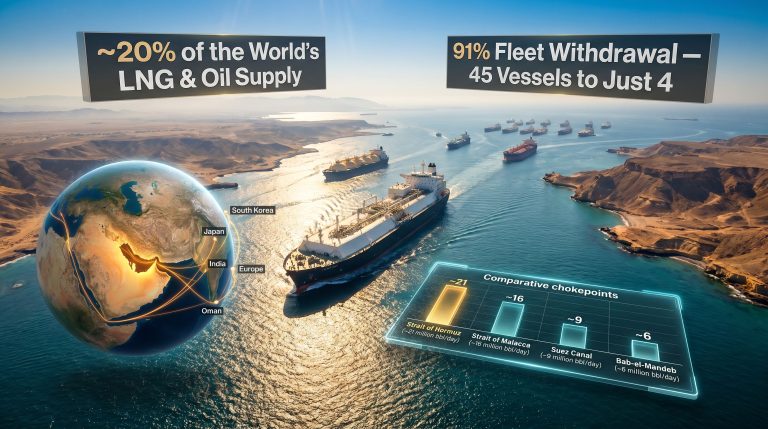
Energy markets carry a structural vulnerability that analysts acknowledge but markets routinely underprice: the concentration of global hydrocarbon flows through a handful of narrow maritime passages. Of these, none carries more systemic weight than the Strait of Hormuz. Roughly 20% of the world's total oil supply moves through a corridor measuring just 33 kilometres at its narrowest point, alongside substantial volumes of LNG, LPG, and petrochemical feedstocks. When Strait of Hormuz shipping tensions fracture stability in this passage, the consequences ripple far beyond crude oil pricing, touching freight markets, fertiliser supply chains, and ultimately, food prices on the other side of the planet.
What makes Hormuz categorically different from other geopolitical flashpoints is the combination of volume dependency and geographic irreplaceability. At peak activity, the strait was processing up to 140 vessel crossings per day, a figure that has since collapsed by approximately 23% from its pre-conflict peak. No pipeline network, no alternative sea route, and no combination of reserve releases can fully absorb that volume on short notice.
When big ASX news breaks, our subscribers know first
Why Geography Gives Iran Structural Leverage That Diplomacy Cannot Easily Overcome
Understanding Strait of Hormuz shipping tensions requires appreciating why geography itself functions as a geopolitical asset. Iran occupies the dominant position along the strait's northern coastline, with the Musandam Peninsula of Oman forming the opposing southern shore. The navigable channel within the strait is constrained by depth and width to two designated shipping lanes, each approximately 3.2 kilometres wide, separated by a median zone. This means all meaningful commercial traffic is funnelled through a space that Iran can monitor, threaten, and interdict with asymmetric military capabilities including mines, fast attack craft, shore-based missiles, and surveillance drones.
This asymmetry is strategically significant. Iran does not need naval parity with the United States to impose economic damage through the strait. It requires only the credible capacity to raise risk levels enough to deter commercial operators and inflate insurance costs beyond operational viability for smaller shipping firms.
Pipeline bypass options exist but are structurally limited. Abu Dhabi's Crude Oil Pipeline (ADCOP) can transport approximately 1.5 million barrels per day, and Saudi Arabia's East-West Pipeline offers additional capacity toward Red Sea terminals. However, combined, these alternatives cannot replace the full volume of hydrocarbons currently dependent on Hormuz transit, and they serve only crude oil, leaving LPG, LNG, and refined product flows with no meaningful bypass option at scale. Furthermore, the influence of OPEC market influence over production decisions adds another layer of complexity to any supply-side response.
How Stability Collapsed: The Sequence That Fractured a Fragile Arrangement
A temporary restoration of transit routes had allowed Brent crude prices to fall below $70 per barrel in June 2026, a development that briefly suggested de-escalation was taking hold. That period of relative calm proved short-lived. Vessel attacks resumed in early July, and the strategic geography of the conflict shifted in a meaningful way.
On the night of 6-7 July 2026, a series of incidents rapidly destroyed the assumption that alternative routing provided a safe workaround:
- IRGC missile strikes targeted a Qatari LNG tanker and a Saudi crude carrier during overnight operations.
- A vessel fire off the Omani coast was attributed to projectile impact from an unidentified source.
- A ship moored off the UAE coast was seized and reportedly redirected toward Iranian territorial waters.
- An Indian-flagged cargo vessel was sunk near Oman following a direct assault, introducing an explicit national security dimension for New Delhi.
- U.S. naval forces disabled Iranian oil tankers in a separate engagement, citing blockade enforcement operations.
The targeting of the Omani shipping corridor carries particular strategic significance. This southern route had been actively promoted as a lower-risk alternative to direct Hormuz transit. Its deliberate targeting signals that Iran is pursuing a strategy of route elimination rather than simple chokepoint control, systematically closing off any commercially viable workaround that would allow shipping operators to bypass Iranian leverage entirely. Strait of Hormuz shipping risk has consequently been raised to severe by major maritime monitoring bodies.
The Diplomatic Deadlock: Incompatible Positions With No Visible Resolution Path
The core diplomatic fault line is not a minor technical disagreement. It is a foundational conflict between two mutually exclusive frameworks of international maritime law.
Iran's negotiating position rests on several interconnected demands:
- Formal international recognition of Iranian sovereignty over the Strait of Hormuz as a precondition for any peace framework
- Compensation payments for damages sustained during the conflict
- Institutionalised IRGC authority over vessel passage coordination
- Transit fee structures reported at up to $2 million per vessel
- A prohibition on military vessel transit through the strait
Each of these conditions directly contradicts the principle of innocent passage enshrined in the United Nations Convention on the Law of the Sea (UNCLOS). The United States has rejected the entire framework, correctly identifying that accepting transit fees would create a precedent with global implications. If a strategically positioned coastal state can commercially monetise a natural waterway classified under international law as an international strait, similar claims could theoretically emerge from other chokepoint-adjacent nations worldwide.
Diplomatic talks held in Qatar concluded without any binding agreement. Iran's Supreme Leader has publicly indicated the strait will remain blocked under present conditions, while Washington has declined to take military re-engagement off the table. This dual hardening of positions is the defining feature of the current impasse.
The diplomatic window is not merely narrow. The structural incompatibility of each side's core position means that any resolution requires one party to make a concession that fundamentally contradicts its stated legal and strategic principles.
Market Repricing: What Strait of Hormuz Shipping Tensions Are Doing to Crude and Freight
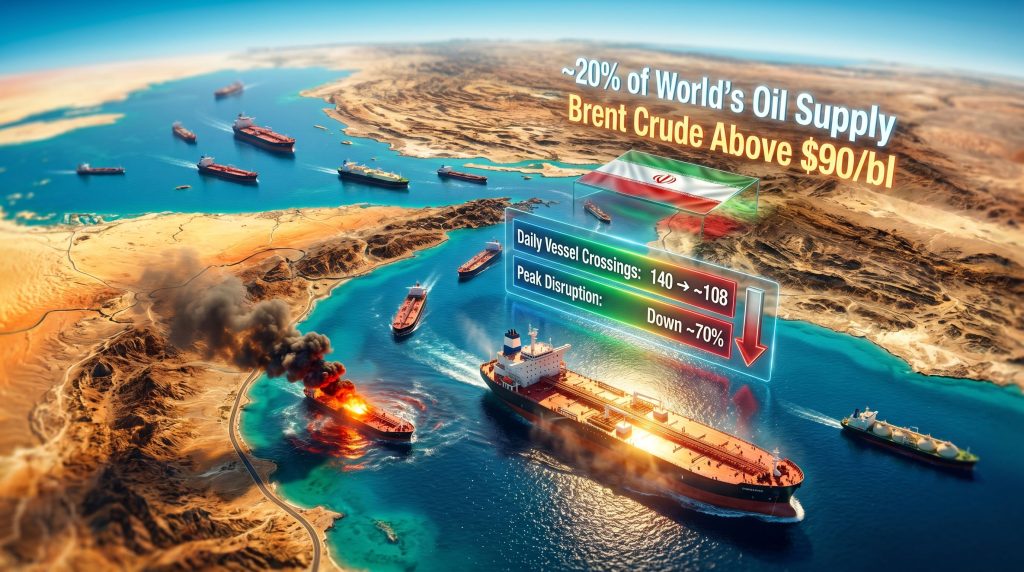
Brent crude prices have climbed above $90 per barrel as geopolitical risk is repriced into forward markets. The contrast with the sub-$70 level seen during June's temporary stabilisation illustrates the direct market sensitivity to Hormuz transit conditions with unusual clarity. In addition, crude oil price trends had already been under pressure before this escalation, leaving markets with limited room for further adjustment.
The collapse in vessel traffic tells its own story:
| Metric | Pre-Conflict Level | Current Level | Change |
|---|---|---|---|
| Daily vessel crossings | Up to 140 ships/day | ~108 crossings/week (recent) | ~23% reduction from peak |
| Peak disruption (post-Operation Epic Fury) | Baseline | Down ~70% at maximum disruption | Severe contraction |
| Route preference shift | Southern Omani corridor | ~50% diverted to northern Larak Island route | Significant forced diversion |
The split in routing preferences reflects a direct geopolitical conflict embedded into everyday shipping operations. Nearly half of vessels currently transiting the strait are using the northern passage past Iran's Larak Island, which Iran considers the legitimate route under its proposed sovereignty framework. The U.S. supports the southern Omani corridor as the correct freedom-of-navigation pathway. With the Omani corridor now under direct attack, operators face a forced binary choice between two options, neither of which is operationally safe.
War Risk Insurance: The Cost That May Close the Strait Without a Physical Blockade
One of the least-discussed but most consequential dimensions of Strait of Hormuz shipping tensions is the role of maritime war risk insurance in determining whether commercial traffic continues at all. Physical risk and insured risk are not the same variable, and the latter may prove to be the more effective deterrent.
War risk premiums have escalated sharply in response to confirmed vessel attacks, seizures, and sinkings. Lloyd's of London and specialist marine underwriters set the threshold pricing that determines whether shipping operators can economically justify transiting the region. As premiums rise, smaller operators with thinner margins face a straightforward calculation: the cost of insurance may exceed the revenue from the voyage.
If war risk premiums continue escalating, the effective closure of the strait may be achieved through insurance economics rather than physical interdiction, concentrating traffic among larger, better-capitalised fleets and functionally restricting the volume of tradeable cargo.
This dynamic has a compounding effect on freight rates. Vessels diverting around the Arabian Peninsula or taking longer alternative corridors add significant voyage days, which directly increases per-barrel transportation costs. Those additional freight costs flow through to landed energy prices in Asia, Europe, and South Asia, functioning as a de facto supply tax on importing economies.
The next major ASX story will hit our subscribers first
Beyond Crude Oil: The Underappreciated Commodity Exposures
LPG and NGL Markets
LPG flows from Gulf producers to Asian buyers represent one of the most concentrated bilateral commodity trades in the world. South Korea, Japan, and India collectively import enormous LPG volumes that transit Hormuz, primarily for use as petrochemical feedstock and residential fuel. Under extended transit restrictions, propane and butane benchmarks face upward price pressure, with downstream cost increases flowing into ethylene and propylene production economics across Asian petrochemical complexes. This is a frequently overlooked transmission mechanism in standard energy market analysis. Similarly, disruptions to global LNG supply are compounding the pressure on Asian buyers already navigating tight import markets.
Fertiliser Supply Chains and the Food Security Lag
Approximately 30% of global seaborne fertiliser trade transits the Strait of Hormuz, connecting Gulf-based ammonia, urea, and phosphate producers to agricultural markets across Asia and Africa. This exposure is structurally different from crude oil in one important respect: the transmission lag to consumer prices is measured in growing seasons, not trading sessions.
Fertiliser supply disruptions typically take three to six months to manifest as food price inflation at the consumer level, because the agricultural input cycle operates on planting and harvest timelines rather than daily market pricing. This lag effect means that the food security consequences of a prolonged Hormuz disruption may be invisible in headline inflation data for months, before appearing suddenly and sharply.
How Asia Is Managing Disproportionate Exposure
Asian economies collectively account for the largest share of Gulf crude imports that transit Hormuz. China, India, Japan, and South Korea each face the tension between energy security imperatives and their respective diplomatic positioning relative to Washington and Tehran.
India's exposure has an additional dimension following the sinking of an Indian-flagged cargo vessel near Oman. This event converts what might otherwise be a purely economic problem into a national security issue requiring a political response, complicating New Delhi's traditionally non-aligned approach to Gulf geopolitics.
Bypass capacity through existing infrastructure remains structurally insufficient:
- ADCOP (Abu Dhabi Crude Oil Pipeline): Approximately 1.5 million barrels per day capacity, crude oil only
- Saudi East-West Pipeline: Partial bypass to Red Sea terminals, crude only
- Combined ceiling: Falls well short of total Hormuz-dependent export volumes
- LNG, LPG, refined products: No viable pipeline bypass exists at any scale
Strategic petroleum reserve releases offer short-term buffering but cannot substitute for sustained transit access. IEA coordinated release mechanisms are calibrated for temporary supply disruptions, not structural chokepoint closures measured in months. Consequently, the trade war oil impact already weighing on global energy markets is being compounded by this transit crisis, creating a uniquely difficult environment for policymakers.
Scenario Analysis: Three Trajectories for the Hormuz Crisis
Scenario 1: Negotiated Framework (Low Probability)
Resolution would require the U.S. to accept modified sovereignty language that stops short of formalising transit fees, and Iran to accept demilitarisation of the passage without receiving the institutional recognition it has demanded. If achieved, Brent crude could normalise rapidly toward sub-$75/bl, and freight rate compression would follow within weeks. The probability of this outcome in the near term is low given the current rigidity of both positions.
Scenario 2: Managed Instability (Base Case)
Ongoing low-level attacks continue alongside partial transit, elevated but non-catastrophic insurance costs, and crude prices ranging between $85-$100/bl with periodic spike events tied to individual incidents. This scenario most closely matches the current trajectory as of July 2026 and is simultaneously the most likely and the most operationally dangerous outcome precisely because it is sustainable enough to persist without forcing resolution. The oil price rally dynamic observed earlier in 2025 demonstrates just how rapidly energy markets can reprice on geopolitical shock alone.
Scenario 3: Full Closure or Direct Military Escalation (Tail Risk)
Trigger conditions include a major vessel loss involving a great-power-flagged ship or U.S. military re-engagement at scale. Under this scenario, Brent crude could exceed $120-$130/bl, LPG and fertiliser markets face severe dislocation, and cascading effects on Asian manufacturing costs, European energy import budgets, and global food price indices would materialise within weeks. For real-time vessel movement data, live strait monitoring platforms have become essential tools for shipping operators and energy traders alike.
The base case of managed instability deserves more analytical attention than it typically receives. It is precisely its sustainability that makes it dangerous. Unlike a shock event that forces resolution, chronic low-level disruption can persist for months, structurally repricing global energy logistics without triggering the political urgency required to resolve the underlying conflict.
The Structural Question: Has the Pre-War Hormuz Assumption Been Permanently Invalidated?
Before this conflict, energy markets and shipping operators priced Hormuz transit as a stable, low-risk operational assumption. That assumption has been structurally invalidated regardless of how the current crisis resolves. Insurance markets, freight operators, and energy importers are now pricing in a persistent risk premium that will not fully disappear even if a ceasefire is reached, because the demonstrated willingness to attack vessels in this corridor has reset the baseline risk perception permanently.
The Iran-Iraq Tanker War of 1984 to 1988 provides the closest historical precedent. Even under sustained conflict conditions, complete physical closure proved difficult to maintain indefinitely. However, that historical episode also demonstrated that partial closure through elevated attack frequency and insurance cost escalation can function as an effective economic blockade without requiring physical interdiction of every vessel. The current situation bears uncomfortable structural similarities.
Long-term, the Hormuz crisis is likely to accelerate infrastructure investment in bypass pipeline capacity, alternative port development on non-Hormuz-dependent coastlines, and supply chain diversification strategies among Asian energy importers. These investments will proceed regardless of diplomatic outcomes, because the risk that markets had previously discounted has now been made undeniably visible.
Frequently Asked Questions: Strait of Hormuz Shipping Tensions
What percentage of global oil passes through the Strait of Hormuz?
Approximately 20% of the world's total oil supply, alongside significant LNG, LPG, and refined product volumes, transits the Strait of Hormuz, making it the single most consequential maritime passage in global energy trade.
Why can't ships simply use an alternative route?
While partial bypass options exist through the Abu Dhabi Crude Oil Pipeline and Saudi Arabia's East-West Pipeline, their combined capacity is structurally insufficient to replace the full volume of hydrocarbons currently dependent on Hormuz transit. LNG, LPG, and refined products have no viable large-scale pipeline alternative. Longer sea routes around the Arabian Peninsula add significant voyage time, cost, and vessel availability constraints.
How have Strait of Hormuz tensions affected oil prices in 2026?
Brent crude has risen above $90 per barrel as geopolitical risk premiums have been repriced into the market. A temporary stabilisation had brought prices below $70/bl in June before renewed escalation reversed those gains, illustrating direct market sensitivity to transit conditions.
What is Iran's position on the Strait of Hormuz?
Iran asserts sovereign authority over the strait and has demanded formal international recognition of that sovereignty, alongside transit fees of up to $2 million per vessel, IRGC coordination authority over vessel passage, and a ban on military ship transit, as preconditions for any diplomatic resolution.
What happened to the Omani shipping corridor?
The Omani corridor, previously positioned as a lower-risk alternative to direct Hormuz transit, was targeted by attacks on 7 July 2026, effectively removing it as a safe diversion option and forcing operators onto the northern Larak Island route preferred by Iran.
How does this affect fertiliser and food prices?
Approximately 30% of global seaborne fertiliser trade transits Hormuz. Disruption to ammonia and urea exports translates into higher agricultural input costs for farmers across Asia and Africa, with the food price inflation impact typically appearing at the consumer level within three to six months of the initial supply disruption.
This article contains forward-looking analysis and scenario projections based on publicly available information as of July 2026. Commodity price forecasts, scenario probabilities, and market trajectory assessments are analytical in nature and do not constitute financial or investment advice. Readers should conduct independent research and consult qualified advisors before making any investment or commercial decisions based on geopolitical market analysis.
Want to Stay Ahead of Major Commodity Discoveries Driven by Global Market Shifts?
When geopolitical disruptions like the Strait of Hormuz crisis reshape energy and commodity markets at speed, identifying the right investment opportunities requires an edge — Discovery Alert's proprietary Discovery IQ model delivers real-time alerts on significant ASX mineral discoveries, translating complex market conditions into actionable insights for investors at every level. Explore how historic discoveries have generated substantial returns on Discovery Alert's dedicated discoveries page, and begin your 14-day free trial today to position yourself ahead of the next major market move.