
August 13, 2026
The Systemic Crisis of Peru's Shadow Gold Economy
Latin America's mineral-rich nations face an escalating challenge that threatens environmental security, governance structures, and regional stability. Illegal gold mining in Peru has transformed from scattered artisanal operations into a sophisticated shadow economy worth billions of dollars annually. This underground industry operates beyond regulatory oversight, creating complex webs of environmental destruction, public health crises, and territorial control disputes that challenge traditional mining permitting challenges frameworks.
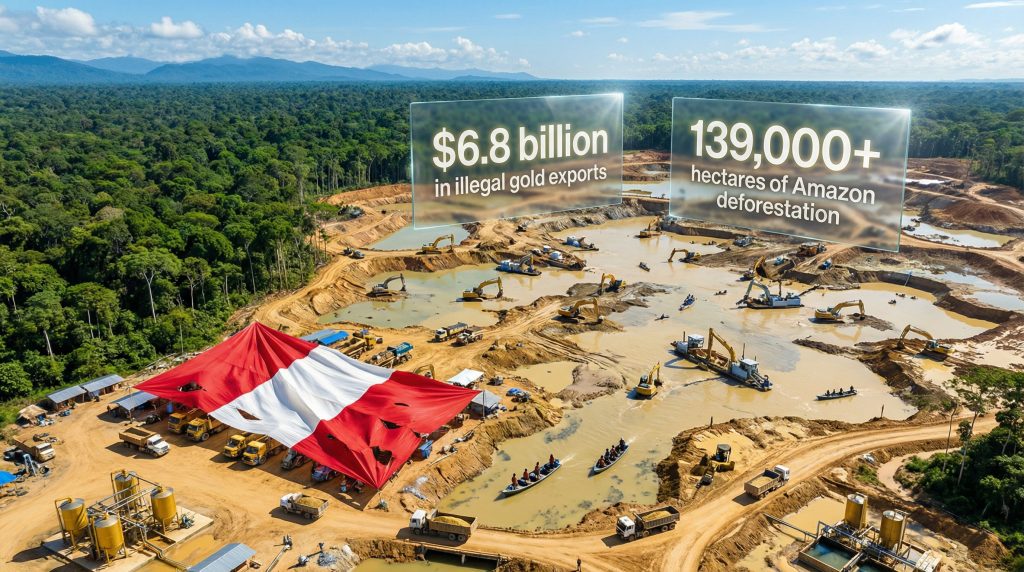
The scale of this challenge extends far beyond simple regulatory enforcement. Contemporary estimates suggest Peru's illegal gold trade generates approximately $6.8 billion in annual revenue, representing a 41% year-over-year growth trajectory that outpaces most legitimate economic sectors. This expansion occurs across nine distinct regions, with operations spanning from the Amazon basin's remote waterways to highland mining corridors where formal projects remain stalled by regulatory delays.
When big ASX news breaks, our subscribers know first
Strategic Policy Vulnerabilities in Peru's Mining Governance
Peru's regulatory architecture contains fundamental structural weaknesses that enable informal mining expansion. The controversial REINFO (Registry of Integral Formalization of Mining Activities) system exemplifies these policy contradictions. Originally designed to transition small-scale operators toward formal compliance, REINFO has instead created a parallel legitimisation pathway that reduces enforcement pressure while maintaining loose oversight requirements.
Critical Regulatory Gaps Include:
- Overlapping territorial jurisdiction between mining concessions and Indigenous territories
- Insufficient state presence in remote Amazon regions
- Weak environmental monitoring across 139,000+ hectares of affected territory
- Limited mercury importation controls despite Minamata Convention obligations
- Inadequate coordination between regional and national enforcement agencies
The invasion of Newmont Corporation's $4.8 billion Conga project in Cajamarca demonstrates how regulatory delays create opportunities for informal occupation. This case study reveals the strategic vulnerability of stalled mega-projects, where permit delays and community opposition create power vacuums that informal miners exploit. Prime Minister Ernesto Alvarez has acknowledged that illegal miners are digging gold at the Conga site, highlighting the government's limited territorial control in contested regions.
Furthermore, the current mining claims framework lacks the adaptability needed to address these complex territorial disputes effectively.
Environmental Security Implications and Regional Impact Assessment
Amazon Deforestation Acceleration Patterns
Madre de Dios region represents the epicentre of Peru's illegal gold mining in Peru environmental crisis. Analysis of satellite data reveals that 135,939 hectares have been deforested across the region, representing 97.5% of Peru's total mining-related forest loss. This concentrated destruction occurs through hydraulic dredging operations that strip topsoil, contaminate water systems, and eliminate biodiversity corridors.
Regional Deforestation Distribution:
| Region | Deforested Area (hectares) | Primary Mining Method | Annual Expansion Rate |
|---|---|---|---|
| Madre de Dios | 135,939 | Hydraulic dredging | 11,500 hectares/year |
| Huánuco | 1,763 | Alluvial extraction | High acceleration |
| Puno | 1,014 | River dredging | Moderate growth |
| Cajamarca | Variable | Underground invasion | Site-specific |
The expansion rate in Madre de Dios alone represents approximately 11,500 hectares of annual forest loss, creating a deforestation velocity that exceeds most agricultural conversion rates. This destruction pattern follows river networks and floodplain areas where gold deposits concentrate, creating linear corridors of environmental damage that fragment remaining forest blocks.
Carbon Release and Climate Impact Modelling
Peatland destruction represents a critical environmental tipping point within Peru's illegal mining crisis. These carbon-rich wetland ecosystems store massive quantities of organic carbon accumulated over thousands of years. Mining operations have destroyed over 550 hectares of peatlands in just two years, exceeding three decades of previous damage from all sources combined.
Carbon Release Scenario Analysis:
- Current Release: 0.2 to 0.7 million tons CO2 equivalent already released
- Expansion Trajectory: Could reach 14.5 million tons if current trends continue
- Regional Impact: Peatland mining could represent 25% of total activity by 2027
- Global Context: Peru's peatland carbon release rivals small nation annual emissions
This carbon release occurs through multiple mechanisms. Direct oxidation of exposed peat releases stored carbon immediately, while ongoing water table disruption continues carbon release for years after initial disturbance. The cumulative climate impact extends beyond Peru's borders, contributing to regional rainfall pattern disruption and Amazon ecosystem stability threats.
Indigenous Community Enforcement and Territorial Defence
The Wampís Self-Defence Model
Indigenous communities have developed autonomous enforcement capabilities that exceed government capacity in remote regions. The Wampís people have established sophisticated patrol systems that combine traditional territorial knowledge with modern communication technologies to monitor and interdict illegal mining operations.
Indigenous Enforcement Metrics (2024):
- Equipment Destroyed: 7 mega-dredges eliminated through community action
- Corruption Interdiction: Multiple corrupt police officials detained by Indigenous patrols
- Geographic Coverage: Operations spanning Amazonas and Loreto border regions
- Resource Constraints: Chronic underfunding limits expansion potential
The Charip patrol system represents a successful community-based intervention model that demonstrates superior local intelligence gathering, cultural legitimacy, and environmental commitment compared to traditional law enforcement approaches. These patrols operate across vast territories where government presence remains minimal, providing real-time monitoring of illegal mining expansion.
Indigenous patrol systems demonstrate effectiveness levels that consistently exceed government enforcement capabilities, yet receive minimal official support or resource allocation despite proven success rates.
However, resource limitations and policy gaps prevent scaling these successful interventions. Indigenous communities lack adequate funding, equipment, and legal authority to expand operations beyond their immediate territories. Government policies have not established formal cooperation frameworks that could leverage Indigenous expertise for broader enforcement strategies.
Public Health Security and Cross-Border Implications
Mercury Contamination Crisis
Illegal gold mining in Peru operations rely heavily on mercury amalgamation for gold extraction, creating widespread environmental contamination that affects public health across multiple river basins. Mercury contamination spreads far beyond mining sites through river transport, bioaccumulation in fish populations, and atmospheric deposition from burning amalgams.
Health Impact Distribution:
- Water Systems: Rivers Nanay (42 active dredgers) and Madre de Dios show severe mercury contamination
- Disease Acceleration: Tuberculosis, leishmaniasis, and leptospirosis outbreaks linked to mining camps
- Population Displacement: Mining boom creates uncontrolled urbanisation with inadequate health infrastructure
- Indigenous Health: 73 Indigenous communities directly affected by mercury contamination
The health crisis extends beyond immediate contamination effects. Mining camps create conditions for infectious disease transmission through overcrowding, poor sanitation, and limited healthcare access. These health security risks spread through population movements between mining areas and urban centres.
Regional Health Security Vulnerabilities
Cross-border mining operations along Peru's boundaries with Ecuador, Colombia, and Bolivia create regional health security challenges that exceed national policy capacity. Additionally, reports indicate that gold mining deforestation continues to accelerate across Peru's Amazon region, exacerbating these health risks.
Transnational Health Risks:
- Mercury Pollution: River systems cross international boundaries carrying contamination downstream
- Disease Vector Expansion: Mining camps create breeding grounds for disease-carrying insects
- Population Movements: Uncontrolled migration between mining areas spreads health risks
- Border Health Monitoring: Weakened surveillance capacity along remote border regions
Economic Incentive Structures and Formal Mining Development
The Conga Project Case Study
The stalled Conga project demonstrates how regulatory delays create economic incentives for illegal mining expansion. Originally valued at $4.8 billion, this Newmont Corporation development received environmental permits in 2010 but faced sustained community opposition that escalated into violent protests. The resulting regulatory paralysis created opportunities for informal miners to occupy project territory.
Prime Minister Alvarez has acknowledged that legal mining delays cede space to illegal operations that use violence and environmental contamination. The rivers originating in the Conga area now suffer mercury contamination from illegal mining activities, creating the environmental damage that formal mining opponents initially sought to prevent.
Alternative Economic Development Strategies
Addressing Peru's illegal gold mining in Peru crisis requires comprehensive economic alternatives that provide sustainable livelihoods in affected regions. Current illegal mining operations employ thousands of workers in areas with limited economic opportunities, creating dependency relationships that complicate enforcement efforts.
Economic Diversification Components:
- Sustainable Agriculture: Development of crop production systems compatible with Amazon ecosystems
- Ecotourism Infrastructure: Creation of tourism circuits highlighting biodiversity and cultural heritage
- Carbon Credit Programs: Payment systems for forest conservation and restoration activities
- Renewable Energy Projects: Solar and hydroelectric development creating local employment
In addition, implementing sustainable mining transformation strategies could provide a pathway for transitioning informal operations into legitimate enterprises.
The next major ASX story will hit our subscribers first
Policy Intervention Framework and Strategic Scenarios
Comprehensive Mercury Phase-Out Strategy
Peru's obligations under the Minamata Convention provide a policy framework for eliminating mercury use in artisanal mining. However, implementation requires coordinated action across import controls, technology transfer, and economic transition support.
Mercury Elimination Timeline (2025-2030):
- Phase 1: Immediate mercury import restrictions and inventory controls
- Phase 2: Clean technology subsidies and training programmes for artisanal miners
- Phase 3: Regional mercury-free processing centres with technical support
- Phase 4: International cooperation programmes for technology transfer
Gold Traceability and Supply Chain Transparency
Blockchain-based traceability systems could transform Peru's gold supply chain by creating transparent tracking from extraction through export. This technology framework would enable real-time monitoring of gold movement and verification of legitimate production sources, especially as gold market trends continue to drive demand for transparent sourcing.
Traceability Implementation Framework:
- Mandatory Tracking: Blockchain recording for all gold production and movement
- Export Certification: Digital certificates required for international gold sales
- Buyer Compliance: International purchaser verification requirements
- Supply Chain Monitoring: Real-time tracking capabilities for enforcement agencies
Long-Term Strategic Implications and National Security Assessment
Sovereignty and Territorial Control Challenges
Illegal mining operations represent a fundamental challenge to state authority in remote regions where government presence remains minimal. Large areas operate under de facto control of mining networks that maintain their own security forces, dispute resolution mechanisms, and economic systems independent of state authority.
National Sovereignty Indicators:
- Territorial Control: Extensive areas under informal miner control with limited state presence
- Revenue Loss: $6.8 billion in untaxed economic activity representing significant fiscal impact
- International Reputation: Environmental destruction damages Peru's global environmental commitments
- Regional Stability: Cross-border operations create diplomatic tensions with neighbouring countries
Climate Change Acceleration and Environmental Feedback Loops
Amazon deforestation from illegal mining creates self-reinforcing environmental degradation cycles that accelerate regional climate change impacts. Forest loss reduces regional rainfall patterns, increases fire susceptibility, and fragments biodiversity corridors essential for ecosystem resilience.
Environmental Feedback Mechanisms:
- Rainfall Reduction: Deforestation decreases regional precipitation patterns
- Fire Vulnerability: Degraded areas become increasingly susceptible to wildfire
- Biodiversity Loss: Corridor fragmentation isolates wildlife populations
- Carbon Sink Reduction: Forest destruction eliminates carbon sequestration capacity
Consequently, mine reclamation innovation becomes increasingly critical for addressing the long-term environmental damage caused by these operations.
Integrated Response Framework and Implementation Pathways
Peru's illegal mining crisis requires coordinated intervention combining immediate enforcement actions with long-term structural reforms. Success depends on simultaneously addressing enforcement capacity, economic alternatives, environmental restoration, and international cooperation.
Priority Implementation Sequence:
- Immediate Actions: Enhanced Indigenous patrol support and mercury import controls
- Medium-Term Reforms: Gold traceability systems and formal mining investment facilitation
- Long-Term Transformation: Economic diversification and environmental restoration programmes
- International Cooperation: Regional enforcement coordination and technology transfer
The window for effective intervention continues to narrow as operations expand and environmental damage accelerates. Strategic policy implementation must prioritise the most effective intervention points while building sustainable alternatives to illegal extraction economies. Without comprehensive action, Peru's illegal gold mining crisis will continue threatening environmental security, public health, and national sovereignty across the Amazon region.
Looking for Mining Investment Opportunities in South America?
Discovery Alert's proprietary Discovery IQ model provides instant alerts on significant ASX mineral discoveries, helping investors identify actionable opportunities before the broader market. Whilst Peru grapples with illegal mining challenges, legitimate mining companies continue making major discoveries that create substantial returns for early investors—discover why historic mineral discoveries have generated exceptional market outcomes and begin your 30-day free trial today to position yourself ahead of the market.