
July 16, 2026
When the World's Safest Asset Becomes a Liability: The Reserve Management Paradox
Every decade or so, the architecture of global reserve management shifts beneath the feet of central bankers who thought they were standing on solid ground. The 1970s ended Bretton Woods and the dollar-gold link. The 2008 financial crisis exposed the fragility of supposedly risk-free sovereign debt. And 2022 demonstrated, with uncomfortable clarity, that Western reserve assets are not immune to geopolitical weaponisation. Russia's foreign exchange reserves, held largely in dollars and euros, were frozen overnight following its invasion of Ukraine, sending a signal to reserve managers worldwide that counterparty risk is never truly zero.
Against that backdrop, gold's safe-haven role has driven its resurgence as a reserve asset, which makes intuitive sense. Yet the IMF gold warning for African central banks, issued on July 9, 2025, complicates that narrative in ways the headlines have not fully captured. The Fund's concern is not with gold itself as a reserve asset. It is with how certain African central banks are acquiring it, and what that acquisition method is doing to their balance sheets, their monetary independence, and their programme review credibility.
Understanding this distinction is essential. Conflating the two leads to precisely the kind of misinformation now circulating online, where viral claims suggest the IMF is attempting to prevent African nations from holding gold altogether. The reality is considerably more nuanced, and considerably more instructive for reserve managers, policymakers, and analysts trying to navigate one of the most complex risk environments in modern central banking history.
When big ASX news breaks, our subscribers know first
The Precise Nature of the IMF's Concern
Procurement Method, Not Asset Class
The July 9 IMF guidance does not instruct African central banks to exit gold positions. It flags a specific operational model: the direct purchase of unrefined bullion from domestic producers, conducted on terms that absorb costs ordinarily borne by private market participants. When a central bank pays above-market prices for raw, unprocessed gold, absorbs refining and assay costs internally, or accepts metal at valuations that diverge from international benchmarks, it generates what economists call a quasi-fiscal loss.
A quasi-fiscal loss is distinct from a conventional budgetary loss. It sits on the central bank's balance sheet rather than being explicitly transferred to the national government's accounts. This matters enormously for several reasons:
- It erodes the institution's financial independence without triggering a visible budget line that parliament or the public can scrutinise
- It creates a transparency deficit that complicates IMF programme reviews, since losses that are not formally recognised cannot be formally addressed
- It can impair the central bank's capacity to conduct orthodox monetary operations if balance sheet deterioration reaches a threshold that undermines institutional credibility
- It blurs the boundary between monetary policy and industrial or trade policy, which is the fundamental governance concern the IMF is raising
Which Countries Are Under Scrutiny
The IMF's concern in this context has been most explicitly documented in two countries: Ghana and Madagascar. Both operate domestic gold purchase programmes that involve unrefined bullion procurement. Both have drawn Fund commentary about the quasi-fiscal risks embedded in those programmes. Critically, the warning does not apply uniformly to all African gold holders. A central bank that holds central bank gold reserves acquired through international market channels, stored at an accredited institution, and valued consistently with global benchmarks, is doing exactly what reserve management best practice recommends.
Ghana's Domestic Gold Purchase Programme: A Study in Trade-Off
Scale, Results, and the Cost the IMF Identified
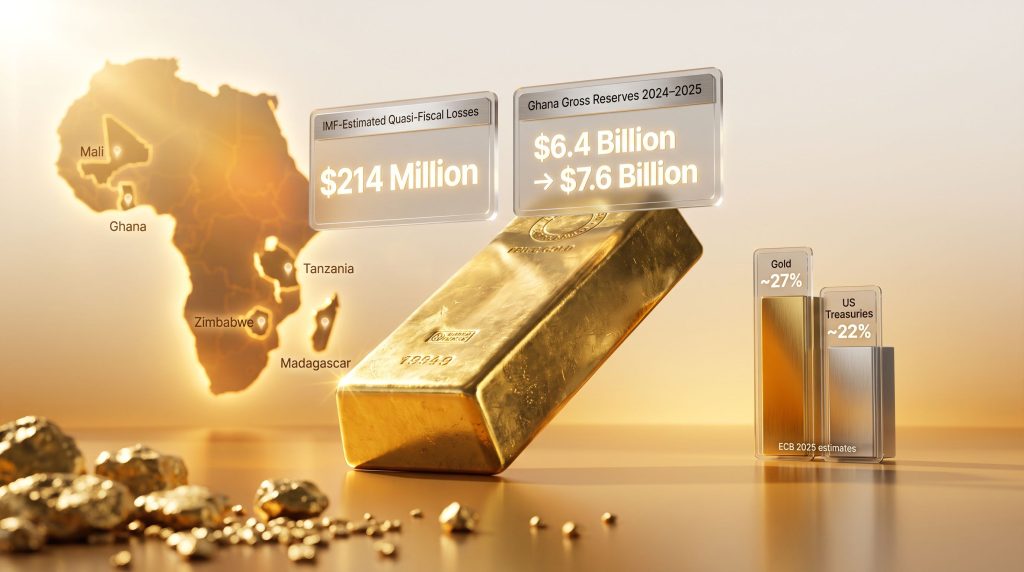
Ghana's programme is the most thoroughly documented case. In 2024, the Domestic Gold Purchase Programme facilitated the acquisition of more than $3.6 billion worth of gold, contributing to a meaningful improvement in the country's reserve position. Gross reserves stood at $6.4 billion at the end of 2024 and had climbed to $7.6 billion by March 2025, a trajectory that would be difficult to achieve through conventional foreign exchange accumulation given Ghana's broader fiscal constraints.
| Metric | Data Point |
|---|---|
| Gold purchased via DGPP in 2024 | Over $3.6 billion |
| Gross reserves at end-2024 | $6.4 billion |
| Gross reserves by March 2025 | $7.6 billion |
| IMF-estimated quasi-fiscal losses (to Q3 2025) | ~$214 million (approx. 0.2% of GDP) |
| IMF review source | Fifth Review under Ghana's Extended Credit Facility |
The IMF's Fifth Review under Ghana's Extended Credit Facility concluded that the programme, while effective at building reserves in headline terms, generated quasi-fiscal losses of approximately $214 million, equivalent to roughly 0.2% of GDP. The Fund characterised these losses as undermining balance sheet transparency and weakening the Bank of Ghana's institutional position. Furthermore, central bank gold demand across the continent is intensifying scrutiny of how such acquisitions are structured and governed.
The Accounting Dispute and What It Reveals
The Bank of Ghana has publicly challenged the IMF's $214 million figure, describing the Fund's methodology as speculative. This disagreement is itself analytically significant. When a central bank and its programme reviewer cannot agree on the basic accounting of a domestic procurement scheme, that divergence is precisely the transparency deficit the IMF's guidance is designed to address. The dispute is not a rebuttal of the warning. In a meaningful sense, it validates it.
The GOLDBOD governance framework, established to oversee Ghana's gold sector, has identifiable strengths in terms of formalising procurement channels that previously operated outside regulatory visibility. However, the IMF's review identified weaknesses in how losses are recognised, reported, and ultimately assigned between the central bank and the national budget.
Madagascar: Structurally Similar, Less Quantified
Madagascar's domestic gold procurement programme operates on a smaller scale but presents structurally analogous concerns. The country acquires unrefined gold through channels that raise IMF safeguard questions about interference with reserve management objectives. Unlike Ghana, the losses associated with Madagascar's programme have not been publicly quantified in IMF documentation, which itself constitutes a transparency concern rather than a reassurance.
The Three Directives at the Heart of the IMF's Guidance
The IMF's recommendations distil into three operational directives with distinct institutional rationales:
| IMF Recommendation | Rationale | Applicable Countries |
|---|---|---|
| Transfer programme losses to national budget | Restores balance sheet integrity and fiscal accountability | Ghana, Madagascar |
| Limit domestic unrefined gold purchases | Prevents absorption of private-sector costs by monetary authority | Ghana, Madagascar |
| Enhance governance and transparency frameworks | Reduces audit risk and programme review complications | Ghana (GOLDBOD framework) |
None of these directives requires a country to reduce its gold holdings. They require a country to change how it accounts for and governs the process of acquiring gold domestically.
The Reserve Asset Landscape: Why Gold's Rise Is Not What It Appears
A Price Story, Not a Conviction Story
Global reserve data for the first quarter of 2026 places the US dollar at just under 57% of allocated global reserves, the euro at approximately 20%, and the Chinese yuan below 2%, barely moved after more than a decade of sustained de-dollarisation rhetoric that has yet to produce a viable structural alternative. Meanwhile, according to ECB estimates for 2025, gold had overtaken US Treasuries as the world's largest individual reserve asset class, accounting for approximately 27% of official reserves compared to 22% for Treasuries. Gold in the monetary system has consequently attracted renewed attention from both institutional analysts and policymakers worldwide.
| Reserve Asset | Share of Global Allocated Reserves |
|---|---|
| US Dollar | ~57% (Q1 2026) |
| Euro | ~20% (Q1 2026) |
| Chinese Yuan | Below 2% (Q1 2026) |
| Gold (ECB estimate, 2025) | ~27% of official reserves |
| US Treasuries (ECB estimate, 2025) | ~22% of official reserves |
What is easy to miss in this data is that gold's rise to the top of the reserve asset league table was driven primarily by price appreciation rather than deliberate accumulation decisions. Gold's value roughly tripled between 2010 and the mid-2020s. Central banks that held their gold positions steady through that period saw their gold share of reserves expand mechanically, without any active shift in reserve strategy. Price, not conviction, did most of the structural work.
The 2022 Lesson No Reserve Manager Can Ignore
The freezing of Russian foreign exchange reserves in 2022 did more to rehabilitate gold's strategic case than any academic paper could. It demonstrated that assets denominated in a foreign currency, held in a foreign jurisdiction, and settled through foreign financial infrastructure carry a counterparty risk that does not appear on standard risk models. Dollar and euro reserves offer yield, depth, and liquidity that gold cannot match. They also offer exposure to decisions made in Washington and Frankfurt that gold, physically held, does not carry.
For Mali, Burkina Faso, Ghana, Tanzania, and Zimbabwe, this tension is not theoretical. These are gold producers capable of converting domestic output into reserve assets in local currency, bypassing the dollar-denominated procurement process entirely. The broader geopolitical risk landscape has only reinforced this calculus. The IMF's guidance asks them to be more careful about how they do it. It says considerably less about what they should hold instead.
Building a Third Option: Africa's Structural Response
PAPSS and the Limits of Incremental Infrastructure
On the same day the IMF published its guidance, the Bank of Central African States formally joined the Pan-African Payment and Settlement System, extending PAPSS to 28 countries and more than 190 connected banks and financial technology institutions across the continent, according to Afreximbank. The timing was coincidental, but the juxtaposition is instructive.
PAPSS reduces the cost and friction of intra-African trade settlement, diminishing dependence on correspondent banking relationships with institutions in New York or London. It is a meaningful piece of financial infrastructure. As a standalone reserve diversification mechanism, however, it is insufficient. Cheaper payments do not resolve the question of what assets sit behind those payments at the central bank level.
The Afreximbank Pan-African Gold Bank: Architecture and Timeline
The more direct institutional response to the reserve management dilemma is Afreximbank's proposed Pan-African Gold Bank. The project, outlined by Afreximbank President George Elombi at the bank's annual meetings in Egypt in late June 2025, envisions an internationally accredited refinery combined with vaulting and trading services. The facility is expected to be located in an Egyptian free zone and is being advanced under a memorandum of understanding signed with the Central Bank of Egypt in December 2024.
McKinsey is conducting the project's feasibility study. The projected timeline, subject to feasibility outcomes, is as follows:
| Project Milestone | Projected Date |
|---|---|
| Feasibility study completion | Underway (2025-2026) |
| Construction commencement | Before end of 2026 |
| Refinery operational target | 2027-2028 |
If operational, the facility would allow African central banks to acquire certified, traceable bullion from a continental refiner rather than purchasing raw, unprocessed metal through channels that currently route much of the continent's gold output elsewhere. That elsewhere is primarily Dubai.
The Dubai Gold Trade and the Traceability Problem
Approximately 15% of global gold trade passes through Dubai's DMCC free zone. Among the largest African suppliers to that system are Mali, Ghana, Guinea, Sudan, and South Africa. Some of this trade is entirely routine. Some of it is not. An investigation published in mid-June 2025 linked Dubai-bound gold exports to conflict financing in the Central African Republic, a finding that echoed earlier UN conclusions regarding Sudanese gold flows. In addition, Reuters reporting on African central banks has highlighted the liquidity and price risks that accompany unregulated procurement channels.
The traceability deficit the IMF identifies in domestic gold purchase programmes and the provenance concerns that attach to Dubai-routed African gold are two sides of the same governance problem. A continental refinery with international accreditation would address both simultaneously, retaining processing fees on the continent while providing the certified chain-of-custody documentation that both the IMF and responsible institutional buyers require.
A Pan-African refinery would not simply retain economic value currently leaving the continent. It would transform the governance architecture around African gold, converting an asset class associated with opacity and procurement risk into one that meets the transparency standards the IMF's guidance demands.
The next major ASX story will hit our subscribers first
Frequently Asked Questions
Is the IMF instructing African central banks to stop holding gold?
No. The IMF's July 9, 2025 guidance targets the method of domestic gold procurement, specifically the purchase of unrefined bullion directly from local producers at terms that generate quasi-fiscal losses. Holding gold acquired through international market channels remains consistent with IMF reserve management guidance. The IMF's own factsheet on gold clarifies its institutional stance on gold as a reserve asset more broadly.
What makes Ghana's Domestic Gold Purchase Programme controversial?
The programme generated over $3.6 billion in gold purchases in 2024, meaningfully improving Ghana's reserve position. The IMF's Fifth Review under Ghana's Extended Credit Facility estimated associated quasi-fiscal losses of approximately $214 million, which the Bank of Ghana has publicly disputed. The dispute itself reflects the transparency gap the Fund has flagged.
What is the Pan-African Gold Bank and when could it become operational?
Afreximbank's proposed Pan-African Gold Bank would combine an internationally accredited refinery with vaulting and trading infrastructure, likely located in an Egyptian free zone. A feasibility study by McKinsey is underway. Construction could begin before the end of 2026, with operations potentially commencing in 2027 or 2028.
Why does the IMF's guidance land differently for gold-producing African economies?
Gold-producing nations can convert domestic output into reserves in local currency, avoiding the foreign exchange drain that dollar-denominated reserve accumulation requires. The IMF's guidance asks these countries to refine how they conduct that conversion. It does not offer an equally cost-effective alternative for economies with limited access to deep dollar or euro markets.
Are claims that Africa has launched a gold-backed bank that has destabilised the IMF credible?
No. These claims, circulating widely on social media, are not supported by any credible institutional evidence and directly contradict the content of IMF programme reviews, which address specific national fiscal risks within established programme frameworks.
Key Takeaways for Reserve Managers, Analysts, and Policymakers
- The IMF gold warning for African central banks targets procurement methodology, not gold as an asset class — a distinction that most commentary has failed to preserve
- Ghana's estimated $214 million in quasi-fiscal losses represents approximately 0.2% of GDP, material at the margin but not systemically destabilising in isolation
- Gold's rise to 27% of official reserves globally, overtaking Treasuries at 22%, reflects price appreciation more than deliberate accumulation, a structural detail that changes the policy implications considerably
- The IMF's framework prices the risk of gold with precision while remaining largely silent on the counterparty and geopolitical risks embedded in the dollar and euro alternatives it implicitly recommends
- Continental infrastructure initiatives, specifically PAPSS and the proposed Afreximbank refinery, represent the earliest institutional steps toward a reserve management framework that does not force a binary choice between gold opacity and Western asset dependency
- Traceability and governance deficits are addressable through institutional design. The proposed Pan-African refinery, if it reaches operational status, would address the precise governance failures the IMF gold warning for African central banks has identified, without requiring African central banks to reduce their gold exposure
This article is intended for informational purposes only and does not constitute financial or investment advice. Reserve management decisions involve complex institutional, legal, and economic considerations that vary by jurisdiction. Readers should consult qualified advisers before drawing operational conclusions from the data and analysis presented here.
Readers seeking ongoing coverage of African monetary policy, reserve management strategy, and continental financial infrastructure developments can explore reporting from Ecofin Agency at ecofinagency.com.
Want to Track the Next Major Mineral Discovery Before the Market Does?
Discovery Alert's proprietary Discovery IQ model delivers real-time alerts on significant ASX mineral discoveries, turning complex mineral data into actionable insights for both short-term traders and long-term investors — explore Discovery Alert's discoveries page to understand why major mineral discoveries can generate substantial returns, and begin your 14-day free trial today to position yourself ahead of the broader market.