June 25, 2026
When the Earth Hides Its Best Secrets Below the Fault Line
In precious metals exploration, the most consequential discoveries are rarely the ones that were planned. History is littered with examples of drill programs designed to test one geological hypothesis that accidentally uncovered something far more significant. The relationship between structural geology and hydrothermal ore deposition is inherently unpredictable, and that unpredictability cuts both ways. For every hole that disappoints, there is occasionally one that rewrites the exploration model entirely.
That dynamic is precisely what has unfolded at the Silica Hill prospect within the Commonwealth project in New South Wales. A six-hole Phase 1 diamond drill program, totalling 1,239 metres, was designed to test down-plunge extensions of known mineralisation and validate geophysical anomalies identified through a prior MobileMT survey. What it returned was something considerably more significant: a bonanza-grade polymetallic intercept at 230 metres depth that now positions the Impact Minerals Silica Hill discovery as one of the more compelling early-stage precious metals findings on the ASX in recent memory.
When big ASX news breaks, our subscribers know first
Understanding What Bonanza Grade Actually Means in Epithermal Systems
The term bonanza grade is one of the most overused descriptors in junior mining communications, which makes it easy to dismiss. In its correct geological context, however, it refers to ore concentrations so elevated that they fundamentally alter the economics of a project and often indicate proximity to the principal hydrothermal fluid conduit within the system. Understanding the mineral exploration importance of such discoveries helps contextualise why this finding matters beyond the headline numbers.
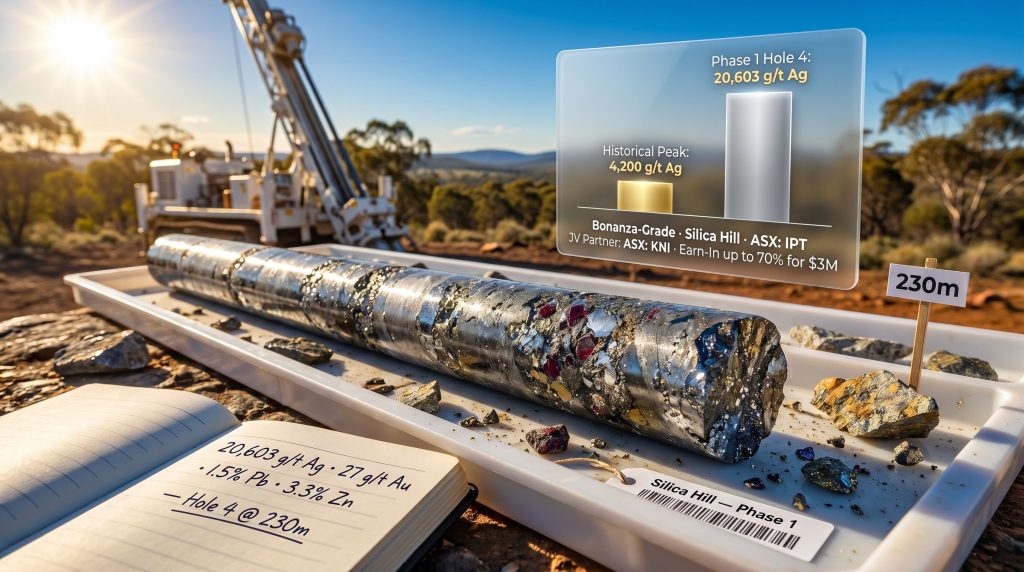
To benchmark what was returned at Silica Hill, consider how silver grades are typically distributed across epithermal systems. The global average silver grade across producing mines sits well below 400 g/t. High-grade silver mines, which command significant investor attention, typically operate in the range of 500 to 1,500 g/t. The intercept returned from Hole 4 of the Phase 1 program at Silica Hill registered 20,603 g/t silver (2.1%) alongside 27 g/t gold, 1.5% lead, and 3.3% zinc across a 0.5-metre massive sulphide vein.
That silver figure is not a rounding artefact. It represents a concentration approximately 50 times higher than what most operating silver mines process as payable ore. The gold grade of 27 g/t is similarly exceptional, sitting roughly 10 to 15 times above the threshold typically required for open-cut gold mining viability.
Why the Width Does Not Tell the Whole Story
The instinctive response to a 0.5-metre intercept width is scepticism, and that scepticism is geologically warranted. Narrow veins present challenges for bulk-tonnage extraction and are frequently insufficient to support resource estimates on their own. However, in the context of epithermal systems, narrow high-grade veins at depth carry a specific geological interpretation that changes the analytical calculus. Furthermore, interpreting drill results correctly requires understanding the distinction between vein geometry and system-scale potential.
Feeder veins, by their nature, are conduits rather than repositories. Their purpose within hydrothermal systems is to transport metal-bearing fluids upward, where broader mineralisation can accumulate in structurally favourable positions. The identification of a feeder-style vein structure at 230 metres depth at Silica Hill raises the question of what exists laterally and above it, rather than suggesting the 0.5-metre width is the system's upper bound.
The company's managing director interpreted the intercept as being consistent with a feeder structure for narrower high-grade veins within the broader system, drawing a connection to a lower-grade vein previously intersected above the fault plane at shallower depth.
The Fault Offset Zone: A Target That Was Not on the Map
Perhaps the most geologically significant element of the Impact Minerals Silica Hill discovery is not the bonanza-grade assay itself, but what it implies about the structural architecture of the broader system. The intercept in Hole 4 was located approximately 100 metres outside the boundaries of prior mineralisation models, in a zone created by fault displacement of the near-surface mineralised corridor.
How Fault Displacement Conceals and Preserves Ore
Fault planes in epithermal systems perform a dual geological function that is frequently underappreciated by non-specialist observers. On one hand, they can disrupt and displace previously mapped mineralised zones, rendering surface sampling and shallow drilling programs incomplete. On the other hand, the same fault structures that offset ore bodies can preserve them at depth from the erosive processes that strip near-surface mineralisation over geological timescales.
The structural mechanics at Silica Hill follow this pattern. A fault plane has displaced near-surface mineralisation, effectively masking the deeper feeder system from historical drilling programs that were focused on shallower targets. The discovery of the feeder vein below this fault introduces a geometrically distinct and previously untested corridor into the exploration inventory.
Key structural observations from Phase 1:
- The fault-offset zone extends approximately 70 metres as a disseminated sulphide zone within sericite-altered rhyolite porphyry
- The mineralogy includes arsenopyrite, pyrite, and proustite, assemblage types associated with higher-temperature hydrothermal environments and greater proximity to the mineralising source
- The zone remains open in all directions, meaning Phase 1 drilling has not encountered any boundary to the system in any spatial dimension
- The discovery emerged as an unplanned outcome from a deep hole that crossed the structural discontinuity, reinforcing the exploratory upside within this system
What Proustite Tells Geologists About the System
Proustite, sometimes called ruby silver due to its characteristic deep-red colour, is a silver arsenic sulphosalt mineral that forms in specific temperature-pressure conditions within hydrothermal systems. Its presence at Silica Hill is geochemically informative. Proustite tends to crystallise in the upper portions of epithermal systems and in zones of significant sulphidation, and its co-occurrence with arsenopyrite and pyrite alongside elevated gold and silver tenors suggests the system experienced multiple stages of mineralisation from a robust hydrothermal source.
Phase 1 Results Versus the Historical Exploration Record
To appreciate the step-change represented by the Phase 1 outcomes at the Impact Minerals Silica Hill project, it is useful to compare them directly with historical intercepts from prior drilling at the same system. Notably, gold exploration results of this calibre are rarely encountered at such an early stage of a program.
| Intercept | Gold Grade | Silver Grade | Width | Depth |
|---|---|---|---|---|
| Historical Intercept A | 2.0 g/t Au | 147 g/t Ag | 41.0m | Near surface |
| Historical Intercept B | 1.7 g/t Au | 276 g/t Ag | 22.5m | Near surface |
| Sub-intercept within B | Not stated | 4,200 g/t Ag | 0.3m | Near surface |
| Phase 1 Hole 4 (2026) | 27 g/t Au | 20,603 g/t Ag | 0.5m | 230m |
The contrast is stark. Historical near-surface drilling returned wider zones with lower-grade profiles, which is the expected expression of an epithermal system at shallow depths where hydrothermal fluids have dispersed across broader fracture networks. The Phase 1 result at depth inverts this pattern, delivering grades nearly 5 times higher in silver and 13 times higher in gold than the best prior surface intercepts, albeit in a narrower vein geometry consistent with feeder-controlled mineralisation.
The critical geological inference is that Silica Hill may represent a zoned epithermal system in which the highest-grade, highest-temperature mineralisation is concentrated at depth within feeder structures, while shallower, lower-grade disseminated mineralisation represents the distal expression of that same hydrothermal event.
It is also worth noting that the Phase 1 assays confirmed previously reported visual estimates of mineralisation from the field program. In junior exploration, this validation step is often underappreciated by investors, but it carries significant technical weight. Visual estimates of sulphide content and vein characteristics that are subsequently confirmed by laboratory assay reduce the probability that results reflect sampling error or selective intercept reporting.
The Kuniko Joint Venture: Structural Capital Efficiency for Impact Minerals
The Commonwealth project, which hosts the Silica Hill prospect, is being advanced through an earn-in and joint venture agreement with Kuniko (ASX: KNI). The financial structure of this arrangement has material implications for how investors should assess the risk-return profile of Impact Minerals (ASX: IPT) at its current market capitalisation. Consequently, understanding the mineral deposit tiers relevant to this style of project helps clarify what a successful Phase 2 program could ultimately mean for project valuation.
| JV Parameter | Detail |
|---|---|
| JV and earn-in partner | Kuniko (ASX: KNI) |
| Initial earn-in interest | 51% |
| Maximum earn-in interest | 70% |
| Total earn-in expenditure commitment | $3 million |
| Funding responsibility | Kuniko funds all exploration to earn-in thresholds |
| Phase 2 drilling commencement | June 2026 |
What this structure means in practice:
- Impact Minerals is not bearing direct exploration costs during the earn-in phase, preserving its cash position while a discovery phase unfolds
- IPT retains a residual interest of between 30% and 49% in a project that has now returned globally exceptional grade intercepts
- Kuniko's incentive to spend aggressively and efficiently is aligned with its interest in demonstrating value within the Commonwealth project through the earn-in
- For a company with a market capitalisation of approximately $24.93 million at the time of the announcement, the carried exploration upside embedded in the JV structure represents a capital efficiency ratio that is difficult to replicate through solely self-funded exploration programs
The announcement also noted that Kuniko's leadership has publicly acknowledged the potential for significant lateral and depth expansion within the Silica Hill system, reinforcing the shared conviction that the Phase 1 discovery warrants an expanded Phase 2 response.
Phase 2 Drilling Targets: Defining the Next Catalyst
With Phase 2 drilling scheduled to begin in June 2026, the program represents the most significant near-term value-resolution event for the Impact Minerals Silica Hill discovery. Based on Phase 1 outcomes, the program will be oriented toward several specific structural and geological targets.
Primary Phase 2 objectives:
- Testing depth extensions below the fault plane where the bonanza-grade feeder vein was intersected, to determine whether vein width increases or additional parallel veins exist at greater depth
- Expanding the 70-metre disseminated sulphide zone laterally to determine its true spatial extent within the sericite-altered rhyolite porphyry
- Structural corridor mapping to assess whether the fault-offset zone connects with other mineralised structures within the broader system
- Commonwealth South secondary target cluster, where additional sulphide intersections were recorded during Phase 1 but remain inadequately tested
Two Scenarios and What They Would Mean
The geological and commercial outcomes of Phase 2 drilling can be broadly conceptualised around two end-member scenarios, with the reality likely falling somewhere along the continuum between them.
Scenario A: Feeder vein narrows or terminates at depth
In this case, Silica Hill remains a high-grade narrow-vein target with limited tonnage potential. Resource estimates would be constrained by geometry, and the project would likely require a bulk underground mining approach to be economically viable. This scenario is not without precedent and does not necessarily preclude project development, but it limits the scale of potential re-rating.
Scenario B: Feeder vein widens at depth and connects to broader disseminated corridor
If Phase 2 drilling confirms that the fault-offset zone extends laterally and the feeder vein system widens into a broader mineralised corridor, Silica Hill could transition from a narrow-vein target to a polymetallic system with meaningful bulk-tonnage potential. For a company currently valued at approximately $24.93 million, a discovery of this scale would represent a substantial re-rating event.
The next major ASX story will hit our subscribers first
Where Silica Hill Sits Within NSW's Precious Metals Geological Framework
The Commonwealth project is located within the Lachlan Fold Belt, one of Australia's most historically productive and geologically diverse precious and base metals terranes. This geological province has hosted significant gold and silver endowments across multiple deposit styles, including orogenic gold systems, intrusion-related gold deposits, and epithermal silver-gold mineralisation of exactly the type expressed at Silica Hill.
The rhyolite porphyry host rock at Silica Hill is a geologically favourable setting for high-temperature epithermal mineralisation. Rhyolitic volcanic sequences commonly serve as competent host rocks for structurally controlled vein systems, and the presence of sericite alteration at Silica Hill indicates that hydrothermal fluids were sufficiently reactive to alter the surrounding rock matrix — a characteristic feature of well-developed epithermal systems.
Within the broader NSW precious metals exploration landscape, few early-stage projects on the ASX have returned silver grades approaching 20,000 g/t from a primary drill program. That does not guarantee resource scalability, but it does position Silica Hill as a geologically distinctive target within a province already known for its metals endowment. In addition, true widths vs apparent widths will be a critical consideration as Phase 2 data is assessed, particularly for the narrow feeder vein intercepts reported at depth.
Exploration Risk Milestones: What Has Been De-Risked and What Remains
Understanding where the Impact Minerals Silica Hill discovery sits on the exploration risk curve is essential for evaluating its significance relative to similar early-stage projects.
De-risked milestones following Phase 1:
- Visual mineralisation confirmed by independent laboratory assay
- Bonanza-grade precious metals intersected at depth (230m), not just at surface
- Fault-offset zone identified, adding a new structural target to the exploration inventory
- Polymetallic assemblage (Au-Ag-Pb-Zn) confirmed, consistent with a coherent hydrothermal source
- Secondary sulphide intersections at Commonwealth South provide additional target optionality
Milestones still to be resolved through Phase 2:
- Lateral and depth extent of the feeder vein system
- Whether multiple parallel feeder structures exist within the fault-offset corridor
- Continuity and grade consistency of the disseminated sulphide zone over drillable intercept widths
- Potential for resource estimation based on expanded drilling data
Frequently Asked Questions: Impact Minerals Silica Hill Discovery
What grades were returned from the Silica Hill Phase 1 program?
Hole 4 of the Phase 1 diamond drill program returned 20,603 g/t silver (2.1%), 27 g/t gold, 1.5% lead, and 3.3% zinc across a 0.5-metre massive sulphide vein at 230 metres depth. These grades are considered bonanza-grade and are extraordinary relative to global epithermal benchmarks.
What is a feeder vein and why does it matter?
A feeder vein is a deep structural conduit through which metal-bearing hydrothermal fluids travel upward from their source before depositing metals in shallower, broader zones. Feeder veins typically host the highest-grade mineralisation within an epithermal system and their identification at depth is considered a positive indicator of system scale and connectivity.
What is the Kuniko earn-in arrangement?
Kuniko (ASX: KNI) is funding all exploration at the Commonwealth project under an earn-in agreement that allows it to acquire up to 70% of the project by spending $3 million. Impact Minerals retains between 30% and 49% of the project without bearing direct exploration costs during this phase. For further context on this earn-in structure, independent coverage has highlighted the capital efficiency advantages it provides to IPT shareholders.
When does Phase 2 drilling commence?
Phase 2 drilling is scheduled to begin in June 2026, targeting depth and lateral extensions of the newly identified fault-offset zone as well as secondary targets at Commonwealth South.
What does open in all directions mean for the discovery?
When geologists describe a mineralised zone as open in all directions, it means that no boundary to the system has been defined by drilling in any spatial orientation. The mineralisation could extend further laterally, at depth, or along strike than any currently drilled hole has reached.
Key Discovery Data at a Glance
| Parameter | Detail |
|---|---|
| Discovery classification | Bonanza-grade polymetallic epithermal vein |
| Primary metals | Gold, Silver, Lead, Zinc |
| Peak silver grade | 20,603 g/t (2.1%) |
| Peak gold grade | 27 g/t |
| Intercept width | 0.5 metres |
| Intercept depth | 230 metres |
| Structural interpretation | Feeder-style vein below fault plane |
| Disseminated sulphide zone extent | ~70 metres |
| Distance from prior mineralisation boundary | ~100 metres |
| Phase 1 total metres drilled | 1,239 metres across 6 holes |
| Phase 2 planned start | June 2026 |
| JV partner | Kuniko (ASX: KNI) |
| Earn-in terms | Up to 70% for $3 million expenditure |
| IPT market capitalisation at announcement | ~$24.93 million |
| IPT share price movement on announcement day | +8.33% to 5.2 cents |
Investment Disclaimer: This article is intended for informational and educational purposes only and does not constitute financial advice or a recommendation to buy or sell any security. Junior mining exploration carries substantial risk, including the possibility that Phase 2 drilling does not confirm or extend Phase 1 results. Readers are encouraged to conduct independent due diligence and consult a licensed financial adviser before making any investment decisions. Forward-looking statements and scenario analyses presented in this article are speculative in nature and should not be relied upon as predictors of future outcomes.
Want to Be First When the Next Bonanza-Grade Discovery Hits the ASX?
Discovery Alert's proprietary Discovery IQ model scans ASX announcements in real time, instantly identifying significant mineral discoveries like the extraordinary silver and gold intercepts at Silica Hill — turning complex geological data into actionable investment insights before the broader market catches on. Explore how historic discoveries have delivered exceptional returns on Discovery Alert's dedicated discoveries page, and begin your 14-day free trial today to position yourself ahead of the next major find.