July 23, 2026
What Defines In-Situ Recovery (ISR) Mining and How Does It Contrast with Traditional Uranium Extraction Methods?
In-situ recovery (ISR) mining is a breakthrough extraction method that has paved the way for projects like Canada first ISR uranium mine. This innovative technique uses specialised lixiviants injected directly underground, eliminating the need for large-scale physical excavation. Consequently, it offers a lower-impact and cost-efficient alternative.
ISR, often termed solution mining, employs drilled wells to inject a weak acid or alkaline solution into the orebody. The solution dissolves uranium minerals in place, allowing the uranium-rich mixture to be recovered with minimal surface disturbance. Furthermore, this method greatly reduces waste generation and environmental impact.
For instance, current uranium market trends highlight this shift towards efficiency and environmental sensitivity. Additionally, the simplicity of the ISR process is evident in its sequential steps.
Fundamentals of ISR Mining Technology
Key requirements for successful ISR operations include suitable geology, amenable mineralogy, and effective aquifer confinement. The rock must be permeable, and natural or engineered barriers should prevent lixiviant from migrating beyond the target zone. This design is a marked departure from traditional methods involving bulky ore transport.
A simplified flow involves:
- Injection of the lixiviant
- In-situ dissolution of uranium
- Recovery of the uranium-laden solution
- Surface extraction of uranium
These steps ensure efficient metal recovery while minimising environmental risks. Moreover, they reduce the extensive land disturbance that accompanies conventional mining.
When big ASX news breaks, our subscribers know first
What Makes the Phoenix ISR Project Technically Distinct Within Canada’s Mining Landscape?
The Phoenix ISR project is strategically located in the eastern Athabasca Basin of northern Saskatchewan. This region is renowned for its ultra high-grade uranium deposits. The area benefits from robust infrastructure, which reduces logistical complexities and construction risks.
Discovered in 2008, the Phoenix deposit is part of what has become a landmark project in Canada first ISR uranium mine. In 2014, its complementary deposit, Gryphon, was identified. Together, they form the Wheeler River project—a multi-deposit initiative that leverages existing mining expertise.
Nearby, ample transportation, power, and historical data further streamline development. In addition, local support and minimal permitting challenges add to the project’s appeal. This scenario highlights the clear advantages of advanced ISR techniques.
Resource Inventory and Recovery Estimates
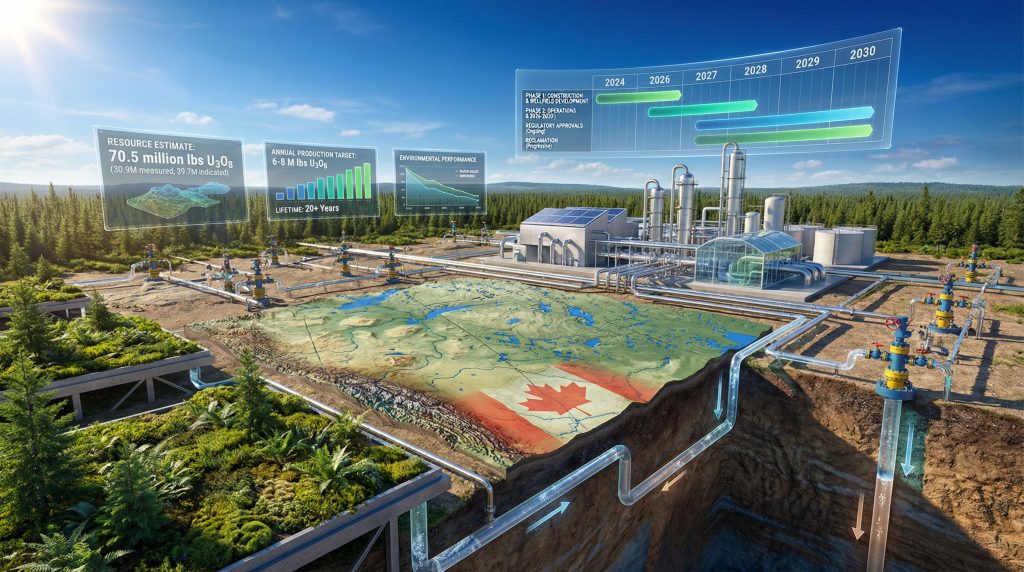
According to the latest resource estimates (June 2023), Phoenix boasts:
- Measured resources: 30.9M lbs U₃O₈
- Indicated resources: 39.7M lbs U₃O₈
The total measured plus indicated resource stands at 70.5M lbs U₃O₈. These figures position Phoenix as one of the most promising undeveloped sites for Canada first ISR uranium mine, with resources surpassing many global ISR projects.
Notably, historical data confirms that over 50% of global uranium output now derives from ISR methods. Thus, this advancement in extraction technology represents both an economic and environmental leap forward for the industry.
Which Engineering and Process Innovations Set This Project Apart?
The Phoenix project tailors its ISR systems to the unique regional geology and hydrogeology. A set of custom engineering measures has been implemented, ensuring both precision in uranium extraction and strict environmental controls.
Customization of ISR Systems for Phoenix
Key adaptations include:
- Wellfield design: Optimised with closely spaced injection and recovery wells to match orebody geometry.
- Tailored solution chemistry: Adjusted pH and flow parameters enhance uranium solubility while minimising gangue dissolution.
- Advanced groundwater monitoring: Continuous checks with sentinel wells ensure environmental safety.
These measures are crucial given the high uranium grade and the need for rigorous groundwater protection. In addition, they represent excellent examples of mining permitting basics in action through streamlined regulatory processes.
A detailed flow diagram clarifies the step-by-step ISR process:
- Geological modeling & wellfield construction
- Injection: Delivery of the lixiviant
- Dissolution: In situ uranium dissolution
- Recovery: Extraction via recovery wells
- Surface extraction: Conversion to yellowcake
- Water management: Recycling or treatment of barren solution
- Monitoring & response: Real-time adjustments to safeguard aquifers
Each stage is designed to maximise uranium recovery while ensuring operational safety and environmental compliance.
Supply Chain and Material Sourcing Strategies
Denison has proactively secured essential project materials well in advance of final investment decisions. This strategy includes:
- Well instrumentation and downhole pumps
- Specialized chemistry dosing systems
- Water management equipment and extensive pipe networks
Such pre-emptive procurement aligns with current industry benchmarks. Moreover, it shields the project from global supply chain uncertainties. In addition, these approaches reflect keen insights into waste management solutions.
A summary table illustrates major equipment and lead time comparisons:
• Wellhead/pump equipment: 12–18 months (industry norm: 12–24 months)
• Processing plant core components: 14–20 months
• Environmental monitoring tech: 8–12 months
How Is Project Execution Structured—From Site Preparation to Commissioning?
Project execution at Phoenix is meticulously planned over multiple phases. The timeline begins with site preparation in March 2026, followed by wellfield installation and plant construction phases lasting around 24 months.
During the regulatory integration phase, vital approvals such as the Environmental Assessment (EA) and construction licences validate the project’s readiness. Furthermore, the commissioning phase, targeted for mid-2028, exemplifies a modern approach to project milestones.
Key construction stages include:
- Site preparation and infrastructure development
- Wellfield and plant construction
- System integration and rigorous testing
- Commissioning and first uranium output
In addition, robust contingency plans and risk management measures ensure smooth execution even under challenging market conditions.
Risk Management in ISR Mine Delivery
Phoenix’s risk management is multi-faceted. Detailed pre-project geological studies are undertaken to predict groundwater behaviour accurately. This is complemented by continuous monitoring and real-time response systems.
Critical risk factors include:
• Geotechnical risk: Mitigated through extensive hydrogeological modelling
• Chemical process risk: Managed with advanced, automated shutdown protocols
• Environmental risk: Closely monitored via boundary well networks
Furthermore, ongoing stakeholder engagement supports transparent communication with regulatory bodies and local communities. These measures underline the commitment to sustainable mining practices.
What Are the Broader Technical Implications for Uranium Mining in Canada?
The success of Phoenix establishes a strong template for future projects across Canada. This breakthrough, as exemplified by Canada first ISR uranium mine, signals new possibilities in low-impact and efficient uranium extraction.
Replicability & Transferability of ISR Methods
The proven methodology at Phoenix paves the way for ISR adoption in other deposits. For example:
• Waterbury Lake (Heldeth Túé deposit) feasibility studies are underway
• Midwest Main is undergoing early-stage investigations
Selection criteria for ISR include orebody permeability, grade, and the presence of robust confining units. Additionally, the efficiency of data-driven mining operations enhances the replicability of the technique across diverse regions.
Production Forecasts and Market Context
Phoenix is projected to achieve first production by mid-2028. Consequently, Canada first ISR uranium mine is expected to join international peers from Kazakhstan, Australia, and the USA. Over the past decade, ISR’s share of global uranium production has grown significantly—from approximately 45% in 2014 to an anticipated over 60% in 2026.
This upward trend emphasises a robust market outlook. In this context, developments like these attract global attention, including insights into a new uranium development that underscores industry momentum.
What Technical Lessons Can Be Drawn for Future North American ISR Developments?
Regulatory success in Canada’s uranium sector depends on rigorous process control and environmental stewardship. The Phoenix project demonstrates that robust pilot testing and adaptive operational frameworks can significantly fast-track approvals while ensuring safety.
Engineering Milestones That Enable Regulatory Success
The rapid licensure process—EA approval in 2025 and construction licence in 2026—attests to thorough baseline studies and extensive pilot testing. These milestones not only secure operational safety but also foster industry trust. In addition, such practices serve as effective risk mitigants during development.
Forward-looking Scenarios: Potential for Tech Export and Process Innovation
As Phoenix transitions from development to production, its expertise is poised for international application. The innovative groundwater management and solution chemistry protocols could, for instance, offer valuable lessons to other sectors. In this way, Canadian innovations may spur broader process innovation and tech export.
A recent industry report on construction start details further supports this transition. Such insights reinforce Canada first ISR uranium mine as a catalyst for future advancements.
The next major ASX story will hit our subscribers first
FAQ: Technical and Operational Aspects of Canada’s First ISR Uranium Mine
What conditions are necessary for successful ISR uranium mining?
• Permeable, confined ore bodies with soluble uranium minerals
• Adequate groundwater management controls
• Strong process monitoring and regulatory compliance capacity
How is groundwater protected during the ISR process?
Monitoring is maintained through hydraulic confinement and continuous checks by sensor wells. In addition, emergency shutdown protocols mitigate any risk of solution migration.
What are the main technical risks and mitigations in this project?
• Risks: Hydrogeochemical excursions, wellfield performance uncertainties, and supply chain delays
• Mitigations: Detailed modelling, pilot-scale field validations, and early procurement measures ensure operational safety.
How does ISR mining improve environmental stewardship compared to legacy methods?
ISR minimises land disturbance, significantly reduces tailings output, and enhances post-mining aquifer restoration. Moreover, it supports industry shifts towards more responsible, low-impact extraction.
Summary Table – Phoenix ISR Technical Milestones and Operational KPIs
| Milestone/Metric | Value/Detail | Industry Benchmark |
|---|---|---|
| Initial resource estimate | 70.5M lbs U₃O₈ | 20–30M lbs (typical ISR) |
| Measured resources | 30.9M lbs | |
| Indicated resources | 39.7M lbs | |
| Planned operational start | 2026 site prep, 2028 prod. | 2–3 years avg. construction |
| Regulatory approval (EA/lic) | July 2025/Feb 2026 | 2–5 years (Canada) |
| ISR productivity (forecast) | [Estimate Needed]* | [Industry median] |
*Forecast details are specified in operator technical documents.
Conclusion – The Technical Impact of Phoenix on Canada’s Uranium Mining Evolution
The Phoenix project’s deployment of ISR technology marks a transformative shift within Canada first ISR uranium mine. By leveraging customised wellfield engineering, tailored solution chemistry, and advanced monitoring systems, it has set new benchmarks for safe, efficient, and low-impact uranium production.
In addition, future projects across Canada are likely to mimic these practices, spurring a wider adoption of ISR methods. Ultimately, the lessons learned at Phoenix will drive innovation, streamline regulatory processes, and offer a replicable model for sustainable mineral extraction worldwide.
Interested in the Latest Mineral Discoveries?
Unlock the potential of cutting-edge mining techniques like in-situ recovery with Discovery Alert’s real-time updates, powered by our proprietary Discovery IQ model. Explore significant discoveries that could redefine your investment strategy by visiting the Discovery Alert's discoveries page here.