
August 14, 2026
Strategic Energy Alliances Reshaping Global Nuclear Markets
Global nuclear supply chains stand at a critical inflection point as nations seek energy security through diversified partnerships. The India-Canada uranium deal exemplifies how uranium market volatility and geopolitical considerations drive strategic partnerships beyond simple commodity trading. These dynamics create opportunities for nations with significant uranium reserves to forge long-term relationships that prioritise reliability and shared values over lowest-cost sourcing.
Nuclear fuel agreements increasingly reflect geopolitical considerations rather than purely commercial calculations. As traditional supply relationships face scrutiny amid changing international dynamics, emerging partnerships between democratic nations signal a fundamental shift toward trusted supplier networks. Furthermore, the intersection of energy security, technological cooperation, and strategic alignment creates new frameworks for nuclear collaboration.
When big ASX news breaks, our subscribers know first
India's Nuclear Expansion: From Current Capacity to 2047 Vision
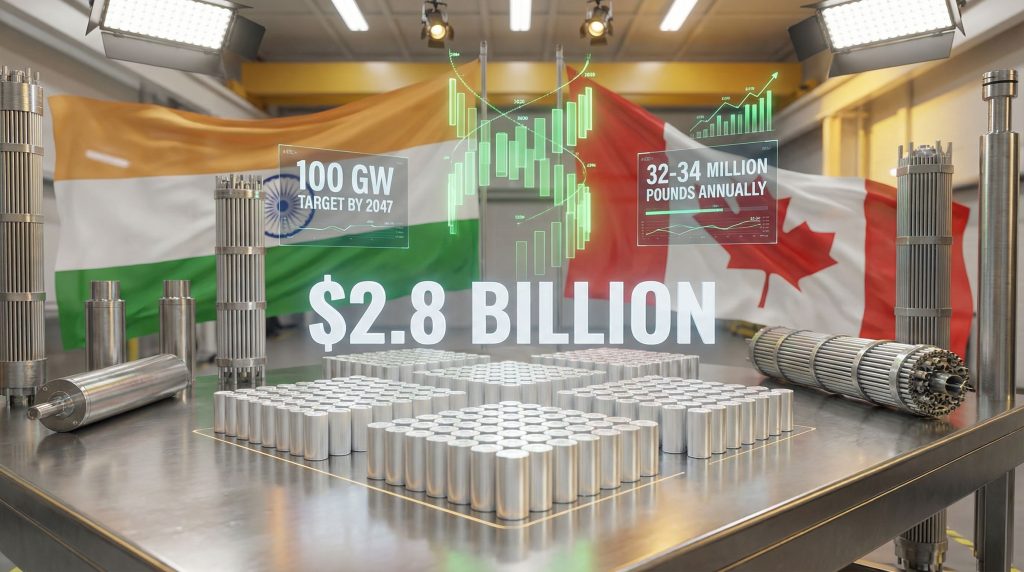
India's nuclear energy roadmap represents one of the world's most ambitious expansion programs, targeting a transformational increase from current levels to 100 GW by 2047. As of January 2025, the country operates 8.18 GW of installed nuclear capacity across multiple reactor technologies, including indigenously developed Pressurised Heavy Water Reactors (PHWRs) and Light Water Reactors (LWRs).
This massive capacity expansion requires sophisticated fuel cycle planning to ensure adequate uranium supplies throughout the buildout period. Industry analysis suggests that achieving the 100 GW target necessitates approximately 12,000-15,000 tonnes of natural uranium annually by 2047, representing a significant increase from current consumption levels. Consequently, the India-Canada uranium deal becomes crucial for meeting these ambitious targets.
Domestic Production Constraints and Import Dependencies
India's domestic uranium production faces geological and regulatory limitations that constrain self-sufficiency objectives. The Uranium Corporation of India Limited (UCIL) currently produces approximately 350-400 tonnes of uranium annually from mines in Jharkhand, Andhra Pradesh, and Telangana states. However, this falls well short of projected requirements for the expanded nuclear fleet.
Key domestic production challenges include:
- Low-grade ore bodies requiring extensive processing infrastructure
- Environmental and land acquisition complexities affecting project timelines
- Limited exploration activities compared to global uranium reserves
- Technical constraints in mining deeper deposits economically
These factors necessitate substantial import arrangements to bridge the gap between domestic supply and reactor fuel requirements. Current import dependency exceeds 70% of total uranium needs, making supply chain resilience a critical strategic priority for the India-Canada uranium deal.
Reactor Fleet Diversification and Fuel Specifications
India's nuclear programme employs diverse reactor technologies, each with distinct fuel requirements affecting procurement strategies. The reactor fleet includes:
| Reactor Type | Current Capacity | Fuel Requirements | Key Suppliers |
|---|---|---|---|
| PHWR (Indigenous) | 5.8 GW | Natural uranium | Domestic + imports |
| BWR/PWR | 1.4 GW | Enriched uranium | International markets |
| Fast Breeder | 0.5 GW | Mixed oxide fuel | Domestic reprocessing |
| Future Advanced | Planning phase | Variable specifications | Technology partnerships |
This technological diversity requires flexible supply arrangements capable of delivering different uranium products with varying enrichment levels and quality specifications.
Canada's Strategic Position in Global Uranium Markets
Canada leverages its position as the world's third-largest uranium reserve holder with approximately 588,000 tonnes of identified resources concentrated in Saskatchewan's Athabasca Basin. The province hosts some of the world's highest-grade uranium deposits, providing significant competitive advantages in global markets.
The country consistently ranks as the second-largest uranium exporter globally, generating over $1 billion annually from uranium sales to international markets. Natural Resources Canada data indicates that roughly 85% of Canadian uranium production serves export markets, with domestic CANDU reactors consuming the remainder.
Athabasca Basin: Global Mining Excellence
Saskatchewan's Athabasca Basin represents the pinnacle of global uranium mining, featuring deposits with grades significantly higher than world averages:
- McArthur River: Grades averaging 8-25% U₃O₈
- Cigar Lake: Consistent high-grade production at 15-20% U₃O₈
- Key Lake: Integrated milling facility serving multiple mines
- Rabbit Lake: Long-established operation with proven reserves
These exceptional grades translate into lower production costs and higher profit margins compared to competitors in Australia, Kazakhstan, and Namibia, where typical grades range from 0.1% to 2% U₃O₈.
Market Position Amid Geopolitical Shifts
Canada's uranium industry benefits from growing demand for non-Russian supply sources following international sanctions and supply chain diversification efforts. The Russian uranium import ban has created opportunities for Canadian producers, while the US uranium market disruptions further highlight the importance of reliable supply partnerships.
Recent market dynamics favour Canadian producers:
- Reduced Russian market access creating supply gaps
- Kazakhstan production uncertainty due to geopolitical tensions
- Australian supply constraints from environmental regulations
- Namibian infrastructure limitations affecting expansion capacity
Cameco's Production Leadership and Financial Performance
Cameco Corporation dominates Canadian uranium production through its integrated mining, milling, and conversion operations. The company's operational excellence in the Athabasca Basin positions it as a global industry leader capable of meeting long-term supply commitments for agreements like the India-Canada uranium deal.
2025 Production Outlook and Operational Updates
Recent production guidance from Cameco's Q3 2025 results demonstrates the company's operational flexibility and market responsiveness:
| Facility | 2025 Production Estimate | Previous Guidance | Operational Status |
|---|---|---|---|
| McArthur River/Key Lake | 14-15 million lbs U₃O₈ | 16-17 million lbs | Adjusted for optimisation |
| Cigar Lake | 19 million lbs | 18-19 million lbs | Exceeding expectations |
| Total Company Share | Up to 20 million lbs | 18-20 million lbs | Within guidance range |
| Sales Guidance | 32-34 million lbs | 32-36 million lbs | Narrowed range |
The company reduced market purchases to 1 million pounds, demonstrating confidence in operational flexibility and inventory management capabilities.
Financial Strength and Market Performance
Cameco's Q3 2025 financial results reflect strong operational performance and favourable market conditions:
- Pre-tax earnings: $172 million (uranium segment)
- Adjusted EBITDA: $220 million (uranium segment)
- Stock performance: Trading around $87.35 (NYSE)
- Market confidence: +4.8% single-day gain
These metrics indicate robust investor confidence in the company's strategic positioning amid growing global uranium demand and supply chain tightening.
Geopolitical Realignment and Nuclear Cooperation Frameworks
The India-Canada uranium deal reflects broader geopolitical realignments favouring democratic cooperation in nuclear technology and fuel supply. This shift accelerates as nations seek alternatives to traditional supply relationships that may carry strategic risks. Moreover, this partnership aligns with broader critical minerals strategy initiatives across democratic nations.
ACITI Partnership and Technology Integration
The Australia-Canada-India Technology and Innovation (ACITI) Partnership creates a trilateral framework for nuclear cooperation extending beyond fuel supply to include:
- Advanced reactor technologies and small modular reactor (SMR) development
- Nuclear fuel cycle innovations including recycling and waste management
- Critical mineral supply chains for nuclear and clean energy applications
- Artificial intelligence applications in nuclear facility operations
This comprehensive approach positions nuclear cooperation within broader strategic technology alliances among democratic partners.
Supply Chain Diversification Imperatives
Global nuclear supply chain vulnerabilities exposed by recent geopolitical tensions drive systematic diversification efforts:
Traditional Supply Concentration Risks:
- Russia/Kazakhstan: ~45% of global uranium supply
- China: Dominant in nuclear fuel fabrication
- Single-source dependencies for enrichment services
- Limited alternative suppliers with adequate scale
Emerging Alternative Networks:
- Canada-Australia-Namibia: Western-aligned uranium producers
- US-UK-France: Advanced fuel cycle capabilities
- Japan-South Korea: Technology and manufacturing partnerships
- Democratic supplier coalitions prioritising supply security
Economic Implications and Investment Projections
The India-Canada uranium deal represents more than a commodity agreement; it establishes a foundation for expanded economic cooperation potentially worth $50 billion in bilateral trade by 2030. According to recent reports, Ottawa is close to finalising a uranium deal with India worth $2.8 billion, marking a significant milestone in bilateral energy cooperation.
Investment Opportunities Beyond Uranium Supply
Nuclear cooperation creates multiple investment channels:
Infrastructure Development:
- Transportation and storage facilities
- Port infrastructure for uranium handling
- Conversion and fabrication capabilities
- Quality assurance and testing laboratories
Technology Transfer Opportunities:
- CANDU reactor licensing and deployment
- Advanced fuel cycle technologies
- Nuclear waste management solutions
- Digital infrastructure for reactor operations
Joint Venture Potential:
- Third-country reactor projects
- Research and development partnerships
- Mining exploration in other jurisdictions
- Clean energy integration projects
Market Impact Analysis
Long-term uranium supply agreements influence global market dynamics through several mechanisms:
| Market Factor | Short-term Impact | Long-term Implications |
|---|---|---|
| Price Discovery | Reduced volatility | Stable price floors |
| Supply Security | Allocation certainty | Investment confidence |
| Market Liquidity | Spot market tightening | Term contract premiums |
| Competitive Response | Supplier consolidation | Alternative partnerships |
The next major ASX story will hit our subscribers first
Regulatory Framework and Safeguards Compliance
Nuclear cooperation between democratic partners requires robust safeguards and compliance frameworks ensuring peaceful use commitments while facilitating commercial cooperation. The India-Canada uranium deal demonstrates how regulatory alignment enables expanded nuclear trade.
IAEA Safeguards and Monitoring Protocols
International Atomic Energy Agency (IAEA) safeguards provide the foundation for peaceful nuclear cooperation:
- Comprehensive Safeguards Agreements covering all nuclear materials
- Additional Protocols enabling enhanced verification activities
- State-level Approaches tailored to specific country circumstances
- Integrated Safeguards optimising verification efficiency
Both India and Canada maintain exemplary safeguards compliance records, facilitating expanded cooperation under international frameworks.
Nuclear Suppliers Group Guidelines
Nuclear Suppliers Group (NSG) guidelines establish export control standards for nuclear technology and materials:
Key Requirements:
- Non-proliferation assurances from recipient states
- Physical protection measures for nuclear materials
- Export licensing procedures ensuring controlled transfers
- End-use verification confirming peaceful applications
Canada's NSG membership and India's commitment to NSG guidelines despite non-membership create a cooperative framework supporting expanded nuclear trade.
Technical Challenges and Operational Considerations
Implementing large-scale uranium supply agreements requires sophisticated logistics and quality management systems addressing technical specifications unique to each reactor type. In addition, the partnership between India and Canada is expected to facilitate Cameco's supply of nuclear fuel over extended periods.
Transportation and Storage Infrastructure
Uranium transportation involves complex regulatory and safety requirements:
Shipping Considerations:
- Container specifications for uranium concentrates (yellowcake)
- Port handling facilities with appropriate security measures
- Customs and regulatory clearances across jurisdictions
- Insurance and liability frameworks for nuclear materials transport
Storage Requirements:
- Inventory management systems tracking material origins and destinations
- Quality preservation during extended storage periods
- Security protocols preventing unauthorised access
- Environmental monitoring ensuring containment integrity
Quality Specifications and Testing Protocols
Nuclear fuel quality requirements demand precise specification adherence:
| Parameter | PHWR Requirements | LWR Requirements | Testing Standards |
|---|---|---|---|
| Uranium Content | >99.5% U₃O₈ | >99.8% U₃O₈ | ASTM International |
| Impurity Limits | <500 ppm total | <100 ppm total | ISO nuclear standards |
| Moisture Content | <0.5% by weight | <0.2% by weight | Gravimetric analysis |
| Physical Properties | Particle size distribution | Flowability requirements | Specified test methods |
Global Nuclear Renaissance and Future Scenarios
The international nuclear revival creates unprecedented demand for uranium supply arrangements as countries prioritise climate goals and energy security simultaneously. For instance, nuclear cooperation creates opportunities for nations to diversify their energy portfolios while maintaining grid stability.
Projected Global Nuclear Capacity Growth
International Energy Agency (IEA) and World Nuclear Association (WNA) projections indicate substantial nuclear capacity expansion:
Conservative Scenario (2025-2040):
- Global capacity increase: 150-200 GW
- Annual uranium demand growth: 15-20%
- Required new supply: 25,000-30,000 tonnes U₃O₈
Aggressive Scenario (2025-2040):
- Global capacity increase: 300-400 GW
- Annual uranium demand growth: 25-35%
- Required new supply: 40,000-50,000 tonnes U₃O₈
These projections underscore the strategic importance of securing long-term uranium supply relationships.
Technology Evolution and Fuel Cycle Innovation
Advanced reactor technologies influence future uranium demand patterns:
Small Modular Reactors (SMRs):
- Higher fuel utilisation efficiency reducing uranium requirements per MW
- Flexible deployment options enabling distributed generation
- Simplified supply chains with standardised fuel assemblies
- Enhanced safety features potentially reducing regulatory barriers
Advanced Fuel Cycles:
- Thorium-uranium cycles potentially reducing natural uranium demand
- Recycling and reprocessing extending fuel cycle efficiency
- High-assay low-enriched uranium (HALEU) requiring specialised supply chains
- Breeding technologies creating fuel from fertile materials
Risk Assessment and Scenario Planning
Long-term uranium partnerships require comprehensive risk analysis addressing operational, market, and geopolitical uncertainties. However, the India-Canada uranium deal benefits from both nations' commitment to democratic governance and nuclear non-proliferation.
Operational Risk Factors
Mining and Production Risks:
- Geological uncertainties affecting resource availability
- Environmental regulations potentially constraining operations
- Labour market dynamics influencing production costs
- Technical challenges in accessing deeper or complex deposits
Market and Commercial Risks:
- Price volatility affecting contract economics
- Demand fluctuations from policy changes or technology shifts
- Currency exchange rate variations impacting international transactions
- Credit and counterparty risks in long-term agreements
Geopolitical and Strategic Scenarios
Scenario 1: Continued Cooperation
- Stable democratic partnerships facilitate expanded nuclear trade
- Technology sharing accelerates advanced reactor deployment
- Supply chain resilience improves through diversification
- Market development creates opportunities for new participants
Scenario 2: Increased Fragmentation
- Geopolitical tensions disrupt traditional supply relationships
- Regional blocs develop separate nuclear technology ecosystems
- Supply chain security becomes paramount consideration
- Premium pricing emerges for trusted supplier networks
Scenario 3: Technology Disruption
- Advanced fuel cycles reduce natural uranium demand
- Alternative energy technologies compete with nuclear power
- Small-scale distributed generation changes market dynamics
- New uranium sources emerge from unconventional deposits
Strategic Implications for Nuclear Industry Evolution
The India-Canada uranium deal exemplifies evolving nuclear industry dynamics where strategic considerations increasingly influence commercial relationships. This transformation reflects broader trends toward energy security prioritisation and trusted partnership networks. Furthermore, such partnerships demonstrate how nuclear cooperation serves broader objectives beyond simple fuel supply arrangements.
Market Structure Evolution
Traditional uranium markets characterised by spot trading and short-term contracts gradually transition toward long-term partnership models:
Emerging Characteristics:
- Strategic partnerships superseding pure commercial relationships
- Technology integration combining fuel supply with reactor cooperation
- Risk sharing mechanisms distributing market and operational uncertainties
- Value chain integration from mining through waste management
Investment and Innovation Implications
Nuclear industry investment patterns shift toward integrated capabilities supporting long-term partnerships:
Capital Allocation Priorities:
- Mining infrastructure in geologically stable jurisdictions
- Conversion and enrichment capacity in allied nations
- Transportation and logistics networks supporting global supply chains
- Research and development in advanced fuel cycle technologies
Disclaimer: This analysis is based on publicly available information and industry assessments. Nuclear industry investments carry inherent risks including regulatory changes, technology evolution, and market volatility. Readers should conduct independent due diligence before making investment decisions related to nuclear or uranium companies.
Nuclear fuel partnerships between democratic nations represent more than commercial transactions; they establish strategic foundations for energy security cooperation extending decades into the future. The India-Canada uranium deal demonstrates how nuclear cooperation serves broader objectives of supply chain resilience, technology advancement, and geopolitical alignment in an increasingly complex global energy landscape.
Looking to Capitalise on Nuclear Energy Market Developments?
Discovery Alert's proprietary Discovery IQ model delivers real-time alerts on significant ASX mineral discoveries, including uranium and nuclear-related opportunities that could benefit from growing global nuclear cooperation. With strategic partnerships like the India-Canada uranium deal reshaping global markets, subscribers gain actionable insights to identify emerging opportunities ahead of broader market awareness through Discovery Alert's comprehensive discoveries page.