July 22, 2026
The Refinery Gap That Has Cost East Africa Billions
For more than a decade, one of the world's most hydrocarbon-rich regions has been paying a premium to import the very fuels derived from resources sitting beneath its own soil. This is not a minor inefficiency — it is a structural economic wound that has drained foreign exchange reserves, amplified inflationary pressure on transport costs, and left six nations perpetually exposed to the volatility of global crude markets and distant refining capacity.
The arithmetic is stark. According to the African Energy Commission (AFREC), East Africa collectively holds approximately 4.7 billion barrels of crude oil reserves and more than 70 trillion cubic feet of natural gas across Uganda, South Sudan, Kenya, and the Democratic Republic of Congo. Yet since Kenya Petroleum Refineries Limited (KPRL) ceased operations in 2013 — ending the region's last domestic refining capability — every litre of refined petroleum product consumed across the region has arrived via overseas supply chains.
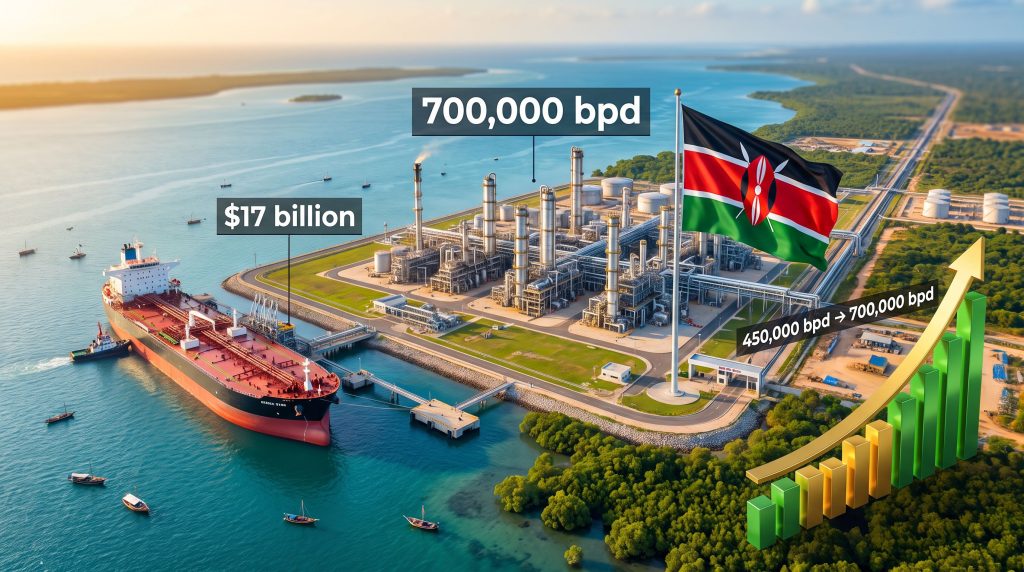
Current aggregate refined fuel demand across East Africa stands at approximately 450,000 barrels per day (bpd). Every barrel of that demand is sourced from refineries in Asia, the Middle East, or Europe, exposing importers to currency risk, supply chain disruptions, and price cycles entirely outside their control. The proposed Dangote oil refinery in Kenya is the most ambitious attempt yet to close this gap permanently.
When big ASX news breaks, our subscribers know first
Project Architecture: Scale, Site, and Strategic Positioning
What the Numbers Actually Mean
The headline figures for the proposed Lamu refinery are significant enough to reframe East African energy economics entirely:
| Project Parameter | Detail |
|---|---|
| Proposed Processing Capacity | 700,000 barrels per day |
| Estimated Capital Investment | $17 billion (approx. KSh 2.2 trillion) |
| Selected Development Site | Lamu Island, Kenya's northern coast |
| Projected Construction Timeline | 30 months to 3 years |
| Estimated Job Creation | 60,000+ direct and indirect positions |
| Primary Markets Served | Kenya, Uganda, South Sudan, Rwanda, Burundi, DRC |
At 700,000 bpd, the facility would exceed East Africa's total current refined fuel consumption by approximately 250,000 bpd — a surplus that is not incidental but central to the project's commercial logic. That exportable margin would feed broader African markets through the trade architecture established under the African Continental Free Trade Area (AfCFTA), a 55-nation framework encompassing 1.4 billion people and a combined GDP of roughly $3.4 trillion.
Why Lamu Was Selected Over Competing Sites
Earlier site assessments evaluated both Mombasa, Kenya and Tanga, Tanzania before Lamu Island emerged as the preferred location. The selection reflects a convergence of logistical and infrastructure advantages that neither alternative could replicate:
- Port depth: Lamu's natural harbor accommodates drafts of up to 18 meters, enabling fully laden Post-Panamax crude tankers carrying up to 2 million barrels per cargo — vessels that cannot physically berth at Mombasa's shallower facility
- LAPSSET Corridor integration: Lamu serves as the anchor terminus of the Lamu Port-South Sudan-Ethiopia Transport Corridor, providing planned pipeline and rail connectivity directly into landlocked East African markets
- Industrial land availability: Greenfield development conditions at Lamu allow for the physical footprint a refinery of this scale requires
- Crude export access: Deep-water access enables direct procurement from global spot markets and long-haul cargo routes from West African exporters including Nigeria and Angola
The LAPSSET dimension deserves particular attention. The corridor was conceived as a continent-spanning infrastructure spine, and positioning the refinery at its coastal anchor means refined products could theoretically move by pipeline toward Uganda and South Sudan as that infrastructure matures — a fundamentally different distribution model than trucking fuel from Mombasa inland.
Financing Structure: How a $17 Billion Refinery Gets Built
Dangote's Capital Stack Approach
The financing architecture for the Dangote oil refinery in Kenya reflects lessons absorbed from the Lagos project, adapted for a cross-border development context with additional regulatory complexity. Rather than relying on a conventional project finance structure anchored by multilateral lenders or sovereign debt, Dangote Industries has outlined a multi-instrument capital approach comprising:
- Cash generation from existing Nigerian refinery operations reinvested into expansion
- Bond issuances targeting institutional capital in African and international debt markets
- A planned initial public offering (IPO) to broaden the equity investor base
This approach mirrors the financing logic used to complete the 650,000 bpd Lagos facility, though the Kenya project adds layers of complexity around concession agreements, cross-border regulatory approvals, and the need to establish new offtake relationships with six sovereign markets simultaneously.
The first major external commitment came from Tanzanian business leader Mohammed Dewji, who publicly pledged $100 million toward the development — a signal that private African capital is prepared to underwrite the project's early momentum and potentially catalyse a broader consortium structure from other regional investors.
The Nigeria Precedent: What Lagos Teaches Nairobi
Documented Outcomes from the 650,000 bpd Lagos Refinery
The operational track record of the Dangote Refinery in Nigeria provides the most directly comparable benchmark for assessing what the Kenya project might deliver. Commissioned in 2023, the Lagos facility has produced measurable economic outcomes across multiple dimensions:
| Economic Indicator | Documented Outcome |
|---|---|
| Domestic fuel import dependency | Eliminated: 100% of Nigeria's gasoline, diesel, and jet fuel demand now met domestically |
| Sovereign credit rating | Nigeria received its first upgrade to B in 14 years, partly attributed to balance of payments improvement |
| CO₂ emissions impact | Projected elimination of over 1 million metric tonnes annually versus overseas refining |
| Trade position | Nigeria transitioned from net refined products importer to active exporter |
| Currency pressure | Reduced structural foreign exchange demand from fuel import bills, easing pressure on the naira |
Beyond the macro indicators, the Lagos refinery introduced a less-discussed downstream benefit: the facility also produces fertiliser, creating additional industrial value chains and export revenues that were not modelled in original project assessments. This diversification of output beyond refined fuels is a dimension worth monitoring closely in any Kenya project design.
Furthermore, the oil futures benchmarks applied to Nigerian crude have demonstrated how domestically processed crude retains economic value within the producing economy rather than transferring refining margins to overseas operators. If East Africa can replicate even a partial version of this model across six sovereign markets simultaneously, the cumulative macroeconomic impact would be substantially larger than the Nigerian precedent on a per-country basis.
However, the Lagos experience also raised a cautionary flag that any investor or policymaker should examine carefully.
The Monopoly Problem: Competition Risk in a Single-Supplier Model
How the Nigeria Experience Became a Warning for Kenya
Following commissioning of the Lagos refinery, Dangote Industries pursued regulatory and legal actions to restrict competing fuel import licences, arguing that unconstrained imports undermined the domestic refining economics necessary to justify the original capital investment. The response from Nigerian regulators, state oil company NNPC, and independent fuel marketers was pointed: concentrated control over refined fuel supply in a single large facility creates structural monopoly risk, leaving consumers and distributors exposed to a single-supplier pricing environment with limited competitive recourse.
In the East African context, the same dynamics could emerge in sharper form given that the refinery would supply six nations rather than one:
- Requests for anti-dumping protections on imported refined fuels could harm existing regional traders and raise end-consumer prices
- Tax incentive packages negotiated with the Kenyan government may create competitive asymmetries disadvantaging independent importers
- A 700,000 bpd facility serving six countries inherently creates supply chain concentration risk at a regional level
Regulatory frameworks governing the refinery's market conduct — particularly around pricing obligations, access terms, and import competition — will ultimately be as consequential as the physical infrastructure in determining whether the project delivers broad economic benefit or entrenches market power in ways that replicate the tensions already visible in Nigeria.
Environmental Opposition and the UNESCO Conflict
Lamu's Heritage Status as a Legal and Ecological Flashpoint
The Dangote oil refinery in Kenya faces its most immediate obstacles not in the financing markets but in the ecological and legal terrain surrounding its chosen site. Lamu Island carries UNESCO World Heritage Site designation, and the surrounding marine environment supports ecosystems of documented ecological sensitivity including mangrove forests, coral reef systems, and artisanal fisheries that sustain coastal livelihoods.
Greenpeace Africa and coalitions of local community groups have formally opposed the project on the following grounds:
- Risk of irreversible marine habitat damage during construction dredging and operational discharge
- Potential for oil spill contamination affecting coral reef and mangrove systems with long recovery timelines
- Livelihood displacement among fishing and eco-tourism communities dependent on an unpolluted coastal environment
- Air quality degradation from refinery emissions in a densely inhabited heritage zone
Human rights and constitutional legal practitioners have signalled preparedness to seek High Court injunctions requiring suspension of all project activity until comprehensive, independently conducted Environmental and Social Impact Assessments (ESIAs) are completed with full public participation — a process that, if pursued through Kenyan courts, could introduce significant timeline uncertainty.
The Stranded Asset Dimension
A separate category of criticism targets the project's long-term financial logic rather than its immediate environmental footprint. In addition, the broader renewable energy transition raises important questions about long-run demand assumptions:
- Global energy transition modelling projects declining fossil fuel demand across developed markets through the 2030s and into the 2040s
- A large-scale refinery commissioned in the late 2020s carries a standard asset life of 30 or more years, meaning its economic assumptions extend well into periods of significant demand uncertainty
- Kenya's own commitments under the Paris Agreement create potential policy tension with locking in large-scale carbon-intensive infrastructure investment
- Electric vehicle adoption and renewable energy penetration, while currently limited in East Africa, are accelerating and could affect long-run fuel demand trajectories more quickly than project feasibility models assume
It is important to note that stranded asset timelines involve considerable uncertainty, and energy demand forecasts for sub-Saharan Africa specifically remain highly contested among analysts. East Africa's current motorisation rates and energy access levels suggest that refined fuel demand growth in the region may diverge significantly from global averages for at least the next two decades.
The next major ASX story will hit our subscribers first
AfCFTA as the Commercial Foundation
Why This Project Is About More Than a Single Refinery
The Dangote oil refinery in Kenya cannot be assessed purely as a standalone infrastructure project. Its commercial viability is structurally linked to the progressive implementation of the African Continental Free Trade Area framework, which provides the trade architecture required to make intra-African refined fuel distribution economically competitive with imports from Asia and Europe. Consequently, green transition pressures will also shape how the project is received by international institutional investors assessing its long-term viability.
Key AfCFTA dimensions relevant to the refinery's business model include:
- Tariff reduction pathways that lower the cost of selling refined products across African borders relative to third-country imports
- Rules of origin provisions that may incentivise crude processing within Africa before export, favouring domestic refiners
- Cross-border infrastructure investment represented physically by the LAPSSET Corridor as a distribution backbone
- Private sector industrial leadership demonstrating that African capital can drive continent-scale infrastructure without relying exclusively on multilateral financing
The project also creates a fascinating test of whether African billionaire capital can be directed toward productive industrial infrastructure in ways that generate shared economic benefit rather than extractive returns. According to Reuters, Mohammed Dewji's $100 million commitment alongside Dangote's anchor investment positions this as a multi-country private sector coalition for East African industrial development.
Frequently Asked Questions: Dangote Oil Refinery in Kenya
Where Will the Dangote Refinery in Kenya Be Built?
The selected site is Lamu Island on Kenya's northern coast, positioned along the LAPSSET Corridor. Mombasa and Tanzania's Tanga were considered in earlier assessments before Lamu was identified as the preferred location based on port depth, land availability, and corridor connectivity.
What Is the Proposed Refinery's Processing Capacity?
The facility is designed to process 700,000 barrels per day, exceeding East Africa's current aggregate refined fuel demand of approximately 450,000 bpd and generating a surplus of roughly 250,000 bpd available for export.
How Much Will the Project Cost?
The estimated capital investment is $17 billion (approximately KSh 2.2 trillion), making it one of the largest proposed industrial investments in East African history.
How Long Will Construction Take?
Construction is projected to require between 30 months and 3 years from groundbreaking.
What Are the Main Risks to the Project Proceeding?
The principal risk categories include environmental and legal opposition linked to Lamu's UNESCO heritage status, potential High Court proceedings demanding comprehensive ESIAs, stranded asset concerns associated with global energy transition trajectories, and competitive market concerns around monopoly dynamics in regional fuel supply.
Key Takeaways
- East Africa's complete absence of domestic refining capacity since 2013 represents a structural economic vulnerability costing the region foreign exchange and competitive industrial development
- At 700,000 bpd, the proposed Lamu facility would become Africa's largest refinery and produce a meaningful exportable surplus beyond current regional demand
- The Nigeria refinery precedent demonstrates both the transformative potential and the competitive market risks that must be addressed proactively by regulators
- Environmental, legal, and community opposition centred on Lamu's UNESCO-protected ecosystem remains the most immediate obstacle to project advancement
- The refinery's success or failure will serve as a critical indicator of AfCFTA's industrial integration ambitions and the capacity of African private capital to drive continent-scale energy infrastructure
This article contains forward-looking assessments, economic projections, and analysis of proposed projects that have not yet received full regulatory approval or commenced construction. Readers should not interpret any content herein as financial or investment advice. All projections and capacity figures relate to proposals and are subject to change.
Want to Track the Next Major Resource Discovery Before the Market Does?
Discovery Alert's proprietary Discovery IQ model scans ASX announcements in real time, instantly identifying significant mineral discoveries across more than 30 commodities — giving subscribers an actionable edge the moment opportunities emerge. Explore historic discoveries and their returns, then begin your 14-day free trial at Discovery Alert to position yourself ahead of the broader market.