July 22, 2026
When Dormant Giants Wake: The Industrial Logic Behind South Africa's Largest Coal Mine Resurrection
Few events in the mining world carry the symbolic weight of a dormant dragline returning to work. These machines, among the largest self-propelled land vehicles ever constructed, represent an era of industrial ambition that modern manufacturing can no longer replicate. When one of Africa's most powerful draglines swings its boom across an Mpumalanga sky for the first time in years, it signals something far deeper than a single company's recovery plan. It reflects a calculated bet on the enduring commercial viability of South African thermal coal, and a conviction that distressed assets, properly capitalised, can be transformed into world-class operations.
That bet is now playing out at Optimum Colliery, where Liberty Coal's Optimum Colliery revival and dragline returned to production has reached a defining milestone: a fully refurbished Marion 8200 recommissioned in July 2026, marking the first successful dragline recommissioning in South Africa in nearly six years.
When big ASX news breaks, our subscribers know first
From State Capture Casualty to Liberty Coal's Centrepiece Asset
Optimum Colliery's origins trace back to 1970, when the complex was purpose-built to feed coal into Eskom's Hendrina Power Station, located less than 2 km from the mine's heavy dense media separation (HMS) plant and fewer than 5 km from its administrative offices. For decades, the 38,000-hectare operation served as one of South Africa's most strategically significant coal supply nodes.
That strategic standing unravelled after the Gupta family acquired the asset in 2015. What followed became one of South Africa's most well-documented cases of industrial neglect driven by governance failure. Equipment was abandoned, infrastructure was stripped by vandals, and export operations were suspended. By the time the colliery entered formal business rescue proceedings, it had transitioned from a high-capacity producer to a cautionary case study in what unchecked mismanagement can do to a nationally significant mining operation.
Liberty Coal's February 2024 acquisition through the business rescue process represented more than a financial transaction. It was a signal to the broader South African mining sector that distressed but historically productive assets could attract serious, capital-backed investors willing to undertake the painstaking work of restoration. This aligns with broader mining industry consolidation trends seen across southern Africa.
The strategic logic was compelling on several fronts:
- Optimum held existing Richards Bay Coal Terminal (RBCT) export allocations, providing immediate access to seaborne coal markets that would have taken years to establish from scratch
- Established rail infrastructure connecting the mine to RBCT was already in place, even if degraded
- The mine's proximity to Hendrina Power Station opened a potential future domestic supply pathway
- Nine previously separate opencast mining rights were subsequently consolidated under a single unified mining right registered to Liberty Coal, dramatically simplifying operational and administrative complexity
Structural Insight: Acquiring pre-existing RBCT export allocations is frequently underestimated as a competitive advantage. The terminal operates at capacity constraints, and new entrants face significant barriers to securing meaningful allocation volumes. Liberty Coal bypassed this entirely.
The Scale of the R3-Billion Turnaround: Capital at Work
The numbers behind the Optimum Colliery revival and dragline returned to production are substantial by any measure. Total capital investment has exceeded R3-billion to date, deployed across mining equipment, processing infrastructure, and logistics systems in a phased, priority-sequenced programme.
| Investment Area | Capital Allocation | Expected Output Impact |
|---|---|---|
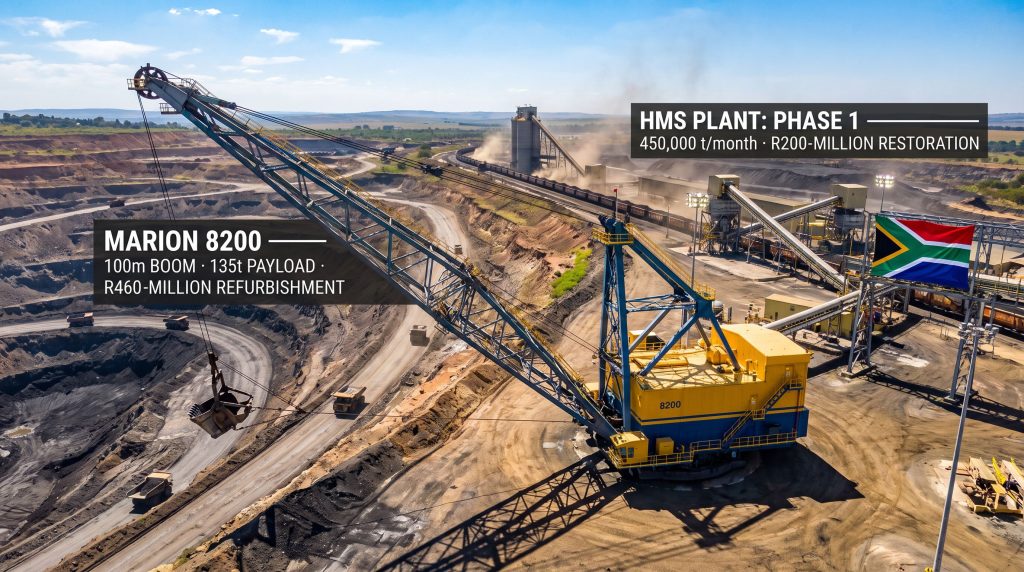
| Marion 8200 Dragline Refurbishment | ~R460-million | Full-scale overburden stripping restored |
| HMS Plant Restoration | ~R200-million | Phase 1: 450,000 t/month; Phase 2-3: 700,000-800,000 t/month |
| Rail Siding and Silo Upgrades | TBC | Train calls increased from 12 to 15 per week |
| Boschmanspoort Underground Revival | TBC | Production target: February 2027 |
| Total Investment to Date | R3-billion+ | Full ramp-up: 1.5-2 million t/month RoM |
The prioritisation of capital is itself analytically instructive. Liberty has sequenced its spending to unlock export revenue first, with domestic market participation treated as a second-phase objective. This reflects an understanding that RBCT export pricing, particularly for higher-grade coal products, generates superior margins compared to domestic supply contracts in the current environment. Furthermore, commodity prices and mining performance are closely intertwined, making this sequencing decision particularly astute.
The Dragline Economics: Why One Machine Justifies R460-Million
The decision to commit R460-million to the refurbishment of a single dragline becomes rational when examined through the lens of operational economics. According to Liberty Coal COO Peter Nordin, a dragline of the Marion 8200 class replaces the productive capacity of eight excavators, delivering cost-per-tonne advantages that compound meaningfully at the scale Optimum is targeting.
The economic case is reinforced by replacement scarcity. Marion 8200 class draglines are no longer manufactured globally. Mine representatives involved in the restoration confirmed that a new equivalent unit would carry a price tag of approximately R2-billion in current market conditions, making the R460-million refurbishment investment appear modest by comparison.
Key technical specifications of the Marion 8200 Number 3:
- Boom length: 100 metres
- Single-scoop payload: approximately 135 tonnes
- Maximum excavation depth: nearly 80 metres
- Primary function: large-scale overburden stripping to expose underlying coal seams
- Replacement value at current market rates: approximately R2-billion per unit
Industry Context: South Africa once operated the most extensive fleet of large-format draglines on the African continent, concentrated in the Mpumalanga coalfields. The Marion 8200 at Optimum represented the pinnacle of that era. Its return to operation is not merely a corporate milestone but a rare industrial recovery story.
The Refurbishment Process: Engineering a Machine Back to Life
Recommissioning a dragline that has sat derelict for years requires a systematic approach that addresses both structural integrity and mechanical reliability. According to Liberty Coal's own reporting, the Marion 8200 Number 3 refurbishment involved multiple concurrent workstreams:
- Structural integrity assessments using non-destructive testing techniques on all major load-bearing components
- Bucket, rigging and fairlead assembly inspection, repair, and performance optimisation
- Full servicing of the walking mechanism and slew system to restore mobility and rotational capability
- Lubrication system overhaul to ensure long-term operational reliability under continuous production conditions
- Long-range parts procurement, with certain components carrying manufacturing lead times of up to 24 months
The workforce challenge was equally complex. Certified dragline operators are a scarce skillset in South Africa's modern mining labour pool. However, Liberty Coal was able to source qualified personnel from nearby operations that had recently reduced their own dragline activities, a fortuitous circumstance of geographic proximity rather than guaranteed market availability.
The Three-Dragline Roadmap: A Five-Year Vision
The Marion 8200 Number 3 is only the starting point of Liberty's dragline strategy. Two additional units remain at the Kwagga mine, previously observed in a state of dereliction during a site visit in December 2022.
| Phase | Dragline | Timeline | Status |
|---|---|---|---|
| Phase 1 | Marion 8200 Number 3 | Completed July 2026 | Fully operational |
| Phase 2 | Second Marion 8200 | Feasibility study: 2027; parts manufacturing to follow | Planning stage |
| Phase 3 | Bucyrus Dragline | After second Marion is operational | Long-term |
| Target | Three concurrent draglines | Within five years of 2026 | Roadmap committed |
Three simultaneously operating draglines would give Optimum one of the largest active dragline fleets on the African continent, with combined overburden stripping capacity sufficient to unlock coal seam access at a scale consistent with the mine's long-term production targets.
HMS Plant Recommissioning: Unlocking the Quality Dimension
The R200-million HMS plant restoration is arguably the most commercially impactful single project within the broader revival programme, because it determines not just how much coal Optimum can produce, but what quality grades it can offer to export markets.
The plant was comprehensively stripped during the abandonment period. Electrical cabling, pumps, cyclones, and conveyor infrastructure all required extensive replacement or repair. Work observed during a site visit in July 2026 included simultaneous electrical cable replacement, pump restoration, cyclone repairs, and conveyor reinstatement, with the pace of activity suggesting a late-2026 completion target remains achievable.
Phase-by-Phase Production Ramp-Up
| Phase | Timeline | Monthly Throughput | Coal Grades Enabled |
|---|---|---|---|
| Phase 1 | August-September 2026 | ~450,000 t/month | RB2, RB3, RB4 |
| Phase 2-3 | Post-Phase 1 | 700,000-800,000 t/month | RB1, RB2, RB3, RB4 |
| Full Production | 3-5 year horizon | 1.5-2 million t/month RoM | Complete product slate |
Understanding Coal Grades: Why RB1 Changes the Revenue Equation
For readers unfamiliar with South African coal grading conventions, the Richards Bay Coal Terminal classification system is central to understanding Optimum's commercial trajectory:
- RB4 is the lowest-grade export product, characterised by higher ash and moisture content and lower calorific value
- RB3 and RB2 represent progressively higher quality, with improved energy content and lower impurity levels
- RB1 is the benchmark premium export grade, carrying the highest calorific value and commanding a meaningfully higher per-tonne price in Asian spot markets
Liberty currently produces RB2, RB3, and RB4 grades. HMS plant operation will unlock RB1 production, improving revenue per tonne shipped without necessarily requiring a proportional increase in total tonnage. This quality upgrade pathway is one of the less-discussed aspects of the Optimum revival but carries significant implications for long-term revenue generation.
Export Strategy: Sequencing Markets for Maximum Return
Liberty Coal currently exports between 400,000 t and 500,000 t of coal per month through RBCT to a diversified client base spanning India, Singapore, Japan, and other markets. The company's deliberate approach has been to fully satisfy export allocation commitments before pursuing domestic supply contracts, a sequencing decision driven by margin considerations rather than capacity constraints.
This export-first strategy reflects a broader truth about South African coal economics: seaborne thermal coal pricing, particularly for higher-grade products destined for Asian power generators, frequently exceeds domestic contract pricing. In addition, the emergence of an India coal trading exchange underscores the growing importance of Asian market access for producers like Liberty Coal, making RBCT-routed volumes the natural priority for any commercially rational operator.
Rail Logistics: The Transnet Constraint and the Silo Solution
Optimum's export ambitions are partially shaped by Transnet's rail network performance, which represents the most significant external variable in Liberty's production ramp-up timeline. The current loading arrangement uses wheel loaders to fill 8,500-tonne-capable trains on a four-hour turnaround cycle, with Transnet delivering wagons and returning with locomotives four hours later.
The restoration of one of two 10,000-tonne rapid load-out silos at Optimum's Pullenshope rail siding would compress that loading window to approximately two hours, enabling weekly train calls to increase from 12 to 15. This improvement in throughput efficiency does not require additional rail capacity allocation from Transnet, making it a relatively low-risk enhancement.
The second silo's recommissioning is explicitly conditional on two factors:
- Production ramp-up reaching volumes that justify the additional loading capacity
- Transnet expanding available rail capacity toward the RBCT's design throughput of 85-90 million tonnes per year
The Transnet Variable: If Transnet can achieve performance levels consistent with RBCT's design capacity within the next two to three years, Liberty's Pullenshope siding would be positioned to supply additional coal volumes that the expanded capacity could accommodate. This represents an upside scenario rather than a base case.
The next major ASX story will hit our subscribers first
Underground Revival and the Domestic Market Horizon
Liberty Coal is advancing plans to recommission the Boschmanspoort underground mine within the same consolidated mining right, with production targeted to begin by February 2027. Underground operations diversify the mine's production methodology, access different coal seam horizons, and reduce dependence on surface stripping rates, providing operational resilience against any single production constraint.
On the domestic supply side, Optimum's proximity to Hendrina Power Station, less than 2 km from the HMS plant, positions it as a natural future coal supplier to Eskom should the utility open a new tendering round. Current discussions within the sector suggest a potential Hendrina Power Station revitalisation within approximately five years. This remains speculative and is not confirmed, but Liberty has acknowledged the opportunity as part of its long-term commercial planning.
At full production, Liberty is targeting run-of-mine output of 1.5-2 million tonnes per month, with saleable coal volumes of 800,000 t to 1.2 million tonnes per month once all processing, dragline, and logistics infrastructure reaches operational maturity. These targets must, however, be weighed against prevailing coal supply challenges that continue to shape the broader South African and global market environment.
Employment Impact and the Mpumalanga Ripple Effect
Beyond the financial metrics, the Optimum Colliery revival and dragline returned to production carries significant social and economic implications for the Middelburg region and broader Mpumalanga coal belt. The operation currently employs more than 500 workers, with further job creation expected as each production ramp-up phase is executed.
The mine's revival also demonstrates a broader principle with implications for South Africa's distressed mining sector: the business rescue mechanism, when combined with sufficient capital commitment and operational expertise, can preserve strategic mining infrastructure that might otherwise be permanently lost. Consequently, this approach offers a compelling template for coal mine expansion impact assessments in other jurisdictions wrestling with similar questions of asset revitalisation.
Key Risk Factors Investors and Observers Should Monitor
The Optimum revival narrative is compelling, but several risk dimensions warrant careful consideration:
- Transnet rail performance remains the single largest external constraint on export volume growth and cannot be controlled by Liberty Coal
- Parts procurement lead times of up to 24 months for certain dragline components introduce supply chain vulnerability into the multi-dragline restoration programme
- Global thermal coal price dynamics create revenue sensitivity, particularly given Optimum's growing exposure to Asian spot markets through RBCT
- Eskom's domestic demand trajectory and the uncertainty surrounding Hendrina Power Station's future limit visibility on the domestic revenue diversification pathway
- Skilled labour scarcity for specialised roles like dragline operation could become a constraint as the fleet expands toward three concurrent machines
Disclaimer: This article contains forward-looking statements, production targets, and capital expenditure projections sourced from company representatives and publicly available reporting. These should not be construed as financial advice. Mining projects involve material operational, market, and regulatory risks, and actual outcomes may differ significantly from stated targets.
Five-Year Milestones: What to Watch
| Milestone | Target Date |
|---|---|
| HMS Plant Phase 1 Restart | August-September 2026 |
| Boschmanspoort Underground Production Begins | February 2027 |
| Second Marion 8200 Feasibility Study | 2027 |
| Second Marion 8200 Parts Manufacturing | 2027-2029 (estimated) |
| Three Draglines Simultaneously Operational | Within five years of 2026 |
| Full RoM Production Target | 1.5-2 million t/month (3-5 year horizon) |
The Optimum Colliery revival and dragline returned to production is more than a headline. It is the physical embodiment of a thesis: that South Africa's coal mining infrastructure, however damaged by years of mismanagement, retains latent productive capacity that disciplined capital can unlock. Whether Liberty Coal's phased strategy delivers on its ambitious production roadmap will depend on variables both within and beyond its control. As detailed coverage from African Mining confirms, the Marion 8200 Number 3 is running again, and in South African coal mining terms, that is a genuinely historic development.
For ongoing coverage of South African coal sector developments and broader Mpumalanga mining activity, Mining Weekly at miningweekly.com provides detailed industry reporting and analysis.
Want To Identify the Next Major Resource Discovery Before the Market Does?
Discovery Alert's proprietary Discovery IQ model delivers real-time alerts on significant ASX mineral discoveries, cutting through complex data to surface actionable opportunities the moment they are announced — the same kind of early-mover advantage that has historically driven extraordinary returns in the resources sector. Explore Discovery Alert's dedicated discoveries page to understand how historic mineral discoveries have generated substantial market returns, and begin your 14-day free trial to position yourself ahead of the broader market.