July 22, 2026
When Oil States Stop Buying and Start Building: The Rise of NOC Innovation Ecosystems
For most of the twentieth century, national oil companies across the Gulf operated within a well-defined hierarchy: international oilfield service giants developed the technologies, and state producers purchased access to them. That relationship made commercial sense during an era of relatively straightforward reservoir development. However, as Gulf fields mature, subsurface complexity deepens, and the economics of production intensify, the old model is showing its limitations. The Kuwait Oil Company Halliburton Ahmadi Innovation Valley partnership represents one of the most compelling responses to this structural shift.
The shift now underway is more than a procurement preference change. It reflects a fundamental recalibration of where technological capability should reside. Kuwait Oil Company's development of the Ahmadi Innovation Valley (AIV) is one of the clearest expressions of this new paradigm, and Halliburton's multi-year agreement to support it offers a revealing window into how the global oilfield services industry is adapting to a world where national oil companies want to co-own the innovation process.
When big ASX news breaks, our subscribers know first
What the Ahmadi Innovation Valley Actually Is
The AIV is a purpose-built research, development, and commercialisation platform established by Kuwait Oil Company in Ahmadi, the historic heart of Kuwait's petroleum industry. Its core mandate goes well beyond the applied field services that conventional oilfield service contracts typically cover. The centre is designed to develop, prototype, test, and ultimately commercialise technologies that address the specific geological and operational conditions Kuwait's upstream sector faces.
Ahmadi itself carries symbolic weight here. As the original base of Kuwait's oil development dating back to the mid-twentieth century, locating a future-focused innovation centre there signals that KOC is treating the AIV as a permanent institutional asset rather than a time-limited programme.
Technology Domains at the Core of AIV's Research Mandate
The AIV's research scope is deliberately broad, covering three distinct upstream categories that reflect Kuwait's operational reality:
- Brownfield reservoir management: Addressing pressure decline, water breakthrough, and ageing surface infrastructure in Kuwait's mature producing fields
- Greenfield development acceleration: Compressing discovery-to-production timelines using locally validated technologies rather than adapting solutions designed for different geological settings
- Unconventional reservoir development: Applying modified completion and stimulation technologies to Kuwait's tight and carbonate formations, which present very different challenges from the shale plays that dominate unconventional discourse in North America
Cutting across all three categories is a digital infrastructure layer built around artificial intelligence, machine learning, data analytics, and Industrial Internet of Things (IIoT) integration. The significance of positioning these tools as foundational infrastructure rather than optional add-ons cannot be overstated. It signals that KOC views data-driven operations as a prerequisite for effective physical technology development, not a supplementary service.
The Five-Partner Consortium: A Deliberate Architecture
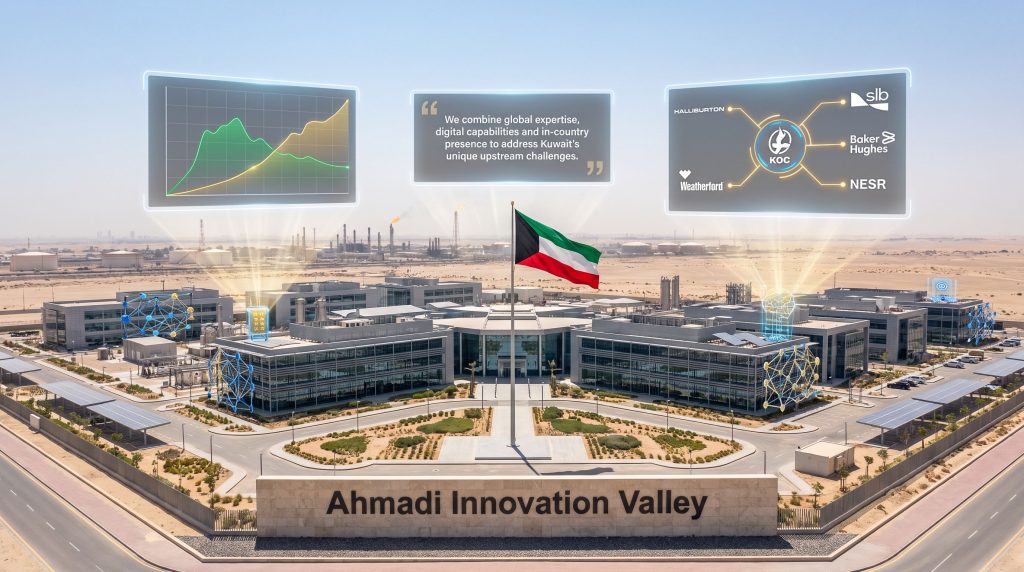
One of the less-discussed but strategically important aspects of AIV is that Kuwait Oil Company did not award a single dominant technology mandate. Instead, it assembled a consortium of five major international oilfield technology providers, each contributing distinct capabilities:
| Partner | Role Within AIV |
|---|---|
| Halliburton | Applied research, AI-driven asset performance, engineering expertise, prototyping and commercialisation |
| SLB | Seven-year contract spanning AI, IIoT, reservoir technologies, water management, and energy transition |
| Baker Hughes | R&D centre development under initial MoU framework |
| Weatherford | In-country technology collaboration under MoU structure |
| NESR | Regional specialist contributions within the broader consortium |
This multi-partner architecture is not accidental. By engaging five providers simultaneously across overlapping but distinct technical domains, KOC creates internal competitive pressure while ensuring no single vendor can develop an exclusive technological lock on Kuwait's upstream innovation agenda. Furthermore, it builds redundancy into the R&D pipeline, meaning that if one technology pathway stalls, parallel workstreams continue advancing.
The simultaneous engagement of five global technology leaders within a single innovation framework represents a sophisticated portfolio approach to R&D risk management, one that mirrors how leading technology companies manage their innovation pipelines across multiple competing internal teams.
Halliburton's Position Within the AIV Framework
Halliburton's AIV agreement is structured as a multi-year engagement covering applied research, engineering deployment, prototyping, pilot testing, and technology commercialisation. What distinguishes this from a conventional oilfield service contract is the co-development mandate: rather than delivering standardised services, Halliburton is expected to tailor its technological programming specifically to Kuwait's reservoir conditions and operational challenges.
Digital capabilities sit at the centre of Halliburton's contribution. The company's AI-powered efficiency tools for reservoir characterisation, production forecasting, and real-time asset performance monitoring are directly relevant to the brownfield optimisation challenges that represent perhaps the most immediate pressure point in Kuwait's upstream portfolio.
Halliburton's engagement with KOC did not begin with the AIV award. The company has maintained an operational presence in Kuwait across offshore services and digital transformation programmes, which provided the technical credibility and institutional relationships that underpin the current partnership. This history matters because AIV partnerships are not purely transactional; they require a level of operational trust that takes years to develop.
Halliburton's chairman, president and CEO communicated that the partnership is built on the depth of long-term collaboration with KOC and a shared focus on advancing technology development within Kuwait's energy sector, combining global expertise, digital capabilities, and in-country presence to address Kuwait's specific upstream challenges. [Source: World Oil, July 2026]
Digital Technologies Driving the AIV Research Agenda
The digital stack being deployed through AIV is worth examining in detail, because it represents a more integrated approach than typical oilfield digitalisation programmes:
- AI and machine learning for subsurface characterisation, enabling faster and more accurate reservoir modelling across heterogeneous carbonate and clastic formations
- Predictive analytics platforms that aggregate real-time production data to identify performance deviations before they translate into output losses
- Digital twin technology allowing engineers to simulate field-scale scenarios virtually before committing capital to physical interventions
- IIoT sensor networks that provide continuous monitoring of wellbore and surface equipment performance, reducing unplanned downtime across ageing brownfield infrastructure
Why In-Country R&D Capacity Has Become a Strategic Imperative
The economic logic behind AIV and comparable NOC innovation initiatives across the Gulf Cooperation Council extends well beyond technology development itself. There are at least three interconnected strategic drivers:
- Intellectual property retention: Technologies developed within an in-country framework can be co-owned, licensed, or commercialised by the NOC rather than remaining the exclusive property of a foreign service provider
- Domestic technical talent development: Building a permanent R&D facility creates an institutional environment where Kuwaiti engineers and researchers progress from technical consumers to technology co-creators, with long-term implications for the country's human capital base
- Reduction of technological dependency: Over a long enough time horizon, a functioning in-country R&D ecosystem reduces Kuwait's reliance on importing solutions calibrated for other geological settings, lowering both cost and geological misalignment risk
The in-country value (ICV) frameworks that many Gulf producers have formalised in recent years provide structural reinforcement for this direction, though the AIV's strategic rationale stands independently of any particular policy framework.
Comparing AIV to Conventional Oilfield Service Models
The structural differences between the AIV model and traditional oilfield service contracting are significant enough to warrant direct comparison:
| Dimension | Traditional Service Contract | AIV Innovation Model |
|---|---|---|
| Engagement Duration | Project-specific | Multi-year, long-term |
| Technology Ownership | Vendor-retained | Co-developed with commercialisation pathway |
| Research Depth | Applied field execution | Fundamental and applied R&D |
| Digital Integration | Supplementary tool layer | Core foundational infrastructure |
| Physical Presence | Rotational field personnel | Permanent facility-based operations |
| Reservoir Scope | Single asset or campaign focus | Portfolio-wide across brownfield, greenfield, unconventional |
| Output Type | Service delivery | Deployable, scalable field technologies |
The commercialisation mandate embedded in AIV's structure is particularly notable. Research programmes that terminate at published findings deliver limited operational value. By explicitly requiring that R&D outputs translate into deployable technologies, KOC has designed an accountability mechanism into the AIV framework that keeps partner efforts tethered to practical upstream outcomes.
The next major ASX story will hit our subscribers first
Long-Term Implications for Kuwait's Upstream Productivity
If AIV succeeds in commercialising even a portion of its R&D pipeline, the downstream implications for Kuwait's upstream output are material. Kuwait holds approximately 101.5 billion barrels of proven crude oil reserves, placing it among the world's top ten by reserve volume. However, reserve size alone does not determine production trajectory; recovery efficiency does.
Brownfield optimisation technologies that improve recovery rates by even modest percentages across Kuwait's mature fields translate into billions of barrels of additional economically recoverable reserves. Given that the Burgan field — one of the world's largest conventional oil accumulations — has been producing since the 1940s and faces the natural processing challenges of a deeply mature asset, locally developed enhanced recovery technologies carry particular strategic value.
Beyond conventional assets, AIV's unconventional research stream positions Kuwait to evaluate tight carbonate formations that have historically been viewed as uneconomic but may become viable as locally adapted completion technologies emerge from the innovation pipeline.
Energy Transition Integration Within the AIV Framework
AIV's research mandate explicitly includes energy transition demand technology streams, encompassing carbon management, water treatment, and emissions-reduction applications. This integration is strategically intelligent for several reasons.
First, it acknowledges that the long-term operating environment for upstream producers will require demonstrated emissions management capability alongside production efficiency. Second, water management technology development directly addresses one of Kuwait's most pressing operational constraints, given the country's limited freshwater resources and the water intensity of mature field operations. Third, positioning AIV as a platform that spans both conventional upstream and renewable mining solutions extends its institutional relevance well beyond the hydrocarbon production cycle.
The deliberate inclusion of energy-transition research within an upstream innovation centre is a signal that Kuwait Oil Company is designing AIV as a decades-long strategic institution, not simply a vehicle for near-term production optimisation.
Frequently Asked Questions
What is the Ahmadi Innovation Valley?
The Ahmadi Innovation Valley is a research, development, and technology commercialisation centre established by Kuwait Oil Company in Ahmadi, Kuwait, designed to develop and deploy advanced upstream technologies across brownfield, greenfield, and unconventional reservoir environments. Kuwait Oil Company's official corporate profile provides further background on the company's strategic direction.
What is Halliburton's role in the Ahmadi Innovation Valley?
Halliburton holds a multi-year agreement with Kuwait Oil Company covering applied research, engineering expertise, prototyping, pilot testing, and technology commercialisation within the AIV framework, with artificial intelligence and data analytics forming the core of its digital contribution.
Which other companies are involved in the Ahmadi Innovation Valley?
The AIV partner ecosystem includes SLB, Baker Hughes, Weatherford, and NESR alongside Halliburton, each operating under separate agreements with Kuwait Oil Company and contributing distinct technical capabilities.
How does AIV differ from a traditional oilfield service contract?
Unlike conventional service agreements focused on discrete operational tasks, AIV is a permanent, facility-based R&D platform where international partners co-develop and commercialise technologies specifically calibrated to Kuwait's upstream conditions. Consequently, outputs are expected to generate deployable field solutions rather than standalone service deliveries. For broader context on how national oil companies are evolving their innovation strategies, the International Energy Agency offers relevant industry analysis.
What digital technologies are central to the AIV framework?
Artificial intelligence, machine learning, predictive data analytics, Industrial Internet of Things sensor networks, and digital twin simulation technologies form the foundational digital infrastructure underpinning AIV's research and commercialisation activities. The Kuwait Oil Company Halliburton Ahmadi Innovation Valley partnership places these tools at the very centre of its operational model.
Disclaimer: This article contains forward-looking statements and analytical projections regarding technology development timelines, upstream productivity outcomes, and institutional objectives. These represent informed analysis based on publicly available information and should not be construed as investment advice. Actual outcomes may differ materially from projections based on geological, commercial, regulatory, or operational factors.
Want to Track the Next Major Resource Discovery Before the Market Reacts?
Discovery Alert's proprietary Discovery IQ model delivers real-time alerts the moment significant ASX mineral discoveries are announced, translating complex geological and commodity data into clear, actionable insights for investors at every level — explore historic discovery returns to understand just how transformative early positioning can be, then begin your 14-day free trial to secure your market-leading edge.