July 22, 2026
The Thermal Energy Challenge That Makes Alumina So Difficult to Clean Up
Industrial decarbonisation is rarely a single-switch problem. For most heavy industries, the pathway away from fossil fuels involves navigating a tangle of thermal requirements, capital constraints, and operational risk tolerances that make straightforward fuel substitution far more complex than it appears on paper. Alumina refining sits near the top of this hierarchy of difficulty, and understanding why helps explain the significance of what Rio Tinto is now attempting at its Gladstone operations in Central Queensland.
The Bayer process, which underpins virtually all commercial alumina production globally, depends on sustained high-temperature steam generation to digest bauxite ore into aluminium oxide. This is not an intermittent heat demand that can be buffered by battery storage or satisfied by variable renewable inputs. It is continuous, high-grade, and thermally unforgiving. Coal has historically been the fuel of choice precisely because it delivers consistent combustion energy at scale, and replacing it requires something that can credibly replicate those characteristics without compromising refinery throughput or product quality.
That is the technical context behind the five-year biopellet supply agreement between Rio Tinto and Australian bioenergy company SuperChar Limited, targeting Rio Tinto biopellets in Gladstone alumina refineries as a partial coal substitute from 2028 onwards.
When big ASX news breaks, our subscribers know first
Gladstone's Refining Footprint and Why It Matters
Rio Tinto's Gladstone repowering ambitions span two alumina refineries within the region of Queensland: Yarwun and Queensland Alumina Limited (QAL). Together, these facilities form a significant component of the company's vertically integrated aluminium supply chain, which runs from bauxite mining through to aluminium smelting. Their geographic concentration in a single industrial precinct makes Gladstone both a strategic production hub and a concentrated source of Scope 1 greenhouse gas emissions.
What is less commonly appreciated is how disproportionately the refining stage contributes to the aluminium industry's overall carbon footprint relative to other parts of the value chain. The energy-intensive nature of the Bayer process means that decarbonising alumina production delivers far greater emissions impact per unit of effort than equivalent interventions at the smelting or mining stages. This asymmetry is a key reason why Rio Tinto's attention has turned to fuel substitution at the boiler level rather than elsewhere in its Australian operations.
What Biopellets Actually Are and Why Industrial Grade Matters
The term biopellet is sometimes conflated with the wood pellets used in domestic heating systems, but the two products have fundamentally different performance requirements. Industrial-grade biopellets must meet specifications that residential products never encounter, including:
- High and consistent calorific value to maintain steam generation targets
- Low moisture content to prevent combustion instability under continuous boiler load
- Predictable ash behaviour to avoid fouling, slagging, or refractory damage inside boiler systems
- Mechanical durability to survive handling, conveying, and storage at industrial volumes
Meeting these criteria simultaneously is technically demanding, and it is one of the reasons that most renewable energy in mining programmes require a dedicated feedstock-to-product development process rather than an off-the-shelf procurement arrangement.
SuperChar Limited has built its production model around bana grass as the primary feedstock, a choice that carries several practical advantages in the Central Queensland context.
Bana Grass: The Agricultural Case for a Perennial Energy Crop
| Characteristic | Detail |
|---|---|
| Crop classification | Perennial energy grass |
| Productive lifespan per planting | 15+ years |
| Harvesting compatibility | Conventional sugarcane equipment |
| Regional suitability | Central Queensland climate and soil types |
| Key biomass advantage | High yield per hectare versus annual energy crops |
The perennial nature of bana grass carries a dimension that is often overlooked in industrial biomass discussions. Because the root system remains in place across multiple harvesting cycles, there is significantly less annual soil disturbance compared to annual energy crops. This characteristic has implications for land management, carbon sequestration potential in soil organic matter, and the long-term cost stability of feedstock supply, since replanting costs are effectively amortised across a decade and a half of production rather than incurred annually.
The compatibility with existing sugarcane harvesting infrastructure is also commercially significant. It substantially lowers the capital barrier for agricultural operators in the region to enter the bana grass supply chain, since they are not required to invest in unfamiliar machinery. For a region where sugarcane has historically been a dominant agricultural activity, this creates a relatively accessible diversification pathway.
SuperChar plans to begin progressive bana grass planting from late 2026, with biopellet processing commencing in 2028 at a production facility located within the Gladstone region. Initial annual production capacity is planned at 35,000 tonnes of biopellets.
From Operational Trials to Commercial Agreement: The Evidence Base
One of the more technically instructive aspects of this programme is the sequencing of evidence-gathering that preceded the commercial commitment. Rio Tinto did not move directly from concept to contract. Instead, the company conducted both operational trials and a formal feasibility study to establish the technical performance of biopellet blends in its actual boiler systems.
Those trials produced a specific and meaningful result: biopellets demonstrated the capacity to substitute for up to 30% of the coal used in steam generation under the tested conditions. This figure is not a theoretical modelling output. It is an empirically derived threshold from operational testing at the refinery level, which gives it considerably more evidential weight than feasibility estimates derived purely from laboratory combustion data.
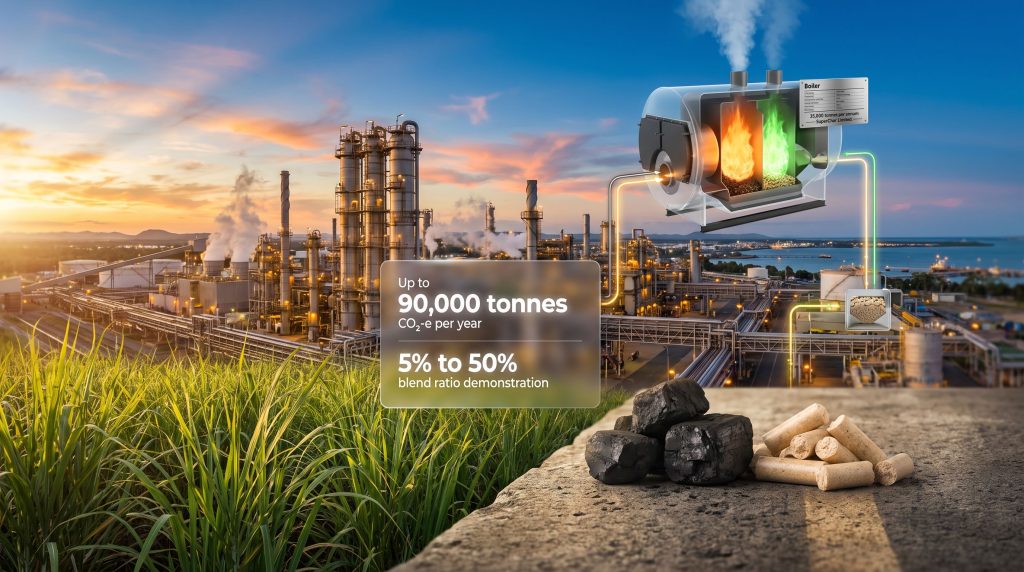
The 30% substitution figure established during trials represents the known technical baseline. The demonstration programme now under contract will systematically test whether that ceiling can be raised, with blend ratios ranging from 5% to 50% to be evaluated across structured operational demonstrations.
This incremental methodology reflects sound industrial practice. Biomass co-firing is well-documented as carrying specific operational risks that do not appear in pure coal combustion, including the potential for increased ash deposition on heat transfer surfaces, changes in flame characteristics affecting combustion zone temperatures, and variability in steam output if feedstock quality fluctuates. Beginning at low blend ratios and building upward allows the refinery team to detect and manage these effects before they become operationally costly.
The initial deployment will occur at Yarwun, with subsequent scale-up at QAL subject to regulatory approvals and site-specific operational readiness assessments. This sequencing reflects the logical risk management approach of learning from the first site before committing the second.
Quantifying the Emissions Reduction at Full Contracted Volumes
At the volumes specified in the five-year supply agreement, the use of Rio Tinto biopellets in Gladstone alumina refineries is projected to reduce Rio Tinto's reported Scope 1 emissions by up to 90,000 tonnes of CO₂-equivalent per year, calculated under Australia's National Greenhouse and Energy Reporting (NGER) framework.
Understanding how this figure is derived requires familiarity with how biomass combustion is treated under Australian emissions accounting conventions. Sustainably sourced bioenergy is classified as carbon-neutral at the point of combustion under the NGER framework, because the carbon released during burning is considered part of the biogenic carbon cycle rather than a net addition of fossil carbon to the atmosphere. Furthermore, this accounting treatment is what enables the substitution of coal with biopellets to register as a Scope 1 reduction under the current reporting methodology.
| Comparison Reference | Approximate CO₂-e Equivalent |
|---|---|
| Average Australian passenger vehicle annual emissions | ~4.5 tonnes CO₂-e |
| 90,000 tonnes CO₂-e in equivalent vehicles removed | ~20,000 vehicles |
| Emissions source targeted | Direct boiler combustion at Yarwun and QAL |
| Reporting framework applied | Australian NGER scheme |
It is worth noting that the 90,000 tonne figure is conditional on achieving higher blend ratios through the demonstration programme. The actual realised reduction in the early years of the contract, when blend ratios will likely remain closer to the lower end of the 5% to 50% range, will be materially lower. The full emissions benefit is a ceiling that depends on demonstrating operational viability at elevated co-firing ratios.
A Portfolio Decarbonisation Strategy, Not a Single-Technology Bet
The biopellet programme does not operate in isolation within Rio Tinto's broader decarbonisation architecture for its Australian alumina operations. Consequently, the company is simultaneously pursuing hydrogen calcination at Yarwun, which targets an entirely different thermal stage of the refining process. The mining decarbonisation benefits associated with this portfolio approach are considerable, since addressing multiple emissions sources simultaneously accelerates overall progress.
This distinction is technically important. The Bayer process involves two thermally distinct unit operations that each present their own decarbonisation challenges:
- Steam generation for digestion and evaporation — the stage addressed by biopellet co-firing, where the fuel substitution approach is applicable because the combustion system is relatively adaptable to alternative fuels.
- Calcination — the high-temperature conversion of aluminium hydroxide to aluminium oxide, which requires temperatures significantly exceeding those achievable in steam boilers and therefore demands a different technological solution, with hydrogen emerging as the leading candidate.
Because these two processes require fundamentally different decarbonisation approaches, a portfolio strategy is not merely a risk management preference but a technical necessity. No single fuel or technology can address both stages simultaneously under current engineering constraints.
Armando Torres, Managing Director of Rio Tinto Aluminium Pacific Operations, has made clear that reducing fossil fuel dependence in alumina refining will require precisely this kind of multi-technology, multi-partnership approach, with no single solution sufficient to deliver the scale of reduction required across the full refining operation.
The next major ASX story will hit our subscribers first
Regional Economic Dimensions: Where Agriculture Meets Heavy Industry
The supply chain architecture underpinning the biopellet programme has implications that extend well beyond Rio Tinto's emissions ledger. The decision to source feedstock locally rather than import industrial biomass from international suppliers creates a supply chain that is structurally embedded in Central Queensland's agricultural and industrial economy.
This local supply logic delivers several advantages that are not immediately obvious from a purely emissions-accounting perspective:
- Transport emissions associated with feedstock and pellet delivery are substantially lower than for imported biomass alternatives, improving the lifecycle emissions profile of the fuel
- Currency and geopolitical risk associated with international biomass procurement is eliminated
- Agricultural operators in the region gain access to a new, multi-decade revenue stream with low equipment transition costs
- SuperChar's Gladstone production facility creates industrial employment in manufacturing, logistics, and agricultural support functions
Torres has specifically highlighted the potential for this programme to forge meaningful connections between Central Queensland's agricultural sector and its heavy industrial base, describing it as a model that could support new industries and supply chains in the region. Indeed, Australia's green metals leadership is increasingly being built on precisely these kinds of regional industrial-agricultural partnerships.
SuperChar's Chief Executive Michael Palmer has characterised the agreement as the product of several years of collaborative development, built on the premise that locally cultivated, regeneratively grown biomass can function as a credible industrial fuel alternative rather than merely a marginal supplement. As mining electrification and decarbonisation continue to accelerate across Australia, this model may offer a replicable template for other resource-intensive regions.
Regulatory Approvals: The Gating Factor on the 2028 Timeline
The 2028 delivery target carries explicit conditionality. Both the production infrastructure and the refinery-side fuel system modifications must clear distinct regulatory pathways before Rio Tinto biopellets in Gladstone alumina refineries can enter commercial use at Yarwun or QAL. These include:
- Environmental approvals for bana grass cultivation at commercial scale in Central Queensland
- Construction and operational approvals for the biopellet processing facility in the Gladstone region
- Fuel system modification approvals at each refinery, which involve changes to boiler feed systems and potentially to combustion management protocols
Each of these represents an independent regulatory pathway with its own assessment timeline. The sequenced nature of the programme, starting with Yarwun before expanding to QAL, reflects a realistic acknowledgement that these approvals will not all resolve simultaneously and that operational readiness will vary between sites.
However, industry observers following Rio Tinto's Gladstone operations note that the company's existing regulatory relationships in the region, combined with the local supply chain structure, may support a more streamlined approvals process than would apply to entirely new industrial entrants.
Disclaimer: Projected emissions reductions, production volumes, and delivery timelines referenced in this article are subject to regulatory approvals, operational performance outcomes, and other conditions. They should not be interpreted as guaranteed outcomes. Investors and stakeholders should review Rio Tinto's official disclosures and consider a range of scenarios when evaluating the programme's potential impact.
Key Programme Parameters at a Glance
| Dimension | Detail |
|---|---|
| Agreement type | Five-year biopellet supply agreement |
| Supply partner | SuperChar Limited (SCL) |
| Target refineries | Yarwun and QAL, Gladstone, Queensland |
| First delivery target | 2028 (subject to regulatory approvals) |
| Initial production capacity | 35,000 tonnes per annum |
| Primary feedstock | Bana grass (locally grown, Central Queensland) |
| Blend ratio demonstration range | 5% to 50% biopellet co-firing |
| Trials-proven substitution ceiling | Up to 30% coal replacement |
| Projected Scope 1 reduction (full volumes) | Up to 90,000 tonnes CO₂-e per year |
| Parallel decarbonisation initiatives | Hydrogen calcination at Yarwun |
| Regulatory status | Subject to approvals and operational readiness |
Frequently Asked Questions
What are Rio Tinto biopellets and why are they being trialled at Gladstone alumina refineries?
Biopellets are densified biomass fuel products engineered to perform as a partial coal substitute in industrial boiler systems. Rio Tinto biopellets in Gladstone alumina refineries form part of a structured programme to reduce Scope 1 emissions from steam generation, following operational trials that demonstrated up to 30% coal substitution under tested conditions.
Which refineries are involved and in what order?
The Yarwun refinery will be the initial deployment site. Following performance assessment and subject to regulatory approvals and operational readiness, volumes will expand to Queensland Alumina Limited (QAL), also located in Gladstone.
When will commercial biopellet supply begin?
Deliveries are targeted to commence in 2028, contingent on regulatory approvals for both SuperChar's production facility and the fuel system modifications at Rio Tinto's refineries. Bana grass planting is scheduled to begin progressively from late 2026.
How much could emissions fall under this programme?
At full contracted supply volumes and higher co-firing blend ratios, the programme is projected to reduce Rio Tinto's reported Scope 1 emissions by up to 90,000 tonnes of CO₂-equivalent per year under the Australian NGER reporting framework.
Why is bana grass specifically chosen as the feedstock?
Bana grass offers a combination of high biomass yield per hectare, perennial productivity exceeding 15 years per planting, and compatibility with existing sugarcane harvesting equipment already prevalent in Central Queensland. Its local availability also eliminates the logistics and cost complexity of imported biomass procurement.
Want to Track the Next Major Resource Innovation Transforming ASX-Listed Miners?
Discovery Alert's proprietary Discovery IQ model scans ASX announcements in real time, delivering instant alerts on significant mineral discoveries and the emerging opportunities they create — from major producers to early-stage explorers. Start your 14-day free trial at Discovery Alert and see why historic discoveries have generated extraordinary returns by exploring the Discovery Alert discoveries page.