
July 27, 2026
The Industrial Metric That Is Quietly Rewriting Aluminium's Competitive Rulebook
Every major industrial transition begins the same way: a new variable enters the cost equation, and companies that fail to adapt discover too late that the ground has shifted beneath them. For decades, aluminium producers in India competed on the basis of energy procurement, raw material access, and operational throughput. Carbon intensity barely registered as a commercial consideration. That calculus is now changing, and the mechanism driving that change is India's Carbon Credit Trading Scheme (CCTS).
Three years into its implementation, the India carbon credit trading scheme aluminium industry relationship is growing more consequential by the year. Binding greenhouse gas emission-intensity targets are now in place. A national carbon registry is operational. Exchange-based trading is expected to launch in the second half of 2026. For the first time in the sector's history, the carbon footprint of a tonne of aluminium carries direct financial and regulatory implications.
This article examines how the scheme works, what it has delivered, where the gaps remain, and why the next phase of implementation may prove more consequential than the first.
When big ASX news breaks, our subscribers know first
Carbon Intensity as a Commercial Variable: Why Aluminium Is Uniquely Exposed
Primary aluminium sits at an uncomfortable intersection. It is one of the most electricity-intensive industrial products on the planet, requiring approximately 13 to 15 MWh of electricity per tonne of output. Electricity is not just an input cost — it is the defining variable in the metal's carbon story. In India, that story has historically been written with coal.
Unlike countries such as Canada, Norway, or Iceland — where hydroelectric power provides cheap, low-carbon baseload electricity for smelting operations — Indian producers have relied heavily on captive coal-fired power plants. The reason is industrial logic rather than environmental indifference. Aluminium potlines operate continuously, and even a brief power interruption risks freezing electrolytic cells, causing equipment damage and costly production disruptions.
Consequently, electricity accounts for an estimated 30 to 40 percent of total aluminium production costs in India, and coal-based captive generation remains the largest single contributor to the sector's carbon footprint. The recently published Roadmap for Aluminium Sector Decarbonisation by NITI Aayog and WRI India reinforces this point, identifying power decarbonisation as the single largest opportunity for reducing emissions across the sector.
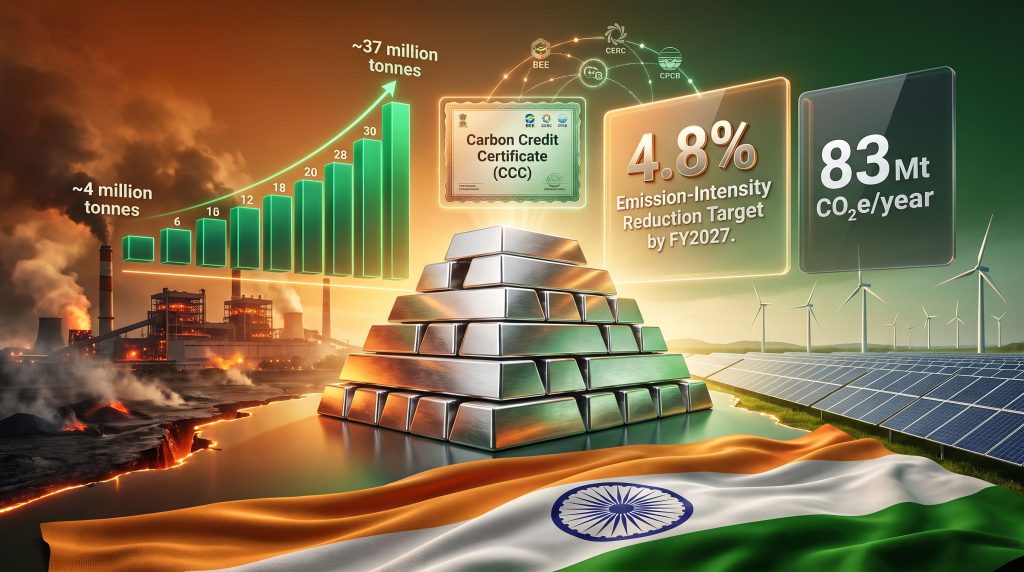
The scale of the challenge becomes vivid in the projections. India's aluminium demand is expected to grow from approximately 4 million tonnes in 2023 to over 37 million tonnes by 2070. Under a business-as-usual trajectory, sectoral greenhouse gas emissions could expand from roughly 83 million tonnes of CO₂ equivalent annually to approximately 376 million tonnes over the same period. That is not a marginal increase — it represents a structural collision between industrial growth ambitions and climate commitments unless energy sourcing is fundamentally transformed.
What Is the Carbon Credit Trading Scheme and How Does It Work?
India's CCTS was formally introduced in 2023 and represents a meaningful departure from the policy instruments that preceded it. For over a decade, the Perform, Achieve and Trade (PAT) scheme governed industrial energy performance by measuring Specific Energy Consumption (SEC) and rewarding facilities that improved their energy efficiency per unit of output. PAT delivered genuine savings, but it measured energy, not carbon.
The CCTS shifts the fundamental unit of measurement. Where PAT tracked energy consumed per unit of production, CCTS tracks Greenhouse Gas Emission Intensity (GEI) — meaning the quantity of carbon dioxide equivalent emitted for every unit of output. This distinction matters enormously in practice. A facility could theoretically improve its energy efficiency while increasing its carbon output if it shifted toward more carbon-intensive fuels. Under PAT, that trade-off might go unpenalised. Under CCTS, it cannot.
The compliance mechanism operates as follows:
- Facility-specific GEI targets are notified by regulators based on baseline FY2024 emissions data
- Facilities that outperform their targets earn Carbon Credit Certificates (CCCs)
- Facilities that exceed their emission-intensity thresholds must purchase CCCs from other market participants or face regulatory penalties
- Exchange-based trading under the Indian Carbon Market is expected to commence in the second half of 2026
- Binding compliance targets currently apply to FY2026 and FY2027 performance periods
The Governance Architecture Behind CCTS
One of the less-discussed strengths of the Indian carbon market framework is the breadth and specificity of its institutional design. Five distinct bodies carry defined responsibilities:
| Institution | Role Under CCTS |
|---|---|
| Ministry of Power | Nodal ministry with overall oversight |
| Bureau of Energy Efficiency (BEE) | Scheme administration and compliance management |
| Grid Controller of India Limited | National carbon registry operations |
| Central Electricity Regulatory Commission | Exchange-based trading oversight |
| Central Pollution Control Board | Enforcement and penalty imposition |
This multi-agency structure differs from many emerging market carbon frameworks where responsibility is concentrated in a single agency with limited enforcement capacity. India's approach distributes technical, commercial, and regulatory functions across bodies with existing institutional expertise, which in principle strengthens both credibility and enforceability. For broader context on how this Indian Carbon Credit Trading Scheme compares internationally, the ICAP ETS database provides useful reference data.
How CCTS Compares to the PAT Scheme
| Feature | PAT Scheme | CCTS |
|---|---|---|
| Primary metric | Specific Energy Consumption (SEC) | Greenhouse Gas Emission Intensity (GEI) |
| Unit of measurement | Energy per unit of output | CO₂ equivalent per unit of output |
| Market mechanism | Energy Saving Certificates | Carbon Credit Certificates (CCCs) |
| Carbon pricing | No direct carbon price | Exchange-based trading launching 2026 |
| Compliance enforcement | Bureau of Energy Efficiency | Multi-agency framework |
Which Parts of the Aluminium Industry Are Now Under Obligation?
The rollout of aluminium-sector obligations under CCTS followed a phased approach that reflects both the complexity of the value chain and the logistical demands of large-scale industrial compliance:
- October 2025: Primary aluminium was included in the first round of sector notifications alongside cement, chlor-alkali, and pulp and paper industries
- January 2026: Secondary aluminium was added in a second notification wave, alongside petroleum refineries, petrochemicals, and textiles
- January 2026 expansion: An additional 208 obligated entities were brought under compliance, raising the total number of covered industrial entities to 490 across India's carbon market
Both primary smelting operations and secondary aluminium processing facilities now operate under facility-specific GEI targets. Furthermore, primary aluminium accounts for approximately 16 percent of baseline emissions covered under the CCTS framework, making it one of the most emissions-significant sectors in the scheme.
Compliance Alert: Aluminium producers operating above their notified emission-intensity thresholds after FY2026 will need to acquire carbon credits from the Indian Carbon Market or face regulatory penalties, establishing carbon procurement as a new operational cost line for underperforming facilities.
Three Years In: What Has the Scheme Actually Delivered?
Measured against institutional milestones, the progress is genuine. India has built from scratch the foundational infrastructure required for a credible domestic carbon market:
- A legal framework establishing binding GHG obligations for designated industries
- Monitoring, Reporting and Verification (MRV) procedures that align with international carbon accounting standards
- Accredited third-party verification agencies capable of auditing facility-level emissions
- A national carbon registry operational under the Grid Controller of India Limited
- GHG emission-intensity targets formally notified for both primary and secondary aluminium
- Carbon accounting practices being embedded into industrial operations as compliance preparation accelerates
However, what the scheme has not yet delivered is its defining function: a functioning carbon price. Exchange-based trading had not commenced as of mid-2026. Without live price discovery, the financial signal that should be driving capital reallocation toward cleaner energy and lower-emission production methods remains absent.
"The distinction between building a carbon market and operating one is not semantic. Governance architecture can be assessed in terms of notifications issued and registries established. But the real test of whether CCTS changes industrial behaviour rests entirely on whether a transparent, stable carbon price emerges that makes investment in decarbonisation commercially rational relative to the cost of purchasing compliance credits."
Financial Impact: What Early Analysis Suggests
While the full commercial consequences of CCTS remain uncertain until trading commences, early financial analysis offers some directional guidance:
- ICRA ESG analysis estimates approximately a 3 percent profitability impact for aluminium firms in FY2027 under assessed compliance scenarios
- Near-term financial strain is characterised as limited but is expected to intensify as targets tighten across successive compliance cycles
- The aggregate emission-intensity reduction target for India's primary aluminium sector is approximately 4.8 percent by FY2027 relative to the FY2024 baseline
These figures warrant careful interpretation. A 3 percent profitability impact at current margins may appear modest, but it represents a baseline, not a ceiling. As targets tighten over the 2028 to 2032 period and a live carbon price emerges, facilities operating with coal-heavy power inputs face a compounding cost disadvantage that grows with each successive compliance cycle.
Disclaimer: Financial projections referenced above are drawn from third-party analysis and involve assumptions about compliance costs, carbon pricing trajectories, and production scenarios. Actual outcomes may differ materially from projected estimates.
The Decarbonisation Pathways Available to Indian Producers
The NITI Aayog and WRI India roadmap identifies three primary technological pathways for reducing aluminium sector emissions. Each carries distinct timelines, capital requirements, and operational suitability. In addition, the choices made now will shape competitive positioning well into the 2030s, both for aluminium industry leaders and for smaller regional producers.
1. Renewable Energy Round-the-Clock (RE-RTC)
The most immediately actionable pathway involves combining solar and wind generation with battery energy storage to deliver continuous, reliable electricity suitable for potline operations. RE-RTC addresses the reliability constraint that has historically anchored Indian smelters to coal and is identified as the most practicable near-term solution. Several major producers have already signed long-term green power purchase agreements and are investing in captive renewable assets.
2. Direct Nuclear Power Supply
Over the medium term, baseload nuclear electricity represents a viable solution for producers requiring guaranteed, continuous supply without fossil fuel dependency. Nuclear power carries a low carbon intensity profile and offers the reliability that smelter operations demand, though lead times for new capacity are considerably longer than renewable deployment.
3. Carbon Capture, Utilisation and Storage (CCUS)
For producers where complete fuel substitution is not immediately feasible, CCUS applied to captive coal-fired power plants represents a transitional option. The roadmap positions this as a bridge technology rather than a long-term destination, recognising that the operational complexity and cost of CCUS at scale remains a significant constraint.
The Structural Inequality Problem
Structural Inequality: Large integrated aluminium producers hold a significant advantage in the decarbonisation transition. Greater financial capacity, existing technical expertise, and established relationships with renewable energy developers mean that major producers can move faster and at lower relative cost. Smaller downstream manufacturers face capital constraints, limited in-house technical capacity, and dependence on grid electricity, creating an uneven compliance landscape that regulators will need to address proactively.
These aluminium decarbonisation efforts are also visible at the global level, with producers outside India investing heavily in renewable transitions to remain competitive as carbon regulations tighten across multiple jurisdictions.
The next major ASX story will hit our subscribers first
CCTS, CBAM, and India's Export Competitiveness
The India carbon credit trading scheme aluminium industry connection extends well beyond domestic compliance. The EU's Carbon Border Adjustment Mechanism applies carbon costs to aluminium imports entering European markets based on embedded emissions. This creates a direct commercial linkage between a producer's carbon performance under CCTS and their competitive position in one of the world's largest aluminium import markets.
As analysis of the aluminium tariff impacts from multiple policy directions has demonstrated, producers that fail to build credible emissions records now face compounding trade headwinds. The implications can be illustrated through a hypothetical comparison of two Indian aluminium exporters in a post-CBAM environment:
| Factor | Producer A (RE-RTC Backed) | Producer B (Coal Captive Power) |
|---|---|---|
| Emission intensity | Below CCTS target | Above CCTS target |
| Carbon Credit Certificates | Earner of CCCs | Must purchase CCCs |
| CBAM exposure on EU exports | Lower embedded carbon levy | Higher embedded carbon levy |
| Verified emissions data | Available under CCTS MRV | Available but commercially unfavourable |
| Three-year cost trajectory | Improving competitive position | Compounding cost disadvantage |
The verified MRV systems developed under CCTS align directly with CBAM's documentation requirements. Furthermore, producers operating transparently within the Indian carbon market are better placed to demonstrate their emissions credentials to European buyers. Carbon-intensive producers, however, face a dual cost pressure: domestic compliance obligations and international trade levies applied simultaneously.
Notably, CBAM has already hit Indian aluminium exports by 41 percent, according to industry reporting — underscoring the urgency of aligning domestic carbon policy with international trade realities.
The Secondary Aluminium Opportunity: An Underappreciated Variable
One dimension of the CCTS story that receives insufficient attention is the strategic positioning it creates for secondary aluminium. Recycling aluminium requires a fraction of the electricity consumed in primary smelting, with typical estimates placing secondary production's energy requirement at roughly 5 percent of the primary route. The carbon emissions differential is proportionally significant.
As carbon pricing attaches a financial cost to emission intensity, the relative economics of recycled aluminium improve across automotive, construction, and packaging applications. India's broader policy objectives around circular economy development and resource efficiency align directly with expanding organised aluminium recycling capacity.
The India carbon credit trading scheme aluminium industry dynamic is therefore not solely about constraining primary smelter emissions. It is also, consequently, about reshaping the relative attractiveness of different production routes across the value chain. Understanding the underlying bauxite supply fundamentals remains essential context, given that primary production volumes and expansion plans feed directly into long-term emissions projections.
While CCTS compliance obligations primarily target large industrial facilities, the broader investment signals generated by an emerging carbon price could encourage greater secondary metal utilisation, improve commercial returns for lower-emission products, and accelerate investment in scrap collection infrastructure and secondary smelting operations.
What Must Happen for CCTS to Deliver Real Industrial Change
Three conditions must be met for the scheme to progress from governance framework to genuine decarbonisation driver:
- Carbon price discovery must emerge: Exchange-based trading needs to commence and generate a credible, stable price signal. Without this, investment cases for renewable energy transitions cannot be accurately modelled against future compliance costs.
- Energy infrastructure must scale: RE-RTC deployment needs to accelerate at industrial scale to give producers a technically reliable and commercially competitive alternative to captive coal power.
- Compliance support must reach smaller participants: Regulatory capacity-building for downstream manufacturers must accompany tightening targets to prevent a permanent two-tier compliance landscape from forming.
India's carbon market has moved through its first phase with meaningful institutional progress. The aluminium sector, as one of the earliest and most carbon-exposed industries brought under the scheme, now faces binding emission-intensity obligations for the first time in its history. Whether the 2026 to 2030 window converts that architecture into genuine transformation will depend on whether carbon pricing becomes commercially material enough to change how producers make decisions about energy, capital, and strategy.
The low-carbon aluminium strategy being pursued by major global producers further signals the direction of travel — and Indian producers will need to accelerate their own transitions to remain competitive in an increasingly carbon-conscious global market.
Frequently Asked Questions: India Carbon Credit Trading Scheme and the Aluminium Industry
What is India's Carbon Credit Trading Scheme?
India's CCTS is a domestic emissions trading framework established in 2023 that places legally binding greenhouse gas emission-intensity targets on designated industrial sectors. Facilities outperforming their targets earn Carbon Credit Certificates, while those exceeding their emission thresholds must purchase credits from the Indian Carbon Market.
Is the aluminium industry covered under India's CCTS?
Yes. Primary aluminium was included in the first notification in October 2025, and secondary aluminium was added in January 2026. Both sectors now operate under binding GEI targets for FY2026 and FY2027.
How many entities are covered under India's carbon market?
Following the January 2026 expansion, which added 208 new obligated entities, the total number of covered industrial entities reached 490 across all sectors.
What financial impact is CCTS expected to have on aluminium producers?
ICRA ESG analysis estimates approximately a 3 percent profitability impact for aluminium firms in FY2027 under current target scenarios. Near-term strain is characterised as limited, but compliance costs are expected to increase as emission-intensity targets tighten in future cycles.
When will carbon trading begin in India?
Exchange-based trading under the Indian Carbon Market was expected to commence in the second half of 2026. Until trading begins, no transparent carbon price exists to guide investment decisions.
How does CCTS relate to the EU's Carbon Border Adjustment Mechanism?
CBAM applies carbon costs to aluminium imports entering the European Union based on embedded emissions. Producers operating under CCTS with verified, lower emission-intensity data are better positioned to meet CBAM documentation requirements and avoid additional trade costs.
What is the emission-intensity reduction target for primary aluminium under CCTS?
The primary aluminium sector faces an aggregate emission-intensity reduction target of approximately 4.8 percent by FY2027 relative to the FY2024 baseline.
Want to Track the ASX Miners Positioned for the Renewable Energy and Aluminium Transition?
As carbon regulations reshape global aluminium supply chains and drive demand for low-emission metals and critical minerals, Discovery Alert's proprietary Discovery IQ model delivers real-time alerts on significant ASX mineral discoveries — turning complex market signals into actionable opportunities the moment they are announced. Explore the historic returns that major mineral discoveries have generated and start your 14-day free trial today to stay ahead of the market.