
June 20, 2026
The Structural Case for Carbon Capture in Hard-to-Abate Industries
Decarbonisation conversations dominated by solar panels and wind turbines obscure a more complicated reality: a significant share of global industrial CO₂ emissions cannot be eliminated through energy source substitution alone. In sectors like cement, steel, and chemical processing, carbon dioxide is not simply a byproduct of burning fossil fuels. It is an inherent output of the chemical processes themselves. Calcination in cement kilns, reduction reactions in blast furnaces, and reforming reactions in ammonia plants produce CO₂ regardless of what fuel powers the facility. This is the structural problem that carbon capture, utilisation and storage technology was designed to solve, and it is precisely why India's newly approved India CCUS scheme approval represents a policy milestone worth examining in depth.
When big ASX news breaks, our subscribers know first
What CCUS Actually Does and Why India Needs It
Carbon capture, utilisation and storage encompasses three distinct but interconnected functions. The capture phase intercepts CO₂ at the point of emission, typically using chemical solvents, membrane separation, or physical absorption, before the gas can enter the atmosphere. The utilisation phase channels captured CO₂ into productive applications, including enhanced oil recovery, synthetic fuel production, CO₂ mineralisation, and industrial feedstock supply. The storage phase involves permanent geological sequestration, injecting compressed CO₂ into deep subsurface formations such as depleted hydrocarbon reservoirs or saline aquifers.
India's emission profile makes this technology combination strategically urgent. As the world's third-largest CO₂ emitter, India faces the dual challenge of sustaining industrial growth while honouring its nationally determined contributions under the Paris Agreement and its longer-term net-zero trajectory. Furthermore, renewable mining solutions can decarbonise electricity grids, but they cannot eliminate process-inherent emissions from cement calcination or blast furnace ironmaking. CCUS addresses this residual gap that no other currently available technology can close at scale.
The seven sectors targeted under the scheme reflect this logic precisely:
- Thermal power generation from coal-fired plants, which remain central to India's baseload electricity supply
- Integrated steel manufacturing, where blast furnace chemistry produces CO₂ as a direct reaction product
- Cement production, where limestone calcination releases CO₂ chemically locked in the raw material
- Petroleum refining, where high-temperature processing generates significant point-source emissions
- Chemical processing, including ammonia and methanol production
- Coal gasification, as a cleaner pathway for India's substantial domestic coal reserves
- Low-carbon hydrogen production, where steam methane reforming with carbon capture enables so-called blue hydrogen
The Financial Architecture of the ₹19,700 Crore Scheme
From Budget Announcement to Fiscal Clearance
The scheme's journey from policy ambition to institutional reality followed a defined procedural path. Its origins lie in the Union Budget for FY2026-27, where an initial outlay of ₹20,000 crore was publicly committed. Before any funds can be deployed, however, India's central government requires clearance from the Expenditure Finance Committee, a body operating under the Finance Ministry that functions as a fiscal gatekeeper for large public expenditure proposals.
The EFC evaluates whether a scheme's financial structure, cost-benefit framework, and implementation design meet the Finance Ministry's standards. Clearance from this body signals that the proposal has passed rigorous scrutiny of its investment rationale and delivery architecture before reaching the Union Cabinet for final executive approval.
The EFC-approved figure of ₹19,700 crore represents a minor reduction from the original ₹20,000 crore budget announcement, which is typical of the EFC review process where financial parameters are refined during evaluation. Notably, India's carbon capture investment of approximately $2.2 billion positions it among the most significant emerging-market CCUS commitments globally. The scheme now awaits Union Cabinet ratification, the final procedural step before it becomes formally operational.
Investment Leverage and Financial Structure
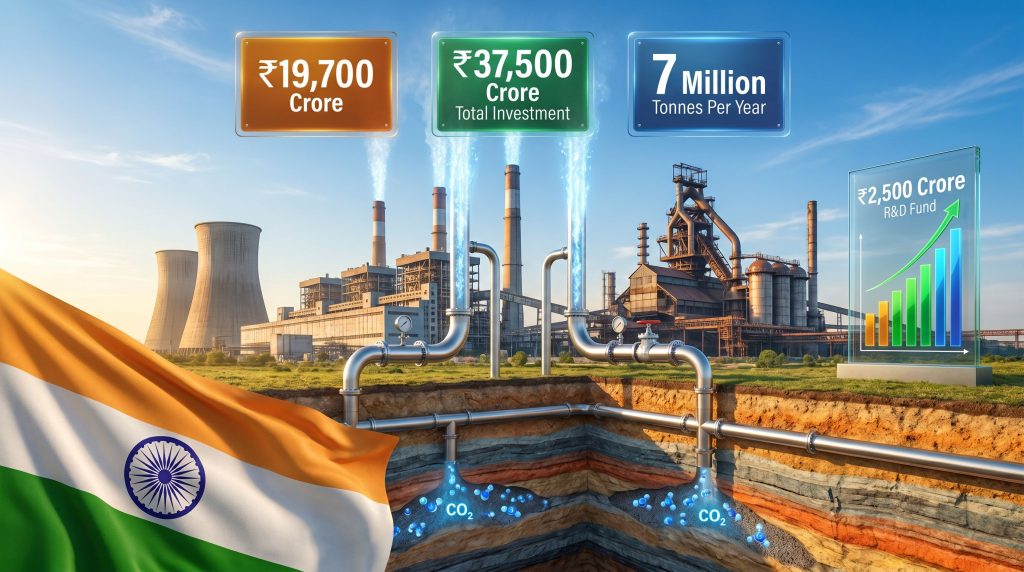
| Parameter | Value |
|---|---|
| EFC-Approved Government Outlay | ₹19,700 crore |
| Original Budget Announcement | ₹20,000 crore (FY2026-27) |
| Expected Total Investment (Public + Private) | ₹37,500 crore |
| Dedicated R&D Innovation Fund | ₹2,500 crore |
| Target Annual Carbon Capture Capacity | 7 million tonnes per year |
The investment architecture embedded in these figures deserves careful analysis. The ₹19,700 crore government outlay is structured to catalyse approximately ₹37,500 crore in total investment when private co-funding is included. This implies a public-to-private leverage ratio of roughly 1:0.90, meaning every rupee of government expenditure is designed to attract nearly an equal rupee of private sector capital.
In the context of capital-intensive infrastructure programmes, this is a relatively conservative leverage assumption, which may reflect realistic investor sentiment toward first-of-kind CCUS deployment in an emerging market context.
The ₹2,500 crore R&D sub-fund operates as a distinct allocation within the scheme. Its purpose is to advance domestic technology readiness rather than fund commercial deployment directly. This distinction matters because the cost trajectory of CCUS is highly sensitive to technology maturity, and investing in moving projects from pilot-scale to demonstration-scale has historically produced the largest unit-cost reductions in analogous clean energy sectors.
The Cost Economics of Carbon Capture: Where India Sits on the Curve
Why First-of-Kind Projects Are Expensive
CCUS currently carries a reputation as prohibitively expensive, and that reputation is not without foundation. First-of-kind industrial projects bear disproportionate cost burdens because supply chains are underdeveloped, engineering expertise is scarce, and financing risk premiums are elevated. The global benchmark cost ranges for carbon capture across key sectors illustrate the challenge:
| Sector | Estimated Current Capture Cost (USD per tonne CO₂) | Projected Cost with Scale |
|---|---|---|
| Power Generation | $60-$120 | $40-$70 |
| Cement | $50-$100 | $30-$60 |
| Steel (Blast Furnace) | $40-$80 | $25-$50 |
| Hydrogen (SMR with CCS) | $15-$40 | $10-$25 |
Note: These figures represent global benchmark ranges. India-specific costs will vary based on local geology, labour, infrastructure availability, and technology sourcing channels.
The analogy most frequently drawn by industry analysts is the solar photovoltaic cost curve. In 2010, utility-scale solar cost approximately $300 per megawatt-hour. By 2023, that figure had fallen below $30 per megawatt-hour in many markets, driven almost entirely by deployment volume and supply chain maturation rather than fundamental technology breakthroughs. Industry consensus holds that CCUS is on a similar trajectory, though the geological complexity of storage adds a layer of cost variability that solar never faced.
The CO₂ Pipeline Revenue Argument
One underappreciated dimension of India's scheme is its explicit provision for connecting commercial CCUS projects to CO₂ pipeline transport networks. This is not merely logistical infrastructure. It is a mechanism that can transform carbon capture from a cost centre into a partially revenue-generating asset class.
When captured CO₂ is transported via pipeline to oil fields, it can be injected into partially depleted reservoirs to enhance oil recovery. This enhanced oil recovery application generates hydrocarbon production revenue that partially offsets the cost of capture and compression. Similarly, CO₂ injected into coal seams displaces methane, enabling coal bed methane extraction as a co-benefit. These revenue streams fundamentally alter the economics of CCUS project bankability and may prove critical to attracting the private co-investment the scheme requires.
India's Regulatory Position Relative to Global CCUS Leaders
International Policy Benchmarking
| Country | Primary Policy Instrument | Government Financial Commitment | Storage Regulatory Framework |
|---|---|---|---|
| United States | 45Q Tax Credit (up to $85/tonne) | ~$3.2B over 10 years (IRA) | EPA Class VI well permitting |
| United Kingdom | CCUS Infrastructure Fund | £1B+ committed | North Sea geological storage rules |
| Norway | Longship Programme | ~$1.8B state funding | Offshore storage regulation |
| Australia | State-based CCS frameworks | State-level funding | State-based permitting systems |
| India | EFC-Approved CCUS Scheme | ₹19,700 crore (~$2.4B) | Reservoir identification phase |
Norway's Sleipner project, which has been injecting CO₂ into the Utsira saline aquifer since 1996, represents the world's longest-running operational CCUS benchmark. What made Sleipner viable was not altruism but economics: Norway's offshore carbon tax made geological storage cheaper than paying the levy. India does not yet have an equivalent carbon pricing mechanism strong enough to replicate this dynamic, which is why direct public expenditure is the instrument of choice at this stage.
The United States' 45Q tax credit, enhanced under the Inflation Reduction Act to reach $85 per tonne for geological storage, has triggered a significant wave of private CCUS investment. India's scheme uses a different mechanism — direct capital support rather than tax-side incentives — which suits India's industrial financing environment where tax credit monetisation is more complex for public sector enterprises. In addition, green transition materials and supply chains will need to be developed domestically to support large-scale CCUS infrastructure deployment.
Regulatory Gaps That Must Be Addressed
The scheme's approval does not resolve several structural regulatory deficiencies that will determine its ultimate effectiveness:
-
Geological storage liability framework: India lacks a comprehensive legal regime governing who bears long-term responsibility for stored CO₂ after a project operator's involvement ends. This is not a minor technical issue. Without clarity on liability, project financing becomes extremely difficult, as lenders cannot adequately price the risk of future CO₂ leakage obligations.
-
Reservoir certification and characterisation: India's subsurface mapping for CO₂ storage suitability remains at an early stage compared to the North Sea basin or Gulf of Mexico, where decades of oil and gas exploration have produced detailed stratigraphic data.
-
Monitoring, reporting, and verification protocols: MRV frameworks define how stored CO₂ volumes are verified and reported for climate accounting purposes. Without internationally recognised MRV standards, India's CCUS credits may not be recognised in global carbon markets.
-
Carbon Credit Trading Scheme integration: India's Carbon Credit Trading Scheme, enabled under the Energy Conservation Amendment Act, creates a potential demand mechanism for verified carbon removals. Linking CCUS outputs to the CCTS would create a domestic revenue stream that significantly improves project economics.
The R&D Fund: Bridging the Technology Readiness Gap
What the ₹2,500 Crore Innovation Mandate Is Trying to Achieve
Technology readiness levels — a scale from TRL 1 (basic research) to TRL 9 (fully commercial deployment) — provide a useful framework for understanding where the R&D fund's efforts are concentrated. Most of India's current domestic CCUS activity sits between TRL 3 and TRL 5, meaning laboratory-proven concepts and early pilot demonstrations. The commercial deployment targets in the scheme require TRL 7 to TRL 9 maturity.
The R&D fund is designed to bridge this gap across several priority technology areas:
- Post-combustion capture using advanced solvent formulations with lower regeneration energy requirements
- Pre-combustion capture for coal gasification and blue hydrogen production pathways
- Oxy-fuel combustion for power and steel applications, which produces a nearly pure CO₂ flue gas stream that is cheaper to capture
- CO₂ mineralisation chemistry, which permanently converts gaseous CO₂ into stable carbonate minerals
- Geological reservoir characterisation and storage capacity mapping across India's sedimentary basins
Institutions likely to serve as R&D delivery partners include CSIR laboratories, Indian Institutes of Technology, and national energy research bodies. Furthermore, the hydrogen iron ore reduction pathway represents one area where international technology transfer could significantly accelerate domestic capability building, particularly in subsurface reservoir modelling where global expertise remains concentrated.
The next major ASX story will hit our subscribers first
Strategic Implications and Execution Risks
Why the 7 Million Tonne Target Matters in Context
The scheme's goal of creating 7 million tonnes per year of carbon capture capacity represents a meaningful but modest starting point. To contextualise this figure, India's total CO₂ emissions from the energy sector alone exceed 2.4 billion tonnes annually. Seven million tonnes represents less than 0.3% of that total.
However, the scheme's significance lies not in its immediate volumetric impact but in its role as a platform-building exercise: establishing supply chains, building engineering capacity, demonstrating project bankability, and creating the institutional infrastructure for much larger-scale deployment in subsequent phases.
If the 7 million tonne per year target is achieved at full operation, the climate equivalence using standard benchmarking is roughly comparable to removing approximately 1.5 million passenger vehicles from Indian roads annually.
Near-Term Milestones and Execution Risks
Milestones to monitor:
- Union Cabinet ratification and formal scheme operationalisation date
- Release of project eligibility criteria and application frameworks
- Launch of the geological reservoir identification programme
- First pilot project announcements across priority industrial sectors
Execution risks that could constrain outcomes:
- India's subsurface characterisation database for CO₂ storage is significantly less developed than comparable CCUS-active jurisdictions, potentially delaying storage site certification
- First-of-kind project cost overruns could dampen private investor appetite if early pilots exceed budget
- Regulatory fragmentation across multiple ministries including Finance, Power, Steel, Petroleum, and Environment may slow coordinated implementation
- Absence of a CO₂ storage long-term stewardship framework creates residual liability uncertainty for project financiers
Consequently, the critical minerals transition required for CCUS infrastructure — including materials for capture equipment, compressors, and pipeline systems — adds another supply chain dimension that will demand early policy attention.
India's India CCUS scheme approval marks the transition from policy aspiration to funded programme. Whether that transition produces operational carbon capture infrastructure at scale depends on regulatory frameworks, geological data, and private capital mobilisation that are still being assembled. The EFC clearance is the beginning of the execution challenge, not the end of it.
Frequently Asked Questions: India CCUS Scheme Approval
What is the India CCUS scheme that received EFC approval?
The Expenditure Finance Committee under India's Finance Ministry has cleared a ₹19,700 crore government-funded scheme to develop carbon capture, utilisation and storage technologies and geological storage reservoirs. The scheme targets heavy industrial emitters including power plants, steel mills, cement factories, refineries, and chemical plants, with a goal of creating 7 million tonnes per year of carbon capture capacity.
What is the total investment expected under the scheme?
The scheme is structured to mobilise total investments of approximately ₹37,500 crore, combining the ₹19,700 crore government outlay with an estimated ₹17,800 crore in private sector co-investment. For instance, green steel pricing dynamics may shift considerably as CCUS-enabled production becomes commercially viable within Indian steel facilities.
What is the next approval step for the CCUS scheme?
Following EFC clearance, the scheme requires Union Cabinet approval before it becomes formally operational and eligible for project applications. Analysts tracking CCUS policy frameworks note that this final ratification step typically follows within weeks of EFC sign-off for priority government programmes.
How does CCUS support India's climate commitments?
CCUS enables emission reductions in hard-to-abate industrial sectors where renewable energy substitution alone cannot eliminate process-inherent CO₂ emissions, directly supporting India's nationally determined contributions under the Paris Agreement.
Is CCUS technology currently cost-effective?
At present, CCUS remains capital-intensive. However, deployment data from global projects indicates that costs decline substantially as scale increases and supply chains mature. The scheme's dedicated R&D sub-fund is intended to accelerate this cost reduction trajectory for Indian industrial conditions.
Disclaimer: This article contains forward-looking analysis, cost projections, and policy assessments based on publicly available information and global industry benchmarks as of the date of publication. Investment and cost figures are subject to revision. Readers should not rely solely on this analysis for financial or investment decision-making. India-specific CCUS cost outcomes will vary materially from global benchmark ranges depending on local geological, regulatory, and market conditions.
Want to Identify the Next Major Resource Discovery Before the Market Does?
Discovery Alert's proprietary Discovery IQ model delivers real-time alerts on significant ASX mineral discoveries — instantly converting complex data across 30+ commodities into clear, actionable insights for both short-term traders and long-term investors. Explore historic discoveries and their returns to understand the opportunity, then begin your 14-day free trial at Discovery Alert to position yourself ahead of the market.