July 21, 2026
India's ₹37,500 Crore Coal Gasification Ambition: What It Means for Industry, Investors, and Energy Security
Few industrial policy challenges are as structurally consequential as import dependency on essential chemical feedstocks. When a large economy relies on overseas suppliers for the majority of its ammonia, methanol, and liquefied natural gas, it is not simply facing a cost problem. It is carrying a strategic vulnerability that compounds with every commodity price cycle, every currency movement, and every geopolitical disruption. India has recognised this reality and is now pursuing one of the most ambitious domestic chemical feedstock programmes in its industrial history through the India coal gasification scheme.
When big ASX news breaks, our subscribers know first
The Import Dependency Problem India Is Trying to Solve
India's exposure to imported industrial inputs is more severe than most commentary acknowledges. The country is nearly entirely dependent on overseas suppliers for ammonia, which is a foundational input for fertiliser manufacturing and therefore food security. Methanol imports account for roughly 80 to 90 percent of domestic consumption. More than half of India's liquefied natural gas supply is sourced internationally, and the import tax structure on LNG further compounds the cost burden for industrial consumers.
The cumulative cost of this exposure flows through multiple channels simultaneously. Import bills drain foreign exchange reserves. Price volatility in global commodity markets translates directly into domestic industrial cost instability. Supply chain disruptions, whether from shipping route disruptions or producer country export restrictions, create near-term shortages that affect everything from crop yields to steel production.
What makes this situation particularly striking is the contrast with India's domestic resource endowment. The country holds an estimated 401 billion tonnes of coal reserves, making it one of the most coal-rich nations on earth. Most of this resource has historically been extracted and combusted for electricity generation, an application that extracts thermal energy but discards the coal's potential as a chemical feedstock.
The core strategic insight behind the India coal gasification scheme is that coal's value as a chemical precursor may ultimately exceed its value as a fuel source, particularly as industrial chemistry demand grows alongside urbanisation and manufacturing expansion.
What the ₹37,500 Crore Scheme Actually Involves
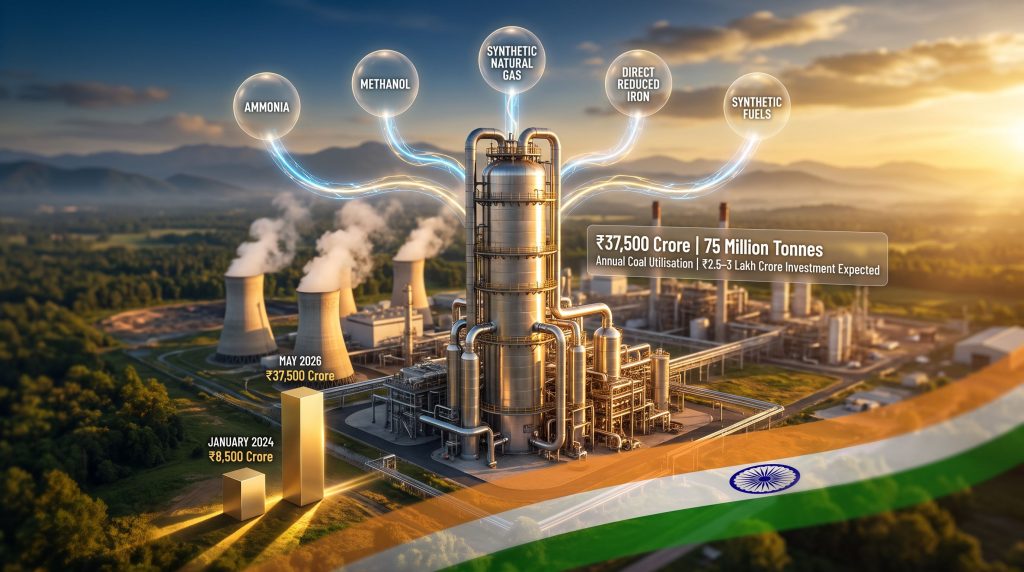
The Union Cabinet approved the Surface Coal and Lignite Gasification Scheme on May 13, 2026, committing a total financial outlay of ₹37,500 crore (approximately USD $3.9 billion). This is not a research subsidy or a pilot programme. It is a structured commercial incentive framework designed to catalyse private and public capital deployment at genuine industrial scale.
The scheme targets annual utilisation of 75 million tonnes of domestic coal, feeding into the broader National Coal Gasification Mission objective of reaching 100 million tonnes per annum by 2030. To understand the scale ambition, it helps to note that the 2026 scheme represents a more than fourfold increase in financial commitment compared to the earlier ₹8,500 crore incentive package approved in January 2024.
The scheme's structural parameters are worth examining in detail:
| Scheme Parameter | Specification |
|---|---|
| Total Government Outlay | ₹37,500 crore (~USD $3.9 billion) |
| Incentive Structure | Up to 20% of Plant and Machinery cost |
| Per-Project Funding Cap | ₹5,000 crore |
| Per-Entity Group Cap | ₹12,000 crore |
| Coal Supply Linkage Duration | 30-year extended contracts |
| Technology Approach | Technology-agnostic; indigenous solutions encouraged |
| Project Selection Method | Competitive bidding on cost, coal input, and syngas output |
| Disbursement Model | Four equal milestone-linked instalments |
| Application Deadline | September 7, 2026 |
Several features of this design deserve particular attention from an investment and policy analysis perspective.
The 30-year coal supply linkage is arguably the most commercially significant element. One of the primary reasons earlier coal gasification proposals failed to attract bankable financing was the absence of long-term feedstock certainty. A gasification project requiring billions in upfront capital cannot support project finance structures without assured coal supply across the asset's economic life. The extension to 30 years directly addresses this constraint.
The milestone-linked disbursement across four equal instalments ensures that government financial exposure is tied to actual project delivery rather than upfront commitments. This approach aligns incentive structures between government and private developers in a way that earlier subsidy models did not.
The technology-agnostic design is commercially inclusive but analytically nuanced. It removes barriers for developers using a range of gasification technologies, whether entrained flow, moving bed, or fluidised bed systems. However, it also places a higher technical due diligence burden on applicants, who must independently demonstrate the feasibility and efficiency of their chosen approach.
Additionally, a 50% rebate on revenue share for coal allocated specifically to gasification purposes provides a direct operating cost advantage over conventional coal procurement channels. This revenue share mechanism effectively creates a price floor advantage for gasification projects competing against imported feedstock alternatives.
The Thermochemical Process Behind the Policy
How Does Coal Gasification Differ from Combustion?
Understanding why coal gasification is fundamentally different from coal combustion is essential for evaluating the scheme's industrial logic. The distinction is chemical, not simply environmental framing.
In conventional combustion, coal reacts with excess oxygen to produce carbon dioxide, water vapour, and heat. The useful output is thermal energy. In gasification, the process operates under controlled oxygen conditions that prevent complete oxidation. The result is syngas, a mixture of carbon monoxide (CO) and hydrogen (H₂), which serves as a chemical building block rather than simply a heat source.
The production sequence for surface gasification follows a structured pathway:
- Feedstock Preparation: Coal is crushed and sized to reactor specification, with particle size requirements varying by gasifier technology type.
- Pressurised Reactor Input: Sized coal enters a high-pressure gasifier vessel, with operating pressures typically ranging from 20 to 80 bar depending on the technology employed.
- Partial Oxidation Reaction: Controlled introduction of steam and sub-stoichiometric oxygen initiates thermochemical conversion at temperatures typically between 700°C and 1,600°C.
- Syngas Generation: The partial oxidation reaction produces carbon monoxide and hydrogen in ratios that vary with reactor design, operating conditions, and coal composition.
- Gas Cleaning: Raw syngas contains sulphur compounds, particulates, tar species, and CO₂, all of which require removal before downstream processing. This cleaning stage is technically demanding and capital-intensive.
- Downstream Synthesis: Purified syngas is directed to synthesis reactors for conversion into ammonia (via the Haber-Bosch process), methanol, synthetic natural gas, or other target products.
What About India's Coal Quality Challenge?
One aspect that is rarely discussed in mainstream policy commentary is the coal quality sensitivity of gasification economics. India's domestic coal is characterised by high ash content, often exceeding 40 percent in non-coking coal seams, compared to global benchmark coals that may carry ash burdens below 15 percent.
High ash coal creates additional gasifier throughput requirements, increases slag handling costs, and can reduce syngas yield per tonne of coal input. Research from NITI Aayog specifically addresses this feedstock quality challenge in the context of Indian coals. This is not insurmountable, but it is a genuine engineering and economic variable that project developers must account for in their feasibility modelling.
This is a critical consideration that project finance analysts will focus on closely. The viability of a gasification project is not simply a function of coal price, but of coal quality-adjusted syngas yield and the capital cost of managing high-ash feedstocks at commercial scale.
Downstream Products and Market Economics
The downstream product portfolio that the India coal gasification scheme is designed to support spans multiple major industrial sectors:
- Synthetic Natural Gas (SNG): A substitute for imported LNG, particularly valuable given that more than half of India's current LNG supply is sourced overseas.
- Ammonia: The primary nitrogen feedstock for fertiliser production, currently almost entirely imported. India's fertiliser sector serves the world's second-largest agricultural economy.
- Methanol: An industrial solvent, chemical precursor, and fuel additive with 80 to 90 percent import dependency. Methanol is also gaining attention as a maritime fuel, creating additional future demand vectors.
- Direct Reduced Iron (DRI): Syngas can serve as a reductant in iron ore processing, potentially enabling lower-emissions steelmaking pathways. Furthermore, this pathway connects directly to the broader pressures on Indian steel prices from imported feedstock costs.
- Synthetic Fuels: Fischer-Tropsch synthesis from syngas can produce diesel and aviation fuel substitutes, though at production costs that currently require supportive pricing environments to compete with petroleum-derived alternatives.
- Industrial Chemicals: Syngas is a versatile precursor for a broad range of petrochemical intermediates.
The economic significance of this product diversification is often underappreciated. Unlike a coal-fired power plant, which generates revenue primarily from a single commodity, a gasification complex can be configured to direct syngas toward whichever downstream product commands the most favourable margin at any given time. This operational flexibility materially improves project resilience against single-commodity price cycles.
Investment Scale and Geographic Distribution
The Ministry of Coal projects that the scheme will catalyse total investment of between ₹2.5 lakh crore and ₹3 lakh crore (approximately USD $26 to $31 billion) across public and private capital. This projection places the India coal gasification scheme among the largest planned industrial investment programmes currently active in any emerging market.
| Investment Metric | Projected Figure |
|---|---|
| Total Investment Expected | ₹2.5 to 3.0 lakh crore (~USD $26-31 billion) |
| Projects Anticipated (5-Year Horizon) | ~25 projects in coal-rich regions |
| Employment Generation | ~50,000 direct jobs |
| Annual Syngas Production Target (3-4 Years) | 5-10 million tonnes |
Geographically, project activity is expected to concentrate heavily in India's coal-bearing states: Jharkhand, Odisha, Chhattisgarh, and Madhya Pradesh. This concentration reflects straightforward logistics economics. Gasification projects are large consumers of coal by definition, and minimising feedstock transport distances substantially improves project-level economics.
There is also a regional political economy dimension that merits consideration. These states are home to communities that have historically depended on coal mining employment. As the global energy transition creates structural pressure on conventional coal mining, gasification projects offer a pathway to preserve industrial employment and royalty revenues in coal-producing regions while shifting the nature of coal's economic contribution from fuel combustion toward chemical manufacturing.
Eligible participants include a broad constituency: public sector enterprises including Coal India subsidiaries, private industrial companies, technology providers and licensors, and joint venture structures combining domestic and international capabilities. The application submission deadline of September 7, 2026 creates a defined near-term market event.
The next major ASX story will hit our subscribers first
Industry Engagement: What the Pre-Application Conference Revealed
The Ministry of Coal convened a pre-application conference in July 2026 to clarify scheme guidelines and the Request for Proposal framework for prospective applicants. The session, which attracted public sector enterprises, private companies, technology providers, and prospective project developers simultaneously, covered eligibility criteria, evaluation methodology, financial incentive structures, and application procedures.
The breadth of participation at this stage is analytically significant. Pre-application conferences for large industrial incentive schemes often attract modest or sector-specific attendance when commercial interest is primarily speculative. The concurrent engagement of public enterprises, private industrial companies, and technology vendors suggests that multiple actor categories have conducted sufficient internal feasibility assessment to find the conference worthwhile — an indicator of genuine commercial momentum rather than policy-level enthusiasm alone.
The active positioning of technology providers at this early stage is particularly noteworthy. International gasification technology licensors, including companies with established entrained flow and fluidised bed gasification intellectual property, have significant commercial incentive to establish early relationships with Indian project developers. Their participation suggests that the global technology supply chain views the India coal gasification scheme as a credible near-term market opportunity.
Policy Evolution: From 2020 to 2026
The 2026 scheme did not emerge in isolation. Understanding the policy progression helps contextualise both the urgency of the current commitment and the lessons absorbed from earlier efforts.
| Policy Milestone | Year | Key Feature |
|---|---|---|
| National Coal Gasification Mission Launched | 2020 | Set 100 MTPA target by 2030 |
| Initial Incentive Scheme Approved | January 2024 | ₹8,500 crore outlay |
| Expanded Surface Coal Gasification Scheme | May 2026 | ₹37,500 crore; broader scope and higher incentives |
The fourfold increase in financial commitment between January 2024 and May 2026 reflects a policy acceleration that warrants attention. It signals that earlier incentive levels were assessed as insufficient to trigger the scale of private sector response required to meet the 2030 target. The expansion also incorporates structural improvements that address constraints which had limited developer interest in prior iterations, particularly the coal supply linkage duration and the technology approach flexibility.
Global Benchmarks and What India Can Learn
India is not operating without precedent. Several countries have pursued coal gasification at commercial or near-commercial scale, with outcomes that offer instructive lessons.
| Country | Programme | Scale and Status |
|---|---|---|
| China | World's largest coal-to-chemicals sector | Operational; hundreds of plants |
| United States | DOE-supported gasification R&D | Primarily demonstration-scale |
| South Africa | Sasol Coal-to-Liquids | Commercial-scale since the 1950s |
| India | Surface Coal Gasification Scheme | Policy-stage; commercial rollout from 2026 |
China's experience is the most directly relevant benchmark. Its coal chemical sector demonstrates that gasification at national industrial scale is technically achievable. However, China's buildout also surfaced the two most persistent operational challenges: water consumption and carbon emissions management. Gasification processes are water-intensive, typically consuming several tonnes of water per tonne of coal processed. In water-stressed coal regions, this creates genuine resource competition conflicts.
South Africa's Sasol operations, which have been commercially producing synthetic fuels and chemicals from coal since the 1950s, demonstrate that long-term operational viability is achievable but that project economics are sensitive to the price differential between syngas-derived products and their petroleum-derived alternatives. When crude oil prices fall sharply, coal-to-liquids economics compress significantly.
Risks That Project Developers and Investors Must Price
Technical risks centre on India's coal quality characteristics. The high ash content of many domestic coal seams directly affects syngas yield, gasifier throughput requirements, and slag management costs. Developers selecting feedstock sources will need to conduct detailed coal characterisation programmes to model production economics accurately.
Financial risks include the sensitivity of project economics to the price differential between domestically produced syngas derivatives and competing imported products. If global ammonia or methanol prices fall significantly during a project's early operating years, the economic case for domestic production narrows. Long-term offtake agreements with creditworthy counterparties will be essential for securing project finance at the ₹5,000 crore per project scale.
Environmental risks are multi-dimensional. Water consumption is substantial, and coal regions in Jharkhand and Chhattisgarh already face water stress in some areas. Carbon capture and storage infrastructure barely exists at commercial scale in India, which means that gasification projects operating under tightening future emissions frameworks may face stranded asset risk if decarbonisation requirements are not integrated into initial project design.
In addition, the scheme intersects meaningfully with India's broader green transition materials agenda, as hydrogen derived from syngas could ultimately feed into cleaner industrial pathways as carbon capture technologies mature.
The technology-agnostic approach creates commercial inclusion but also amplifies the technical due diligence burden on applicants. Developers without deep gasification engineering expertise may underestimate the complexity of feedstock-specific process optimisation, particularly with high-ash Indian coals.
Regulatory infrastructure gaps also present execution risk. Syngas pipeline networks, product distribution systems for SNG and methanol, and safety regulatory frameworks for large-scale gasification operations are all underdeveloped compared to what a fully commercialised sector would require.
Key Milestones and Timeline
For investors and industry participants tracking the scheme's progression, the following timeline provides a structured reference:
- September 7, 2026: Final deadline for application submissions under the RFP process.
- 2027 to 2028: Expected period for financial close and construction commencement on first-wave projects, assuming a normal evaluation and award timeline.
- 2029 to 2030: Anticipated window for first commercial syngas production volumes from early-mover projects.
- 2030: National Coal Gasification Mission target of 100 million tonnes per annum gasification capacity.
The Broader Industrial Transformation Thesis
If the India coal gasification scheme delivers on its stated objectives, the implications extend well beyond the energy sector. A functioning domestic syngas industry producing ammonia at scale would structurally reduce India's fertiliser import dependency, with direct implications for agricultural input costs and food security. Domestic methanol production would create feedstock for India's expanding chemical manufacturing sector and support the country's methanol economy initiatives.
Syngas-based DRI production could, furthermore, enable a new generation of lower-emissions steelmaking capacity. Considered alongside the global steel outlook for 2025 and beyond, India's potential to reduce raw material import dependence carries significant strategic weight.
The cumulative import substitution potential across ammonia, methanol, LNG, and chemical derivatives represents a structural improvement in India's current account position that would compound over decades rather than single fiscal years. Consequently, the scheme's success would also strengthen the resilience of India's broader resource and energy exports relationships with trading partners.
What remains to be demonstrated is whether the policy framework, the commercial incentives, and the technical capabilities of India's industrial sector can combine effectively enough to translate an ambitious national target into operational gasification capacity at the scale required. The pre-application conference engagement suggests the commercial ecosystem is mobilising. The September 2026 application deadline will provide the first concrete data point on the depth of that mobilisation.
This article is intended for informational and analytical purposes only and does not constitute financial or investment advice. Projections, investment estimates, and capacity targets referenced herein represent government and industry forecasts that are inherently subject to execution risk, commodity price variability, and regulatory evolution. Readers should conduct independent due diligence before making any investment or commercial decisions related to the India coal gasification scheme or associated sectors.
Want to Stay Ahead of Major Resource and Commodity Discoveries on the ASX?
Discovery Alert's proprietary Discovery IQ model delivers real-time alerts on significant ASX mineral discoveries — instantly translating complex resource data into actionable investment insights for both short-term traders and long-term investors. Explore how historic mineral discoveries have generated exceptional market returns on Discovery Alert's dedicated discoveries page, and begin your 14-day free trial today to position yourself ahead of the broader market.