July 21, 2026
When Maritime Chokepoints Become Macro Events: The Refining Margin Story Behind the Hormuz Crisis
Energy markets have long operated under the assumption that geopolitical disruptions produce predictable price responses: supply falls, crude spikes, and downstream margins compress as feedstock costs overwhelm product premiums. The 2026 Strait of Hormuz disruption challenged every part of that assumption, making Reliance Industries global refining margins Strait of Hormuz dynamics one of the most closely watched stories in energy markets. Supply was removed at historically unprecedented scale, yet crude prices remained relatively subdued. Paradoxically, refining margins in Asia surged to their highest levels since 2022.
Understanding why this happened, and what it signals for the global refining cycle, requires unpacking a set of interconnected dynamics that most market commentary has only partially addressed. Furthermore, the broader implications for the global crude market outlook suggest this event may reshape refinery strategy for years to come.
When big ASX news breaks, our subscribers know first
The Hormuz Chokepoint: Scale, Significance, and Structural Consequence
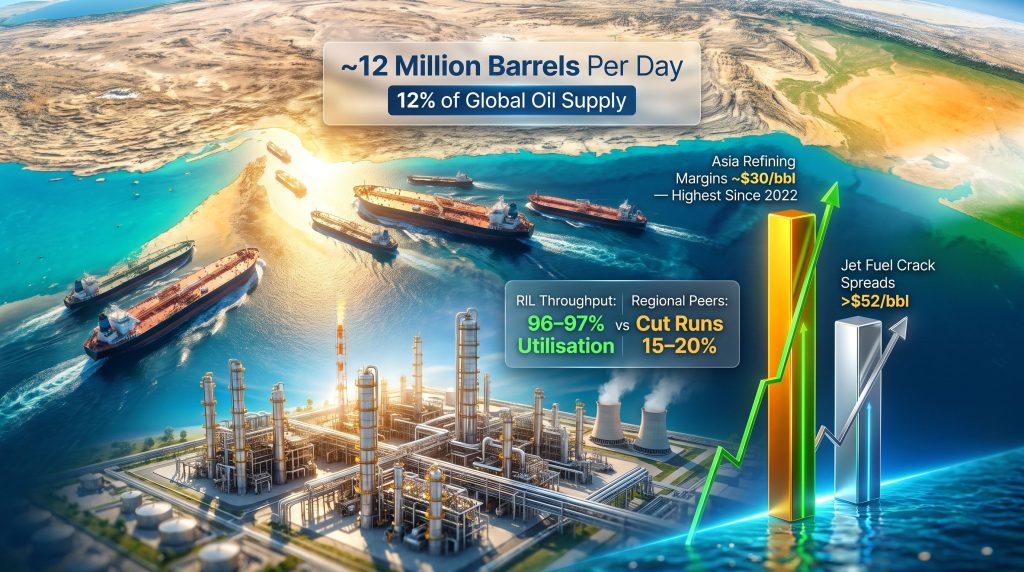
The Strait of Hormuz is not simply a shipping lane. It is the single most concentrated point of energy vulnerability in the world, responsible for facilitating the transit of roughly 12 million barrels per day of crude oil and petroleum products. Global oil production currently sits at approximately 100 million barrels per day, meaning the strait's closure rendered around 12% of the entire world's oil supply inaccessible in one event.
No other maritime chokepoint, including the Suez Canal or the Strait of Malacca, carries equivalent systemic risk at this scale. Consequently, the geopolitical oil price drivers at play here are fundamentally different in character from typical supply disruptions.
What makes the 2026 closure particularly significant from a structural standpoint is the duration of uncertainty. Unlike brief tactical disruptions, the escalation in the Iran conflict introduced a prolonged period of ambiguity over vessel safety and corridor access. Even as flows showed gradual improvement in prior weeks, fresh escalation reversed that progress rapidly.
This reinforces a key principle: the Hormuz risk premium is not a one-time event but a recurring variable that sophisticated refiners must now permanently factor into their sourcing strategies.
"The distinction between a tactical disruption and a durable supply shock matters enormously for refining economics. A brief interruption affects inventory levels; a prolonged closure forces feedstock realignment across entire regional supply chains, permanently reshaping the cost and margin calculus for every refiner dependent on Gulf crude."
Why Crude Oil Prices Did Not Spike Despite Record Supply Removal
The intuitive expectation when 12 million barrels per day are removed from accessible supply is a dramatic crude price spike. That spike did not materialise in the way historical precedent would suggest, and the reasons are instructive.
Two primary mechanisms suppressed the price response:
- IEA strategic reserve releases — Member nations of the International Energy Agency coordinated a release of approximately 5 million barrels per day into the market, absorbing a significant portion of the supply deficit and anchoring near-term price expectations.
- China's deliberate withdrawal from import markets — Throughout the crisis, China was notably absent as a buyer, only returning in a limited capacity as conditions evolved. Given that China represents the world's largest crude importer, its absence removed substantial demand-side pressure that would otherwise have amplified the supply shock into a price spike.
The interaction of these two forces created an unusual market dynamic: a historically large supply disruption met with both institutional supply-side intervention and organic demand contraction, producing a muted price outcome. This asymmetry is precisely what generated the windfall for well-positioned refiners.
| Supply Shock Factor | Volume Impact | Price Direction |
|---|---|---|
| Hormuz closure (unavailable supply) | ~12 million bbl/day | Upward pressure |
| IEA strategic reserve release | ~5 million bbl/day | Downward offset |
| China import pullback | Significant reduction | Additional downward offset |
| Net crude price movement | Subdued relative to shock scale | Contained near-term |
How the Disruption Translated Into Exceptional Refining Margins
The mechanics behind refining margin expansion during a supply shock are often misunderstood. When crude availability tightens, refiners do not uniformly benefit. The margin impact depends entirely on whether a refiner can continue sourcing feedstock while competitors cannot, and on the severity of the resulting product shortage in end markets.
During the Hormuz disruption, both conditions aligned sharply in favour of Asian refiners with diversified sourcing capabilities. Feedstock scarcity drove refined product crack spreads, particularly for jet fuel and middle distillates, to extraordinary levels:
- Asian refining margins surged to approximately $30 per barrel, the highest level recorded since 2022
- Jet fuel crack spreads exceeded $52 per barrel, reflecting acute supply shortages in aviation fuel markets
- The distillate-led margin expansion was proportionally far larger than the underlying crude price movement, creating an asymmetric profit environment for capable operators
This dynamic illustrates a less-discussed principle in refining economics: product scarcity, not crude price direction, is the primary driver of gross refining margin during supply shocks. When refiners who can operate at full capacity are selling into a market where competitors have curtailed output, the pricing power for refined products detaches from the crude cost base entirely.
The Regional Divergence That Caught Many Analysts Off Guard
Not all refining regions benefited equally. US and European refiners, less directly exposed to Gulf crude dependencies and operating in product markets with different demand profiles, experienced relative margin compression compared to their Asian counterparts.
The geographic and logistical proximity of Asian refiners to the disrupted supply zone paradoxically became an advantage. Those with alternative sourcing routes captured the full margin windfall from elevated crack spreads, while those structurally reliant on Hormuz flows faced the steepest operational constraints. According to analysis from Jefferies, Reliance in particular was highlighted as positioned to gain from exactly these kinds of Hormuz-related oil market disruptions.
Reliance Industries' Refining Outlook: Reading the Structural Signals
Reliance Industries' position in this environment is particularly instructive. The company's Jamnagar refining complex, the world's largest single-location refinery, maintained 96–97% throughput utilisation during the disruption period, while regional peers cut runs by 15–20% in response to feedstock scarcity. This operational divergence is not accidental.
The Jamnagar advantage rests on a set of structural capabilities that most competitors cannot replicate quickly:
- Simultaneous sourcing relationships across multiple producing regions, reducing dependency on any single corridor
- The ability to substitute crude grades at scale without significant throughput loss or quality degradation
- Integrated logistics infrastructure that enables real-time vessel risk assessment and route adjustment
- Processing flexibility across a complex refinery configuration designed to handle wide crude grade variation
RIL's management expressed confidence in the refining margin outlook beyond the near-term Hormuz uncertainty, citing two durable supply-side forces as the structural underpinning of this view. First, the Russian oil trading impact has resulted in permanent damage to Russian refining capacity through sanctions, investment withdrawal, and infrastructure degradation. These are not cyclical headwinds that reverse when geopolitical tensions ease; they represent structural throughput losses that will weigh on global supply for years.
Second, conflict-related damage across Middle Eastern refining and production infrastructure has created lasting feedstock realignment, with multi-year recovery timelines even under optimistic assumptions. Against this backdrop, RIL reported distillate margins increasing by 250–300% in Q1 FY2026-27 on a largely flat crude cost basis.
| Period | RIL Gross Refining Margin | Context |
|---|---|---|
| FY2025 | ~$8.50/bbl | Above Indian peer average |
| Prior cycle high | ~$10.10/bbl | Consistent outperformance vs BPCL, HPCL |
| Q1 FY2026-27 | Distillate margins +250–300% | Exceptional cycle performance |
| Asia benchmark (peak) | ~$30/bbl | Highest since 2022 |
The Replenishment Risk: Why Windfall Margins Are Structurally Temporary
The same market conditions that generated exceptional margins for well-positioned refiners carry the seeds of their own reversal. As geopolitical conditions stabilise and Hormuz flows resume, two forces will converge to compress the windfall.
"As nations move to replenish strategic reserves and resume standard import volumes following the disruption, crude prices are expected to find renewed upward support, potentially eroding the feedstock cost advantage that drove margin expansion during the acute supply shock period. RIL itself highlighted this risk in its post-results analysis (ET EnergyWorld, July 2026)."
The replenishment cycle works as follows:
- Strategic reserve drawdowns are finite, and rebuilding those reserves requires purchasing crude at market prices, driving demand and price higher
- China's re-entry into import markets as a major buyer will remove the demand suppression effect that contained crude prices during the crisis
- Global crude run reductions of approximately 1 million barrels per day estimated for 2026 will partially unwind as feedstock availability normalises, increasing refined product supply and compressing crack spreads
- Nations that scaled back imports in response to elevated prices are expected to rebuild volumes through 2027, adding further crude demand pressure
The net effect is a margin cycle where the acute peak is followed by a moderation phase, though the structural floor for margins remains higher than pre-disruption levels given the permanent capacity losses in Russia and the Middle East.
The next major ASX story will hit our subscribers first
Comparing the 2026 Hormuz Closure to Historical Supply Shocks
Placing the 2026 disruption in historical context clarifies both its extraordinary scale and the effectiveness of modern price stabilisation mechanisms.
| Historical Event | Supply Removed | Duration | Price Impact |
|---|---|---|---|
| 1973 Arab Oil Embargo | ~5 million bbl/day | ~6 months | +300% crude price |
| 1990 Gulf War | ~4.3 million bbl/day | ~6 months | +90% crude price |
| 2011 Libya Crisis | ~1.5 million bbl/day | ~12 months | +25% crude price |
| 2026 Hormuz Closure | ~12 million bbl/day | Ongoing | Contained (IEA offset) |
The 2026 event removed more supply than any prior disruption in the modern era, yet produced the most muted price response. This inversion reflects the maturation of the IEA's strategic reserve coordination mechanism, which did not exist in its current form during the 1973 embargo. It also reflects the structural shift in global oil demand away from pure volume growth toward more price-responsive import behaviour, particularly in Asia.
For refiners, this muted crude price response was not just a relief — it was a profit opportunity. The gap between contained crude costs and surging product prices widened to levels not seen since the post-pandemic demand recovery of 2022, and operators with the flexibility to capitalise on that gap generated returns disproportionate to their historical benchmarks.
India's Emerging Structural Role in Asian Refining
The Hormuz disruption has accelerated a broader shift in Asian energy market geography. India's refining sector, anchored by large, complex integrated facilities, has demonstrated a resilience that positions the country as a natural beneficiary of Middle East supply instability. When Gulf-dependent refiners across Southeast Asia reduced throughput, Indian refiners with diversified sourcing maintained output and captured elevated margins, effectively absorbing market share in regional product markets.
This structural positioning reflects decades of investment in refinery complexity, measured by the Nelson Complexity Index, which determines a refinery's ability to process heavier, cheaper crude grades into high-value products. High-complexity refiners like Jamnagar are doubly advantaged during supply disruptions: they can process a wider range of alternative crude grades, and they derive proportionally more revenue from high-value distillate products where crack spreads widen most aggressively during shortages.
Furthermore, OPEC's market influence during this period added another layer of complexity to the supply picture. OPEC's production decisions intersected with the Hormuz closure in ways that shaped both crude price trajectories and the relative availability of various crude grades for Asian refiners.
In addition, the oil market trade shocks triggered by broader geopolitical realignment compounded the effects of the physical supply disruption, influencing freight costs, insurance premiums, and the willingness of traders to commit to forward contracts during the period of peak uncertainty.
The competitive gap between integrated Indian refiners and simpler regional peers has historically been visible in gross refining margin comparisons. During normal market conditions, this gap is measured in dollars per barrel. During supply shocks of the scale experienced in 2026, it compounds into an order-of-magnitude performance differential. Hydrocarbon Processing reported that ships loaded with Reliance diesel and jet fuel were redirecting from European destinations toward Asian markets, further illustrating the company's pivot toward the most profitable available outlets during the crisis.
The Structural Case for a Higher Refining Margin Floor
Three macro forces are converging to sustain the Reliance Industries global refining margins Strait of Hormuz opportunity at structurally elevated levels beyond the acute event:
- Permanent Russian capacity losses — Western sanctions have not only reduced Russia's crude export revenues but have degraded its refining infrastructure through restricted access to Western technology, spare parts, and capital. These losses do not reverse with political developments; they compound over time as maintenance-deferred equipment reaches end-of-life.
- Middle East infrastructure damage — Conflict-related damage to production and refining facilities across the region carries recovery timelines measured in years, not months. The capital requirements, engineering complexity, and security preconditions for reconstruction are substantial.
- Demand normalisation trajectory — The demand softening observed during the crisis, as countries scaled back imports in response to elevated prices, is expected to reverse through 2027 as conditions stabilise. This demand recovery, layered on top of a structurally reduced supply base, creates a tightening dynamic that supports product prices and, by extension, refining margins.
Disclaimer: Forward-looking statements and margin forecasts referenced in this article are based on publicly available company disclosures and analyst commentary as reported by ET EnergyWorld. They involve material uncertainties and should not be construed as investment advice. Actual outcomes may differ substantially from projections depending on geopolitical developments, crude market dynamics, and demand conditions.
Frequently Asked Questions: Reliance Industries, Global Refining Margins, and the Strait of Hormuz
Why did global refining margins rise when the Strait of Hormuz was disrupted?
When crude supply through the Strait was curtailed, feedstock availability tightened sharply at refineries dependent on Gulf crude. Those able to source alternative grades continued operating and sold refined products, particularly jet fuel and distillates, at significantly elevated crack spreads. The combination of maintained output and product scarcity drove margin expansion across Asia-Pacific markets to levels not seen since 2022.
How much oil flows through the Strait of Hormuz?
Approximately 12 million barrels per day, representing roughly 12% of total global oil production, transits the Strait of Hormuz, making it the world's most strategically critical maritime energy chokepoint.
Why did crude prices remain subdued despite the scale of the supply shock?
Two primary factors offset the price pressure: coordinated strategic reserve releases by IEA member nations of approximately 5 million barrels per day, and China's notable absence from the import market during the crisis, which removed significant demand-side purchasing pressure.
What is Reliance Industries' gross refining margin?
RIL reported a gross refining margin of approximately $8.50 per barrel in FY2025. In Q1 FY2026-27, distillate margins increased by 250–300% on a broadly flat crude cost basis, reflecting the exceptional margin environment created by the supply shock.
What happens to refining margins when the Strait of Hormuz reopens?
Market normalisation triggers a crude price rebound as nations replenish strategic reserves and China resumes standard import volumes. This compresses the feedstock cost advantage that generated windfall margins during the disruption, though structural capacity losses in Russia and the Middle East are expected to maintain a higher long-run margin floor.
How did Jamnagar maintain high throughput during the supply disruption?
The Jamnagar complex operates with a diversified crude sourcing strategy across multiple producing regions, enabling feedstock grade substitution at scale without throughput loss. This capability allowed the facility to maintain 96–97% utilisation while regional peers reduced runs by 15–20%, underscoring the operational resilience that defines the Reliance Industries global refining margins Strait of Hormuz advantage.
Want to Stay Ahead of the Next Major Commodity Market Shift?
Discovery Alert's proprietary Discovery IQ model scans ASX announcements in real time, delivering instant alerts on significant mineral discoveries and transforming complex market data into actionable investment insights — the same edge that separates informed investors from the rest. Explore historic discoveries and their remarkable returns, then begin your 14-day free trial to position yourself ahead of the market.