July 21, 2026
When Record Revenue Isn't Enough: Understanding the Paradox of Peak Earnings in Commodity Equities
There is a well-documented phenomenon in resource equity markets where the best operational quarters paradoxically produce the sharpest short-term share price corrections. This occurs not because performance was poor, but because elevated expectations had already been priced into the stock well before results were published. Understanding this dynamic is essential for interpreting what happened when Alcoa reported its strongest quarterly revenue in company history during Q2 2026, yet still saw its share price fall 5.9% in the immediate aftermath.
The Alcoa Portland smelter restart and Q2 earnings story is, at its core, a study in simultaneity: record production, record margins, record revenue, and a consensus earnings miss all occurring within the same reporting period. To understand what this means for Alcoa, and what it signals for global aluminum and alumina markets more broadly, it is worth examining the operational mechanics before the financials.
When big ASX news breaks, our subscribers know first
Alcoa's Integrated Model and Why the Portland Facility Matters
Alcoa operates one of the most vertically integrated upstream aluminium businesses in the world, spanning bauxite mining, alumina refining, and primary aluminium smelting across Australia, Europe, South America, and North America. This integration is strategically significant because it provides cost insulation at multiple points along the value chain, allowing the company to capture margin from raw material extraction through to refined metal production.
Within this network, the Portland aluminium smelter in Victoria, Australia occupies a position of considerable operational weight. Portland has a consolidated capacity of approximately 186,000 metric tonnes per year and serves as a key production node within Alcoa's Asia-Pacific operations. Critically, a 35,000 metric tonne per year tranche of capacity at Portland had been idled since 2009, meaning this output had been dormant for more than 15 years before its restart was completed in Q2 2026.
Bringing that capacity back online was not simply a matter of flipping a switch; reactivating long-idle electrolytic cells in an aluminium smelter requires extensive preparatory work, including pot relining, anode system inspection, power infrastructure testing, and workforce re-mobilisation.
The Complexity Behind Smelter Restarts
Aluminium smelting is one of the most energy-intensive industrial processes on earth, and long-dormant smelters present unique restart challenges that are not always visible in quarterly reports:
- Electrolytic cells (pots) that have been cold for extended periods require careful thermal cycling to avoid structural damage during restart.
- Power supply stability is critical, as fluctuations during the restart phase can cause costly pot failures.
- Skilled workforce availability becomes a constraint, particularly for facilities that have been curtailed for over a decade.
- Carbon anode supply chains must be re-established at scale, adding procurement lead time.
The successful completion of Portland's restart in Q2 2026, bringing the smelter to approximately 95% of total capacity, demonstrates a level of execution discipline that is not trivial to achieve. The restart also contributed meaningfully to what became a record production quarter across the group.
Q2 2026 Financial Results: Parsing the Numbers
The Alcoa Portland smelter restart and Q2 earnings results represent the most financially productive quarter in the company's history as an independent entity, spun off from Arconic in 2016. The headline figures are compelling:
| Financial Metric | Q2 2026 Result | Comparison |
|---|---|---|
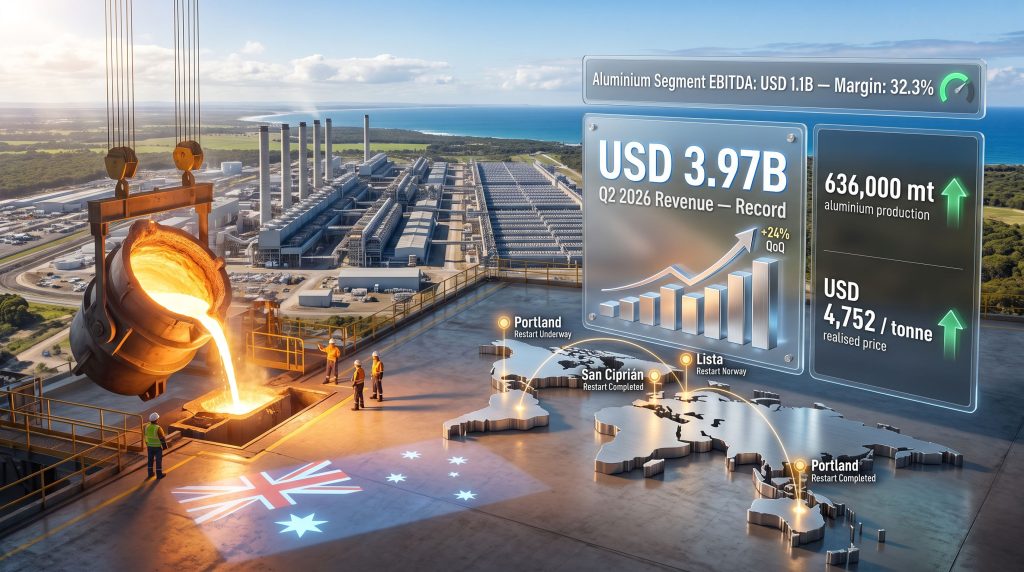
| Total Revenue | USD 3.97 billion | +24% vs Q1 2026 |
| GAAP Net Income | USD 407 million | Record quarter |
| GAAP EPS | USD 1.53 per share | |
| Adjusted Net Income | USD 562 million | +51% QoQ |
| Adjusted EPS | USD 2.12 per share | Missed USD 2.32 consensus |
| Aluminium Segment Adj. EBITDA | USD 1.1 billion | Record |
| EBITDA Margin (Aluminium) | 32.3% | Record |
| Operating Cash Flow | USD 608 million | |
| Group Aluminium Production | 636,000 tonnes | +5% QoQ |
| Aluminium Shipments | 726,000 tonnes | +18% QoQ |
| Realised Aluminium Price | USD 4,752/tonne | +13% QoQ |
The EPS Miss and Its Market Impact
Despite adjusted net income rising 51% sequentially to USD 562 million, Alcoa's adjusted EPS of USD 2.12 fell short of the analyst consensus of USD 2.32 by USD 0.20. Revenue at USD 3.97 billion also missed the forecast of USD 3.99 billion by approximately USD 20 million. These shortfalls, modest in absolute terms, were sufficient to trigger a 5.9% decline in Alcoa's share price following the earnings release.
In commodity-sector equity investing, expectations are often the most powerful short-term price driver. A record operational quarter can still disappoint a market that had already priced in perfection. The USD 0.20 EPS miss against a USD 2.12 result illustrates how a less-than-9% deviation from expectations can erase significant perceived value in a single session.
This dynamic is amplified in aluminium equities because the sector is closely tied to LME pricing cycles. When aluminium prices run strongly, analyst models tend to revise upward aggressively, setting consensus bars that even well-executing operators can struggle to clear. Furthermore, the Bank of America downgrade earlier in 2025 had already highlighted the sensitivity of Alcoa's valuation to consensus expectations, with the Bank of America downgrade serving as an instructive precedent for how quickly sentiment can shift. For long-term investors, the post-earnings dip in a record revenue quarter may represent a positioning opportunity rather than a fundamental signal of deterioration.
The Multi-Smelter Restart Strategy: A Compounding Production Effect
Portland was not the only facility undergoing restart activity during Q2 2026. Alcoa was simultaneously progressing capacity restorations across multiple geographies, creating a production compounding effect that lifted group output well beyond what any single facility restart could achieve independently.
| Smelter Location | Country | Q2 2026 Status |
|---|---|---|
| Portland | Australia | Restart completed, 35,000 tpa restored |
| San Ciprián | Spain | Restart underway |
| Lista | Norway | Restart underway |
| Alumar | Brazil | Restart in progress |
The coordinated nature of these restarts reflects a deliberate capacity management strategy tied to the aluminium price environment. Primary aluminium smelting carries high fixed costs, meaning that curtailed capacity represents a significant drag on margin efficiency. When LME prices recover sufficiently to justify the capital and operational costs of restart, bringing multiple facilities online simultaneously maximises the window of high-price capture. With the realised average aluminium selling price reaching USD 4,752 per tonne in Q2 2026, a 13% sequential improvement, the economics clearly supported accelerated capacity restoration.
Production Records Across the Portfolio
The scale of the production achievement in Q2 2026 extends beyond the Portland headline. Four smelters and one refinery within Alcoa's global network achieved year-to-date production records during the quarter. Group aluminium production reached 636,000 metric tonnes, a 5% sequential increase from Q1 2026, while aluminium shipments climbed to 726,000 tonnes, up 18% from the previous quarter. The shipment volume increase outpacing the production increase reflects strong demand absorption and the contribution of inventory optimisation alongside restored Portland output.
Understanding the 32.3% EBITDA Margin in Context
An aluminium segment EBITDA margin of 32.3% is noteworthy for several reasons that are not always apparent to investors outside the sector. Among the top aluminium producers globally, margins at this level are exceptional, and as highlighted in analysis of top aluminium producers, only operators with strong vertical integration tend to sustain them through pricing cycles.
Primary aluminium smelting is traditionally a low-to-mid margin business in commodity terms, subject to energy cost volatility, carbon cost exposure, and raw material pricing cycles. Achieving a margin above 30% in the aluminium segment requires a convergence of favourable conditions, including:
- High realised LME-linked pricing with favourable regional premiums.
- Near-full capacity utilisation, which drives fixed cost absorption across a larger volume base.
- Integrated feedstock supply reducing exposure to spot alumina and bauxite costs.
- Operational efficiency at the smelter level, minimising energy waste and pot failure rates.
The Portland restart contributed to point two directly. Operating at approximately 95% of total capacity rather than a curtailed rate means that fixed costs, including infrastructure maintenance, grid connection fees, and administrative overhead, are spread across a significantly larger tonne base. This fixed-cost dilution effect is one of the least discussed but most financially impactful aspects of smelter restart economics.
The South32 Acquisition: Deepening Upstream Integration
Q2 2026 also marked the announcement of Alcoa's agreement to acquire South32's bauxite, alumina, and aluminium assets, with the Worsley Alumina operation in Western Australia being the centrepiece asset. The deal is expected to generate approximately USD 900 million in net present value synergies, driven by integration efficiencies across Alcoa's existing Western Australian refinery network.
Worsley is strategically significant because it sits within the same bauxite-rich corridor of Western Australia that underpins much of Alcoa's existing Australian operations. In addition, the broader bauxite supply dynamics across the region remain favourable, and understanding bauxite supply dynamics helps contextualise why Worsley's location is so commercially compelling. Adding Worsley's alumina output to Alcoa's existing refinery network improves the company's alumina self-sufficiency ratio, reducing reliance on third-party alumina procurement and strengthening margin insulation across the aluminium production value chain.
The timing of the South32 acquisition announcement, concurrent with multi-site smelter restarts and record aluminium prices, positions Alcoa to expand upstream capacity precisely when the economics of doing so are most favourable. This sequencing is a hallmark of disciplined resource sector capital allocation.
The next major ASX story will hit our subscribers first
Guidance Revision: The Pinjarra Disruption Offsets Portland Momentum
Not all operational news from Q2 2026 was positive. Alcoa revised its full-year alumina production guidance downward to 9.5 to 9.6 million metric tonnes, citing operational disruptions at the Pinjarra refinery in Western Australia. The Pinjarra revision partially offsets the production momentum created by Portland's restart and represents a risk to alumina segment earnings in the second half of 2026.
Full-year aluminium production guidance was maintained at 2.5 to 2.6 million tonnes, reflecting confidence in the smelter network's output trajectory. The divergence between the alumina guidance cut and the maintained aluminium production target highlights the operational independence of refining and smelting within an integrated system, as Alcoa can source third-party alumina to compensate for reduced Pinjarra output where necessary.
Gallium Production at Wagerup: A Critical Minerals Dimension
Beyond the aluminium headlines, one of the most strategically consequential developments in Q2 2026 was Alcoa's final investment decision to develop a gallium production facility at its Wagerup refinery in Western Australia. This decision was reached alongside the Australian, US, and Japanese governments, whose participation reflects the geopolitical significance of the project rather than routine commercial support.
Gallium is a byproduct of aluminium refining, produced in small quantities from the Bayer process used to refine bauxite into alumina. Its strategic importance lies in applications such as gallium in semiconductors, compound semiconductors for defence electronics, LED manufacturing, and emerging technologies including 5G infrastructure. China currently dominates global gallium production, holding an estimated 80% or more of refined gallium output capacity globally.
Western supply chain vulnerability to Chinese export restrictions on gallium, demonstrated when Beijing imposed export controls on the material in 2023, has elevated the strategic priority of developing alternative production sources. The Wagerup facility is expected to supply approximately 10% of global gallium demand once operational. For context, global gallium consumption for high-purity applications runs in the range of several hundred tonnes annually, making even a 10% supply contribution from a single facility commercially meaningful.
What the Gallium Project Means for Alcoa's Long-Term Positioning
- It transforms a byproduct stream from the alumina refining process into a commercially valorised critical mineral output.
- It provides revenue diversification beyond the cyclical aluminium price environment.
- It positions Alcoa as a participant in critical minerals supply chains that attract government-backed offtake interest and strategic partnerships.
- It demonstrates that integrated aluminium producers hold latent critical mineral assets embedded within existing refinery infrastructure that have historically been undervalued by markets.
Labour Stability and Operational Risk Reduction
Shortly after the June quarter closed, approximately 1,400 employees across Alcoa's Western Australian mining and refining operations ratified a new four-year enterprise agreement with the Australian Workers Union. In capital-intensive industrial sectors, multi-year labour agreements are a meaningful risk management tool. They provide operational cost visibility, reduce the probability of production disruption from industrial action, and signal a stable workforce relationship at facilities that are critical to Alcoa's alumina and bauxite output.
For long-cycle industrial assets like aluminium refineries and smelters, where a single extended strike can cause irreversible damage to electrolytic cells or require costly process restarts, labour stability carries a value premium that is difficult to quantify but real in its impact on operational risk pricing.
What Q2 2026 Signals for Global Aluminium Markets
The Alcoa Portland smelter restart and Q2 earnings narrative extends well beyond a single company's financial report. Several macro signals are embedded within the data, and recent industry analysis confirms that Alcoa is not alone in responding to favourable price conditions with accelerated capacity restoration:
- A 13% sequential improvement in realised aluminium prices to USD 4,752 per tonne points to sustained LME price strength heading into H2 2026.
- Multi-geography smelter restarts across Australia, Spain, Norway, and Brazil indicate that the global primary aluminium supply curve is expanding in response to price signals, which may moderate the pace of further price appreciation.
- Record EBITDA margins at the aluminium segment level, at 32.3%, confirm that the current price environment is generating exceptional returns on smelting capacity, incentivising further capacity restoration globally.
- The energy transition continues to underpin structural aluminium demand growth, with the metal critical to electric vehicle manufacturing, solar panel mounting systems, and electricity grid expansion.
Disclaimer: This article contains forward-looking statements and financial projections based on publicly available information and analyst consensus data. It does not constitute financial advice. Past performance and record quarterly results do not guarantee future outcomes. Investors should conduct independent due diligence before making investment decisions.
For further context on aluminium industry developments, production dynamics, and upstream market analysis across the bauxite, alumina, and primary aluminium segments, readers can explore reporting and analysis available through AL Circle.
Want to Capitalise on the Next Major Resource Discovery Before the Market Prices It In?
Discovery Alert's proprietary Discovery IQ model delivers real-time alerts on significant ASX mineral discoveries, cutting through complex data to surface actionable opportunities the moment they are announced — explore historic discoveries and their returns to see what early positioning can mean, then begin your 14-day free trial at Discovery Alert to secure your market-leading edge.