
July 21, 2026
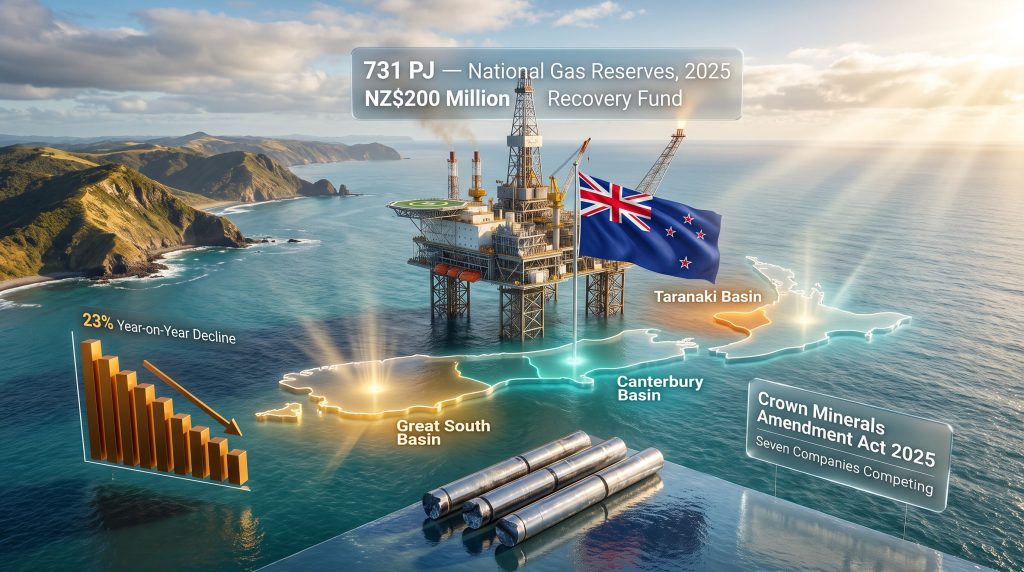
The Supply Cliff Driving Urgency Around New Zealand Offshore Gas Exploration Rights
When energy sectors experience prolonged periods of policy-induced investment drought, the structural consequences compound quietly until they become impossible to ignore. New Zealand's gas industry is a textbook case of this dynamic. Nearly a decade of regulatory freeze has left the country confronting a supply trajectory that industry participants describe as a cliff edge, not a gradual slope. Understanding how that cliff was created, who is now racing to pull the sector back from the edge, and what political forces could reverse course again is essential context for anyone watching the current scramble for New Zealand offshore gas exploration rights.
When big ASX news breaks, our subscribers know first
A Sector Hollowed Out by Seven Years of Policy Paralysis
The numbers tell a stark story. New Zealand produced 7.6 petajoules (PJ) of gas in May 2026, a figure that sounds substantial until you understand that virtually all of it came from fields either already in decline or approaching end-of-life status. The country's total gas reserves fell by 23% year-on-year to 731 PJ in 2025, according to government data released in January 2026. That rate of depletion, with no meaningful pipeline of replacement supply, points toward a structural crisis rather than a cyclical dip.
How Does This Compare to Other Resource Economies?
Making this more acute is the fact that all gas produced in New Zealand is consumed domestically. There is no export volume to redirect inward, no LNG import infrastructure to draw on as a backstop, and no neighbouring grid connection to lean on. The Energy Resources Aotearoa (ERA) industry body estimates that if additional supply were physically available, domestic demand could absorb an additional 100 PJ per year. The constraint is entirely on the supply side.
In contrast, New Zealand resource exports in other commodity sectors have continued to grow, highlighting how the gas sector's stagnation is particularly pronounced. Furthermore, evolving natural gas price trends globally add another layer of complexity to domestic planning decisions.
The origin of this supply gap traces directly to a 2018 policy decision. The Ardern government's prohibition on new offshore drilling was introduced on environmental grounds, but its market consequences extended well beyond any single project. Major international operators including Chevron and Equinor surrendered their exploration permits after the ban took effect, eliminating not just their own drilling programmes but also the institutional knowledge, subsurface data-sharing relationships, and contractor ecosystems they supported.
ERA chief executive John Carnegie has characterised the cumulative effect as a seven-year gap in the exploration pipeline, with the sector now effectively rebuilding from a near-standing start. That framing is important because it resets expectations: the return of exploration activity in 2025 and 2026 is not a resumption of an interrupted programme. It is the beginning of a new one, with all the lead times that implies.
How the Legal Framework for New Zealand Offshore Gas Exploration Rights Was Rebuilt
The Crown Minerals Amendment Act 2025, passed on 31 July 2025, formally dismantled the six-year offshore drilling prohibition and reopened the application process for new exploration permits. Under New Zealand's constitutional framework, the Crown retains sovereign ownership of all in-ground petroleum resources, and exploration permits grant holders exclusive rights to explore and mine within a defined permit boundary for periods expected to run 10 to 15 years under the current regime.
Permit holders under the new framework also retain the right to convert an exploration permit into a mining permit upon confirming a commercial discovery, and can apply for extensions, work programme modifications, and permit transfers. These provisions matter structurally because they reduce the binary risk of exploration expenditure, providing a clear pathway from discovery to development within the same regulatory instrument.
The current permit landscape reflects how much ground was lost during the ban period:
| Permit Category | Status as of Mid-2026 |
|---|---|
| Existing offshore exploration permits | 22 permits, covering ~100,000 sq km |
| Last existing permit expiry | 2030 |
| New applications open from | September 2025 |
| New formal permits issued | None |
| Permit duration (new framework) | 10 to 15 years |
| Government support fund | NZ$200 million (~USD $117 million) |
The NZ$200 million fund established alongside the legislative changes is designed to assist operators in developing projects, including enhanced recovery from mature reservoirs. It exists partly to bridge the commercial viability gap for smaller explorers entering a sector with limited recent well data, where subsurface uncertainty is higher than it would be in a basin with continuous development activity.
However, the fund's existence has not yet translated into formal permit issuance, and regulatory processing timelines remain the sector's most immediate practical bottleneck. Consequently, government intervention in resources of this kind is being watched closely by industry participants as a potential model for other markets facing similar supply challenges.
The Seven Competing Operators and Their Strategic Positions
As of mid-2026, seven oil and gas companies are actively pursuing New Zealand offshore gas exploration rights, creating a competitive dynamic that the regulatory framework deliberately enables. The system allows rivals a three-month window to submit superior work programmes for the same permit areas, functioning as a structured competitive tender rather than a first-come-first-served allocation. This mechanism is designed to maximise the quality of exploration commitments rather than simply reward speed of application.
| Company | Domicile | Target Basin | Status |
|---|---|---|---|
| Sunda Energy (LON: SNDA) | United Kingdom | Taranaki Basin | Grant secured, formal permit pending |
| Pancontinental Energy (ASX: PCL) | Australia | Taranaki Basin | Grant secured, formal permit pending |
| EnZed Energy | New Zealand (private) | Taranaki Basin | Grant secured, formal permit pending |
| Three-company NZ consortium | New Zealand | Canterbury Basin area | Pursuing jointly |
| CBX Energy | Undisclosed | Canterbury Basin (South Island offshore) | Application in progress |
A pattern visible across this field of applicants is the near-complete absence of major international operators. The companies now leading the charge are predominantly junior and mid-tier explorers, a composition that reflects both the deterrence effect of the ban period on large-cap portfolio allocations and the specific attractions of the Taranaki Basin for smaller operators. Taranaki's extensive legacy subsurface data and its track record as the country's only producing offshore basin meaningfully lower geological risk for companies with constrained exploration budgets.
Sunda Energy's chief executive Andy Butler has indicated that the company views identified discoveries in the Taranaki Basin as genuinely promising targets worth pursuing, reinforcing the view that existing subsurface knowledge is functioning as a de-risking mechanism for new entrants.
Meanwhile, EnZed founder Neil Young has noted that instability in Australia's domestic gas policy environment is actively redirecting capital toward New Zealand, with investors and allocators increasingly viewing the country as a more predictable regulatory alternative to its trans-Tasman neighbour. This is a significant and underappreciated dynamic: New Zealand's relative attractiveness is being amplified by Australia's policy missteps, not just by its own legislative improvements.
Basin Geology and Why Taranaki Dominates Near-Term Interest
Understanding which basins are attracting exploration activity, and why, requires a basic grasp of the geological risk spectrum involved.
The Taranaki Basin
The Taranaki Basin sits off the west coast of New Zealand's North Island and represents the country's only offshore basin with a proven production track record. Decades of development have generated extensive seismic survey data, well logs, and reservoir characterisation studies, all of which remain available to new entrants. Known gas discoveries within the basin provide specific drill targets with meaningful probability-of-success estimates, a very different risk profile from frontier exploration where structural leads are inferred rather than confirmed.
The Canterbury Basin
The Canterbury Basin, located offshore New Zealand's South Island, represents a middle tier of exploration risk. It is attracting both CBX Energy and the three-company New Zealand consortium, suggesting that at least some operators are willing to accept higher geological uncertainty in exchange for potentially less competitive permit areas. In addition, the possibility of larger undiscovered resources makes the Canterbury Basin an appealing longer-term prospect for those with a higher risk appetite.
The Great South Basin
The Great South Basin sits at the far end of the risk spectrum. With limited subsurface data and no production history, it offers the potential for scale but requires a substantially longer investment horizon and a higher tolerance for dry holes. It is better suited to operators with the balance sheet depth to absorb extended exploration programmes without near-term production pressure. For context, the broader LNG supply outlook globally is also shaping how investors assess frontier basins such as this one.
The November 2026 Election: The Defining Risk Event for Permit Holders
For all the structural logic supporting renewed exploration activity, the defining near-term variable is political. New Zealand's general election is scheduled for November 2026, and current polling indicates the contest is genuinely uncertain. The opposition Labour party has committed formally to reimposing a ban on new offshore oil and gas permits if it wins government.
Labour's position includes a stated commitment to honouring existing permits already formally granted, but explicitly opposes any new issuance and frames ongoing government financial support as propping up an industry it characterises as outdated. Acting Labour Energy and Resources spokesperson Tangi Utikere has argued that reimposing the ban serves both energy security and long-term power cost reduction goals, positioning renewables as the preferred pathway rather than additional fossil fuel development.
The political risk comparison is instructive:
| Policy Dimension | Current Government | Labour (Opposition) |
|---|---|---|
| New offshore permits | Actively encouraging | Would reimpose ban |
| Existing permits | Honouring and supporting | Would honour, not extend support |
| Government funding | NZ$200M fund active | Opposed to ongoing subsidies |
| Energy security framing | Gas as essential transition fuel | Renewables-first approach |
The most legally significant detail in Labour's position is the distinction between a grant and a formal permit. Several of the current contenders have secured grants but not yet received formal permits. Whether grant-holders would be protected under Labour's stated policy of honouring existing permits is not explicitly confirmed, creating meaningful legal uncertainty for companies currently in that intermediate status.
Furthermore, broader trade war impacts on global energy investment sentiment could also influence how international capital flows toward or away from New Zealand's reopened basin environment in the months ahead.
This distinction is not merely procedural. In a sector where exploration commitments represent multi-year capital outlays, the difference between a grant and a formal permit could determine whether an operator's position survives a change of government intact.
Resources Minister Shane Jones has publicly acknowledged that rebuilding investor confidence required significant work on the regulatory environment, and characterises the current field of applicants as evidence that risk appetite is returning after years of policy-induced paralysis. Whether that confidence is sustained beyond November 2026 depends on an electoral outcome that neither polling nor market positioning can reliably predict. For further background on New Zealand's oil and gas sector history, the depth of the country's resource base provides important context for understanding what is at stake.
The next major ASX story will hit our subscribers first
Frequently Asked Questions: New Zealand Offshore Gas Exploration Rights
What legislation governs new offshore exploration permits in New Zealand?
The Crown Minerals Amendment Act 2025, passed 31 July 2025, provides the current legal foundation. It formally reversed the 2018 prohibition and reopened the application process.
How many existing offshore permits remain active?
As of mid-2026, 22 existing offshore exploration permits cover approximately 100,000 square kilometres, with the last of these expiring in 2030.
Why have gas reserves fallen so sharply?
The 23% decline in reserves to 731 PJ in 2025 reflects the ageing of producing fields combined with a near-decade absence of new field development. No replacement supply was brought into the pipeline during the ban period.
What happens to existing grants if Labour wins the election?
Labour has stated it will honour existing formal permits, but has not explicitly extended that protection to grants not yet converted to formal permits. This ambiguity is a material risk for several current applicants.
Why are no major international operators involved?
Chevron and Equinor exited after the 2018 ban. The current entrant field reflects the smaller capital base of junior and mid-tier explorers who are willing to re-enter a sector that majors have yet to return to. However, sustained policy stability beyond the November 2026 election could eventually attract larger players back to a basin with proven resource potential.
Want to Stay Ahead of the Next Major Resource Discovery?
Discovery Alert's proprietary Discovery IQ model delivers real-time alerts on significant ASX mineral discoveries — instantly translating complex resource data into actionable investment insights, so subscribers can act before the broader market catches on. Explore historic discoveries and their exceptional market returns, then begin your 14-day free trial at Discovery Alert to position yourself at the forefront of the next major find.