July 21, 2026
When Cash Declines Can Signal Confidence Rather Than Crisis
In junior mining, a falling cash balance triggers an almost instinctive reaction from investors: concern. Capital preservation is treated as a proxy for financial health, and any significant drawdown tends to invite uncomfortable questions. But this framing misses a critical distinction that separates companies investing aggressively in their own future from those genuinely burning through reserves out of operational necessity.
The difference comes down to what the capital is being directed toward. Underground development, record exploration campaigns, and debt elimination represent fundamentally different uses of cash than operational losses or cost overruns. Understanding that distinction is essential to interpreting what happened when Luca Mining cash position falls to US$24.7 million across the second quarter of 2026.
When big ASX news breaks, our subscribers know first
Dissecting the US$11.7 Million Cash Reduction
Between March 31 and June 30, 2026, Luca Mining's cash reserves moved from US$36.4 million to US$24.7 million — a reduction of approximately US$11.7 million, or roughly 32% of the opening balance. Taken in isolation, that figure looks significant. Placed in context, it reflects a company pressing forward on multiple capital-intensive fronts simultaneously.
The outflows stemmed from four distinct categories, each carrying a different strategic logic:
| Capital Outflow Category | Nature of Expenditure | Strategic Intent |
|---|---|---|
| Underground mine development | Growth capex | Expand reserve access and extend mine life |
| Record exploration drilling | Growth capex | Resource expansion at both Mexican assets |
| Lump-sum tax payments | Regulatory obligation | Compliance timing requirement |
| Share repurchases (NCIB) | Capital return | Shareholder value management |
A fifth pressure came from an external source rather than company-directed spending. Negative provisional pricing adjustments, triggered by softer gold and silver spot prices during the quarter, reduced the cash received from concentrate settlements below initially estimated levels. This is a standard feature of polymetallic concentrate sales, where provisional invoices are issued at shipment and then adjusted when final assays and prevailing prices are confirmed at settlement. When prices fall between shipment and settlement, the adjustment flows against the producer.
Furthermore, understanding drilling results and their implications is vital for interpreting how exploration spending contributes to longer-term value rather than simply representing a cash drain.
In polymetallic operations, provisional pricing mechanics mean that commodity price movements during a quarter can materially affect cash receipts independent of production volumes or operational performance. This is a structural feature of the business, not an operational failure.
Debt Position: The Structural Counterweight to Cash Reduction
Any assessment of Luca Mining's financial position that focuses only on cash without accounting for debt load is incomplete. At June 30, 2026, the company's outstanding debt stood at approximately US$1.4 million, with full repayment scheduled for July 2026.
That figure changes the picture considerably. A junior mining company holding US$24.7 million in cash against effectively zero debt occupies a balance sheet position that most companies in its peer group cannot replicate. The post-repayment status as a fully debt-free producing company eliminates refinancing risk, removes interest burden from the cost structure, and provides management with maximum flexibility over capital allocation decisions.
For context, the junior and mid-tier mining space is populated with companies carrying debt multiples that dwarf their cash positions, often requiring continuous financing activity just to sustain operations. A debt-free producer with a meaningful cash runway represents a materially different risk profile. In addition, interpreting drill results alongside balance sheet strength gives investors a more complete picture of a junior miner's trajectory.
Management confirmed the company is positioned to fund both operational optimisation programs and growth initiatives from existing cash reserves, with no equity dilution activity disclosed alongside the Q2 results.
Q2 2026 Production: What the Numbers Actually Reveal
Consolidated production across both Mexican operations delivered a broad polymetallic output in Q2 2026:
| Metal | Total Production | Payable Output | Payability Ratio |
|---|---|---|---|
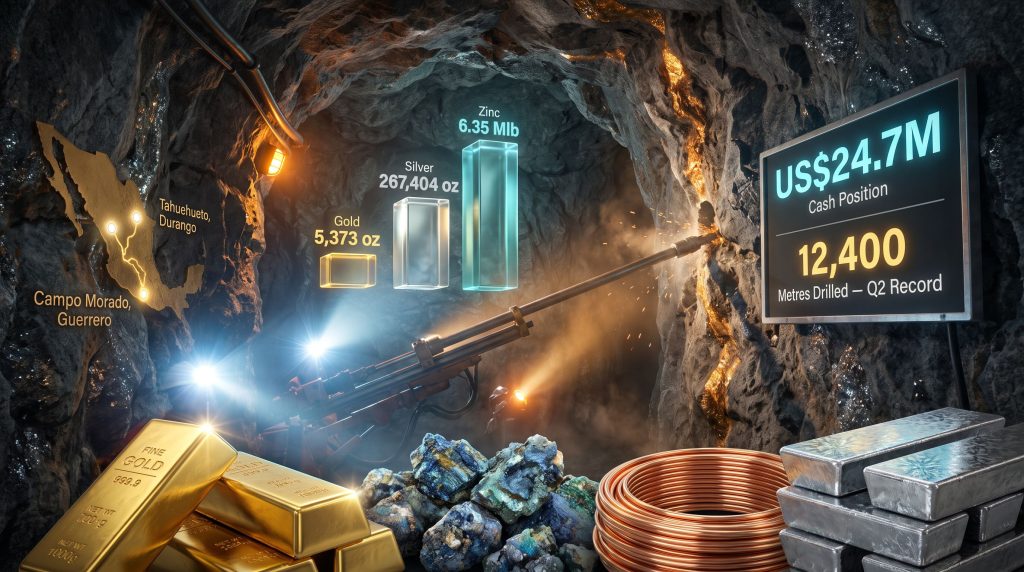
| Gold | 6,161 oz | 5,373 oz | ~87% |
| Silver | 334,237 oz | 267,404 oz | ~80% |
| Copper | 2.66 Mlb | 1.96 Mlb | ~74% |
| Lead | 1.94 Mlb | 656,000 lbs | ~34% |
| Zinc | 8.88 Mlb | 6.35 Mlb | ~71.5% |
Understanding Payability in Polymetallic Concentrate Operations
The gap between total production and payable metal is a concept that receives insufficient attention in mining coverage but is central to revenue realisation. Payability refers to the percentage of contained metal for which a smelter or offtaker will actually pay, after accounting for treatment charges, refining charges, moisture penalties, and minimum deduction thresholds built into smelter contracts.
In polymetallic concentrate operations, these terms are more complex than in single-metal scenarios because multiple metals appear across multiple concentrate streams. Each stream carries its own penalty and payability structure. The result is that two companies reporting identical production volumes can generate very different revenue depending on their smelter contracts and concentrate quality.
Gold payability at approximately 87% and silver at 80% are broadly consistent with industry norms for complex base metal concentrates where precious metals appear as by-products. Lead payability at roughly 34% warrants specific note — this low ratio is typical where lead reports to a zinc concentrate rather than as a clean galena product, as lead content in zinc concentrates is frequently penalised or deducted entirely by smelters. The cut-off grade significance also plays a role here, as economic thresholds directly influence which mineralisation is processed and how payability ratios are ultimately managed.
Campo Morado (Guerrero): The Logic of Deliberate Throughput Restraint
Asset-Level Production Metrics
| Metal | Total Production | Payable Output |
|---|---|---|
| Gold | 1,700 oz | 963 oz |
| Silver | 234,896 oz | 173,578 oz |
| Copper | 2.23 Mlb | 1.72 Mlb |
| Lead | 964,000 lbs | not disclosed separately |
| Zinc | 7.27 Mlb | 5.26 Mlb |
Why the Underground Stockpile Strategy Is More Sophisticated Than It Appears
Campo Morado's gold payability of approximately 56.6% stands in sharp contrast to Tahuehueto's 98.9% figure. This gap reflects the different metallurgical character of each orebody, concentrate type, gold deportment behaviour, and smelter contract terms rather than operational inefficiency.
The more significant operational development at Campo Morado during Q2 2026 was the deliberate decision to increase mined tonnage relative to milled tonnage — effectively building an underground stockpile rather than feeding all mined material directly to the processing plant. This temporarily suppressed reported metal output for the quarter.
Metallurgical recovery in polymetallic sulphide systems is highly sensitive to feed grade variability. When run-of-mine ore with inconsistent grades enters a flotation circuit directly, recovery performance fluctuates, and optimising reagent addition becomes difficult. A controlled stockpile enables operators to blend feed ahead of the mill, smoothing grade variation and allowing flotation chemistry to be dialled in for consistent performance.
The practical consequence of this approach is that near-term reported production figures appear lower than the underlying mining rate would suggest, while the long-term benefit is improved recovery of silver, copper, and zinc — the primary value drivers at the operation. This is a trade-off that experienced metallurgists would recognise as rational, even if the quarterly numbers look subdued.
The stockpile initiative is also positioned as preparatory groundwork ahead of the Campo Morado expansion project, which is currently in design phase. Operational flexibility during a plant expansion transition period is critical — having a material buffer means the mill can continue receiving consistent feed even as expansion-related work progresses.
Tahuehueto (Durango): Operational Maturation Takes Shape
Asset-Level Production Metrics
| Metal | Total Production | Payable Output |
|---|---|---|
| Gold | 4,461 oz | 4,410 oz |
| Silver | 99,340 oz | 93,826 oz |
| Copper | 434,000 lbs | 244,000 lbs |
| Lead | 979,000 lbs | 656,000 lbs |
| Zinc | 1.61 Mlb | 1.09 Mlb |
Three Operational Drivers Worth Understanding
-
Plant processing upgrades — Circuit-level enhancements that improve throughput consistency and reduce variability in recovery performance across the processing campaign.
-
Underground infrastructure development — Ongoing capital investment in development headings to establish access to higher-grade ore zones, which requires upfront capital before ore extraction can begin at elevated rates.
-
New mining contractor integration — La Cantera was brought on board during the quarter to supplement underground production capacity, increasing the operational flexibility of the mine's extraction program.
Tahuehueto's gold payability ratio of approximately 98.9% is the standout figure at this operation. Achieving near-complete gold recovery in a payable sense indicates the gold at this asset reports to a high-quality concentrate where smelter deductions are minimal. This is partly a function of gold deportment — whether gold occurs as free particles or locked within sulphide minerals determines how it partitions into concentrates and how smelters apply deductions.
The next major ASX story will hit our subscribers first
Record Exploration Drilling: What the Intercepts Actually Mean
Q2 2026 Drilling Reaches a Company Milestone
Approximately 12,400 metres of exploration drilling was completed during Q2 2026, establishing a new quarterly record for the company. Combined with Q1 activity, total first-half 2026 drilling reached approximately 22,000 metres across both operations.
Campo Morado Exploration: Unmined Zones Deliver High-Grade Results
The critical qualifier on Campo Morado's exploration intercepts is the word unmined. Both the El Rey surface zone and the Naranjo underground zone represent areas where no historical extraction has occurred, meaning positive intercepts in these locations carry genuine resource addition potential beyond what is already captured in declared reserve statements.
El Rey Zone (Surface, Unmined):
- Hole CMRY-26-10: 28.4 metres grading 2.28 g/t Au and 134.89 g/t Ag
- Including: 9.7 metres returning 4.09 g/t Au and 208.99 g/t Ag
Naranjo Zone (Underground, Unmined):
- Hole CMUG-26-44: 19.6 metres grading 2.78 g/t Au and 103.12 g/t Ag
- Hole CMUG-26-42: 20.6 metres grading 3.05 g/t Au and 50.69 g/t Ag
For context, intercepts of 20–28 metre widths at grades above 2 g/t gold equivalent in a massive sulphide system are considered economically meaningful. The combination of width and grade in unmined areas suggests these targets have the structural characteristics to contribute to future resource updates.
AI-Assisted Target Generation: A Shift in Exploration Methodology
Perhaps the least-discussed element of Luca Mining's exploration program is the technology layer underpinning target selection at Campo Morado. The company processed a historical dataset comprising 650,000 metres of drilling records, 30,000 soil geochemistry samples, and 153 geophysical layers through 100 automated deep learning models using the VRIFY Technology platform and DORA AI software.
This methodology generated six high-priority exploration targets for ground-truthing. The significance of this approach extends beyond the targets themselves. Traditional geological target generation relies on experienced geologists synthesising disparate datasets through manual interpretation — a process that is both time-intensive and susceptible to cognitive bias toward known deposit types. However, AI in mineral exploration is reshaping how companies identify and prioritise drill targets at scale.
Machine learning models applied to large historical datasets can identify spatial correlations and anomaly patterns across multiple data layers simultaneously, often surfacing targets in areas that manual review would deprioritise. This reduces the cost-per-discovery risk profile by improving the hit rate on drill-ready targets, though it does not eliminate geological risk entirely. According to World Bank research on mineral sector frameworks, robust geological data infrastructure is increasingly recognised as a cornerstone of effective resource development in emerging mining jurisdictions.
Tahuehueto Exploration: Older Structures Reopened
An additional US$2.4 million was allocated to Tahuehueto's expanded 2026 campaign, with two contracted surface diamond drill rigs and one company-owned underground rig completing 40 underground holes totalling 8,268 metres and 25 surface holes totalling 4,599 metres.
Creston Vein (Surface, Below Level 23):
- Hole DDH26-SU-07: 6.8 metres grading 5.54 g/t AgEq, including 1.0 metre at 22.35 g/t AgEq
- Hole DDH26-SU-04: 4.5 metres grading 4.50 g/t AgEq
El Rey Vein (Underground, Unmined Since 1983):
- Hole DDH26-239: 3.3 metres grading 3.04 g/t AgEq, including 1.0 metre at 7.48 g/t AgEq
The El Rey vein's dormancy since 1983 is geologically noteworthy. Structures left unmined for four decades at underground operations typically reflect either historical access limitations or grade characteristics that were below the economic threshold at the time. Revisiting such structures with modern drill technology and updated metal price contexts can unlock mineralisation that was previously sub-economic.
Capital Allocation Framework: How Q2 2026 Fits Into a Longer Narrative
Junior producers face a recurring strategic tension: capital spent on exploration and development today reduces the cash buffer available for operational contingencies, but capital withheld from growth programs delays the resource expansion that underpins long-term value creation. How a company navigates this tension reveals its management philosophy.
Luca Mining's Q2 2026 activity reflects a growth-weighted allocation model across three distinct time horizons:
| Pillar | Activity | Timeframe of Benefit |
|---|---|---|
| Near-term optimisation | Stockpile strategy, plant upgrades, contractor integration | 1-2 quarters |
| Medium-term resource growth | Record exploration drilling across both mines | 12-24 months |
| Long-term structural expansion | Campo Morado expansion design | 2-4 years |
The simultaneous pursuit of all three pillars within a single quarter, whilst also returning capital to shareholders via the NCIB program and extinguishing the remaining debt load, suggests a management team operating with a high degree of financial confidence in the company's underlying cash generation capacity. Consequently, a definitive feasibility study for the Campo Morado expansion will ultimately be the document that crystallises whether this multi-pillar capital strategy translates into durable long-term value. Notably, the Reality of Aid report highlights how resource-dependent economies benefit most when extractive companies reinvest capital locally rather than simply repatriating profits — a dynamic that responsible junior producers operating in jurisdictions like Mexico are increasingly mindful of.
Disclaimer: This article is for informational purposes only and does not constitute financial or investment advice. All financial figures, production data, and exploration results cited are derived from Luca Mining's publicly disclosed Q2 2026 operational and financial reporting. Forward-looking statements regarding exploration potential, expansion timelines, and financial positioning involve inherent uncertainty and should not be relied upon as guarantees of future performance. Readers should conduct their own due diligence and consult a qualified financial adviser before making investment decisions.
FAQ: Luca Mining Q2 2026 Results
Why Did Luca Mining's Cash Position Fall in Q2 2026?
The reduction from US$36.4 million to US$24.7 million reflected underground development capital, record exploration expenditure, scheduled tax payments, share buybacks under the NCIB program, and negative provisional pricing adjustments linked to weaker gold and silver prices during the quarter.
Is Luca Mining at Financial Risk With US$24.7 Million in Cash?
Based on disclosed information, the company carries only US$1.4 million in remaining debt, scheduled for full repayment in July 2026. Management indicated the cash position is adequate to fund both operational improvements and growth programs without additional financing.
What Is the Underground Stockpile Strategy at Campo Morado?
Rather than processing all mined material directly, the company accumulated an underground stockpile to enable controlled blending of mill feed. This is designed to improve metallurgical recoveries by reducing grade variability entering the processing circuit, ahead of the planned Campo Morado expansion.
What Exploration Results Were Reported for Q2 2026?
Approximately 12,400 metres of drilling was completed, a quarterly company record. Notable intercepts included 28.4 metres at 2.28 g/t Au and 134.89 g/t Ag at Campo Morado's El Rey zone, and 6.8 metres at 5.54 g/t AgEq at Tahuehueto's Creston vein.
When Did Luca Mining Become Debt-Free?
The company's remaining debt of approximately US$1.4 million was scheduled for full settlement during July 2026, after which no outstanding financial debt obligations would remain on the balance sheet.
Want to Stay Ahead of the Next Major ASX Mineral Discovery?
Discovery Alert's proprietary Discovery IQ model delivers real-time alerts the moment significant mineral discoveries are announced on the ASX, transforming complex geological data into actionable investment insights for both short-term traders and long-term investors — explore historic discoveries and their exceptional returns to understand the opportunity, then begin your 14-day free trial at Discovery Alert to position yourself ahead of the broader market.