July 21, 2026
The Hidden Cost of Sequential Approvals in Latin American Mining
Long before a single drill bit enters Peruvian soil, the clock is already working against exploration investors. Peru cuts environmental permitting times for mining pipeline projects, and this reform arrives at a critical moment. In jurisdictions where administrative architecture was designed around a linear, one-step-at-a-time approval logic, the geological quality of a deposit becomes almost irrelevant if the permitting queue stretches beyond investor patience. For decades, Peru operated precisely this kind of system, one where the sequence of regulatory approvals was as consequential as the regulations themselves.
The global copper market is entering a structural deficit period. The International Energy Agency projects that demand for copper could nearly double by 2040, driven primarily by electric vehicle manufacturing, grid infrastructure expansion, and renewable energy deployment. The copper supply crunch already creating pressure globally makes it even more critical for jurisdictions to act swiftly. The ability to translate geological endowment into permitted, investable projects within a commercially viable timeframe is not merely an administrative consideration — it is a competitive variable measured in billions of dollars of capital allocation decisions made annually.
Peru's regulatory reforms targeting its US$757 million mining exploration pipeline sit at exactly this intersection of geological potential and administrative execution.
When big ASX news breaks, our subscribers know first
Why Peru's Old Permitting System Worked Against Its Own Interests
The Sequential Dependency Problem
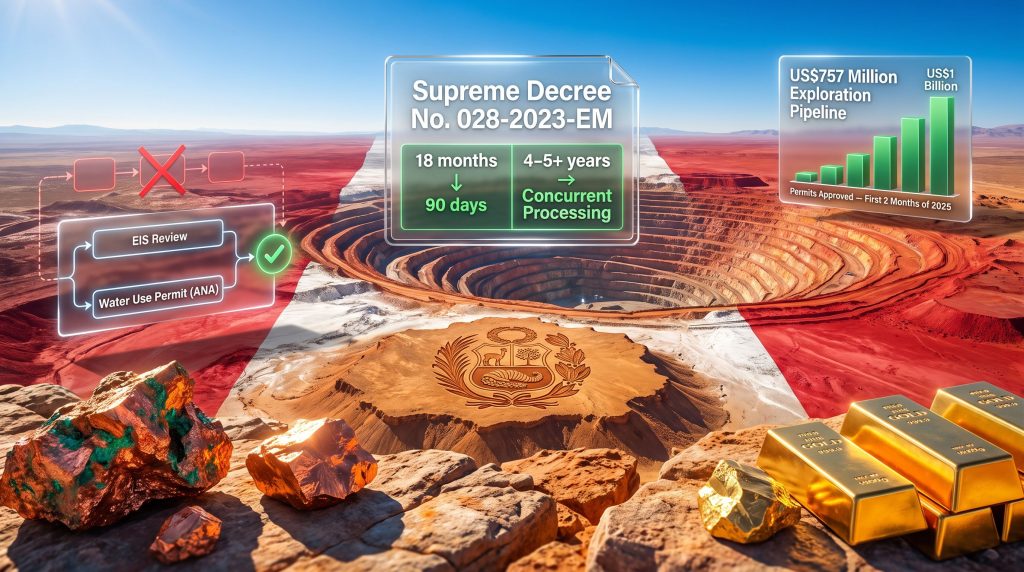
To understand why reform was necessary, it helps to understand how the legacy system functioned mechanically. Under the previous framework, mining companies pursuing exploration permits were required to complete and obtain full approval of an Environmental Impact Study before they could even initiate the water use authorisation process with the National Water Authority, known by its Spanish acronym ANA.
This sequencing created a compounding delay structure. The EIS process itself could consume years of technical work, public consultation, and regulatory review. Only after that entire cycle concluded could a company begin engaging ANA on water rights, triggering a second, parallel bureaucratic sequence that frequently added another twelve to eighteen months to project timelines.
The aggregate result was approval cycles stretching to four to five years or longer for complex projects. Industry observers frequently noted that this duration was not a reflection of environmental complexity or community opposition, but of administrative architecture. The bottleneck was procedural, not substantive.
Peru's Competitive Position and the Stakes of Reform
Peru ranks as the world's second-largest copper producer and remains a globally significant gold producer, operating within one of the most mineralised geological corridors on the planet. The Andean copper belt running through Peru contains some of the highest-grade porphyry copper deposits accessible to modern mining techniques, giving Peru a geological advantage that few jurisdictions can match.
Furthermore, the importance of gold and copper exploration in Peru cannot be overstated, given that neighbouring jurisdictions — including parts of Chile and increasingly Colombia and Ecuador — have used competitive permitting timelines as a tool to attract exploration capital. When a junior explorer must choose between deploying limited capital into a five-year permitting queue or a two-year one, geological quality alone does not always win the argument. Capital flows toward certainty, and certainty in mining exploration is partly a function of regulatory predictability and speed.
Key Insight: In the mining exploration sector, permitting timeline risk functions as an invisible discount rate applied to project net present value calculations. A two-year reduction in permitting time on a project with a 10% discount rate can meaningfully shift the economics of whether exploration investment is sanctioned at all.
How Supreme Decree No. 028-2023-EM Restructures the Approval Pathway
Concurrent Processing: The Core Mechanism
The structural change introduced by Supreme Decree No. 028-2023-EM is conceptually straightforward but administratively significant. Rather than requiring water use authorisation to commence only after the EIS has received full approval, the decree authorises the simultaneous submission and review of both processes.
Under the reformed framework, ANA now delivers its technical opinion on water use during the EIS review phase rather than after it. Critically, this opinion does not sit as a separate procedural artifact. It is designed to integrate directly into the EIS review outcome, meaning that upon EIS approval, the water use authorisation basis is already established rather than pending.
For companies that choose not to pursue simultaneous processing, the reform still delivers a meaningful improvement: water use authorisation can now be initiated immediately upon EIS approval, rather than requiring the launch of an entirely new standalone procedure with its own intake and queuing timeline. Peru's plans to speed up mining permit approvals reflect a broader governmental commitment to reducing bureaucratic friction across the sector.
The Single-Window Platform: Ventanilla Única (VUM)
The operational mechanism translating this policy change into practice is the Ventanilla Única Minera, or VUM, a centralised submission platform administered by the Ministry of Energy and Mines (Minem). Prior to this system, applicants were required to initiate and manage separate procedural tracks across multiple agencies independently, including coordinating their own inter-agency communication and documentation transfer.
The VUM consolidates this into a single submission point. Inter-agency coordination, including ANA's water resource assessment, is managed internally within the government system rather than being the responsibility of the applicant to orchestrate. The practical efficiency gain is substantial: parallel agency review replaces sequential inter-agency handoffs, and the audit trail is centralised.
Quantifying the Timeline Improvements
| Permitting Stage | Previous Timeline | Reformed Timeline |
|---|---|---|
| EIS + Water Use (Combined Sequential) | 4 to 5+ years | Concurrent processing available |
| Water Use Authorisation Post-EIS | New standalone procedure required | Immediate application permitted |
| Specific Process Benchmarks | Up to 18 months for certain steps | As low as 90 days under reformed articulation |
| Exploration Pipeline Value Targeted | Not defined | US$757 million |
Early validation of the reformed system is measurable. In the first two months of 2025 alone, exploration-related environmental permits with a combined value exceeding US$1 billion received approval through the reformed framework, suggesting that the system is generating real processing throughput rather than simply shifting administrative paperwork.
What a US$757 Million Pipeline Actually Represents
Commodity Composition and Capital Distribution
The US$757 million figure represents the aggregate capital expenditure value of exploration projects targeted by the accelerated permitting framework. Copper and gold dominate this pipeline by value, reflecting both Peru's geological endowment and the commodity priorities of international mining capital in the current cycle.
It is worth understanding what exploration-stage capital actually funds, as it differs materially from construction or production capex. Exploration investment covers:
- Geophysical surveying and geological mapping
- Reverse circulation and diamond core drilling programmes
- Assaying, metallurgical testing, and resource estimation
- Environmental baseline studies required for EIS preparation
- Community engagement and social licence development activities
Each of these activities requires permitting certainty before capital can be committed. A faster path through the environmental and water use approval cycle directly accelerates when these expenditures can be deployed, which in turn compresses the timeline to resource definition and ultimately to a production decision.
The NPV Mathematics of Permitting Speed
The financial logic connecting permitting speed to project value is not speculative. It is a straightforward function of discounted cash flow mechanics. Consider a copper exploration project with a projected ten-year production life generating US$150 million in annual free cash flow at a 10% discount rate. A two-year acceleration in the timeline to first production does not add two years of revenue — it shifts the entire cash flow profile forward, increasing the present value of every future cash flow by the compounding effect of the discount rate applied over those two years.
For projects at the margin of investment viability, this shift can determine whether a board approves exploration spending at all. The US$757 million pipeline is therefore best understood not as a fixed number but as a floor figure representing projects that become viable under the accelerated framework and that might otherwise have been deferred or redirected to competing jurisdictions.
The Broader Reform Landscape: Deregulation Beyond Decree 028
Peru's 2025 Regulatory Reform Package
Supreme Decree No. 028-2023-EM does not exist in isolation. Peru's Economy Ministry under José Antonio Salardi has pursued a broader deregulatory agenda targeting redundancies across the permitting ecosystem. The objective is to eliminate duplicated review requirements, harmonise inter-agency timelines, and reduce the administrative friction that historically accumulated across the multi-agency approval process.
This positions the 028 decree as one component of a larger architectural reform. The ambition, as articulated through policy communications, is to reposition Peru as the most investor-accessible mining jurisdiction in Latin America — a claim that requires sustained reform implementation rather than a single decree. Considering the broader mining geopolitical landscape, Peru's reforms are well-timed to capture capital being redirected from jurisdictions perceived as higher-risk environments.
The Concession Tenure Counterweight
Not all elements of Peru's evolving regulatory landscape point in the same direction. A 2026 legislative proposal would reduce the maximum holding period for idle mining concessions from 30 years to 15 years. For major producers with established operations, this change would be largely immaterial. However, for junior explorers and companies advancing long-gestation exploration projects through complex geological terrains, the implications are more serious.
Exploration in high-altitude Andean environments, remote jungle zones, or geologically complex polymetallic systems does not always conform to fifteen-year timelines. Community consultation, environmental baseline data collection across multiple seasons, and staged exploration drilling programs can collectively consume a decade before a resource is defined with sufficient confidence to support a development decision.
Warning: Investors with exposure to longer-horizon Peruvian exploration projects should track the progress of this concession tenure proposal carefully. If enacted without appropriate grandfathering provisions, it could introduce a new category of timeline pressure that partially negates the gains achieved through environmental permitting reform.
Does Streamlined Processing Compromise Environmental Rigor?
Administrative Speed vs. Substantive Review Depth
A legitimate question surrounds whether faster permitting necessarily means weaker environmental outcomes. The Peruvian government's position is that concurrent processing changes the timing of ANA's assessment within the review cycle, not its technical depth or independence. ANA retains full authority to conduct water resource evaluation; it simply does so in parallel with the EIS review rather than after it.
This distinction matters for international investors subject to environmental, social, and governance frameworks. A mining company securing a permit through the reformed system can maintain that the water use assessment was independently conducted by the National Water Authority under its full technical mandate. The reform optimised administrative sequencing, not regulatory standards.
International precedent supports this interpretation. Peru's simplified procedures for environmental approvals align with broader global trends, as Canada's federal impact assessment reforms and Australia's various state-level concurrent approval processes have demonstrated that parallelising review tracks does not inherently compromise environmental outcome quality, provided each agency retains independent assessment authority within its domain.
Community Consultation Within the Accelerated Framework
One area requiring careful attention is the relationship between permitting acceleration and social licence development. Community consultation requirements remain embedded within the EIS framework and are not shortened by Decree 028. However, faster administrative processing can create a perception mismatch between regulatory timelines and community engagement readiness.
Companies operating in Peru's mining corridors, particularly in communities with historical tension around water resource use, need to ensure that social licence work advances concurrently with the accelerated permitting schedule rather than being treated as a post-approval activity.
The next major ASX story will hit our subscribers first
Strategic Positioning for Mining Companies Under the New Framework
Who Gains the Most
The reformed framework creates differentiated advantages depending on the company profile:
- Junior explorers benefit most directly, as permitting holding costs during pre-resource definition phases represent a proportionally larger share of their total project budgets. Faster permitting reduces cash burn during the regulatory phase.
- Mid-tier operators managing multi-project portfolios in Peru gain the ability to sequence permit applications without bottlenecks cascading across assets. Portfolio cadence becomes manageable.
- Major producers pursuing brownfield exploration adjacent to operating mines benefit from faster reinvestment cycle times, enabling tighter integration of exploration drilling with production planning.
Operational Recommendations for Navigating the New System
- Elect concurrent processing at project inception. The decision to pursue simultaneous EIS and water use submission should be evaluated during project scoping, not after the EIS is already underway.
- Engage ANA in pre-application dialogue. Since ANA's technical opinion now integrates directly into the EIS outcome, early technical engagement reduces the risk of late-stage objections that could still delay finalisation.
- Centralise all documentation through the VUM platform from day one. Procedural errors in documentation submission can reset administrative timelines even under the reformed framework.
- Build contingency into project schedules for the concession tenure proposal. If the 15-year idle concession bill advances, project milestone planning should be stress-tested against the shorter holding period.
- Run community engagement in parallel with regulatory processing. Faster permits do not create social licence. Community engagement programmes need to be resourced and sequenced independently of the regulatory track. This is particularly important for projects requiring a definitive feasibility study, where community opposition at a late stage can prove especially costly.
Frequently Asked Questions
What does Supreme Decree No. 028-2023-EM actually change?
It restructures the sequencing of environmental and water use permitting for mining projects in Peru, enabling simultaneous rather than sequential processing of the Environmental Impact Study and water use authorisation through ANA. It also allows immediate water use application upon EIS approval for companies not electing concurrent submission.
How significant is the timeline reduction in practice?
Specific steps that previously required up to 18 months have been compressed to as few as 90 days under the reformed framework. Overall approval cycles that previously extended to four to five years or beyond are targeted for material reduction, though actual project timelines will vary based on complexity and location.
What is the VUM and why does it matter?
The Ventanilla Única Minera is a centralised single-window submission platform managed by Minem. It eliminates the need for applicants to independently initiate and coordinate separate procedural tracks across multiple agencies, centralising inter-agency review and creating a unified audit trail.
Does the US$757 million pipeline figure include construction capital?
No. The figure represents exploration-stage capital expenditure targeted by the accelerated permitting framework, covering activities from geological surveying through resource definition drilling, not construction or production infrastructure.
Is there a risk that reform momentum stalls?
Regulatory reform in Peru has historically been subject to political cycle disruption. While the 2025 permit approval data is encouraging, sustained implementation requires consistent institutional commitment across successive administrations. Investors should treat the current reform trajectory — including Peru cuts environmental permitting times for mining pipeline decisions — as a positive directional indicator rather than a permanently locked outcome.
This article is intended for informational purposes only and does not constitute financial or investment advice. Forward-looking statements, scenario projections, and NPV analyses involve inherent uncertainties. Readers should conduct independent due diligence before making any investment decisions related to Peruvian mining assets or associated equities.
Want to Identify the Next Major Mineral Discovery Before the Market Does?
Discovery Alert's proprietary Discovery IQ model delivers real-time alerts on significant ASX mineral discoveries, translating complex geological data into actionable investment insights for both short-term traders and long-term investors — explore the historic returns major discoveries have generated to understand the opportunity, then begin your 14-day free trial at Discovery Alert to position yourself ahead of the market.