May 12, 2026
The Invisible Infrastructure Problem Holding Back the Clean Energy Transition
Every megawatt of solar capacity installed, every electric vehicle rolling off an assembly line, and every grid-scale battery system commissioned requires a physical foundation built from minerals pulled from the earth. Yet the financial architecture needed to extract, refine, and process those minerals at scale remains dangerously underdeveloped across much of the world. For India, a country pursuing some of the most ambitious clean energy targets on the planet, India critical minerals financing has become the central strategic challenge of the decade.
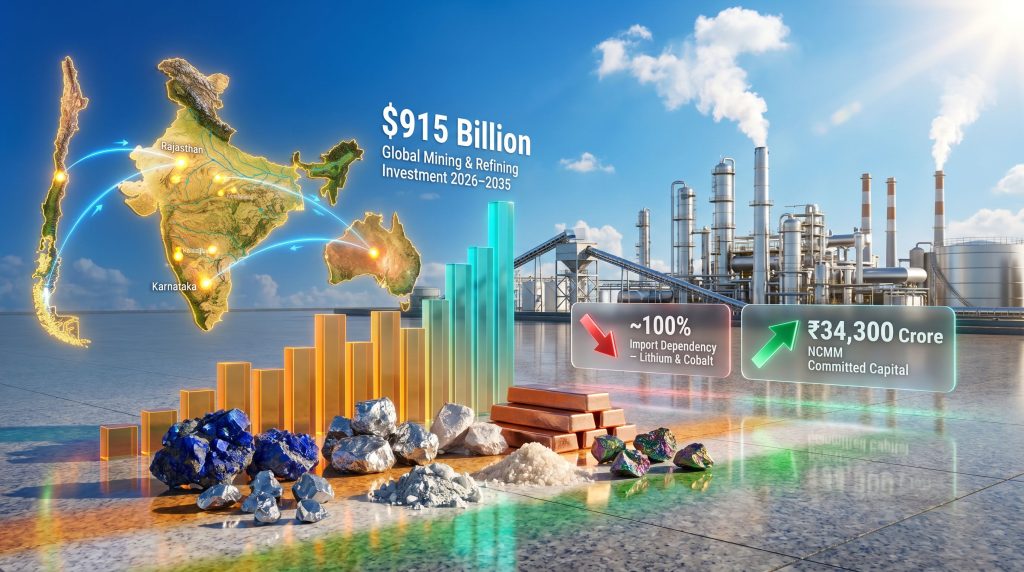
The technical requirements are staggering. The International Energy Agency estimates that approximately $915 billion in fresh global capital investment will be required for mining and refining activities between 2026 and 2035 under its Announced Pledges Scenario. That single figure captures the cumulative pressure being placed on global capital markets to fund the physical backbone of decarbonisation. For emerging economies still building the institutional frameworks needed to attract private investment at scale, that number is not an opportunity statement. It is a warning about how far behind the financing reality currently sits relative to the physical demand curve.
India sits at the intersection of three compounding demand vectors that make its mineral financing challenge uniquely acute. Its renewable energy deployment targets, electric vehicle adoption trajectory, and electronics manufacturing expansion ambitions are each capital-intensive in isolation. Together, they create a triangulated demand for lithium, cobalt, nickel, copper, and rare earth elements that India's domestic supply chains are structurally incapable of meeting without a fundamental transformation in how critical mineral projects are financed and developed. The broader context of critical minerals energy transition pressures makes this challenge even more urgent for policymakers to address.
When big ASX news breaks, our subscribers know first
Why Private Capital Refuses to Enter India's Critical Minerals Sector
Understanding India's critical minerals financing gap requires looking past the policy headlines and into the mechanics of how private capital actually makes investment decisions. Four structural barriers consistently emerge as the primary deterrents to large-scale private participation.
The Four Barriers That Suppress Investment
-
Price volatility across commodity cycles: Lithium carbonate equivalent prices moved from roughly $6,000 per tonne in 2020 to over $78,000 per tonne in 2022, then collapsed to the $12,000-$20,000 range by 2024-2025. For investors deploying capital into projects with 7-15 year development timelines, this kind of price swing makes conventional financial modelling essentially unreliable.
-
Gestation period mismatch: Mining projects from exploration approval to first commercial production typically require between seven and fifteen years. Most institutional capital operates on five-to-seven-year deployment horizons. This temporal misalignment is not a regulatory problem that policy can easily solve. It is a geological and engineering reality that demands purpose-built financing instruments.
-
Front-loaded capital intensity: Small-scale exploration programmes require $50-200 million in upfront spending before a single tonne of commercial-grade ore is confirmed. Mid-scale mining operations demand $500 million to $2 billion before revenue generation begins. These front-loaded cost structures are prohibitive without risk-sharing mechanisms that simply do not exist in sufficient form in India today.
-
Regulatory pathway uncertainty: India's mining approvals span multiple central and state government bodies simultaneously, including the Ministry of Mines, the Ministry of Environment, state mining departments, and district administrations. Each jurisdiction operates with distinct timelines, approval criteria, and discretionary authority. Studies on mining permitting in comparable jurisdictions suggest this fragmentation adds one to three years to project timelines compared to systems with clearer, more consolidated approval pathways.
A briefing note published by the Institute for Energy Economics and Financial Analysis (IEEFA) and Climate and Sustainability Initiative (CSI) in May 2026 concluded that the absence of risk-sharing capital, midstream capital expenditure support, and integration with manufacturing incentives is systematically limiting private investment. According to Saloni Sachdeva Michael, Lead Energy Specialist for India Clean Energy Transition at IEEFA, this is not a marginal constraint. It is a structural condition that actively suppresses capital flows across the entire supply chain.
The Midstream Processing Bottleneck: India's Most Underappreciated Vulnerability
Upstream exploration progress is largely meaningless without corresponding refining and processing capacity to convert extracted ore into usable industrial inputs. Yet midstream investment faces an additional layer of deterrents that exploration-stage projects do not encounter.
Kaira Rakheja, Energy Analyst at IEEFA, has identified feedstock uncertainty, price volatility, and global overcapacity as the three converging forces that actively discourage investment in refining and processing. Each element reinforces the others in a circular pattern that is particularly difficult to break without government intervention.
The feedstock problem operates as a classic coordination failure. Refinery investors require guaranteed mineral supply before committing capital. Mining investors require guaranteed offtake agreements with refiners before committing capital. Neither party can move first without bearing disproportionate risk. This chicken-and-egg dynamic has paralysed midstream investment across multiple mineral categories simultaneously.
Compounding this is China's dominant position in global refining capacity. China controls approximately 55-60% of cobalt refining capacity globally and holds significant positions across nickel, lithium, and rare earth element processing. The resulting global overcapacity in these segments means Indian refining investments would enter markets with structurally depressed margins, making them economically marginal without domestic policy support.
India's Import Dependency: Quantifying the Strategic Exposure
The depth of India's reliance on imported critical minerals represents one of its most significant long-term strategic vulnerabilities. The scale of this dependency across key minerals is detailed below.
| Mineral | Import Dependency | Primary Source Concentration | Strategic End-Uses |
|---|---|---|---|
| Lithium | ~100% | Australia, Chile, China (processed) | EV batteries, grid storage |
| Cobalt | ~100% | DRC mined, China refined | EV batteries, aerospace |
| Nickel | Near-total | Indonesia, China | Battery cathodes, stainless steel |
| Copper | Rising | Chile, China | Power grids, EVs, electronics |
| Rare Earth Elements | High | China (~60%+ of global supply) | Defence, wind turbines, electronics |
What makes this dependency particularly dangerous is not the import reliance itself but the concentration of processing and refining in a single country. Even where raw minerals originate from geopolitically diverse sources like Australia or Chile, the refining stage frequently routes through Chinese facilities before reaching Indian manufacturers. India's supply chain exposure is therefore not simply a mining problem. It is a processing and logistics problem that sits several stages downstream from where most domestic policy attention is focused.
India's untapped domestic reserve potential adds strategic irony to this situation. Reliable estimates suggest only around 20% of India's geological wealth has been systematically explored, leaving vast portions of the subcontinent without the baseline geological data needed to attract exploration investment. Known reserve positions include approximately 163.9 million tonnes of copper ore and 44.9 million tonnes of cobalt ore, deposits that remain largely undeveloped due to the same financing barriers described above. Furthermore, the critical minerals demand surge anticipated over the next decade will only intensify pressure on India to unlock these dormant resources.
Decoding the National Critical Mineral Mission: Architecture and Shortfalls
The National Critical Mineral Mission (NCMM) represents the most comprehensive policy response India has deployed to address its mineral supply chain vulnerabilities. Its financing architecture combines direct government spending with public sector undertaking (PSU) capital deployment.
The NCMM's Financial Structure
- Total committed capital: ₹34,300 crore (approximately US$4 billion)
- Direct government expenditure: ₹16,300 crore (~US$1.9 billion)
- PSU-channelled capital: ₹18,000 crore (~US$2.1 billion)
- Mandate scope: exploration, overseas asset acquisition, processing capacity, and recycling infrastructure
Recent amendments to the Mines and Minerals (Development and Regulation) Act have created new mechanisms for private participation, including exploration licensing in states such as Karnataka and Rajasthan and the auctioning of 20 critical mineral blocks to private bidders. These regulatory changes represent meaningful progress toward market activation, though implementation quality varies significantly across state jurisdictions.
Where the Mission Falls Short
Despite its scale, the NCMM contains structural gaps that limit its capacity to mobilise private capital at the velocity India's clean energy timeline requires.
The NCMM addresses exploration and overseas acquisitions effectively, but its structural linkage between mineral extraction and domestic manufacturing incentives remains underdeveloped, limiting its capacity to catalyse private sector investment at the scale required.
The most consequential gap is the weak integration between the NCMM and India's Production-Linked Incentive (PLI) schemes covering batteries, electric vehicles, solar modules, and electronics. These two policy pillars operate largely in parallel rather than in coordination, creating a situation where manufacturing demand incentives and upstream mineral supply incentives do not reinforce each other. A battery manufacturer benefiting from PLI scheme incentives has no corresponding policy mechanism linking their procurement decisions to domestically mined or processed minerals.
Additional gaps identified in the IEEFA-CSI analysis include fragmented research and development linkages between academic institutions, PSUs, and private industry, and the absence of a coherent domestic processing and refining financing strategy. India currently lacks the integrated capital instruments that would simultaneously incentivise mining activity and the downstream processing capacity needed to convert that output into battery-grade materials.
De-Risking Instruments: What Exists and What Is Missing
Several risk-sharing mechanisms are either operational or under active consideration for deployment in India's critical minerals sector. Understanding their mechanics is essential for evaluating how effectively they address the underlying investment deterrents.
The Risk-Sharing Toolkit
-
Government loan guarantees and output purchase agreements: Floor-price purchase commitments neutralise the commodity price volatility problem for project developers by providing a revenue floor that allows financial modelling to proceed. These instruments are structurally similar to power purchase agreements in the renewable energy sector, which successfully unlocked large-scale private investment.
-
EXIM Bank specialised credit lines: Proposed financing instruments targeting overseas mineral acquisition and processing project development would extend India's capital reach beyond its domestic resource base, supporting KABIL's international acquisition strategy.
-
PSU anchor investment: Entities such as Coal India functioning as balance-sheet anchors in upstream mining ventures provide regulatory navigation capabilities and risk absorption capacity that smaller private players cannot replicate independently.
-
National Mineral Exploration Trust (NMET): This existing funding mechanism supports geological survey and early-stage exploration activities, addressing the pre-commercial risk phase that deters private capital most acutely.
Innovative critical minerals financing models developed in other jurisdictions offer instructive templates for how India might structure blended finance vehicles that combine public and private capital more effectively.
Khanij Bidesh India Limited: Overseas Strategy and Its Limits
Khanij Bidesh India Limited (KABIL) serves as India's designated vehicle for securing strategic mineral access through foreign asset acquisition. The entity has pursued active engagement with resource-rich nations, including Chile for lithium and copper assets, as a supply diversification strategy operating alongside bilateral diplomatic frameworks.
The overseas acquisition model addresses supply concentration risk but creates a dependency of its own. Minerals acquired through KABIL's international operations still require processing and refining before they can serve Indian manufacturing demand. Without corresponding domestic processing capacity, overseas acquisitions shift the supply bottleneck rather than eliminating it. India's lithium supply strategy in particular illustrates how overseas resource access must be paired with domestic processing investment to deliver genuine supply chain security.
A Four-Pillar Financing Framework for the Full Value Chain
Analysts and policymakers have converged on a multi-pillar approach as the necessary architecture for India's critical minerals financing challenge. Each pillar addresses a distinct segment of the supply chain where current financing instruments fall short.
Pillar 1: Upstream Exploration Financing
Targeting large non-financial corporations with strong balance sheets as anchor investors in exploration-stage projects, combined with government co-investment structures that absorb geological risk during pre-revenue phases. Expanding NMET funding to accelerate systematic geological mapping across the estimated 80% of India's subsoil wealth that remains unsurveyed.
Pillar 2: Midstream Processing and Refining Capital
Dedicated capital expenditure support instruments for refining and processing infrastructure, integrated within existing PLI scheme architecture. Technology transfer partnerships with advanced mineral economies such as Australia, Canada, and Finland would help bridge processing capability gaps without requiring India to develop expertise from first principles.
Pillar 3: Downstream Manufacturing Integration
Creating demand-side certainty for domestic mineral processors through long-term offtake agreements with Indian battery manufacturers, EV producers, solar module assemblers, and electronics fabricators. ESG compliance frameworks embedded as financing eligibility prerequisites to reduce supply chain risk exposure and lower the cost of capital for compliant projects.
Pillar 4: International Partnerships and Strategic Stockpiling
Bilateral mineral security agreements with Chile, Australia, and African resource nations combined with strategic stockpiling mechanisms to buffer against supply disruptions. Rati Verma, Research Consultant at CSI, has observed that the high concentration of critical mineral supply chains in a small number of countries, primarily China, means diversification of sources and augmentation of domestic manufacturing capabilities must proceed simultaneously rather than sequentially. Indian investment in lithium through bilateral partnerships with Australia is increasingly seen as one of the more viable near-term pathways for supply chain diversification.
The next major ASX story will hit our subscribers first
ESG Integration: From Optional Add-On to Financing Prerequisite
The role of Environmental, Social and Governance factors in critical minerals financing has shifted fundamentally over the past five years. What was previously a reputational consideration for large institutional investors has become an embedded requirement in lending criteria across a growing number of financial institutions.
Emissions intensity benchmarks are increasingly appearing as explicit conditions in project finance term sheets for mining developments. Conflict-linked sourcing risks function as deal-breakers for multilateral development bank financing. Major EV and battery manufacturers are also imposing supply chain transparency requirements on their upstream suppliers, creating downstream commercial pressure that reinforces the financial system's ESG demands.
For India's critical minerals sector, this shift carries a practical implication: projects that embed robust ESG frameworks from the outset will access capital at meaningfully lower costs than those that treat compliance as an afterthought. The risk premium demanded by private capital for ESG-non-compliant projects effectively adds 100-200 basis points to financing costs, an additional barrier that is entirely avoidable with appropriate project design.
Centre-State Coordination: The Institutional Bottleneck Nobody Talks About
Mining regulation in India spans both central and state jurisdictions, creating layered approval processes that extend project timelines and introduce execution risk that sophisticated investors price heavily. Royalty structures, land acquisition frameworks, and environmental compliance processes vary significantly across state boundaries, making it impossible for project developers to apply consistent financial models across India's mineral-rich regions.
Labanya Prakash Jena, Director of CSI, has emphasised that international experience consistently demonstrates Centre-state coordination frameworks with clearly defined institutional roles and shared revenue models are foundational to attracting large-scale private mining investment. Countries including Canada, Australia, and Chile have each developed federal-provincial or central-regional coordination mechanisms that provide project developers with predictable timelines and transparent approval criteria.
India's current approach lacks both a unified critical minerals project clearance authority and shared project pipelines between Union ministries and state mining departments. This fragmentation does not merely slow individual projects. It prevents the sector-level investor confidence needed to attract the sustained, long-duration capital that critical minerals development requires. The mobilising capital for India's minerals challenge, as documented by IEEFA, underscores how institutional reform is just as important as financial instrument design in unlocking investment flows.
Key Takeaways: India's Critical Minerals Financing Landscape
| Dimension | Current Status | Critical Gap |
|---|---|---|
| Policy Framework | NCMM operational, ₹34,300 crore committed | Weak PLI integration, limited midstream focus |
| Import Dependency | ~100% for lithium and cobalt | No near-term domestic substitution at scale |
| Domestic Reserves | ~20% of geological wealth explored | Exploration financing insufficient |
| Private Investment | Constrained by price volatility and gestation risk | No structured risk-sharing instruments at scale |
| Overseas Acquisitions | KABIL active in Chile and Argentina | Processing capacity to utilise acquired minerals lacking |
| Centre-State Coordination | Fragmented institutional roles | No unified clearance or pipeline framework |
| ESG Compliance | Emerging financing requirement | Not yet embedded in eligibility criteria |
Frequently Asked Questions: India Critical Minerals Financing
What is the National Critical Mineral Mission (NCMM)?
The NCMM is India's primary policy framework for developing domestic critical mineral supply chains, backed by approximately ₹34,300 crore (~US$4 billion) in committed public capital. It covers exploration, overseas acquisitions, processing, and recycling, though significant gaps remain in its integration with manufacturing incentive schemes.
Why is India critical minerals financing so difficult to secure from private investors?
A combination of commodity price volatility, project gestation periods of seven to fifteen years, high front-loaded capital requirements, regulatory uncertainty across state jurisdictions, and the absence of structured risk-sharing instruments makes these projects unattractive to conventional private capital without government de-risking support.
What role does KABIL play in India's critical minerals strategy?
Khanij Bidesh India Limited is the government-mandated entity responsible for securing critical mineral supplies through overseas exploration and strategic asset acquisitions, with active engagements targeting lithium and cobalt in countries including Chile and Argentina.
How much global investment is needed for critical minerals mining and refining?
The International Energy Agency estimates approximately $915 billion in new global capital investment will be required for mining and refining activities between 2026 and 2035 under its Announced Pledges Scenario.
What are the biggest gaps in India's critical minerals financing strategy?
Key gaps include weak PLI-NCMM integration, inadequate midstream processing financing, fragmented Centre-state coordination, limited risk-sharing capital instruments, and underdeveloped research and development linkages between academia, public-sector units, and private industry.
This article contains forward-looking analysis and references to policy frameworks, investment projections, and market conditions. Readers should note that mineral price forecasts, investment timelines, and policy outcomes are subject to material uncertainty. Nothing in this article constitutes financial or investment advice. Independent verification of all data points is recommended before making investment or policy decisions.
Want to Track ASX Mineral Discoveries Driving the Clean Energy Transition?
Discovery Alert's proprietary Discovery IQ model delivers real-time alerts on significant ASX mineral discoveries — instantly converting complex geological data into actionable investment insights for both short-term traders and long-term investors. Explore how historic mineral discoveries have generated substantial returns on Discovery Alert's dedicated discoveries page, and begin your 14-day free trial today to position yourself ahead of the market.