June 20, 2026
The Private Equity Race Into Japan's Industrial Core
Mature industrial economies rarely generate the kind of acquisition opportunities that combine defensive market positioning, dual-use manufacturing exposure, and regional growth optionality in a single transaction. Yet Japan's ongoing corporate restructuring cycle is producing exactly these conditions at a pace not seen in two decades. Legacy conglomerates are systematically shedding non-core subsidiaries, and the assets coming to market carry decades of operational refinement, embedded customer relationships, and balance sheets that private equity return models are well-suited to optimise.
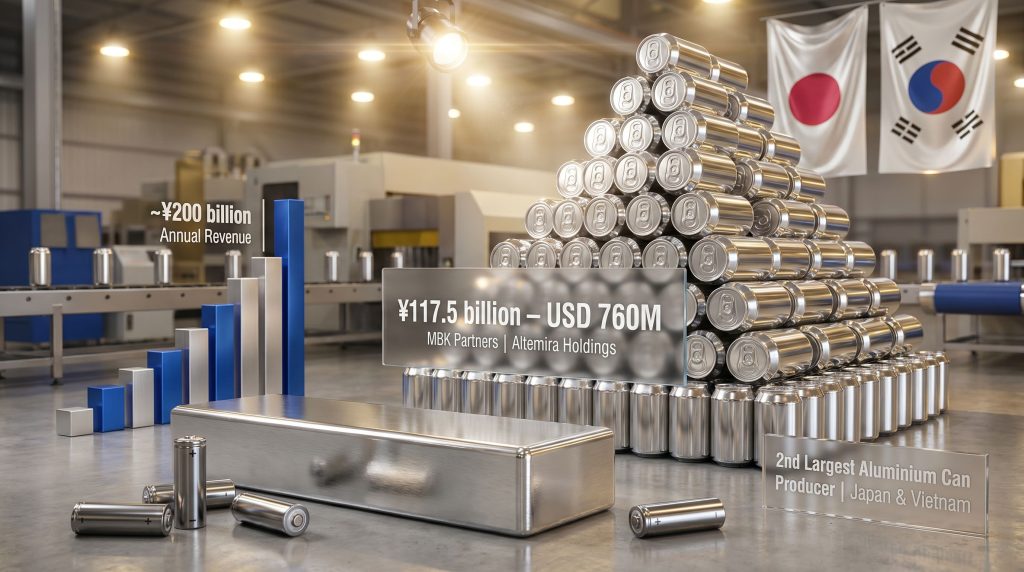
Against this backdrop, MBK Partners to acquire Altemira is among the most structurally interesting transactions to emerge from Japan's manufacturing sector in recent years. At approximately ¥117.5 billion (USD 760 million) in equity value, the deal is not simply a packaging industry play. It sits at the intersection of consumer packaging, battery raw materials, regional growth markets, and Japan's increasingly rigorous foreign investment framework — a combination that makes it worth examining from multiple analytical angles.
When big ASX news breaks, our subscribers know first
Why Japan's Industrial Divestiture Cycle Is Creating Private Equity Opportunity
The Structural Forces Behind Corporate Carve-Outs
Japan's conglomerate model, which sustained decades of cross-shareholding arrangements and diversified subsidiary structures, has been under sustained pressure from governance reform advocates and institutional investors. The Tokyo Stock Exchange's campaign to address companies trading below book value has pushed listed groups to articulate credible capital allocation strategies, and for many, that means shedding industrial subsidiaries that lack strategic coherence with the parent's core business.
The result is a pipeline of divestiture opportunities that foreign private equity firms are increasingly well-positioned to capture. Unlike strategic acquirers, which face antitrust scrutiny and integration complexity, financial sponsors offer sellers a cleaner transaction structure, deal certainty, and the ability to retain existing management. For sellers navigating complex regulatory pre-screening requirements, counterparty credibility matters enormously. Furthermore, mining private equity dynamics across the broader materials sector offer useful parallels for understanding how financial sponsors approach these industrial carve-outs.
Aluminium Packaging as a Defensive Growth Asset
Aluminium beverage cans occupy a specific and durable position within the broader packaging industry. They are infinitely recyclable, increasingly preferred by major global beverage brands committed to sustainability targets, and structurally advantaged over single-use plastics in markets where regulatory pressure on plastic packaging is accelerating. Across Asia-Pacific, the shift away from returnable glass and multi-use plastic containers toward aluminium formats has been a steady, long-term trend rather than a cyclical one.
This creates exactly the type of revenue profile that private equity firms value: predictable, contract-supported cash flows with defensible market positions and meaningful barriers to new entrant competition. Building a greenfield aluminium can manufacturing operation in a mature market requires substantial capital investment, established raw material supply chains, and long-term customer contracts that incumbents have typically locked in over years of commercial relationship-building.
Vietnam's expanding consumer goods market adds an additional dimension to this thesis. Rising middle-class consumption, rapid urbanisation, and accelerating shifts in packaging preferences across Southeast Asia extend the regional growth runway meaningfully beyond what Japan's more mature domestic market alone could provide.
What Altemira Holdings Is and Why Its Manufacturing Profile Matters
Formation from Two Industrial Giants
Altemira Holdings came into existence in 2022 through the consolidation of aluminium manufacturing divisions from two of Japan's most established industrial groups: Showa Denko (subsequently rebranded as Resonac Holdings) and Mitsubishi Materials. The merger combined complementary capabilities across consumer packaging and industrial components, creating a vertically integrated manufacturer with meaningful scale in both its primary end markets.
Apollo Global Management subsequently acquired the combined entity, holding it as a portfolio asset through a value optimisation period before initiating the sale process that ultimately resulted in the MBK transaction. In addition, top aluminium companies globally have been consolidating their positions in similar ways, reflecting broader sectoral pressures.
Altemira's Market Position and Financial Scale
| Metric | Detail |
|---|---|
| Market Position (Japan) | Second-largest aluminium can producer by market share |
| Market Position (Vietnam) | Second-largest aluminium can producer by market share |
| Annual Revenue (Estimated) | ~¥200 billion (approx. USD 1.29 billion) |
| Key Product Categories | Aluminium beverage cans, lithium-ion battery components, industrial aluminium parts |
| Year Established (Current Form) | 2022 (via consolidation of Showa Denko and Mitsubishi Materials aluminium divisions) |
| Equity Value (Acquisition Price) | ~¥117.5 billion (approx. USD 760 million) |
The implied revenue multiple of approximately 0.59x (equity value of ¥117.5 billion against revenues of ¥200 billion) is consistent with how capital-intensive mature manufacturers are typically priced. In this valuation framework, EBITDA margins, asset replacement costs, and cash conversion efficiency carry more weight than top-line revenue growth when buyers and sellers converge on a price.
The Battery Materials Dimension: More Than a Packaging Business
A portion of Altemira's manufacturing output covers aluminium components used in lithium-ion battery production. This is a secondary product line relative to the company's core beverage can operations, but it carries disproportionate strategic significance for several reasons.
First, it anchors Altemira within Japan's economically sensitive industrial classifications, which has direct implications for any foreign acquisition attempt. Second, it introduces a forward-looking demand narrative as electric vehicle adoption across Asia accelerates through the late 2020s. Third, it complicates the otherwise straightforward packaging sector valuation by layering in the growth optionality of battery materials exposure.
The dual-use manufacturing profile of companies like Altemira illustrates a broader dynamic in Japan's industrial sector: assets that span commercially mature operations and strategically sensitive advanced materials simultaneously attract premium investor interest and elevated regulatory scrutiny. These two forces do not cancel each other out; they create a more complex, and potentially more rewarding, acquisition environment for sponsors with the expertise to navigate both dimensions.
Deal Structure: How the MBK Partners–Altemira Transaction Is Constructed
Transaction Parameters at a Glance
| Deal Parameter | Detail |
|---|---|
| Acquirer | MBK Partners (Asian private equity firm, Seoul-based) |
| Seller | Apollo Global Management (U.S.-based investment firm) |
| Acquisition Structure | 100% equity purchase via Share Purchase Agreement |
| Equity Value | ~¥117.5 billion (approx. USD 760 million) |
| Total Transaction Value (Including Debt) | ~¥130 billion (approx. USD 840 million) |
| Implied Debt Assumption | ~¥12.5 billion (approx. USD 80 million) |
| Expected Deal Closing | End of May 2026 |
Understanding the Ownership Transition
The transaction is structured as a full 100% equity acquisition rather than a partial stake or co-investment arrangement. This distinction matters operationally: MBK will hold complete strategic and operational control over Altemira from the moment the transaction closes, with no co-investor veto rights or shared governance obligations to manage.
The compressed timeline from signing to anticipated close suggests that pre-deal due diligence was substantially complete before the share purchase agreement was executed, and that both parties had aligned on commercial terms with sufficient confidence to move quickly. In the context of Japanese industrial transactions, where regulatory review timelines can introduce meaningful uncertainty, this level of transaction readiness reflects sophisticated deal preparation on both sides.
The implied debt assumption of approximately ¥12.5 billion (USD 80 million) against an equity value of ¥117.5 billion suggests a conservatively structured balance sheet with a debt-to-total-capitalisation ratio of approximately 9.6%. This relatively light leverage profile is consistent with the type of capital-intensive manufacturing business where asset-heavy balance sheets are already carried at the operational level, and where additional financial leverage would reduce strategic flexibility.
Navigating Japan's Foreign Investment Screening Framework
How FEFTA Works and Why It Applied to This Deal
Japan's Foreign Exchange and Foreign Trade Act establishes a prior notification requirement for foreign investors seeking to acquire controlling stakes in domestic companies operating across designated core sectors. The framework spans defence-adjacent manufacturing, critical infrastructure, telecommunications, and advanced materials production, with the Ministry of Finance administering the review process in coordination with the relevant sector ministries.
For Altemira, the trigger was the company's production of aluminium components used in lithium-ion batteries. Despite this being a secondary product line within a predominantly consumer packaging business, the battery materials connection was sufficient to activate the mandatory prior review requirement. Consequently, understanding the critical minerals supply chain context helps explain why regulators have become increasingly attentive to transactions of this nature.
Key features of the FEFTA review process:
- Prior notification required before any foreign acquisition of a controlling interest in a core sector company
- Review administered by Japan's Ministry of Finance in coordination with relevant sector ministries
- Approval timelines typically range from several weeks to several months depending on deal complexity and strategic sensitivity
- Outcome options include unconditional approval, conditional approval with operational restrictions, or direction to withdraw
- Battery materials, semiconductors, and advanced manufacturing are among the expanding categories subject to core sector designation
The Makino Contrast: A Practical Framework for Regulatory Risk Assessment
The distinction between the Altemira approval and the concurrent Makino Milling outcome provides a practical lens through which to assess where Japan's regulatory framework draws its lines.
Japanese regulators directed MBK Partners to withdraw its tender offer for Makino Milling Machine Co., a manufacturer of high-precision machine tools whose products carry potential dual-use applications in defence-related manufacturing contexts. The decision reflected the view that the primary output of the business, rather than its incidental applications, posed unacceptable national security risks under foreign exchange law. The Altemira approval, by contrast, reflects a regulatory assessment that a commercially oriented aluminium packaging manufacturer with secondary battery materials operations sits in an approvable category with appropriate pre-screening engagement.
This distinction offers a practical framework for private equity firms evaluating future Japanese industrial acquisitions:
- Primary business purpose carries more regulatory weight than secondary product applications when assessors classify sensitivity
- Consumer goods manufacturing with incidental advanced materials exposure is generally navigable within the FEFTA framework
- Defence-adjacent precision manufacturing with dual-use potential faces a materially higher regulatory barrier, often insurmountable regardless of commercial rationale
- Eight to ten weeks should be treated as the baseline regulatory review window for approvable transactions in the current environment
- Pre-screening engagement with relevant ministries before formal notification may reduce review timelines and increase outcome predictability
The Altemira transaction received regulatory approval approximately two months after initial FEFTA submission, suggesting that coordinating ministry alignment was achievable within a standard review cycle for this type of commercially oriented acquisition. Reporting from Nikkei Asia confirms that MBK's regulatory preparation was a key factor in securing a timely outcome.
MBK Partners' Strategic Plan: Roll-Up, Expansion, and IPO Optionality
MBK Partners: Firm Profile and Investment Philosophy
MBK Partners operates as one of Asia's largest independent private equity firms, with its primary investment focus concentrated across Japan, South Korea, and Greater China. The firm's portfolio strategy is built around operational improvement, market consolidation, and value creation within established industrial and consumer-oriented businesses rather than early-stage or venture-oriented investments.
This acquisition profile makes Altemira a natural strategic fit: a near-duopoly manufacturer with stable cash generation, regional growth optionality, and a clear operational improvement pathway under focused private equity ownership.
The Roll-Up Strategy and What It Means for Japan's Aluminium Sector
Following the Altemira acquisition, MBK is reported to be pursuing a roll-up strategy targeting complementary businesses within Japan's aluminium and adjacent industrial manufacturing sectors. These industry consolidation trends are reshaping how capital is deployed across resource-intensive manufacturing globally. Roll-up strategies in mature capital-intensive industries typically generate value through several mechanisms:
- Procurement consolidation: Combined purchasing volumes for raw materials (aluminium sheet, coatings, packaging components) generate pricing leverage with suppliers
- Logistics rationalisation: Overlapping distribution networks and customer service infrastructure can be streamlined across acquired entities
- Production capacity optimisation: Consolidating manufacturing capacity across facilities reduces per-unit fixed cost burdens
- Customer contract expansion: Combined market positions strengthen negotiating leverage with major beverage brand customers
- Shared R&D and product development: Technical capabilities in battery materials components could be enhanced through scale
Vietnam as a Regional Growth Platform
Altemira's existing second-place market position in Vietnam's aluminium can sector provides MBK with an operational foundation rather than a greenfield starting point for Southeast Asian expansion. Vietnam's consumer goods sector is expanding on multiple structural drivers simultaneously: a growing middle class, accelerating urbanisation, and ongoing packaging format shifts away from alternatives toward aluminium.
MBK's regional expertise across Asian markets positions the firm to allocate targeted capital investment toward the Vietnam operation with greater confidence than a Western financial sponsor lacking equivalent regional experience.
IPO Optionality as the Long-Term Exit Pathway
Industry sources suggest that MBK Partners is evaluating a potential future IPO for Altemira following a period of operational improvement and portfolio expansion through roll-up acquisitions. An IPO exit would require Altemira to demonstrate several years of sustained revenue growth, improving margins, and a compelling equity narrative for public market investors.
The combination of factors working in favour of this pathway includes:
- Established second-place market positions in two markets (Japan and Vietnam)
- Battery materials exposure providing a growth technology narrative alongside stable packaging cash flows
- Roll-up scale creating a more compelling public market story than the standalone business
- MBK's typical investment horizon of five to seven years allowing sufficient time for operational enhancement before a public offering
Disclaimer: IPO timelines, valuations, and market conditions are subject to significant uncertainty. Any discussion of potential future exits represents speculative analysis based on industry norms and reported strategic intent, not confirmed plans or guaranteed outcomes.
The next major ASX story will hit our subscribers first
What This Transaction Reveals About Japan's Evolving M&A Landscape
Japan at Peak Divestiture Activity
Japan's M&A market has reached its highest activity level in approximately two decades, underpinned by corporate governance reforms that have fundamentally changed how listed companies are assessed by institutional investors. The Tokyo Stock Exchange's sustained focus on companies trading below book value has accelerated a structural shift: diversified conglomerates that once held non-core subsidiaries indefinitely are now under genuine pressure to either improve returns from those assets or sell them to buyers better positioned to generate value.
For foreign private equity firms, this creates a compelling acquisition environment characterised by:
- High-quality asset availability from credible sellers with legitimate commercial rationale for divesting
- Motivated counterparties seeking clean, certain transactions rather than complex strategic mergers
- Transparent deal structures as Japanese corporate governance standards have risen toward international norms
- Regulatory frameworks that, while more rigorous than a decade ago, have become well-understood by experienced market participants
The Competitive Advantage of Regulatory Navigation Expertise
Perhaps the most important signal from MBK Partners to acquire Altemira for future Japanese industrial M&A is that regulatory navigation has become a core deal competency rather than a peripheral consideration. The ability to anticipate FEFTA review triggers, engage with relevant ministries proactively, and structure transactions to maximise approval probability has become a meaningful competitive differentiator between private equity firms active in Japan.
The growing scope of Japan's core sector designations, now expanding to encompass battery materials, semiconductors, and advanced manufacturing categories, means that regulatory pre-screening is a standard deal structuring consideration for any acquisition of a Japanese industrial company operating beyond purely conventional manufacturing applications.
Firms that have successfully navigated FEFTA reviews, as MBK demonstrated with the Altemira approval, carry a reputational and process advantage when competing for future Japanese industrial assets. Sellers value counterparties who can demonstrate both the regulatory expertise and the track record to close transactions in this environment. Coverage from the Seoul Economic Daily further highlights how regional financial media have positioned this outcome as a significant benchmark for cross-border deal-making in Asia.
Key Takeaways for Investors and Industry Observers
| Insight | Implication |
|---|---|
| Sub-1x revenue acquisition multiple | Reflects mature manufacturing pricing driven by EBITDA and asset costs, not growth multiples |
| FEFTA review cleared in ~8-10 weeks | Efficient outcome for complex cross-border deal; sets baseline timeline expectation |
| Makino blocked, Altemira approved | Primary business purpose determines regulatory sensitivity more than incidental product applications |
| Roll-up strategy signalled | Japanese aluminium sector consolidation likely to accelerate under MBK ownership |
| IPO pathway under evaluation | Suggests 5-7 year value creation horizon with public market exit as preferred outcome |
| Battery materials exposure retained | Adds technology growth narrative to core packaging cash flow profile |
MBK Partners to acquire Altemira is ultimately a case study in how sophisticated private equity execution, regulatory preparation, and regional market expertise combine to unlock value in Japan's complex industrial landscape. The deal's approval, its valuation logic, and MBK's stated strategic intent all point toward a broader consolidation of Japan's aluminium manufacturing sector that is likely to generate additional transaction activity in the years ahead. However, as with any transaction of this complexity, investors and industry observers should monitor how the roll-up strategy unfolds before drawing firm conclusions about sector-wide implications.
This article is intended for informational purposes only and does not constitute financial advice. All financial figures, deal parameters, and strategic assessments are based on publicly available reporting as of May 2026. Forward-looking statements regarding roll-up strategies, IPO timelines, and market expansion plans involve inherent uncertainty and should not be relied upon as indicators of future outcomes.
Want to Catch the Next Major ASX Mineral Discovery Before the Market Does?
Discovery Alert's proprietary Discovery IQ model delivers real-time alerts on significant ASX mineral discoveries, transforming complex geological and commodities data into actionable investment insights for both short-term traders and long-term investors. Explore Discovery Alert's dedicated discoveries page to understand how historic mineral discoveries have generated substantial returns — and begin your 14-day free trial to position yourself ahead of the broader market.