July 28, 2026
The Economics of Frontier Risk: Why Deepwater Exploration Demands a Different Policy Playbook
Every major deepwater oil province in the world required a specific inflection point before global capital arrived in meaningful volumes. In Guyana, it was ExxonMobil's landmark Liza discovery in 2015 that transformed an unexplored frontier into one of the most coveted acreage positions in the industry. In Brazil, it was Petrobras's willingness to absorb the first wave of pre-salt risk through state co-participation before international oil companies committed capital at scale.
In Mozambique, it was the gradual accumulation of seismic data quality that finally persuaded majors to move from desk studies to drill commitments. India has the geological endowment to join this list. What it has historically lacked is a policy mechanism capable of bridging the gap between prospective acreage and actual drilling activity. The proposed India deepwater oil exploration incentive package, formalised under the National Deepwater Exploration Mission known as Samudra Manthan, represents the most direct attempt yet to close that gap.
When big ASX news breaks, our subscribers know first
Why Global Capital Has Avoided India's Offshore Basins
The structural case for Indian deepwater exploration has existed for decades. India's offshore sedimentary basins, stretching across the Krishna-Godavari (KG) Basin on the eastern coast, the Mahanadi Basin further north, the Andaman arc, and the Kutch-Saurashtra province on the western shelf, collectively represent one of Asia's largest underexplored hydrocarbon frontiers.
Yet exploration activity has remained thin relative to the prospective area. The reasons are layered and compound one another in ways that make the investment case difficult to solve through any single policy instrument.
The core problem has always been cost against uncertainty. Drilling a single deepwater exploratory well in Indian waters costs between ₹1,000 crore and ₹1,200 crore, depending on water depth and subsurface complexity. Ultra-deepwater targets carry additional cost premiums of several hundred crore rupees per well. Against a backdrop of historically modest discovery rates in Indian frontier basins, these figures make the risk-adjusted arithmetic deeply unattractive for international oil companies with competing capital deployment options in more proven provinces.
Furthermore, global oil price volatility amplifies this risk calculus, as explorers must model returns across a wide range of commodity price scenarios before committing capital to frontier drilling programmes.
The comparison with peer markets is instructive:
| Country | Deepwater Basin | Key Catalyst for Investment |
|---|---|---|
| Brazil | Santos/Campos pre-salt | Petrobras state co-participation, proven giant fields |
| Guyana | Stabroek Block | ExxonMobil discovery de-risked basin at scale |
| Mozambique | Rovuma Basin | Multi-TCF gas discoveries attracted LNG majors |
| India | KG, Mahanadi, Andaman | Fragmented discoveries, limited IOC engagement |
This comparison underscores a critical insight: the issue is not geology, it is the absence of a bankable de-risking mechanism. India's deepwater basins have not been proven barren. They have simply never had the combination of data quality, fiscal certainty, and shared cost exposure that turns frontier acreage into drill commitments.
A Decade of Reforms That Missed the Core Barrier
India's upstream policy has not been static. The shift from the old Production Sharing Contract (PSC) regime to the Hydrocarbon Exploration and Licensing Policy (HELP) and subsequently the Open Acreage Licensing Programme (OALP) delivered genuine improvements: revenue-sharing models replaced cost recovery mechanisms, marketing and pricing freedoms were extended, and royalty rates for offshore blocks were reduced.
However, every one of these reforms operated on the same side of the ledger: the production phase. They improved what explorers could expect to earn after a commercial discovery. None of them reduced what explorers had to spend before knowing whether anything was there.
This is the structural flaw that Samudra Manthan is designed to correct. Earlier upstream reforms in India focused on improving fiscal terms post-discovery, but left the exploration-phase cost burden entirely with the explorer, making frontier drilling economically irrational in basins with low historical success rates.
The consequence was predictable. Explorers would acquire blocks, complete minimum seismic obligations, and then face a binary choice: drill an expensive well into a low-probability target, or surrender the block. Surrender became the rational economic decision. The policy framework punished inaction through minimum work programme (MWP) penalties, but those penalties were often less than the cost of a dry hole.
How the Samudra Manthan Incentive Structure Actually Works
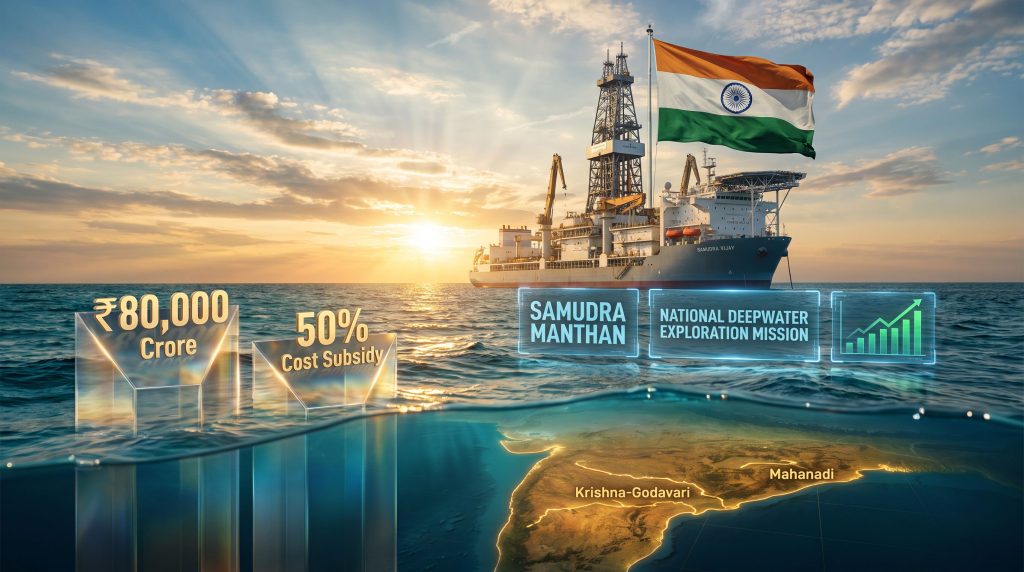
The proposed India deepwater oil exploration incentive package is built around a single transformative mechanism: the government will reimburse up to 50% of the drilling cost of deepwater exploratory wells. This is not a royalty holiday or a revenue-share adjustment. It is direct co-participation in exploration-phase expenditure, applied at the moment of maximum financial risk.
The government's ₹80,000 crore package to attract deepwater explorers includes the following components:
| Incentive Component | Detail |
|---|---|
| Total Package Size | ₹80,000 crore (~USD 9.5 billion) |
| Exploratory Well Cost Reimbursement | Up to 50% of verified drilling costs |
| Per-Well Cost Benchmark | ₹1,000-1,200 crore (deepwater); higher for ultra-deepwater |
| Cost Cap Mechanism | Per-well funding capped to prevent overrun exposure |
| 3D Seismic Co-Funding | Under consideration as a complementary measure |
| Eligible Participants | State-owned enterprises and private sector explorers |
The practical effect on project economics is significant. Consider a standard deepwater well costing ₹1,100 crore. Under the proposed framework, the government absorbs ₹550 crore, reducing the explorer's direct exposure to the same amount. This halving of dry-hole cost materially improves the internal rate of return (IRR) on exploration programmes, particularly when modelled across a portfolio of wells where success rates may sit in the 20-30% range typical of frontier deepwater basins globally.
The per-well funding cap is an important design feature. It protects public finances from open-ended liability while still providing enough financial relief to change the exploration decision calculus. An uncapped subsidy would create moral hazard incentives to allow costs to escalate. The cap preserves cost discipline while sharing downside risk.
The possible co-funding of 3D seismic surveys adds a second layer of de-risking that operates upstream of the drill decision itself. Better seismic data reduces dry-hole probability by improving subsurface imaging, meaning the incentive package could function both as a financial buffer and as a technical risk-reduction tool working in tandem.
The Parallel Data Quality Investment
Alongside the financial incentive framework, India has been investing in the quality of geological information available to explorers. The government has committed significant resources to acquiring new offshore 2D seismic coverage and is actively engaging private companies to reprocess legacy seismic datasets using advanced technologies.
These technologies include AI-assisted interpretation workflows and full-waveform inversion (FWI), a computationally intensive technique that dramatically improves the resolution of subsurface velocity models compared to conventional processing. FWI has been transformative in proving up deepwater prospects in other basins globally, particularly where legacy data was acquired under older acquisition geometries.
This data investment matters because it addresses a dimension of exploration risk that financial incentives alone cannot resolve. An explorer offered a 50% drilling cost subsidy will still decline to drill if the seismic data is too ambiguous to identify a credible target. Better data feeds directly into the decision to commit capital, creating what can be described as a data-to-drill pipeline that shortens the pathway from block award to spud.
Mapping the Full Policy Stack: Old Instruments vs. New
Understanding Samudra Manthan requires placing it within the broader architecture of Indian upstream policy. The table below illustrates how it differs from and complements existing instruments:
| Policy Instrument | Type | Stage Targeted | Key Limitation |
|---|---|---|---|
| HELP / OALP | Licensing reform | Pre-exploration | No cost relief for drilling phase |
| Revenue-sharing contracts | Fiscal | Post-discovery | Does not reduce upfront risk |
| Royalty concessions (deepwater) | Fiscal | Production phase | No exploration-phase impact |
| Marketing and pricing freedom | Commercial | Post-discovery | Irrelevant before a discovery |
| Samudra Manthan (proposed) | Direct cost subsidy | Exploration phase | Subject to cabinet approval |
When combined, the policy stack is more compelling than any single instrument in isolation. Reduced royalty rates lower the government take from production revenues, improving field economics once hydrocarbons are found. Marketing freedom allows explorers to optimise realised prices. Consequently, the Samudra Manthan cost-sharing mechanism reduces the financial exposure required to find out whether there is anything worth producing in the first place.
The layered approach mirrors successful international precedents. Norway's exploration refund scheme, under which the Norwegian government reimburses a substantial portion of exploration costs for companies without taxable income, is widely credited with maintaining a diverse and active exploration community in the Norwegian Continental Shelf across multiple commodity price cycles. Brazil's Petrobras co-participation model in the pre-salt auction rounds similarly demonstrated that sovereign risk-sharing can unlock investment that purely private-sector economics would not justify.
The Geological Case: What India's Basins Actually Offer
Key Deepwater Provinces and Their Prospectivity
India's deepwater geology presents both genuine opportunity and well-documented complexity. The Krishna-Godavari Basin on the east coast has attracted the most sustained attention, primarily because Reliance Industries' D6 block demonstrated that large hydrocarbon accumulations exist in Indian deepwater. However, the KG Basin experience also illustrated the challenges: reservoir quality variability, complex structural geology, and production performance that fell well short of initial projections created lasting caution among international operators.
The Mahanadi Basin, further north along the eastern coast, remains significantly less explored but has geological analogies with productive deepwater systems elsewhere in the Bay of Bengal. The Andaman region offers the deepest water depths and carries the highest geological uncertainty but also the most significant upside potential if structural traps prove to contain significant gas columns. According to Rystad Energy's analysis of Andaman deepwater prospectivity, this frontier area represents one of Asia's most compelling undrilled gas targets.
A critical and underappreciated aspect of Indian deepwater geology is the quality and vintage of available seismic data across different basins. In the KG Basin, multiple rounds of modern 3D acquisition have been conducted. In the Mahanadi and Andaman basins, data coverage is far sparser and largely comprises vintage 2D lines acquired under older acquisition parameters. This data asymmetry means that explorers assessing blocks outside the KG Basin are making decisions on substantially less subsurface information, amplifying perceived risk beyond what the underlying geology may actually warrant.
The 18 OALP Blocks: Strategic Timing
India is currently auctioning 18 deepwater and ultra-deepwater blocks through the Open Acreage Licensing Programme. The bid submission deadline has been extended to September 17, a timeline the government has deliberately aligned with the finalisation of the Samudra Manthan incentive package. The logic is straightforward: potential bidders need to understand the financial support framework before they can rationally price their participation.
This sequencing reflects a more sophisticated understanding of investor decision-making than earlier licensing rounds demonstrated. Offering blocks before the incentive terms are clear creates uncertainty that suppresses bidding. Finalising the support package in parallel with the auction process signals institutional seriousness and gives explorers the information they need to build credible investment cases.
Who Stands to Participate and What Changes for Them
International Oil Companies: The Target Audience
The primary audience for the Samudra Manthan framework is the community of international oil companies with genuine deepwater technical capability. This is a relatively small group globally. Companies including TotalEnergies, Shell, BP, Equinor, and ExxonMobil possess the proprietary drilling technology, subsurface expertise, and operational track records required to explore and develop deepwater fields efficiently.
Several of these companies have engaged with Indian licensing rounds in the past, only to withdraw or decline participation when their internal hurdle rate analysis found the economics insufficient. The 50% cost-sharing mechanism directly addresses this by reducing the capital at risk before a discovery is made. For an IOC modelling a portfolio of six to ten deepwater wells across a work programme, having government absorb half the drilling cost of each well materially changes the expected value of the entire programme.
ONGC as the Programme's First Mover
State-owned Oil and Natural Gas Corporation (ONGC) has already spudded its first deepwater exploratory well under the Samudra Manthan programme, a move that carries strategic significance beyond the technical act of drilling. When a state enterprise commits to being the first participant in a new framework, it sends a confidence signal to private and foreign investors that the programme is operationally active rather than aspirational.
ONGC's role as first mover also serves a data-generation function. Results from early wells, whether discoveries or dry holes, contribute to the basin-level understanding that makes subsequent investment decisions more informed. In frontier exploration, each well drilled adds information value to the entire acreage position, benefiting future explorers even when the individual well does not find commercial quantities.
Private Indian Explorers and Joint Venture Potential
The eligibility of private domestic companies alongside state-run entities creates conditions for a more competitive exploration landscape. Private Indian upstream companies can access the same cost-sharing mechanism as ONGC, potentially enabling joint ventures that pair Indian companies' local knowledge and regulatory experience with the deepwater technical capabilities of international partners. This JV model has proven effective in other frontier markets and could accelerate the pace of exploration activity beyond what either party could achieve independently.
The next major ASX story will hit our subscribers first
Risks That Incentives Cannot Fully Address
Policy Execution and Approval Uncertainty
The Samudra Manthan package remains subject to inter-ministerial consultation and cabinet approval. The terms described are proposals, not finalised policy. This distinction matters because the history of Indian upstream reform includes instances where announced frameworks were modified materially before implementation, eroding the credibility that is essential for sustaining investor confidence.
Financial incentives address the cost side of the exploration equation, but they cannot substitute for streamlined regulatory processes, competitive contract terms, and a proven track record of commercial discoveries. India's ability to retain investor interest beyond the first round of wells will depend on execution quality and institutional consistency, not subsidy size alone.
Exploration Success Rate Realities
Global deepwater exploration success rates in frontier basins typically range between 20% and 30%. India's historical deepwater discovery rate has been more modest. Even with subsidised drilling costs, a programme of ten wells could reasonably expect seven to eight dry holes. The government must be prepared to manage public expenditure risk across a sustained programme of subsidised exploration without political pressure forcing early exit from the framework.
Structural Barriers Beyond Cost
Several structural constraints sit outside the reach of financial incentives:
- Regulatory approval timelines for offshore exploration activities can extend programmes significantly
- Environmental clearance processes for deepwater operations add procedural complexity
- India lacks sufficient domestic deepwater drillship capacity, creating dependency on internationally contracted vessels whose day rates can vary substantially with global demand
- Skilled workforce depth for deepwater operations remains reliant on international contractors and expatriate expertise
- Logistics and supply chain infrastructure for deepwater support services is underdeveloped relative to mature deepwater provinces
These constraints do not negate the value of the incentive package, but they do set a ceiling on how quickly the programme can generate results even if investor interest materialises. For a broader perspective on the crude oil market overview, the crude oil market overview provides useful context on the pricing environment in which these exploration decisions are being made.
India's Energy Security Imperative: The Strategic Stakes
The Import Dependency Equation
India currently imports approximately 85-88% of its crude oil requirements, one of the highest import dependency ratios among major economies. Domestic crude production has been in structural decline for over a decade, a trend that accelerated as mature fields on the western continental shelf depleted without sufficient new discoveries to offset the decline.
The cost of this dependency extends beyond the import bill. India's current account deficit is substantially influenced by crude oil expenditure, and the country's economic exposure to oil market disruption risks is amplified considerably by the scale of that dependency.
India's current crude import basket is concentrated, with the Middle East historically accounting for roughly 60% of supply and Russia rising sharply to account for approximately 40% of volumes following the 2022-2024 period of redirected Russian export flows. This concentration creates strategic vulnerability that deepwater domestic production, at scale, could gradually address over multi-decade timeframes.
The Long-Cycle Reality of Deepwater Investment
It is essential to be clear-eyed about what Samudra Manthan can and cannot deliver in the near term. The lead time from exploration well to first deepwater production typically spans 8 to 12 years, encompassing appraisal drilling, concept selection, front-end engineering, fabrication, installation, and commissioning. No exploration programme initiated today will meaningfully reduce India's import dependency within this decade.
What deepwater exploration can deliver in the medium to long term is a pipeline of discovered resources that forms the foundation of future domestic supply growth. Gas discoveries, in particular, carry additional strategic value as India navigates its energy transition dynamics, since natural gas functions as a bridging fuel between coal dependence and renewable energy targets. Furthermore, the LNG supply outlook for the region suggests that any significant Indian deepwater gas discovery could find ready markets across Asia.
The ₹80,000 crore proposed under Samudra Manthan should therefore be evaluated as a long-cycle strategic investment rather than a near-term supply solution. If the programme enables two to three material deepwater discoveries over the next decade, the production revenues, import substitution value, and energy security benefit would substantially exceed the exploration subsidy cost.
Frequently Asked Questions
What is the Samudra Manthan mission?
Samudra Manthan, translating to the churning of the ocean, is India's National Deepwater Exploration Mission. It is administered by the Ministry of Petroleum and Natural Gas and aims to accelerate offshore hydrocarbon discovery through direct financial participation in exploration-phase drilling costs, with the government proposing to reimburse up to 50% of individual exploratory well costs.
How large is the proposed India deepwater oil exploration incentive package?
The total proposed package is valued at approximately ₹80,000 crore, equivalent to roughly USD 9.5 billion, designed to cover cost-sharing across a sustained programme of deepwater exploratory drilling.
What does a deepwater well cost in Indian waters?
A standard deepwater exploratory well in Indian offshore basins costs between ₹1,000 crore and ₹1,200 crore, depending on water depth and geological complexity. Ultra-deepwater wells carry additional cost premiums of several hundred crore rupees above this benchmark.
How is Samudra Manthan different from OALP and HELP?
OALP and HELP reformed licensing terms and post-discovery fiscal structures. Samudra Manthan directly co-funds exploration-phase expenditure at the point of maximum financial risk, before any discovery is confirmed. This distinction makes it structurally different from all previous Indian upstream reform instruments.
When will the incentive package be finalised?
The package is under inter-ministerial review as of mid-2026. The government has indicated its intention to finalise the framework before the OALP bid deadline of September 17, 2026, though final terms remain contingent on cabinet approval and may be adjusted during the consultation process.
Who is eligible to access the Samudra Manthan subsidies?
Both state-owned enterprises such as ONGC and private sector explorers are eligible to access the proposed cost-sharing mechanism, making this one of the broadest participation frameworks India has introduced for upstream exploration support.
This article contains forward-looking statements, projections, and analysis based on policy proposals that have not yet received final cabinet approval. The terms of the India deepwater oil exploration incentive package may change materially before implementation. Nothing in this article constitutes investment advice. Readers should conduct independent due diligence and consult qualified financial advisers before making investment decisions related to the Indian upstream oil and gas sector.
Want to Stay Ahead of Major Resource Discoveries Before the Broader Market Reacts?
While India's deepwater exploration push highlights the transformative potential of significant resource discoveries, Discovery Alert's proprietary Discovery IQ model delivers real-time alerts on ASX mineral discoveries the moment they are announced — explore historic examples of major discovery returns to understand the opportunity, and begin your 14-day free trial today to position yourself ahead of the market.