
July 24, 2026
The Geography of Vulnerability: How Maritime Chokepoints Define Energy Security
Long before the latest escalation in West Asia made headlines, energy economists identified a structural flaw at the heart of Asia's oil supply architecture: the concentration of crude transit through a small number of narrow maritime passages. These chokepoints, though rarely discussed outside specialist circles, function as pressure valves for the global economy. When they operate freely, their importance is invisible. When they are threatened, their centrality becomes undeniable.
For India, the current crisis involving India energy supplies and Bab al-Mandeb Strait represents exactly this kind of unwelcome visibility. The strait connects the Red Sea to the Gulf of Aden before opening into the Indian Ocean, sitting at a geographic intersection that determines whether Gulf-origin crude reaches Asian refineries efficiently or not at all. The question facing New Delhi's energy planners in mid-2026 is not merely logistical. It is strategic.
When big ASX news breaks, our subscribers know first
Why the Bab al-Mandeb Strait Occupies a Unique Position in Global Energy Flow
To understand the current disruption, it helps to understand the architecture of Gulf oil exports. Crude produced in Saudi Arabia, Iraq, Kuwait, and the UAE moves in two broad directions: eastward through the Strait of Hormuz into the Arabian Sea, or westward via pipeline to Red Sea terminals, then northward through the Suez Canal toward European markets or southward past the Bab al-Mandeb toward Asia.
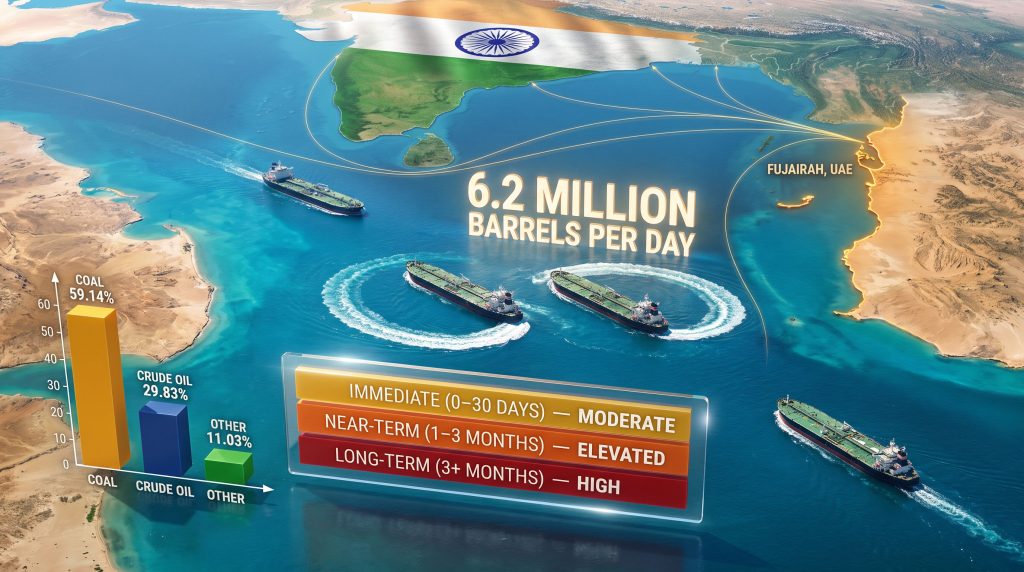
According to data from the U.S. Energy Information Administration, approximately 6.2 million barrels per day of crude oil and refined petroleum products transited the Bab al-Mandeb Strait in 2018, with an estimated 2.6 million barrels per day directed toward Asian markets including India. These figures underscore why the strait is not a peripheral concern but a central pillar of the energy trade corridor connecting producers to consumers across the Indo-Pacific.
What makes the Bab al-Mandeb particularly consequential is its relationship to the Strait of Hormuz. These two passages effectively bookend the Arabian Peninsula's export architecture. Hormuz governs outflows from the Persian Gulf on the eastern side, while Bab al-Mandeb governs access to Red Sea export terminals on the western side. When both are disrupted simultaneously, the rerouting options available to Gulf producers and their customers narrow dramatically.
India's Structural Energy Dependency: A Quantitative Overview
India's exposure to maritime chokepoint risk is not incidental. It is the direct consequence of its energy mix. According to data from India's Ministry of Petroleum and Natural Gas for FY 2023-24, the country's primary energy supply is dominated by fossil fuels, with coal and crude oil together accounting for roughly 89% of total supply.
| Energy Source | Share of Total Primary Supply | Volume (Ktoe) |
|---|---|---|
| Coal | 59.14% | ~534,128 |
| Crude Oil | 29.83% | ~269,412 |
| Other Sources | ~11.03% | ~99,618 |
| Total | 100% | ~903,158 |
Source: India's Ministry of Petroleum and Natural Gas, FY 2023-24
India imported nearly 47% of its total primary energy as of 2019, a figure that has remained structurally elevated in subsequent years. Crude oil represents the dominant imported commodity, making the reliability of Gulf shipping lanes a first-order concern for energy planners. Furthermore, the LNG supply outlook adds a secondary layer of maritime exposure, particularly for routes that pass through or near the Red Sea corridor.
The dependency is not merely volumetric. It is geographic. The Gulf region has historically supplied the largest share of India's crude import basket, meaning that any sustained disruption to West Asian transit corridors carries direct implications for refinery throughput and fuel pricing across the country.
What Is Actually Happening at the Bab al-Mandeb Strait in 2026
The current crisis crystallised in July 2026 when Houthi forces, operating from northern Yemen and controlling coastline adjacent to the Bab al-Mandeb, declared a naval blockade specifically targeting Saudi Arabian port activity. Shipping companies received warnings through direct communication that loading or discharging cargo at Saudi ports could result in vessels being targeted regardless of their subsequent location. This declaration extended threat exposure well beyond the strait itself, effectively placing any vessel with Saudi port exposure under risk across multiple ocean zones.
The practical consequences became visible almost immediately. Three Saudi crude oil tankers — the Xin Long Yang, the Rodos, and the Amazon — reversed course in the Red Sea following the blockade declaration. Of these, the Rodos and the Amazon were confirmed to be carrying crude consignments destined for India. The reversal was not precautionary in an abstract sense; it was an operational response to a declared and credible threat.
This incident matters because it demonstrates that the risk is no longer theoretical. Physical disruption to India-bound crude flows has already occurred, even if non-Saudi tankers bound for India have not yet faced direct interference. Consequently, oil price movements in this period have reflected mounting market anxiety around the strait's stability.
| Vessel Category | Current Status |
|---|---|
| Saudi-flagged tankers bound for India/China | Subject to Houthi targeting warnings; U-turns confirmed |
| Non-Saudi tankers transiting Bab al-Mandeb toward India | No disruptions reported as of July 2026 |
| Vessels using UAE's Fujairah terminal as alternative | Operational; India sourcing crude via this route |
The Yanbu Pivot and the Compounding of Western Flank Risk
A crucial piece of context that deepens the strategic picture involves Saudi Arabia's own rerouting decisions. Following disruptions in the Strait of Hormuz linked to the Iran-US conflict, Saudi Arabia shifted its primary oil export operations to the Red Sea port of Yanbu, located on its western coastline. Yanbu's position made it the logical alternative for routing crude away from the Persian Gulf, enabling the continued export of millions of barrels per day through a corridor that bypassed Hormuz entirely.
The Houthi naval blockade now directly threatens this fallback mechanism. Saudi Arabia's export infrastructure is facing simultaneous pressure on both its eastern flank, through Hormuz disruptions, and its western flank, through the Bab al-Mandeb crisis. This is not a one-chokepoint problem. It is a pincer scenario in which the primary and backup routes face concurrent threats.
Adding to the complexity, reports of mine-laying activity in sections of the Strait of Hormuz have further elevated the risk calculus for commercial shipping operators. Insurance premiums for vessels transiting the region have risen sharply, increasing the landed cost of crude oil even when physical delivery is ultimately completed. The combination of declared blockades, active naval threats, and mine hazards constitutes a multi-layered deterrent that operates independently of diplomatic negotiations.
Indeed, the broader oil price rally observed in recent months reflects, in part, this compounding of route insecurity across the Arabian Peninsula's export corridors.
The convergence of threats at both Hormuz and Bab al-Mandeb simultaneously eliminates the primary and secondary routing options that Gulf oil producers have historically relied upon. This is the scenario that energy security planners have long modelled but hoped would remain hypothetical.
India's Immediate Tactical Responses
In the short term, India has demonstrated meaningful flexibility in managing supply continuity. The Fujairah terminal in the UAE has been activated as an alternative crude sourcing point, with its position on the Gulf of Oman providing direct access to Indian Ocean shipping lanes that sidestep Red Sea exposure. This tactical pivot reflects years of relationship-building with UAE energy infrastructure that can now be drawn upon in moments of stress.
India's broader import diversification also provides a meaningful buffer. The country's crude import portfolio spans:
- Russia, which has supplied the largest share of Indian crude imports since 2022 following sanctions-driven pricing adjustments
- Iraq, a consistent top-three supplier with direct Persian Gulf access
- Saudi Arabia and the UAE, whose current disruptions are partially offset by the Fujairah alternative
- The United States and Western Hemisphere producers, whose supply routes are structurally independent of Red Sea and Hormuz passage
Russian crude deserves particular attention in this context. Since Western sanctions reshaped global crude flows in 2022, Russia has supplied India at discounted prices through Arctic and Pacific routes that carry no Red Sea exposure whatsoever. This has inadvertently created a structural hedge against exactly the kind of disruption now unfolding in West Asia.
| Time Horizon | Risk Level | Primary Concern |
|---|---|---|
| Immediate (0-30 days) | Moderate | Rerouting delays, freight cost increases |
| Near-term (1-3 months) | Elevated | Supply tightening if blockade persists |
| Long-term (3+ months) | High | Structural rerouting costs, inflationary pressure on fuel imports |
The next major ASX story will hit our subscribers first
Long-Term Architecture: What India's Energy Security Strategy Requires
The crisis exposes vulnerabilities that short-term tactical responses cannot fully address. India's long-term energy security architecture requires movement across several dimensions simultaneously.
Accelerating the Domestic Renewable Transition
India has committed to reaching 500 GW of non-fossil energy capacity by 2030, a target that carries heightened strategic relevance in the current environment. Every percentage point of primary energy demand met through domestically produced renewables reduces the import volume that must traverse contested maritime corridors. The economic logic of renewable transition and the national security logic of import reduction converge at exactly this point.
In addition, renewable energy solutions for the broader industrial and mining sectors can further reduce India's aggregate fossil fuel demand over time. A country that generates more of its own energy is simply less exposed to geopolitical disruptions occurring thousands of kilometres away.
Strategic Petroleum Reserve Expansion
India's Strategic Petroleum Reserve capacity, while operational, remains limited relative to the scale of its import dependency. Expanding SPR holdings provides a buffer against acute supply interruptions of the kind now unfolding, buying time for diplomatic resolution or alternative supply arrangement without immediate price transmission to consumers.
Geographic Diversification of Supplier Relationships
Expanding crude import relationships with Western Hemisphere producers including the United States, Brazil, and Guyana structurally reduces dependence on Middle Eastern routes. Strengthening bilateral energy agreements with producers accessible via the Cape of Good Hope route creates routing redundancy that operates entirely independently of Red Sea and Hormuz dynamics.
Moreover, the broader energy security transition — encompassing critical minerals and next-generation technologies — reinforces India's ability to reduce structural vulnerability over the medium term.
These priorities can be summarised as follows:
- Accelerate domestic renewable capacity to reduce absolute import volume
- Expand strategic petroleum reserves to extend supply buffers from weeks to months
- Deepen supplier relationships with Western Hemisphere producers whose routes bypass West Asian chokepoints
- Invest in route intelligence and shipping insurance frameworks that reduce the cost premium of alternative routing
India's Diplomatic Positioning in a Multi-Theatre Conflict
India's historically non-aligned posture provides diplomatic flexibility that more committed alliance partners do not have. New Delhi can engage with Gulf producers, Houthi interlocutors through third parties, and global shipping stakeholders without foreclosing supply relationships. This neutrality is a genuine asset in navigating a conflict involving the US, Israel, Iran, and Houthi forces simultaneously.
However, as Business Standard reports, diplomatic flexibility has operational limits. When physical shipping infrastructure is compromised, neutral intent does not guarantee neutral treatment. The confirmed reversal of India-bound cargo demonstrates that commercial disruptions can occur regardless of the diplomatic posture of the destination country.
Frequently Asked Questions
What Is the Bab al-Mandeb Strait and Why Does It Matter for India Energy Supplies?
The Bab al-Mandeb Strait is a narrow maritime passage connecting the Red Sea to the Gulf of Aden, positioned at the southwestern tip of the Arabian Peninsula. It forms a critical link in the energy corridor between Gulf producers and Asian consumers. For India, it represents a key transit point for a significant share of the crude oil that reaches its refineries from Gulf origins, making it central to India energy supplies and Bab al-Mandeb Strait security planning.
How Much Oil Does India Import Through This Route?
India does not route all of its crude through Bab al-Mandeb, but a significant portion of Gulf-origin crude — part of the estimated 2.6 million barrels per day moving toward Asian markets through the strait according to EIA data — is ultimately destined for Indian refineries. The exact share varies by supplier and routing decisions made by individual shipping companies.
Is India's Oil Supply Currently at Risk?
As of July 2026, non-Saudi tankers bound for India have not faced direct disruption. However, the confirmed reversal of two Saudi crude tankers carrying Indian-bound cargo, combined with dual chokepoint pressure at Hormuz and Bab al-Mandeb, represents a materially elevated risk environment that could escalate quickly if the blockade expands in scope.
What Alternative Routes Can India Use?
India can source crude via the UAE's Fujairah terminal, route shipments around the Cape of Good Hope, and draw on diversified suppliers including Russia, Iraq, and Western Hemisphere producers whose supply chains carry no Red Sea exposure.
Key Takeaways
- Coal and crude oil together represent nearly 89% of India's primary energy supply, making maritime route security a fundamental national interest rather than a peripheral concern
- The simultaneous disruption of the Strait of Hormuz and the Bab al-Mandeb Strait eliminates both primary and secondary routing options for Gulf-origin crude, creating a scenario without simple logistical solutions
- Three confirmed tanker reversals, including two vessels carrying India-bound crude, demonstrate that disruption has moved from theoretical risk to operational reality as of July 2026
- India's short-term resilience rests on supplier diversification and alternative terminals including Fujairah, but long-term vulnerability persists without structural expansion of strategic petroleum reserves and domestic energy capacity
- The crisis provides a compelling strategic and economic case for accelerating India's 500 GW non-fossil energy target and deepening crude import relationships with Western Hemisphere producers whose routes bypass West Asian chokepoints entirely
Disclaimer: This article contains forward-looking assessments of energy supply risk and geopolitical scenarios. These assessments are based on publicly available information as of July 2026 and are subject to rapid change as the conflict situation evolves. Readers should consult primary sources including the U.S. Energy Information Administration at eia.gov and India's Ministry of Petroleum and Natural Gas for updated data and official assessments.
Want to Stay Ahead of the Commodity Opportunities Emerging From Global Energy Disruptions?
When geopolitical crises reshape energy corridors and redirect commodity flows, the ripple effects reach ASX-listed resource and energy companies almost immediately. Discovery Alert's proprietary Discovery IQ model scans ASX announcements in real time, delivering actionable alerts on significant mineral discoveries so investors can identify opportunities ahead of the broader market — begin your 14-day free trial today, or explore Discovery Alert's discoveries page to understand how major mineral finds have historically generated substantial returns.