June 8, 2026
When Energy Chokepoints Become National Stress Tests
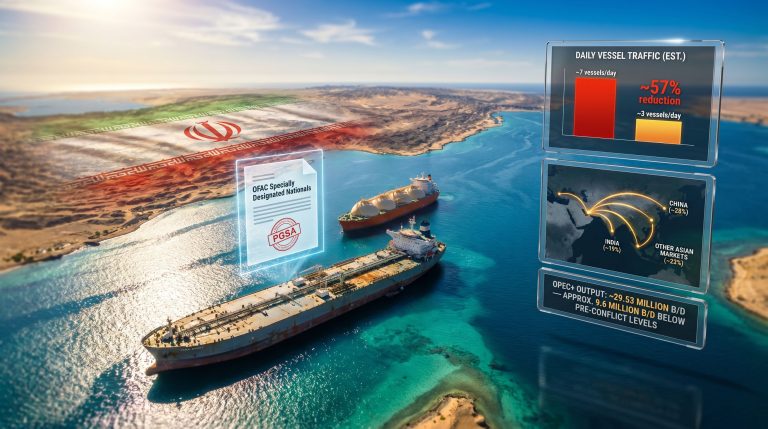
Few infrastructure vulnerabilities carry the weight of a single narrow waterway. The Strait of Hormuz, stretching roughly 33 kilometres at its narrowest point, handles an estimated 20% of the world's traded oil and a significant share of global LPG shipments. When geopolitical instability flares in the surrounding region, it does not merely create headlines. It activates contingency planning inside energy ministries across Asia, none more acutely than in New Delhi.
India's relationship with Gulf energy is structurally deep and historically entrenched. For decades, the subcontinent drew the overwhelming majority of its crude oil from Middle Eastern suppliers, creating an asymmetric dependency that successive governments have worked methodically to reduce. That effort has produced measurable results. Yet the country remains meaningfully exposed, and the question of whether India fuel and LPG stocks adequate amid global supply disruptions has moved from a technical policy debate into public consciousness.
When big ASX news breaks, our subscribers know first
India's Import Dependency: Understanding the Structural Exposure
To understand why global energy disruptions affect Indian consumers, it helps to map the actual import architecture rather than rely on broad generalisations. Furthermore, examining these resource and energy exports dynamics provides crucial context for understanding regional supply chain pressures.
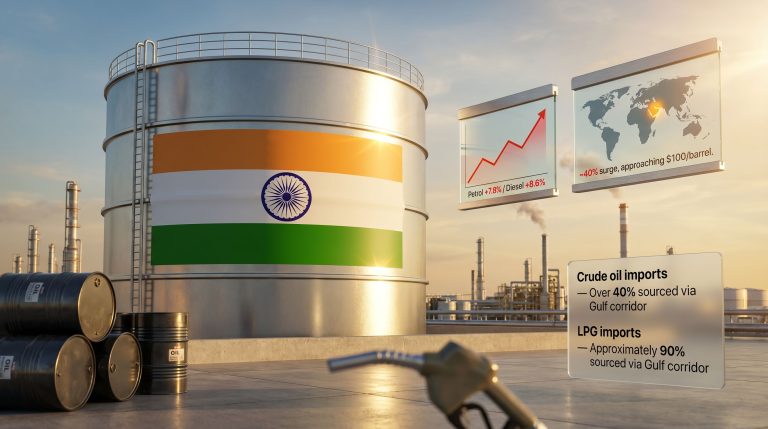
India has made genuine progress diversifying its crude oil sourcing away from the Gulf, reducing Middle East dependency from near-total reliance to approximately 70% through deliberate procurement across Russia, the United States, and West African suppliers. However, LPG dependency on Gulf sources remains considerably higher, with the United States supplying roughly 2.2 million tonnes annually, representing only around 10% of total national requirements.
This asymmetry matters because LPG and crude oil face different supply chain dynamics. Crude oil can be refined domestically once it arrives, giving India's extensive refining network a meaningful buffering role. LPG, by contrast, enters the distribution chain largely ready for end use, meaning disruptions closer to the point of origin translate more directly into household-level availability pressures.
| Fuel Type | Primary Import Source | Estimated Gulf Dependency | Alternative Sources |
|---|---|---|---|
| Crude Oil | Middle East, Russia, US | ~70% (post-diversification) | US, Russia, West Africa |
| LPG | Middle East (Gulf) | 70%+ | US (~10% of needs), domestic |
| Natural Gas (LNG) | Qatar, Australia, US | Moderate | Diversified |
| Petrol/Diesel | Domestically refined | Low direct import | Domestic refinery output |
India imported approximately 23.3 million tonnes of LPG in 2025, reflecting an 8.4% year-on-year increase in demand. Domestic LPG production stood at roughly 12.8 million tonnes in FY2023-24, highlighting a structural supply gap that makes uninterrupted import flows a non-negotiable operational requirement rather than a preference. The India LNG import structure further illustrates how deeply embedded these dependencies are within national energy planning.
What India's Government Is Confirming About Current Supply Conditions
Against this backdrop, India's Ministry of Petroleum and Natural Gas moved to reassure both consumers and markets in May 2026, confirming that India fuel and LPG stocks adequate amid global supply disruptions remain a present reality across multiple fuel categories.
At an inter-ministerial briefing in New Delhi, Joint Secretary (Marketing and Oil Refinery) Sujata Sharma confirmed that the country's energy supply position remained stable. The core assurances centred on several key metrics.
The Official Supply Position in Numbers
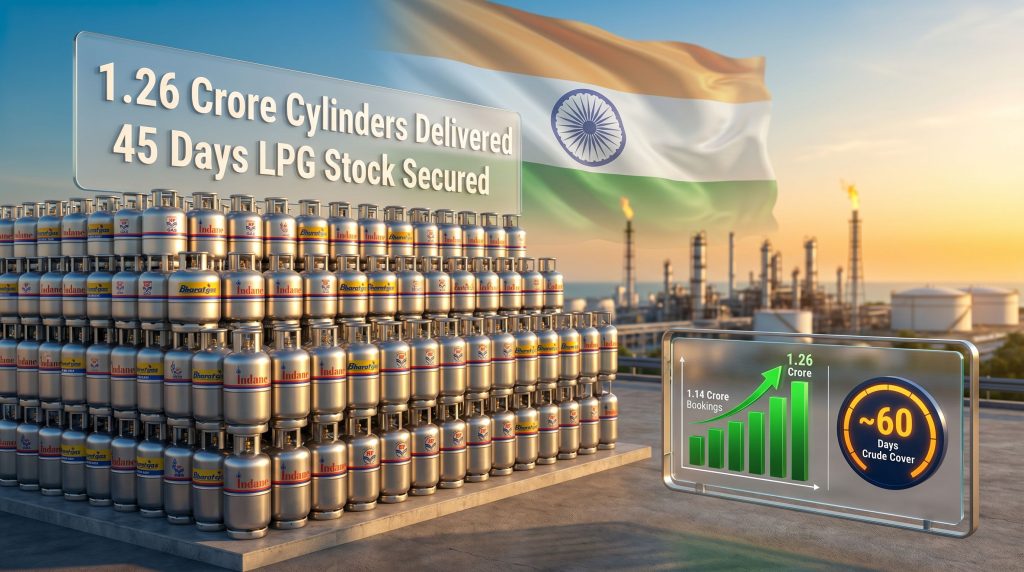
- Crude oil inventories: Maintained at approximately 60 days of cover
- LPG stocks: Approximately 45 days of supply secured across the distribution network
- Domestic PNG and CNG demand: 100% of household piped gas and compressed natural gas requirements met through existing supply
- Industrial natural gas: Approximately 80% of industrial requirements being fulfilled
- Retail outlets: No instances of dry-outs reported at petrol or diesel stations nationwide
- LPG distributorships: No dry-outs confirmed across the distributor network
The operational delivery data presented at the briefing was equally direct. Over a representative three-day measurement window, 1.26 crore LPG cylinders were delivered to households against 1.14 crore booking requests, meaning physical supply was actually outpacing registered consumer demand. Commercial LPG sales exceeded 17,000 tonnes during the same period, while auto LPG volumes surpassed 762 tonnes.
Since March 2026, over 18 crore domestic LPG cylinders have been delivered nationwide. Commercial LPG sales in April 2026 reached approximately 147,000 tonnes, representing roughly 70% of normal commercial volumes, indicating some demand moderation in the commercial segment while household supply remained intact.
The government's framing is deliberate and strategically calibrated: by leading with delivery figures that show supply exceeding demand, the communication is designed to prevent the very panic-buying behaviour that could transform a manageable supply tightness into an artificial crisis.
Vessel and Logistics Continuity
Indian-flagged and chartered vessels transiting through the Strait of Hormuz were confirmed to be operating without incident as of early May 2026. No rationing measures have been announced or are currently planned. According to the Ministry of Petroleum and Natural Gas, the online booking system for LPG cylinders is being actively promoted to regulate demand patterns and avoid clustering of orders that could create localised shortfalls.
The Divergence Between Official Data and Market-Level Estimates
Where the official narrative becomes more complex is in the comparison between government-stated inventory positions and the assessments circulating at the market level. This is not a case of one side being wrong. It is a case of two different methodological frameworks producing figures that measure different things.
| Metric | Government Position | Independent Market Estimate |
|---|---|---|
| Crude Oil Stock Cover | ~60 days | Broadly consistent |
| LPG Stock Cover | ~45 days | As low as ~10 days (some estimates) |
| LPG Import Continuity | Diversified; stable | Gulf disruption creating cargo sourcing pressure |
| Rationing Risk | Not planned | Possible if Gulf supply is blocked |
| Demand Trajectory | Softening (seasonal dip) | Import volumes under strain |
The 45-day LPG buffer cited by the government almost certainly incorporates pipeline inventory, volumes in transit on chartered vessels, LPG held at import terminals, and strategic reserve accounting. This is legitimate supply security accounting. The significantly shorter figures cited by some market-level observers typically reflect only immediately accessible terminal stocks available for rapid distribution, excluding volumes still at sea or in transit infrastructure.
Both metrics are analytically valid. They simply answer different questions. The 45-day figure addresses total supply security. The shorter market estimate addresses the speed at which a sudden cargo disruption could affect ground-level availability if imports were completely halted.
The Storage Infrastructure Constraint
A less-discussed but important structural limitation is the finite storage capacity at India's LPG import terminals. Unlike crude oil, which can be held in large-volume strategic petroleum reserves, LPG requires pressurised or refrigerated storage infrastructure. India's major LPG import terminals, while substantial, cannot indefinitely absorb surplus imports to build buffer reserves beyond their design parameters.
This physical constraint means that India's LPG security relies heavily on supply flow continuity rather than large static stockpiles. Seasonal demand moderation has provided some relief, with LPG booking volumes declining from earlier peaks to the 46 to 50 lakh per period range, temporarily easing pressure on distribution infrastructure. However, a sustained disruption to Gulf shipping lanes could erode available buffers considerably faster than the headline 45-day figure might suggest.
How India Is Actively Reducing Its Gulf Exposure
The current disruption is accelerating policy conversations that were already underway. Moreover, broader oil market disruptions stemming from global trade tensions are adding further urgency to India's diversification agenda. India's import diversification strategy operates across several simultaneous tracks.
Supply-Side Diversification
The reduction of crude oil dependency on the Middle East from historical levels approaching 99% to the current approximate 70% represents a significant structural shift achieved over roughly a decade. This has been accomplished through:
- Scaling US crude and LPG imports — bringing American LPG to approximately 2.2 million tonnes annually
- Expanding Russian crude procurement — particularly following the post-2022 global energy realignment
- Deepening West African supplier relationships — reducing single-region concentration risk
- Excise duty flexibility — deploying fiscal adjustments to absorb international price volatility before it fully reaches domestic pump prices
Domestic Production as a Supply Floor
India's domestic LPG output from refineries and natural gas processing plants provides a baseline of approximately 46,000 to 50,000 metric million tonnes per month. While this covers only a portion of total demand, it represents a supply floor that cannot be disrupted by events in the Gulf.
India also operates strategic petroleum reserves at Visakhapatnam, Mangaluru, and Padur, providing underground crude oil storage that can be drawn upon during acute supply disruptions. The current crude inventory position of approximately 60 days, while below the International Energy Agency's recommended 90-day benchmark, provides meaningful buffer capacity.
Piped Natural Gas Expansion
The longer-term structural hedge against LPG cylinder dependency is the expansion of the piped natural gas network. Converting households from cylinder-based LPG to piped supply eliminates last-mile distribution vulnerability and creates a supply pathway that bypasses the import terminal bottleneck. This transition is proceeding across Indian cities but remains a multi-year programme rather than an immediate response to current pressures.
PM Modi's Seven-Point Conservation Framework
Parallel to supply-side management, India's leadership has launched a demand-side conservation initiative framed explicitly as a national economic resilience measure rather than a crisis response.
Prime Minister Narendra Modi, addressing a public gathering in Secunderabad, outlined a seven-point framework for citizens to reduce fuel consumption:
- Prioritise public transport — metro systems and buses over private vehicles wherever accessible
- Adopt carpooling — reducing per-capita fuel consumption in urban commuting patterns
- Shift freight to railways — moving goods via rail to reduce diesel-intensive road transport
- Increase electric vehicle adoption — accelerating the structural transition away from liquid fuels
- Work from home where feasible — reducing commuting-related fuel consumption
- Reduce foreign travel for one year — conserving foreign exchange reserves under pressure
- Adopt Swadeshi products — reducing import dependence across categories, including edible oils
The Prime Minister also highlighted the burden that chemical fertiliser imports place on foreign exchange reserves, urging farmers toward natural farming practices as an import-substitution strategy. Edible oil imports were separately identified as another area where reduced consumption would support foreign currency conservation.
The framing of these conservation measures as a patriotic economic contribution rather than a response to supply inadequacy is a textbook example of sovereign communication strategy. Governments managing supply stress consistently prefer to normalise voluntary reduction over acknowledging potential scarcity.
The Foreign Exchange Dimension
An often-underappreciated element of India's fuel import equation is its foreign exchange dimension. India's total hydrocarbon import bill represents one of the largest components of the country's foreign exchange expenditure. When international energy prices spike due to geopolitical events, the impact is not merely felt at the pump.
As CNBC TV18 reports, rising oil price movements place direct pressure on the rupee, increase the current account deficit, and compete with other import priorities including fertilisers, edible oils, and industrial inputs. This broader macroeconomic context explains why PM Modi's conservation messaging extended well beyond fuel into gold purchases, foreign travel, and agricultural inputs. The conservation initiative is best understood as a foreign exchange preservation strategy with energy conservation as its most visible component.
The next major ASX story will hit our subscribers first
India's Energy Security Architecture: A Structural Assessment
| Standard | IEA Recommendation | India's Reported Position (May 2026) |
|---|---|---|
| Crude Oil Strategic Reserve | 90 days of net imports | ~60 days (government estimate) |
| LPG Operational Buffer | 30+ days recommended | 45 days official / shorter market estimates |
| Refinery Utilisation | Optimal (85%+) | Operating at optimum levels |
India's current position reflects a system that is well-prepared for moderate disruptions but would face genuine pressure under a prolonged closure of Gulf shipping lanes. The 30-day gap between India's crude cover and IEA benchmarks is notable but not alarming in isolation, particularly given India is not an IEA member state and operates under different policy frameworks.
Furthermore, considering the broader geopolitical oil price risks at play globally, what the 2026 West Asia disruption has demonstrated clearly is that India's energy security architecture is resilient enough to absorb initial shocks through diversification, stock cover, and demand management, but that the LPG segment specifically carries more concentrated Gulf exposure than the headline crude diversification figures might imply.
The Strategic Outlook: Key Priorities Going Forward
Near-term priorities (0 to 6 months):
- Maintaining cargo diversification for LPG away from Gulf-dependent supply chains
- Monitoring Strait of Hormuz transit conditions and activating contingency sourcing protocols if escalation continues
- Managing consumer communication to prevent panic-driven demand spikes that could artificially strain distribution infrastructure
Medium-term structural shifts (6 to 24 months):
- Scaling US and non-Gulf LPG import agreements to reduce Gulf concentration below 60% for this specific fuel category
- Expanding domestic LPG terminal storage capacity to accommodate larger strategic buffers
- Accelerating piped natural gas network rollout to structurally reduce household cylinder dependency
- Deepening electric vehicle adoption to progressively reduce petrol and diesel demand
Long-term trajectory:
India's stated ambition to reduce overall fossil fuel import dependence through renewable energy scaling, green hydrogen development, and domestic biofuel production positions the current disruption as an acceleration catalyst rather than simply a crisis to be managed. The urgency created by Gulf supply volatility has historically translated into policy follow-through on infrastructure investments that were otherwise proceeding at a slower pace.
Current Status Summary: India Fuel and LPG Stocks at a Glance
| Dimension | Current Status | Risk Assessment |
|---|---|---|
| Petrol and Diesel Supply | Adequate; no shortages reported | Low |
| LPG Domestic Supply | Adequate; deliveries exceeding bookings | Low to Medium |
| LPG Strategic Buffer | Official: 45 days; market estimates disputed | Medium |
| Crude Oil Inventory | ~60 days cover | Low |
| Refinery Operations | Running at optimum capacity | Low |
| Import Diversification | In progress; Gulf remains dominant | Medium |
| Consumer Demand | Seasonally softening | Low |
| Rationing Risk | Not planned as of May 2026 | Low (near-term) |
The broader picture for India is one of a large, complex energy system that has invested meaningfully in resilience without yet completing the structural transformation that would insulate it fully from Gulf supply shocks. The India fuel and LPG stocks adequate amid global supply disruptions narrative is accurate in its immediate framing. Consequently, the more important question is whether the current pressure accelerates the infrastructure and diversification investments that would make that assessment equally accurate under a more severe scenario.
Disclaimer: This article is for informational purposes only and does not constitute financial or investment advice. All statistics and figures referenced are based on publicly available government statements and reported data as of May 2026. Readers should consult official sources for current supply and pricing information.
Want to Track the Commodity Opportunities Emerging From Global Energy Disruptions?
As geopolitical stress reshapes global energy supply chains, the ripple effects are creating significant movements across ASX-listed resource and energy companies — and Discovery Alert's proprietary Discovery IQ model delivers real-time alerts the moment significant mineral and energy discoveries hit the ASX, ensuring subscribers can identify actionable opportunities ahead of the broader market. Explore historic discovery returns on Discovery Alert's dedicated discoveries page and begin a 14-day free trial to position yourself at the forefront of market-moving announcements.