
June 5, 2026
Understanding India's Position in the Global Oil Demand Transformation
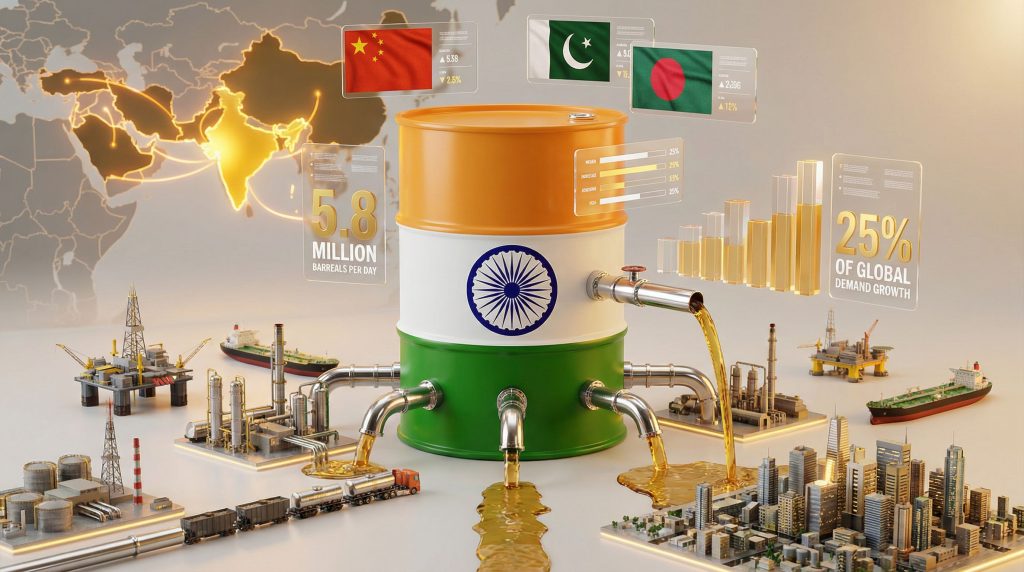
Global energy markets are experiencing a fundamental restructuring as emerging economies transition from agrarian to industrial societies. Within this broader transformation, India's petroleum consumption patterns represent the most significant single-country demand driver shaping international oil markets through 2030. This global oil demand surge in Indian market marks a departure from the previous decade's China-dominated growth narrative, introducing new supply chain dynamics and pricing mechanisms across global energy systems.
India's current petroleum consumption baseline stands at approximately 5.3-5.4 million barrels per day (mbpd) according to International Energy Agency data, with projections suggesting continued expansion toward 5.8-6.0 mbpd by 2025. This growth trajectory positions India as the primary incremental demand contributor globally, accounting for roughly 20-22% of worldwide oil consumption increases.
The scale of India's energy appetite creates cascading effects throughout international commodity markets. Unlike China's historical industrial-focused demand, India's consumption growth stems primarily from transportation fuels and middle-class consumption patterns, creating more resilient baseline demand that persists through economic cycles.
The Scale of India's Energy Appetite
India's petroleum demand expansion occurs across multiple sectors simultaneously, creating compounding growth effects that distinguish it from other emerging markets. Transportation fuels represent 65-70% of total consumption, while petrochemicals and industrial applications account for 15-20% and heating/power generation comprise the remaining 10-15%.
This sectoral distribution contrasts sharply with developed economies where transportation represents a smaller percentage due to alternative energy adoption. India's transportation-heavy demand structure provides consumption resilience even during economic slowdowns because commercial and agricultural transportation requirements persist regardless of GDP fluctuations.
Comparative Analysis with Other Major Economies
| Region | 2025 Demand Growth (bpd) | Primary Drivers | Market Impact |
|---|---|---|---|
| India | 150,000-200,000 | Transportation, urbanization | Leading contributor |
| China | 50,000-100,000 | Economic stabilization, EVs | Declining growth |
| Southeast Asia | 120,000-150,000 | Manufacturing expansion | Regional catalyst |
| United States | Variable | Policy shifts, data centers | Demand volatility |
China's transformation from dominant growth driver to marginal contributor reflects structural economic changes including manufacturing contraction and electric vehicle adoption reaching 35% of new passenger vehicle sales in 2024. This transition creates market opportunities for other economies to fill demand growth gaps previously occupied by Chinese consumption.
When big ASX news breaks, our subscribers know first
What Economic Forces Are Propelling India's Oil Consumption Surge?
India's petroleum demand expansion reflects convergent macroeconomic trends creating sustained consumption growth independent of short-term economic cycles. These underlying fundamentals distinguish India's current trajectory from other emerging market patterns and provide predictability for long-term energy market planning.
GDP Growth and Middle-Class Expansion Dynamics
India's economic growth maintains momentum with 6.4% GDP expansion in 2024 and projected 6.8% growth in 2025 according to International Monetary Fund estimates. However, the Reserve Bank of India's more conservative projections of 6.2% for FY2024-2025 indicate potential variance in actual performance.
Middle-class population expansion represents a critical demand multiplier, growing from 50 million in 2010 to 253-320 million by 2024, representing 18-24% of total population. This demographic shift creates sustained petroleum demand through increased vehicle ownership, aviation travel, and petrochemical product consumption.
Disposable income growth among middle-class households averages 9-11% annually during 2020-2024, creating purchasing power for energy-intensive goods and services. This income elasticity demonstrates that petroleum consumption increases approximately 1.2-1.4% for every 1% increase in per-capita income, reflecting income-sensitive demand patterns.
Urbanization as a Demand Multiplier
India's urbanization accelerates at 2.3% annually, with urban population growing from 28% in 2010 to 36% in 2024. Urban migration creates petroleum demand through multiple channels beyond individual consumption patterns.
Urban Infrastructure Development:
- Highway construction and maintenance requiring diesel fuel for equipment operation
- Commercial activity generating increased logistics and transportation fuel demand
- Industrial agglomeration creating concentrated petrochemical feedstock requirements
- Individual consumption patterns showing 40-50% higher personal vehicle usage than rural counterparts
The National Infrastructure Pipeline, launched in 2019 with projected investment of $1.4 trillion through 2040, directly correlates with increased fuel consumption across construction, transportation, and industrial operations. Highway construction alone consumes significant diesel volumes for equipment operation and worker transportation.
Industrial Transformation Impact
Manufacturing Sector Evolution:
The shift from informal to organized manufacturing, coupled with Production-Linked Incentive scheme implementation across 14 sectors, creates concentrated demand for petroleum-based industrial inputs. Petrochemical production as manufacturing input represents secondary demand distinct from end-user consumption.
- Plastics consumption: Increased from 7 million tonnes in 2010 to 16-18 million tonnes in 2024
- Cement production: Reached 340 million tonnes in 2024, growing at 5-6% annually
- Steel production: Expanded to 140 million tonnes in 2024, up from 60 million tonnes in 2010
India's e-commerce market, valued at approximately $55-65 billion in 2024, generates incremental diesel demand through logistics networks. The sector's annual growth of 20-25% directly translates to increased commercial transportation fuel consumption independent of traditional retail patterns.
How Will India's Import Dependence Shape Global Supply Chains?
India's domestic petroleum production constraints create structural reliance on international crude oil markets that intensifies through 2035, fundamentally altering global trade flows and supply security considerations. This dependency trajectory influences geopolitical relationships and supply chain diversification strategies across producing regions.
The Import Dependency Trajectory
India's crude oil import dependency stands at 96.5-97% as of 2024, meaning domestic production meets only 3-3.5% of consumption requirements. Domestic oil production declined from 38 million tonnes annually in 2010 to 29-30 million tonnes in 2024, representing a 2.1-2.3% annual decline rate.
Projected Import Timeline:
- Current import reliance: 96.5-97% of crude oil needs
- 2030 dependency projection: 94-96% despite exploration efforts
- 2035 dependency forecast: 93-95% as domestic production continues gradual decline
Domestic production is forecast to decline to 25-26 million tonnes by 2035 (approximately 0.5 million bpd), while consumption reaches 4.2-4.5 million bpd, creating widening supply gaps requiring international market dependence.
Refining Capacity Expansion Strategy
| Timeline | Capacity Target | Investment Required | Strategic Objective |
|---|---|---|---|
| 2024 | 249-250 MMTPA | Current baseline | Processing capability |
| 2030 | 330-350 MMTPA | $8-12 billion | Regional hub development |
| 2040 | 500-550 MMTPA | $20-30 billion total | Energy security enhancement |
India's refining capacity expansion strategy aims to process crude oil beyond domestic consumption requirements, creating export opportunities for refined products while maintaining strategic petroleum reserves. This approach transforms India into a regional refining hub serving Southeast Asian and Middle Eastern markets.
Geopolitical Supply Diversification
India has emerged as a "swing refiner" of Russian crude oil, processing approximately 1.4-1.6 million bpd of Russian crude (representing 35-40% of total imports) as of 2024. This role provides strategic positioning within global supply chains, allowing arbitrage between sanctioned and premium crude grades.
Supply Diversification Strategy:
India's diversification across multiple suppliers reduces geopolitical vulnerability, with no single supplier representing more than 40% of imports. Key suppliers include Middle Eastern producers (Saudi Arabia, Iraq, UAE), African suppliers (Angola, Nigeria), and Russia, demonstrating sophisticated supply security strategy.
What Does India's Demand Growth Mean for Global Oil Prices?
The magnitude and persistence of India's consumption expansion creates both stabilizing and volatility factors in international petroleum pricing mechanisms. This demand foundation provides market support while introducing complexity through seasonal variations and infrastructure constraints.
Furthermore, the oil price rally observed in recent months demonstrates how supply-demand fundamentals interact with geopolitical factors. Similarly, the broader context of global trade tensions continues to influence market sentiment and pricing mechanisms.
Price Support Mechanisms
India's consistent demand growth provides baseline consumption support for global oil prices through multiple mechanisms:
- Demand floor establishment: India's growth provides persistent consumption baseline
- Supply absorption capacity: Ability to process various crude grades including discounted Russian oil
- Market liquidity enhancement: Increased trading volumes improving price discovery mechanisms
- Seasonal demand patterns: Predictable consumption spikes during economic growth periods
India's fuel subsidy structure (particularly diesel and LPG) artificially suppresses domestic prices by 20-30% below global Brent-linked pricing, masking true demand elasticity and creating additional consumption beyond market-driven levels.
Volatility Factors and Risk Assessment
Upside Price Pressures:
- Infrastructure bottlenecks creating temporary supply constraints during peak demand periods
- Currency fluctuation impacts on import costs affecting purchasing patterns
- Strategic petroleum reserve building programs creating additional demand beyond consumption
Downside Stabilization:
- Flexible refining capacity utilization allowing processing optimization
- Alternative energy transition timeline extensions providing sustained petroleum demand
- Commercial strategic reserve development reducing spot market exposure
Which Sectors Drive India's Petroleum Consumption Growth?
Understanding sectoral petroleum demand breakdown reveals sustainability and trajectory of current growth patterns, with implications for long-term market forecasting and supply planning across different product categories. The global oil demand surge in Indian market stems from multiple concurrent sectoral expansions.
Transportation Fuels Dominance
Gasoline Consumption Drivers:
Private vehicle ownership expansion maintains 8-10% annual growth from 2019-2024, with India adding approximately 12-15 million new vehicles annually during 2022-2024. Two-wheeler markets (motorcycles and scooters) represent 78% of India's vehicle fleet, with premium segment growth (above ₹150,000 or ~$1,800) reaching 12-15% year-over-year.
The expansion of ride-sharing economy and urban mobility transformation creates additional gasoline demand independent of personal vehicle ownership patterns. Urban retail and service sectors generate increased fuel demand through delivery logistics and commercial transportation.
Diesel Demand Fundamentals:
- Commercial transportation expansion supporting freight and logistics sectors
- Agricultural mechanization increasing tractor and equipment utilization
- Industrial power generation for backup and remote applications
- Construction sector equipment operation consuming significant diesel volumes
India's logistics sector, particularly driven by e-commerce platforms, increases diesel consumption for commercial transportation by approximately 8-12% annually over 2019-2024, demonstrating demand resilience independent of traditional GDP correlations during economic transition periods.
Aviation Fuel Growth Trajectory
- Domestic air travel expansion: 6% annual growth rate reflecting middle-class income increases
- International connectivity improvements: Hub airport development expanding route networks
- Cargo aviation development: E-commerce and logistics support creating freight demand
- Business travel recovery: Post-pandemic commercial aviation normalization
Petrochemical Industry Expansion
Plastics and Chemicals Demand:
India's residential construction sector, accelerating under the "Housing for All" initiative, consumes significant petrochemical inputs for building materials, plastics, and synthetic products. The construction sector utilized approximately 45-50 million tonnes of cement in 2024, requiring petroleum-based transportation and processing.
- Consumer goods manufacturing requiring packaging and plastic products
- Construction industry demanding infrastructure development materials
- Export market opportunities through value-added chemical processing
- Industrial feedstock requirements for organized manufacturing sector expansion
How Do Global Supply Dynamics Respond to Indian Market Growth?
The magnitude of India's oil demand expansion requires corresponding adjustments in global production, refining, and transportation infrastructure to maintain market equilibrium. These supply responses create ripple effects throughout international energy systems.
Consequently, the OPEC+ production strategy must adapt to accommodate this growing demand while maintaining price stability. Moreover, recent developments including Saudi Arabia exploration licenses indicate expanded production capacity planning in response to emerging demand patterns.
OPEC+ Production Strategy Adaptations
OPEC+ production strategies must accommodate India's sustained demand growth while maintaining price stability objectives. Key strategic adaptations include:
- Spare capacity utilization: Meeting incremental demand requirements during growth periods
- Production quota adjustments: Balancing price stability with volume growth accommodation
- Long-term capacity investment: Planning supply security for sustained Indian market expansion
- Grade diversification: Providing crude oil qualities suited to Indian refinery specifications
Non-OPEC Supply Response Mechanisms
U.S. Shale Production Flexibility:
American shale production provides short-cycle production adjustments responding to price signals created by Indian demand growth. Enhanced recovery techniques and technology advancement impacts allow rapid supply response to market tightness.
- Export capacity expansion through LNG and crude oil infrastructure development
- Transportation logistics improvements connecting production to international markets
- Quality specifications meeting Indian refinery processing requirements
Other Producing Regions:
- Brazil and Guyana: New production capacity coming online providing additional supply options
- Norway and UK: North Sea production optimization extending field life
- Canada: Oil sands expansion considerations balancing environmental and economic factors
- West Africa: Angola and Nigeria providing traditional supply relationships with India
Transportation Infrastructure Development
Global tanker fleet capacity must expand to accommodate increased crude oil flows to Indian refineries. Tanker fleet constraints forecast strong shipping rates through early 2026, reflecting supply-demand imbalances in maritime transportation.
Port and terminal upgrades enhance import capacity, while pipeline network expansion connects production centers to consumption areas domestically. Storage facility construction supports both strategic and commercial reserves development.
The next major ASX story will hit our subscribers first
What Are the Long-Term Implications for Energy Transition?
India's oil demand surge occurs simultaneously with global energy transition initiatives, creating complex interactions between traditional hydrocarbon consumption and renewable energy adoption. These dynamics influence transition timelines and investment priorities.
Additionally, energy transition challenges observed globally demonstrate the complexity of balancing economic development with environmental objectives, particularly relevant for emerging economies like India.
Transition Timeline Realities
India's energy transition follows different patterns than developed economies due to economic development priorities and infrastructure constraints:
- Peak demand projections: Post-2030 plateau expectations based on current consumption trends
- Electric vehicle adoption rates: Gradual penetration in Indian market due to infrastructure limitations
- Industrial electrification challenges: Heavy industry transformation requiring extended timelines
- Grid stability requirements: Backup power generation maintaining petroleum demand
Current renewable energy penetration primarily affects electricity generation rather than transportation and industrial uses, limiting near-term impact on oil consumption patterns before 2030. Transportation electrification faces infrastructure constraints including charging network development and battery supply chains.
Natural Gas Complementarity
India's natural gas consumption doubling to 140 bcm by 2035 provides complementary rather than substitutional demand growth alongside petroleum consumption. This dual expansion reflects different applications across industrial processes and power generation.
- Infrastructure development: Pipeline and LNG terminal expansion supporting gas utilization
- Industrial fuel switching: Coal-to-gas transitions in manufacturing creating additional demand
- Power generation backup: Gas-fired plants supporting renewable energy intermittency
- Petrochemical feedstock: Natural gas liquids supporting chemical industry expansion
Policy Framework Evolution
Government Strategy Elements:
Government policies balance energy security prioritization with environmental objectives, creating sustained petroleum demand through multiple channels:
- Energy security prioritization: Domestic production incentives requiring continued exploration
- Strategic reserve development: Emergency supply preparations creating additional demand
- Renewable energy integration: Grid stability and backup requirements maintaining fossil fuel needs
- Industrial development policies: Manufacturing incentives supporting petrochemical demand growth
Investment Opportunities and Market Implications
The sustained nature of India's oil demand growth creates specific investment themes and market opportunities across the energy value chain, from upstream exploration through downstream marketing and distribution.
Upstream Exploration and Production
India's domestic exploration receives government incentives targeting $25 billion investment in production enhancement and new field development. International asset acquisitions support strategic reserve building while technology partnerships enable enhanced recovery techniques.
- Domestic exploration incentives: Tax benefits and regulatory support for production increases
- International asset acquisitions: Strategic positioning in producing regions
- Technology partnership opportunities: Enhanced recovery techniques improving field performance
- Joint venture developments: Risk sharing for exploration in frontier areas
Midstream Infrastructure Development
Pipeline Network Expansion:
Connecting production centers to consumption areas requires significant infrastructure investment. Pipeline capacity expansion reduces transportation costs while improving supply security across regional markets.
- Storage facility construction: Strategic and commercial reserves supporting supply security
- Port and terminal upgrades: Import capacity enhancement handling increased crude volumes
- Transportation logistics: Rail and truck networks supporting distribution systems
Downstream Refining and Marketing
Refining Sector Opportunities:
Capacity expansion projects meet both domestic consumption and export demand, while technology upgrades improve efficiency and environmental performance. Product quality enhancement ensures compliance with evolving fuel specifications.
- Capacity expansion projects: Meeting domestic and regional export demand requirements
- Technology upgrades: Efficiency improvements and environmental compliance
- Product quality enhancement: Meeting evolving fuel specifications and standards
- Regional hub development: Processing crude oil beyond domestic consumption for export
Marketing and Distribution:
- Retail network expansion: Rural and urban market penetration increasing fuel access
- Digital transformation: Payment systems and customer engagement improving efficiency
- Alternative fuel infrastructure: Preparing for transition periods while maintaining petroleum supply
- Commercial fleet services: Supporting logistics and transportation sector growth
According to Wood Mackenzie's analysis, India's economic growth will significantly impact global energy markets, reinforcing the strategic importance of investment in Indian energy infrastructure.
India's oil demand growth represents the final major wave of petroleum consumption expansion from a large emerging economy, making it a critical factor in global energy market dynamics through 2030 and beyond.
Frequently Asked Questions About India's Oil Market Impact
How does India's oil demand compare to China's historical growth?
India's current growth trajectory mirrors China's expansion from 2000-2015, but occurs in a more constrained global supply environment with higher baseline prices and greater geopolitical complexity. Unlike China's industrial-focused demand, the global oil demand surge in Indian market stems primarily from transportation and middle-class consumption patterns.
What happens if India's economic growth slows significantly?
Even with reduced GDP growth, demographic trends and urbanization momentum would likely sustain oil demand increases, though at moderated rates potentially 30-40% below current projections. Transportation and commercial requirements provide demand resilience independent of GDP fluctuations.
How quickly could renewable energy adoption change India's oil demand?
Current renewable energy penetration primarily affects electricity generation rather than transportation and industrial uses, limiting near-term impact on oil consumption patterns before 2030. Transportation electrification faces infrastructure constraints requiring extended implementation timelines.
What role does government policy play in demand growth?
Government infrastructure spending, urbanization policies, and energy security strategies directly influence consumption patterns. Subsidy structures particularly affect diesel and LPG demand, while manufacturing incentives support petrochemical consumption growth.
How does India's refining capacity expansion affect global markets?
India's emergence as a regional refining hub processes crude oil beyond domestic consumption, creating export opportunities for refined products while influencing global trade flows and supply chain relationships across producing regions. The global oil demand surge in Indian market drives this capacity expansion strategy.
Disclaimer: This analysis incorporates market projections and forecasting based on current trends and government policies. Actual demand growth may vary due to economic conditions, policy changes, technological developments, or unforeseen market disruptions. Investment decisions should consider multiple scenarios and risk factors beyond oil demand projections.
Are You Positioning Yourself for the Next Major Energy Investment Opportunity?
India's oil demand surge represents one of the most significant energy market shifts of the decade, creating ripple effects across global commodity markets and supply chains. Discovery Alert's proprietary Discovery IQ model delivers instant alerts on ASX-listed energy and mineral exploration companies positioned to benefit from these global demand transformations, helping investors identify actionable opportunities before the broader market recognises their potential.