June 5, 2026
When Affordability Meets Culture: The Fault Lines Running Through India's Gold Market
Few commodities carry the dual weight of financial logic and cultural identity the way gold does in India. For generations, gold has functioned simultaneously as a store of wealth, a social signal, a bridal necessity, and a hedge against monetary uncertainty. Yet even the most deeply embedded consumer behaviours bend under the pressure of sustained price elevation. India gold demand subdued amid volatile prices is precisely the environment unfolding in India's bullion market right now, and the consequences are rippling outward into global pricing dynamics.
Understanding why this demand weakness has taken hold requires examining not one market force but a convergence of at least five: a structural price shock from policy intervention, a seasonal demand trough, a retail affordability ceiling, heightened global price volatility, and an accelerating bifurcation between physical and paper gold consumption. Each factor is significant on its own. Together, they have produced conditions that are measurably more severe than typical seasonal softness. Furthermore, the gold market outlook for the broader year remains shaped heavily by these converging domestic pressures.
When big ASX news breaks, our subscribers know first
The Two-Pillar Architecture of India's Gold Market
India's relationship with gold is not monolithic. The market functions on two structurally distinct demand pillars that respond to different triggers, move at different speeds, and are currently moving in opposite directions.
The first pillar is jewellery consumption, which is deeply embedded in cultural and religious life. Weddings alone account for roughly half of India's annual gold purchases, making the country's auspicious calendar as important to gold demand as any macroeconomic variable. Gold jewellery forms a central part of a bride's attire and serves as a traditional gift from family members and guests.
This pillar is highly price-sensitive at the retail level because the buyers are predominantly middle-income households making once-in-a-generation purchases, not institutional actors with dynamic hedging strategies.
The second pillar is investment demand, which includes gold ETFs, bars, and coins. This segment is driven by wealthier, more financially sophisticated buyers who evaluate gold through a portfolio lens. Investment buyers respond to inflation expectations, currency risk, and asset allocation logic. In addition, physical gold vs ETFs represents a meaningful choice for these investors, particularly as paper gold instruments gain traction among urban savers.
When these two pillars diverge sharply, as they are doing now, the aggregate picture becomes misleading. Headline demand figures may suggest moderate conditions, but the underlying market structure is bifurcating in ways that have significant long-term implications.
What the Data Actually Shows: India's Gold Market in 2026
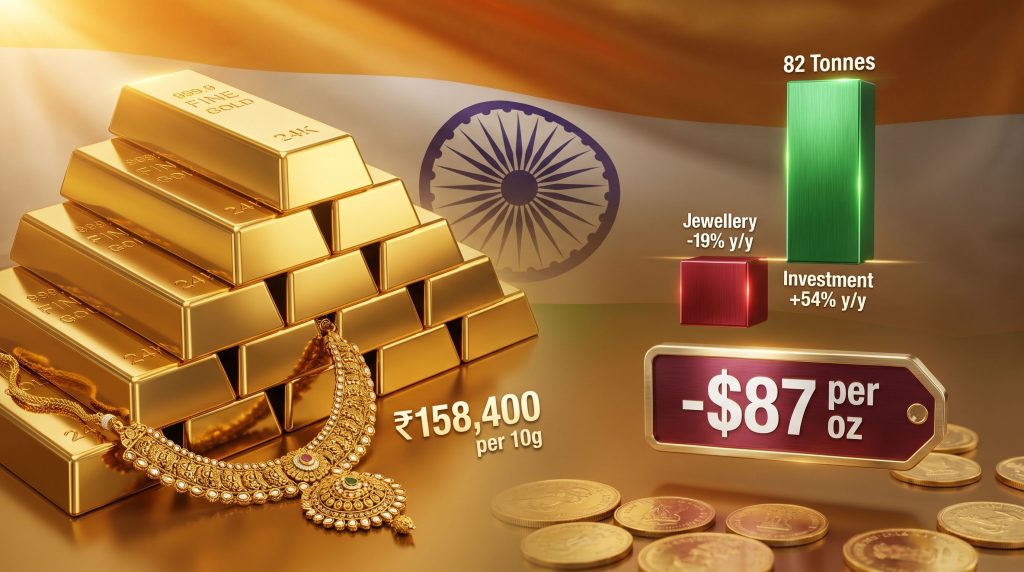
The quantitative evidence for India's current market conditions is unambiguous. Jewellery demand volumes declined by 19% year-on-year in the first quarter of 2026, even as the rupee value of jewellery spending increased due to elevated prices. This is a textbook illustration of volume contraction masked by price inflation: consumers are spending more per gram but buying fewer grams overall.
Meanwhile, investment demand has surged to 82 tonnes in Q1 2026, representing a 54% year-on-year increase. Gold ETF inflows reached record levels, driven by urban investors treating gold as a financial instrument rather than an ornament.
| Demand Category | Q1 2026 Performance | Year-on-Year Change |
|---|---|---|
| Jewellery Volumes | Declined | -19% y/y |
| Jewellery Spending (Value) | Increased | Positive (price-driven) |
| Investment Demand (Volume) | Rose to 82 tonnes | +54% y/y |
| Gold ETF Flows | Record inflows | All-time high |
This divergence is not merely a statistical curiosity. It reflects a structural transition in how Indian consumers access gold, with the market increasingly splitting along income and sophistication lines. Wealthier buyers accumulate through paper instruments; middle-income buyers step back from physical purchases.
Dealer Discount Dynamics: Reading the Bullion Market's Hidden Signal
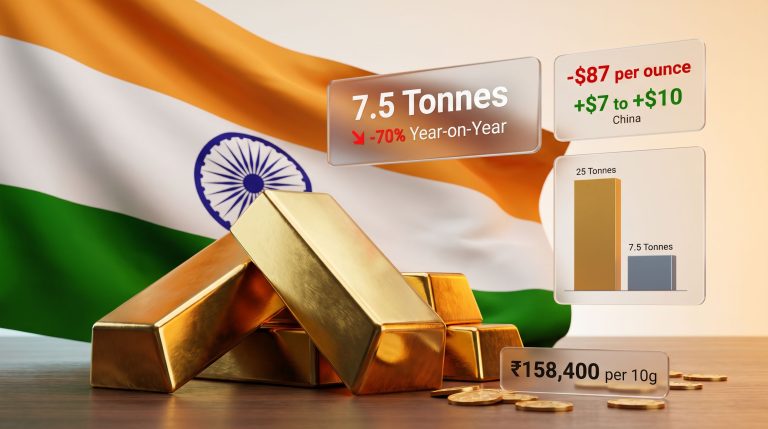
One of the most telling indicators of India's current demand environment is the dealer discount. As of the week ending May 11, 2026, dealers across India were quoting discounts of up to $87 per ounce over official domestic prices, with those official prices already incorporating the 15% import duty and 3% sales levy. The previous week's discounts had reached as high as $106 per ounce, suggesting some marginal recovery in demand, but conditions remain deeply distressed by any historical comparison.
To understand what these discounts signal, it helps to understand the mechanics. When a dealer quotes a discount below the official domestic benchmark, they are effectively accepting a loss on margin to clear inventory. This happens when new buyers are not entering the market at prevailing prices, forcing dealers to compete aggressively to liquidate existing stock.
Deep discounts of this magnitude are a reliable leading indicator of weak physical offtake; the inventory is sitting, and retailers are prioritising working capital recovery over profit preservation.
"A discount environment of this depth, where dealers must price substantially below official benchmarks just to clear stock, reflects a structural demand gap rather than a temporary seasonal fluctuation. It signals that price levels have moved beyond what the broad retail base considers acceptable entry points."
Jewellery retailers across India are corroborating this picture, reporting reduced store footfall nationally. Stores have shifted from procurement mode into inventory clearance mode, where older gold stock is being liquidated at steeper cash discounts to free up working capital. This inventory behaviour is consistent with a late-cycle demand correction following a sustained period of elevated prices.
The Policy Dimension: How Import Tariff Changes Are Reshaping India's Gold Ecosystem
India's gold market does not operate in a policy vacuum. The Indian government's decision to raise gold and silver import tariffs from 6% to 15% last month — a 150% increase in the duty rate — was framed as a foreign exchange reserve management measure. Gold imports consistently rank among India's largest import categories, and with oil price pressures also weighing on the current account, reducing discretionary metal imports was a logical fiscal lever.
The policy achieved its stated objective of compressing import volumes. However, the mechanism through which it worked created significant collateral distortions. By embedding a substantially higher price premium into domestically traded gold, the tariff increase pushed prices through the affordability ceiling for a large segment of retail buyers. The domestic price at ₹158,400 per 10 grams reflects this structurally inflated baseline.
The consequences extended into the paper gold market in unexpected ways. India's physically backed gold ETFs recorded their first net monthly outflow in twelve months in May, as investors who had accumulated positions moved to lock in profits generated by the policy-triggered price spike. This profit-booking behaviour illustrates a dynamic that policymakers rarely model explicitly.
"Import duty increases designed to suppress gold demand may paradoxically generate short-term price spikes that attract speculative ETF inflows, followed by profit-driven outflows. The net effect is increased price volatility rather than the sustained demand reduction the policy intended."
However, it is worth noting that the ETF outflow does not represent a structural retreat from gold investment in India. It reflects tactical repositioning following an abnormal policy-driven price catalyst. The longer-term trajectory of Indian gold ETF adoption remains strongly positive, driven by demographic shifts toward financial literacy and urbanisation.
Seasonal Demand Cycles and the Wedding Season Wind-Down
Layered on top of the policy shock is a purely cyclical factor: India's wedding season is drawing to a close. The wedding season broadly spans October through May, with demand clustering around auspicious dates. During peak wedding periods, jewellery stores operate at elevated procurement and sales velocities. As the season ends, this demand engine decelerates sharply.
The combination of a winding-down wedding season and prices operating near or above the affordability threshold creates a compounding suppression effect. Even buyers who might otherwise have been willing to stretch their budget for a wedding-related purchase are holding back when prices are this elevated and volatile. The result is reduced national retail footfall and a pivot from procurement to inventory clearance.
This seasonal pattern is predictable and well-documented, but the severity of the current downturn is amplified by the policy-driven price increase that occurred precisely as the wedding season was entering its final phase. The timing created an unusually sharp and prolonged demand trough.
Asia-Pacific Gold Premium Comparison: India's Outlier Position
Viewed within its regional context, India's current discount position is dramatically more pronounced than any other major Asian market, underscoring the severity of the demand contraction.
| Market | Premium/Discount vs. Global Benchmark | Market Condition |
|---|---|---|
| China | +$7 to +$10 per ounce | Moderate demand, easing from prior week |
| Hong Kong | Par to +$2 per ounce | Neutral to slight premium |
| India | Up to -$87 per ounce (discount) | Deep discount, weak physical demand |
| Japan | -$0.25 per ounce | Marginal discount |
| Singapore | -$0.50 to +$3 per ounce | Mixed, near neutral |
The contrast between India's -$87 per ounce discount and China's +$7 to +$10 per ounce premium is nearly $100 per ounce, one of the widest India-China spread differentials observed in recent years. This divergence makes clear that the forces suppressing Indian gold demand are domestic and policy-specific rather than reflective of a broad Asian demand retreat.
China's Demand Softness: A Different Kind of Headwind
China's physical gold demand has also moderated, though through a fundamentally different mechanism. Investor appetite in China has been constrained by concerns over potential interest rate adjustments and the impact of rising bond yields on portfolio allocation. Furthermore, central banks and gold positioning continues to add a structural layer of price support that partly insulates global benchmarks from localised demand softness.
A regional director at MKS PAMP noted that physical demand in China has been somewhat subdued due to anxiety over potential interest rate movements and rising bond yield pressures. He also pointed to cautious optimism that geopolitical resolution could ease inflationary concerns and help stabilise demand in subsequent periods.
The easing of China's premium from $9-$12 to $7-$10 per ounce is a modest compression compared to India's discount environment. This suggests China's softness is cyclical and sentiment-driven, while India's is structurally amplified by the layering of policy, affordability, and seasonal forces.
The next major ASX story will hit our subscribers first
Macro Forces Compressing Indian Gold Consumption
Beyond prices and policy, two additional macro variables are adding pressure to Indian gold consumption. The World Gold Council has flagged inflationary pressures and the potential for a below-average monsoon season as compounding risks to Indian demand. These factors operate through different channels than price dynamics.
Monsoon risk is particularly significant because it directly affects rural agricultural incomes, which represent a substantial share of India's total gold-buying population. A weak monsoon compresses those incomes, reducing the purchasing power of one of gold's largest and most consistent buyer segments. This creates a lagged effect: a poor monsoon in mid-2026 would suppress gold demand in the second half of the year even if prices moderated.
Inflationary pressure operates through a different mechanism, reducing real disposable income across both urban and rural buyer segments. When households are spending more on food, fuel, and essential goods, discretionary purchases like jewellery are deferred. Considering gold as an inflation hedge, this is somewhat counterintuitive — however, gold as an inflation hedge benefits sophisticated investors rather than price-sensitive retail jewellery buyers who face squeezed budgets.
The interaction between these macro forces and the price environment creates what might be described as a dual-threshold model for Indian gold demand:
- Jewellery demand operates against a hard affordability ceiling determined by real disposable income and price levels simultaneously
- Investment demand operates against a soft momentum floor influenced by financial sophistication, inflation expectations, and asset allocation trends
- Policy shocks and price volatility affect these two thresholds asymmetrically, which is why they are currently moving in opposite directions
Investment Demand as the Counterweight: India's Record ETF Accumulation
The surge in India's investment demand to 82 tonnes in Q1 2026, a 54% year-on-year increase, represents a structural shift in how gold is accessed and understood by a growing segment of Indian savers. In addition, central bank gold demand at the institutional level has continued to provide a price floor that supports this investment sentiment globally.
India's gold ETF market, while still considerably smaller than Western markets in absolute terms, is growing rapidly. Record ETF inflows signal increasing financial sophistication among urban investors who are choosing the liquidity and cost efficiency of paper gold over physical jewellery. This trend has compounding long-term implications:
- It reduces the structural link between gold price increases and physical import volumes
- It creates a domestic financial market for gold exposure that does not directly translate into current account pressure
- It expands the investor base for gold beyond the traditional buyer demographic, introducing younger, urban, professionally employed buyers with strong financial motivation to hold gold as a portfolio asset
The financialisation of Indian gold demand is not a new phenomenon, but the pace at which it is accelerating appears to have been catalysed by the very policy intended to suppress gold consumption. Higher import duties, by making physical gold more expensive, may be inadvertently pushing more buyers toward paper alternatives.
Forward Outlook: What Could Reignite India's Physical Gold Demand?
The recovery triggers for India's physical gold market are identifiable, but they are contingent on multiple variables aligning within a relatively compressed timeframe:
- Price stabilisation: A sustained period of lower volatility would reduce the buyer hesitation that is currently preventing even motivated purchasers from committing.
- Wedding season re-entry: The next major wedding season cycle, broadly resuming in late Q3 and Q4 2026, will be the first major test of whether pent-up demand has accumulated during the current trough.
- Import duty review: Any downward recalibration of the 15% import tariff would directly reduce the domestic price premium and restore affordability headroom for middle-income buyers.
- Monsoon performance: A strong monsoon outcome in the June-September period would support rural agricultural incomes heading into the festive and wedding season.
- Inflation moderation: Easing inflationary pressure on household essentials would free up discretionary income and reduce the affordability constraint on jewellery purchases.
Conversely, several risk factors could extend the current demand suppression period:
- Continued global price volatility driven by geopolitical uncertainty or central bank policy shifts
- Sustained high import duties maintaining the structural domestic price premium
- Weak monsoon outcomes compressing rural incomes through the second half of 2026
- Persistent inflationary pressures eroding real purchasing power across income cohorts
Frequently Asked Questions: India Gold Demand and Price Volatility
Why is India's gold demand subdued despite gold's deep cultural significance?
Cultural significance does not override affordability constraints when prices breach psychological thresholds. At current domestic price levels around ₹158,400 per 10 grams, a substantial portion of the retail buyer base has effectively been priced out of the market temporarily. The wedding season wind-down compounds this effect by removing the single largest recurring demand catalyst simultaneously.
What does a dealer discount in India's gold market actually mean for the broader market?
A dealer discount means that physical gold is being sold below the official domestic benchmark price, which already incorporates import duties and sales taxes. Discounts of up to $87 per ounce indicate that dealers hold excess inventory they cannot clear at prevailing prices. This metric is one of the most reliable leading indicators of physical market health because it reflects actual transaction conditions rather than reported consumption estimates.
How does India's gold ETF market relate to physical jewellery demand?
ETF buyers and jewellery buyers are distinct cohorts with different motivations. ETF demand is investment-driven and responds to gold's financial attributes, including inflation hedging and portfolio diversification. Jewellery demand is consumption-driven and responds to affordability and cultural occasions. These two segments can, and currently do, move in opposite directions within the same market simultaneously.
Could India's import duty increase permanently alter the structure of the gold market?
A 15% import duty creates a structural domestic price premium that permanently compresses affordability relative to global prices unless reversed. The more significant long-term consequence may be the acceleration of the shift from physical jewellery toward paper gold instruments. Higher physical prices simultaneously make ETFs more attractive on a relative cost basis and incentivise informal market activity, both of which reduce the policy's intended impact on the current account.
How does India's current demand environment compare to China's?
China is experiencing moderate softening of physical gold demand driven by interest rate and bond yield concerns, with premiums easing from $9-$12 to $7-$10 per ounce. India's situation is considerably more acute, with discounts reaching $87 per ounce. The nearly $100 per ounce differential between the two markets reflects the compounding impact of policy-driven price increases, seasonal demand exhaustion, and affordability constraints that are specific to India's domestic conditions.
Key Takeaways
- India gold demand subdued amid volatile prices reflects a convergence of a policy-driven price shock, elevated volatility, seasonal demand trough, and affordability constraints — rather than a structural retreat from gold as an asset class
- The divergence between -19% year-on-year jewellery volume decline and +54% year-on-year investment demand growth signals a market in structural transition, not uniform contraction
- Dealer discounts of up to $87 per ounce represent one of the most pronounced physical demand gaps in India's recent market history
- India's discount position is outlier-level compared to other Asian markets, with a nearly $100 per ounce spread against China's positive premium confirming the domestic and policy-specific nature of India's demand contraction
- Recovery is contingent on multiple variables aligning: price stabilisation, seasonal re-entry, possible policy recalibration, a favourable monsoon, and inflation moderation
- The long-term financialisation of Indian gold demand through ETFs and paper instruments is being inadvertently accelerated by the very import duty policy designed to reduce gold consumption overall
This article is intended for informational purposes only and does not constitute financial advice or a solicitation to trade in any financial instrument. Gold market forecasts, demand projections, and price level references involve inherent uncertainty. Past demand cycles and seasonal patterns do not guarantee future performance. Readers should conduct their own research and consult qualified financial advisers before making investment decisions.
Want to Catch the Next Major Mineral Discovery Before the Broader Market Does?
Discovery Alert's proprietary Discovery IQ model delivers real-time alerts on significant ASX mineral discoveries — cutting through complex data to surface actionable opportunities for both short-term traders and long-term investors the moment they emerge. Explore Discovery Alert's dedicated discoveries page to understand how historic mineral discoveries have generated substantial returns, and begin your 14-day free trial today to position yourself ahead of the market.