August 21, 2026
The Tariff Trap: Why India's Precious Metals Policy Keeps Cycling Between Control and Crisis
Few economic instruments reveal a government's macroeconomic anxieties more clearly than import tariffs on gold. Unlike duties on industrial inputs or consumer electronics, India raises gold and silver import tariffs to 15% and exposes the fundamental tension between cultural consumption patterns deeply embedded in a society and the cold arithmetic of foreign exchange management. India's recurring oscillation between tariff liberalisation and tariff escalation is not a policy failure but rather a structural feature of an economy where gold demand is simultaneously a source of cultural identity, investment utility, and macroeconomic vulnerability.
Understanding the latest escalation requires more than tracking duty rates. It demands examining the feedback loops between investment sentiment, forex reserve management, enforcement capacity, and the grey market economics that have historically shadowed every high-tariff era in India's precious metals history. Furthermore, tariffs and precious metals markets are increasingly intertwined with broader geopolitical and monetary dynamics.
When big ASX news breaks, our subscribers know first
India Raises Gold and Silver Import Tariffs to 15%: The New Duty Architecture
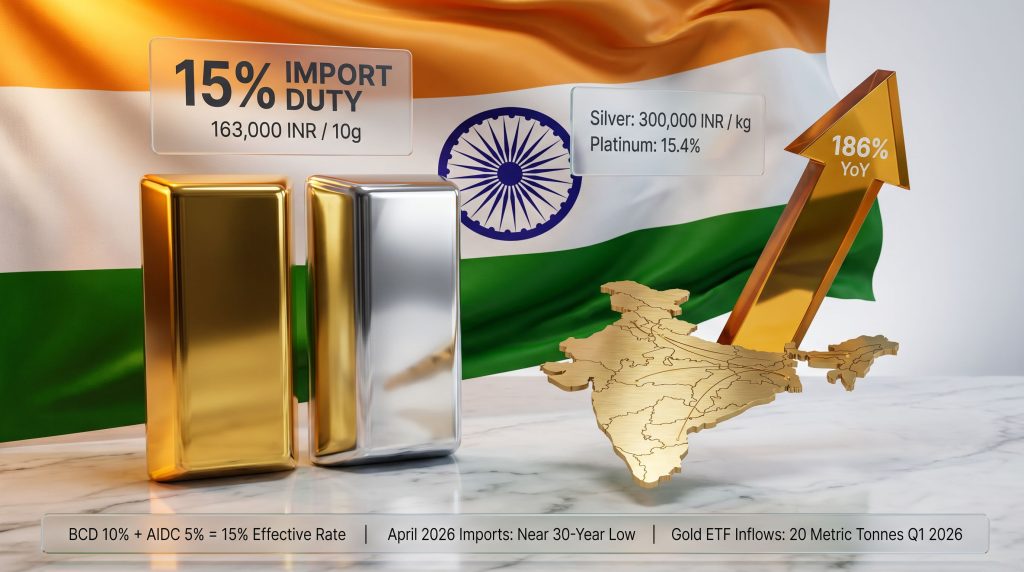
In May 2026, the Indian government formally increased the effective import duty on gold and silver to 15%, more than doubling the previous rate of 6%. The structure is built from two components stacked on each other:
- A 10% Basic Customs Duty (BCD) applied at the point of customs clearance on all incoming gold and silver consignments
- A 5% Agriculture Infrastructure and Development Cess (AIDC) layered on top, with proceeds designated for rural infrastructure development programmes
- A combined effective rate of 15%, compared to the previous 6% rate
- Platinum duties raised in parallel to 15.4% from 6.4%, signalling a coordinated approach across the precious metals complex rather than a gold-specific intervention
The dual-component structure deserves attention from a policy design perspective. By routing part of the tariff through a development cess rather than consolidating all revenue under a single customs duty head, the government achieves two objectives within a single instrument: compressing precious metals imports to protect forex reserves while simultaneously channelling a revenue stream toward rural development. This makes the tariff a multi-purpose fiscal tool rather than a straightforward protectionist measure.
Mechanically, the cascading nature of the duty compounds the cost burden. An importer receiving a consignment valued at 100 USD first pays 10% BCD, bringing the assessable cost to 110 USD. The 5% AIDC is then applied to that 110 USD figure, resulting in a total landed cost of 115.50 USD. The effective burden therefore slightly exceeds the nominal 15% sum, applying pressure at each stage of the supply chain from importer to wholesale dealer to retail jeweller.
This escalation did not arrive in isolation. Earlier in 2026, the government imposed a 3% Integrated Goods and Services Tax (IGST) on gold and silver imports, a preceding policy layer that caused banks to halt imports entirely for more than a month before they resumed operations after IGST compliance was established. The consequence was stark: April 2026 gold import volumes fell to a near 30-year low. The May 2026 tariff announcement represents the second and more aggressive phase of the same import suppression campaign.
How the 2026 Duty Compares to India's Historical Tariff Trajectory
| Period | Effective Import Duty | Primary Policy Driver |
|---|---|---|
| Pre-2024 (elevated era) | ~15% | Current account deficit control |
| Mid-2024 (reduction) | 6% | Demand stimulation, smuggling reduction |
| Early 2026 (IGST addition) | ~9% | Forex pressure, initial import curbing |
| May 2026 (current) | 15% | Rupee defence, CAD narrowing |
The table above reveals the recurring nature of this policy cycle. India has operated at 15% effective duty before, reversed that position in mid-2024, and has now returned to the same level within approximately 24 months. Each phase of this oscillation generates its own market distortions, enforcement challenges, and downstream consequences.
Why the 2024 Liberalisation Was Reversed So Quickly
The 2024 tariff reduction to 6% was a deliberate intervention designed to stimulate formal market demand and suppress grey market activity. By reducing the arbitrage gap between official import prices and smuggled goods, the government aimed to shift consumption back into taxable, traceable channels. That strategy delivered measurable results: smuggling activity declined, formal import volumes increased, and industry participants reported healthier compliance rates.
The problem was that the policy worked too well in stimulating demand at a time when global gold prices were already elevated and Indian equity markets were delivering negative returns over the prior 12 months. This combination of elevated gold prices and poor equity performance redirected significant Indian savings into gold as a store of value. Consequently, gold as an inflation hedge became an increasingly dominant narrative among retail and institutional investors alike.
The most striking data point from this period: inflows into Indian gold exchange-traded funds surged 186% year-on-year in the March quarter of 2026 to reach a record 20 metric tonnes, according to data from the World Gold Council. Investment-driven gold demand is structurally more responsive to price signals than jewellery demand, which is anchored to cultural occasions and gifting calendars. However, it is also more responsive to foreign exchange concerns, meaning it compounds forex reserve pressure precisely when that pressure is already elevated.
India sources virtually all of its gold consumption through imports, creating a direct and inescapable link between domestic demand and outflows of USD-denominated foreign exchange. With the rupee under significant depreciation pressure, ranking among Asia's worst-performing currencies in the period leading up to the announcement, every kilogram of imported gold represented a compounding drain on a reserve base already under stress.
Prime Minister Narendra Modi's public appeal to citizens to voluntarily abstain from gold purchases for one year, made before the formal tariff notification, was unusual in its directness. Such appeals from heads of government to alter individual consumption patterns are rare in modern economic policy and signal the degree of concern within the administration about the trajectory of import volumes and their forex consequences. The tariff announcement that followed formalised what the appeal framed as a national economic resilience objective.
The National Secretary of the India Bullion and Jewellers Association, Surendra Mehta, acknowledged the government's reasoning while noting that the decision created a compounding cost environment, given that gold and silver prices were already at elevated levels prior to the duty increase. From the industry's perspective, the combination of record spot prices and doubled import duties created an unprecedented pricing challenge for downstream participants.
Domestic Market Shock: Quantifying the Price Impact
The immediate domestic market response to India raising gold and silver import tariffs to 15% was swift and exceeded what a mechanical application of the tariff differential would suggest.
| Metal | Price Before Tariff Increase | Price After Tariff Increase | Observed Change |
|---|---|---|---|
| Gold | ~154,000 INR / 10g | 163,000+ INR / 10g | +9,000 INR (~+5.8%) |
| Silver | ~280,000 INR / kg | ~300,000 INR / kg | +20,000 INR (~+7%) |
The observed price increases reflect more than the arithmetic of the duty rate. Several behavioural and structural factors amplified the direct tariff effect:
- Anticipatory buying before the formal tariff notification drove demand spikes that tightened near-term supply
- Dealer margin expansion during periods of rapid price movement is a documented behaviour in commodity markets, as participants price in inventory replacement costs at higher future prices
- Supply chain repricing across the importer-wholesaler-retailer chain layered incremental margins at each stage
- Sentiment-driven price pressure as market participants anticipated further policy tightening
For a jeweller purchasing 100 kilograms of raw gold for manufacturing purposes, the shift from 154,000 to 163,000 INR per 10 grams represents an additional input cost burden of approximately 90 million INR on that single consignment. For small-scale artisans and family-owned jewellery businesses operating on thin margins, this kind of cost shock is not easily absorbed or passed through to consumers, particularly at a time when consumer appetite is already being tested by elevated retail gold prices.
The silver market response was proportionally sharper in percentage terms, with the approximately 7% price increase partially reflecting silver's dual demand profile as both a precious metal and an industrial input. Small investors may have been adjusting allocation decisions in response to gold price pressures, further contributing to the movement.
The Smuggling Incentive: A Known and Recurring Risk
Every analysis of Indian gold import policy eventually confronts the same structural problem: when the tariff-induced price differential between officially imported gold and internationally priced gold is wide enough, the financial incentives for illicit importation become commercially significant. At 15% effective duty applied to gold prices above 163,000 INR per 10 grams, the absolute rupee value of the arbitrage opportunity per unit is substantially larger than in any previous high-tariff era.
A Mumbai-based bullion dealer at a private bank, speaking without attribution to media, flagged this concern directly: the conditions created by the 15% tariff at current price levels are such that illicit importers can undercut legal channels by a meaningful margin while still earning substantial profits. This assessment aligns with the historical pattern.
The tariff-to-smuggling relationship in India's gold market follows a well-documented pattern: higher duties expand the arbitrage window, which activates dormant trafficking networks, which partially offsets the intended import reduction, which eventually creates pressure for a policy reversal.
| Tariff Level | Historical Smuggling Activity | Policy Consequence |
|---|---|---|
| High (pre-2024) | Elevated, significant grey market volumes | Tariff reduction in mid-2024 |
| Low (6%, mid-2024) | Suppressed, formal channels dominant | Demand surge, forex reserve pressure |
| High again (15%, 2026) | Expected re-escalation | Enforcement challenge now underway |
The effectiveness of the current tariff as a genuine demand suppression and forex conservation tool depends critically on the parallel enforcement response. Smuggled gold still requires USD payment in offshore procurement markets, meaning that grey market substitution for formal imports does not eliminate the forex drain. It simply redirects it through unregulated channels while simultaneously depriving the government of tariff revenue.
This creates a paradox at the heart of the policy: a tariff high enough to generate meaningful demand suppression among formal market participants is also high enough to provide meaningful financial incentives for informal market participants to meet that suppressed formal demand. The net import reduction achieved depends entirely on enforcement capacity.
Macroeconomic Transmission: Trade Deficit and Rupee Mechanics
Gold and silver imports occupy a specific and uncomfortable position in India's external accounts. Unlike imports of crude oil, semiconductors, or industrial machinery, precious metals imports do not directly generate export revenue or contribute to productive capacity. They represent a discretionary consumption and savings allocation that absorbs foreign exchange without creating the economic activity needed to earn that foreign exchange back.
This is why they are a recurring target for import compression strategies. A sustained reduction in precious metals import volumes has a direct mechanical effect on the merchandise trade deficit, reducing the USD demand from this category. An improved trade balance supports the current account, reducing net selling pressure on the rupee. In addition, central bank precious metals demand continues to provide a structural floor beneath global prices, limiting how much domestic price relief any import suppression strategy can realistically deliver.
However, the transmission is not instantaneous or guaranteed, and several limitations constrain the rupee support potential:
- Grey market displacement: If formal import suppression is partially offset by smuggling volumes, the forex drain persists without the government capturing tariff revenue
- Flow versus stock dynamics: Tariff-driven import compression addresses the ongoing flow of forex outflows but does not address the adequacy of existing reserve stocks
- Global price sensitivity: If gold prices continue rising internationally, the USD cost per unit of imports increases even as volume decreases, potentially limiting the aggregate forex savings
- Time lag effects: Supply chain adjustments, consumer behaviour changes, and enforcement responses all introduce lags between the policy announcement and the measurable trade balance impact
The rupee support from this measure is therefore best characterised as gradual and partial rather than immediate and comprehensive. It represents one instrument among several that the Reserve Bank of India and the Ministry of Finance are likely deploying simultaneously to manage external sector pressures.
The next major ASX story will hit our subscribers first
What India's Policy Means for Global Precious Metals Markets
India's status as the world's second-largest gold consumer gives its demand trajectory measurable influence on global price formation. When Indian import volumes contract sharply, as they did in April 2026 when volumes reached near 30-year lows, a significant price-supportive demand source temporarily exits global markets.
For gold, this demand withdrawal is relevant given that global prices were already elevated at the time of the tariff announcement. A sustained reduction in Indian import volumes, whether driven by genuine tariff-induced demand destruction or temporary stockpiling behaviour, removes a structurally important buyer from the market. Furthermore, gold-silver ratio analysis suggests that when major demand centres like India withdraw from formal markets, price dynamics between the two metals can shift in unexpected ways.
Silver's situation is more nuanced. The metal's dual identity as both a precious metal and an industrial input, critical in solar panel manufacturing, consumer electronics, and electric vehicle components, means that demand suppression in India's investment and jewellery segments does not fully offset the structural growth in industrial consumption globally. The approximately 7% domestic price surge in silver following the announcement reflected immediate supply chain repricing rather than a fundamental reassessment of silver's industrial demand outlook.
The inclusion of platinum in the tariff adjustment, with duties raised to 15.4% from 6.4%, suggests that this is a broad precious metals import management strategy rather than a gold-specific intervention. Platinum's primary consumption in India spans automotive catalyst applications and jewellery manufacturing, and a 15.4% effective duty creates supply cost pressures across both sectors.
Three Scenarios for Policy Effectiveness
The ultimate impact of India raising gold and silver import tariffs to 15% will depend on the interaction between enforcement capacity, global price movements, consumer behaviour, and industry lobbying dynamics. Three distinct outcome pathways are plausible:
Scenario 1: High Enforcement, Genuine Demand Destruction
Customs enforcement successfully contains smuggling re-escalation. Consumer and investment demand contracts materially in response to elevated total prices (spot price plus duty). Import volumes decline significantly, the current account deficit narrows, and the rupee receives measurable structural support. This outcome requires sustained enforcement investment and continued elevated gold prices discouraging investment demand.
Scenario 2: Partial Effectiveness, Grey Market Absorption
Formal import channels contract but grey market volumes partially compensate for suppressed official imports. Domestic prices remain elevated, dampening jewellery demand without fully suppressing investment demand. CAD improvement is partial and the rupee receives limited support. This scenario is most consistent with India's historical experience during previous high-tariff eras and represents the most probable near-term outcome.
Scenario 3: Industry-Pressure-Driven Policy Reversal
Smuggling re-escalation, jewellery sector distress, and organised industry lobbying from bodies including the India Bullion and Jewellers Association generate political pressure for a tariff review. The government reduces duties within 12 to 18 months, mirroring the 2024 liberalisation cycle. This outcome becomes more likely if global gold prices moderate, reducing both the forex pressure that motivated the tariff and the smuggling incentive that undermines it.
The structural tension between India's cultural and investment appetite for gold and the government's imperative to manage its external accounts has historically produced oscillating tariff cycles. The 2026 escalation is the latest iteration of this recurring dynamic, and its longevity will be determined by how effectively enforcement agencies can contain grey market re-emergence while the government monitors its CAD trajectory.
Key Facts at a Glance
| Parameter | Detail |
|---|---|
| New effective duty rate | 15% (10% BCD + 5% AIDC) |
| Previous effective duty rate | 6% |
| Platinum duty | Raised to 15.4% from 6.4% |
| Gold ETF inflows, Q1 2026 | Record 20 metric tonnes (+186% YoY, World Gold Council) |
| Gold price post-announcement | 163,000+ INR per 10g (+9,000 INR) |
| Silver price post-announcement | ~300,000 INR per kg (+7%) |
| April 2026 import volumes | Near 30-year lows |
| Prior IGST imposition | 3%, caused banking sector import halt exceeding one month |
Frequently Asked Questions
What is the new effective gold import duty rate in India as of May 2026?
The effective duty rate is now 15%, combining a 10% Basic Customs Duty and a 5% Agriculture Infrastructure and Development Cess. This is more than double the previous 6% rate that was established following the mid-2024 tariff liberalisation.
Why did India reverse the 2024 tariff reduction so quickly?
A surge in gold investment demand, with ETF inflows rising 186% year-on-year to a record 20 metric tonnes in Q1 2026, combined with significant rupee depreciation and current account deficit expansion, created macroeconomic pressures that prompted the government to reverse its liberalisation stance.
Does the tariff increase apply to silver and platinum as well?
Yes. Silver faces the same 15% effective duty as gold. Platinum duties have been raised to 15.4% from 6.4%, indicating a coordinated approach across precious metals rather than a gold-only intervention.
Will higher tariffs revive gold smuggling in India?
Industry participants have warned that the 15% duty applied at current elevated gold price levels creates strong financial incentives for illicit importation. Analysts at MoneyControl note that smuggling activity had declined measurably following the 2024 tariff reduction but is expected to re-emerge under current conditions.
What was India's gold import situation before this tariff increase?
A preceding 3% IGST imposition caused banks to halt imports entirely for more than one month, pushing April 2026 import volumes to a near 30-year low. The subsequent 15% tariff is expected to produce a second and more sustained phase of import suppression.
Disclaimer: This article is intended for informational purposes only and does not constitute financial, investment, or legal advice. Forecasts, scenario projections, and market outcome assessments involve inherent uncertainty and should not be relied upon as the basis for investment decisions. Past policy cycles and market behaviours are referenced for contextual analysis and do not guarantee future outcomes. Readers should consult qualified financial advisers before making any investment decisions related to precious metals or affected sectors.
Want to Stay Ahead of Significant Precious Metals Discoveries on the ASX?
While India's tariff cycle reshapes global precious metals demand dynamics, Discovery Alert's proprietary Discovery IQ model scans ASX announcements in real time, instantly alerting subscribers to significant gold, silver, and platinum group metal discoveries before the broader market reacts. Explore historic discovery returns on Discovery Alert's dedicated discoveries page and begin your 14-day free trial today to position yourself ahead of the next major find.