
June 10, 2026
The Economics of Evasion: How India's Gold Tariff Hike Created a Smuggler's Bonanza
Every major commodity market carries within it a fundamental tension: the higher the regulatory cost of legal access, the more attractive illegal alternatives become. This is not a failure of enforcement imagination, nor a unique weakness of any particular government. It is a predictable consequence of price arbitrage, and nowhere is this dynamic more visible in 2026 than in India's gold market. The country's decision to more than double gold import tariffs in May 2026 — a case of India gold tariff hike smuggling in action — has not suppressed gold consumption so much as redirected it into a rapidly expanding grey market.
Understanding why this keeps happening, and why it is so difficult to stop, requires looking past the headline policy and into the structural mechanics underneath.
When big ASX news breaks, our subscribers know first
How Price Arbitrage Turns Policy Into Opportunity
The 18.45% Tax Wedge and What It Creates
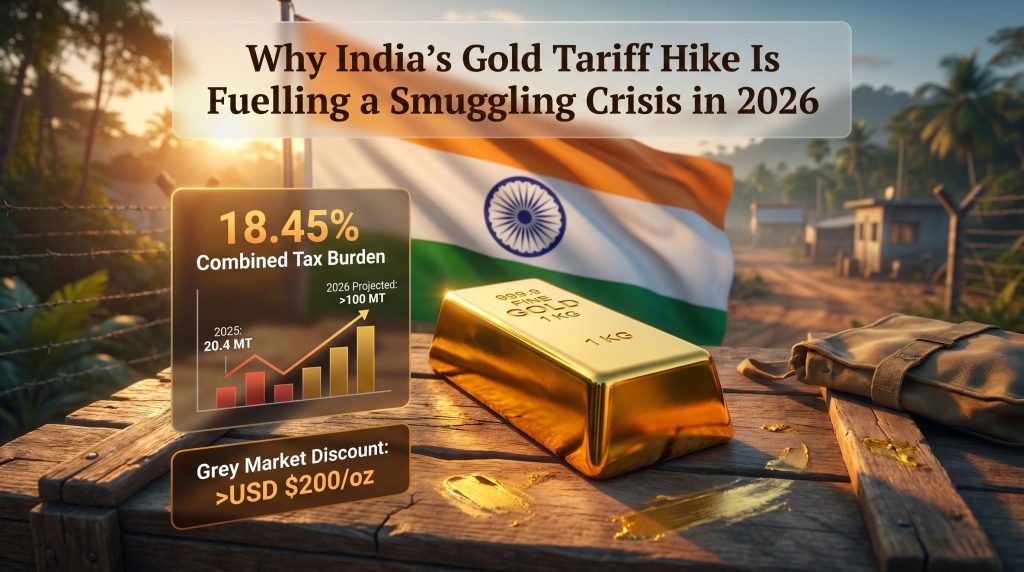
When India's government raised gold import tariffs to 15% in May 2026, the combined burden on legal gold imports, inclusive of goods and services tax, reached 18.45%. On a per-kilogram basis, this translates into a profit opportunity for grey-market operators of approximately ₹2.5 million (around USD $26,000) for every kilogram successfully moved across the border without customs declaration. To put that figure in physical terms: a one-kilogram gold bar is roughly the dimensions of a modern smartphone.
That profit margin is not incidental. It is the structural engine driving the current smuggling revival. The economics are straightforward:
- Legal importers must price gold to recover the full 18.45% tax burden, leaving virtually no room to offer buyers competitive discounts.
- Grey-market operators, having paid no duty whatsoever, can offer discounts exceeding USD $200 per ounce, which is more than 4% below official market pricing.
- Authorised bullion-importing banks, by contrast, are structurally unable to offer buyers more than approximately $10 per ounce in discount.
- The competitive gap between legitimate and illicit supply is therefore not marginal; it is categorical, representing roughly a 20x pricing disadvantage for legal importers.
Even after offering buyers that 4% discount, grey-market operators retain substantial margins. This is the arithmetic that enforcement agencies cannot easily overcome, because the incentive is not psychological or cultural. It is purely mathematical.
The Tariff-Smuggling Relationship: A Documented Policy Cycle
India's experience over the past several years provides one of the clearest empirical records of the inverse relationship between import duty levels and illegal gold inflows anywhere in the world. Furthermore, the gold market outlook for 2025 and beyond highlighted how regulatory decisions increasingly shape both formal and informal trade flows globally.
| Period | Import Duty Context | Estimated Smuggling Volume | Key Outcome |
|---|---|---|---|
| Decade pre-2024 average | Elevated | ~108 metric tons/year | Sustained grey-market activity |
| 2023 | Elevated | 156.1 metric tons | Peak smuggling year |
| 2024 | Reduced | 69.2 metric tons | Sharp decline in illegal inflows |
| 2025 | Reduced further | 20.4 metric tons | Near-suppression of smuggling |
| 2026 (projected) | Hiked to 15% | 100+ metric tons | Grey-market revival underway |
The pattern embedded in this data is not ambiguous. India's duty reductions in 2024 and 2025 compressed smuggling to levels not seen in over a decade, while the 2026 hike is already reversing those gains within a single policy cycle.
The speed of that reversal is itself significant. Grey-market distribution networks, once established, do not disappear during periods of low-tariff suppression. They go dormant. When incentives are restored, infrastructure reactivates rapidly, which is precisely what is occurring now.
The Scale of the Shadow Market in 2026
Projected Volumes and the Hidden Fiscal Cost
Multiple bullion market participants and industry insiders project that illegal gold imports into India could exceed 100 metric tons across 2026, a figure that represents a near-fivefold increase from the 20.4 metric tons recorded in 2025. At current gold prices, 100 metric tons carries a market value of approximately USD $14.35 billion.
The fiscal implication of that volume flowing through informal channels is substantial:
- Foregone import tariff and goods and services tax revenue is estimated at approximately USD $2.65 billion annually if smuggling reaches the projected 100-ton threshold.
- This figure may substantially offset, or potentially exceed, any incremental revenue the government collects from higher duties applied to reduced legal import volumes.
- India's legal gold imports reached 45.6 metric tons in April 2026, but industry observers believe May figures may have fallen by as much as half as banks and refiners pulled back from overseas purchasing in response to the widening grey-market discount.
This is the fiscal paradox at the heart of the policy: a tariff increase designed in part to protect government revenue may ultimately reduce it, by driving consumption into channels where no tax is collected at all. In addition, record gold prices in recent years have further amplified the financial incentive for illicit operators, making each smuggled kilogram even more lucrative.
The Grey Market Discount and Its Market Distortion Effect
The grey-market discount ripples beyond the illegal segment itself. Stockpiles of gold imported legally prior to the tariff hike are being liquidated at discounts exceeding $100 per ounce as holders seek to clear inventory before the price differential widens further. This distortion compresses margins across the entire formal supply chain and creates pricing confusion for end buyers who may be comparing legally sourced and grey-market gold without full awareness of provenance differences.
Who Absorbs the Damage: Banks and Refiners Under Structural Pressure
Authorised Bullion Banks: Caught in an Impossible Position
India's authorised bullion-importing banks are among the most directly harmed participants in the current environment. Their operating model requires pricing gold to recover full duty obligations, which makes their offers structurally non-competitive against grey-market supply offering discounts that are more than twenty times larger than what banks can extend to customers.
The result is a contraction in legal import activity that compounds the government's revenue problem. As banks scale back overseas gold purchases, the formal import market shrinks while informal inflows expand to fill the demand vacuum. India's gold demand is not falling; it is migrating. Central bank gold buying behaviour at the global level, however, continues to underpin strong structural demand for the metal regardless of domestic policy shifts.
The Refining Sector: A 0.65% Margin Against a 4% Headwind
Perhaps the most structurally precarious position in India's gold supply chain belongs to domestic gold refiners. The refining business in India operates on margins of approximately 0.65%, a figure that is notable for being precisely equal to the duty differential India applies between gold doré (a semi-processed gold-silver alloy) and fully refined gold.
This 0.65% differential was deliberately engineered to incentivise domestic refining activity. The logic: by making it marginally cheaper to import raw doré and process it domestically, the policy would support Indian refining capacity and associated employment. Under normal tariff conditions, that 0.65% buffer provides just enough margin for refiners to operate viably.
Under current grey-market conditions, it provides nothing at all.
James Jose, Managing Director of refiner CGR Metalloys, has noted publicly that with domestic discounts now comfortably above the 0.65% refining margin, the commercial rationale for importing doré for domestic processing has effectively ceased to exist under present market conditions. When the processed output cannot be sold at a price sufficient to recover input costs, refiners have no economic incentive to import raw material.
The consequence is a cascading contraction:
- Grey-market discounts exceed refining margins.
- Doré imports become economically unviable for refiners.
- Domestic refining capacity sits underutilised.
- Formal sector employment and revenue decline.
- A policy designed partly to strengthen domestic industry inadvertently hollows it out.
Smuggling Routes and Operational Methods: How Gold Crosses India's Borders
Geographic Rebalancing Toward Land Corridors
Heightened enforcement pressure at major international airports has produced a meaningful geographic shift in how illegal gold enters India. While airports historically dominated detection statistics, land border crossings now account for more than 55% of detected smuggling cases, with key routes running through borders shared with Myanmar, Bangladesh, and Nepal.
These corridors offer several operational advantages for smugglers:
- Lower surveillance density compared to major air cargo terminals.
- Multiple informal crossing points that are difficult to monitor comprehensively.
- Established local networks that reduce logistical complexity and single-point-of-failure risk.
Airport detection has simultaneously intensified. Seizure frequency escalated from roughly 2 detected cases per day in FY2022 to approximately 16 cases per day in FY2024, with daily seizures regularly exceeding 10 kilograms. That escalation in detection rates is significant not as evidence of improved control, but as a measure of the underlying volume attempting to move through formal entry points. As reported by the Times of India, this wave of illicit movement is intensifying pressure on customs authorities already stretched thin.
Evasion Techniques: From Body Concealment to Gold Paste
Smuggling methodologies range from straightforward to technically sophisticated:
- Body concealment remains widespread for small-volume, high-frequency carriers operating across land borders.
- Gold paste techniques represent a more advanced approach, in which gold is chemically processed into a compound form designed to evade standard metal detection equipment. This method has grown in prevalence as enforcement technology has improved.
- Distributed carrier networks reduce the financial exposure of any single seizure by spreading shipments across multiple individuals, ensuring that a detection event does not compromise an entire consignment.
India's Directorate of Revenue Intelligence has formally acknowledged across multiple reporting cycles that elevated import duties directly incentivise smuggling activity. The agency's own assessments suggest that enforcement alone cannot neutralise a price differential of the current magnitude.
This is the enforcement paradox in its starkest form: rising seizure rates confirm the problem's scale but leave its economic root cause untouched.
The Broader Systemic Consequences for India's Gold Economy
Cascading Effects Across the Formal Ecosystem
The damage extends well beyond banks and refiners. Several systemic risks are accumulating across India's formal gold sector:
- Consumer provenance risk: End consumers purchasing grey-market gold may have no reliable means of verifying supply chain integrity, creating downstream liability for jewellers and retailers who cannot validate the source of their stock.
- Jewellery export competitiveness: India is a globally significant jewellery exporter. If domestic gold input costs remain elevated relative to alternatives available to manufacturers in lower-duty jurisdictions, Indian exporters face a structural cost disadvantage that undermines their competitiveness in international markets.
- Forex channel bypass: Informal gold payments routed through grey-market networks bypass official foreign exchange channels entirely, which partially negates the tariff hike's intended goal of reducing pressure on the Indian rupee by controlling USD outflows.
Three Policy Objectives Versus Three Observed Outcomes
| Policy Objective | Intended Outcome | Observed 2026 Reality |
|---|---|---|
| Curb domestic gold demand | Reduce consumption volumes | Demand migrates to grey market; total consumption broadly maintained |
| Reduce trade deficit | Lower import bill | Legal imports fall but grey-market inflows offset official reductions |
| Ease pressure on the rupee | Reduce USD outflows | Informal payments bypass official forex channels entirely |
The common thread across all three objectives is the same: the policy achieves its stated goal within the formal economy while producing compensating effects in the informal one. Net outcomes are substantially diminished compared to policy intentions.
The next major ASX story will hit our subscribers first
What History Tells Us About Demand-Side Resilience
Cultural Embeddedness and Price Inelasticity
A critical and sometimes underappreciated factor in this analysis is that India's gold demand is not simply an investment preference. It is culturally embedded across wedding ceremonies, religious observance, inheritance traditions, and household savings behaviour spanning centuries. This structural characteristic makes Indian gold demand relatively price-inelastic at the consumer level in ways that distinguish it from most other commodity markets.
This is not a speculative observation. The decade-long average of 108 metric tons smuggled annually before the 2024 duty reduction reflects the baseline level of grey-market activity that persists when legal access is priced prohibitively. That demand did not disappear during high-tariff periods; it simply moved. The 2024-2025 suppression to as low as 20.4 metric tons, followed by the rapid projected rebound to over 100 metric tons in 2026, confirms the pattern with unusual clarity.
Consequently, gold safe-haven demand at the consumer level remains deeply resilient in India regardless of policy environment. When the formal supply chain becomes prohibitively expensive, Indian gold demand does not contract in line with price theory. It relocates to informal channels with remarkable speed and efficiency.
For those who prefer to remain within the formal market, buying physical gold through authorised channels — while costlier in a high-tariff environment — continues to offer transparency, provenance assurance, and legal protection that grey-market supply cannot match. However, as long as the India gold tariff hike smuggling dynamic remains structurally intact, these advantages will need to be compelling enough to overcome a 20x pricing gap in the eyes of cost-sensitive buyers.
Furthermore, broader commentary and expert analysis circulating across financial networks, including insights shared on NDTV, has highlighted how the India gold tariff hike smuggling issue is gaining mainstream recognition as a systemic policy challenge rather than a fringe enforcement problem.
Frequently Asked Questions
Why did India raise gold import tariffs in 2026?
India raised gold import duties to 15% in May 2026, with the stated goals of reducing domestic gold demand, narrowing the trade deficit, and relieving downward pressure on the Indian rupee.
How much gold is being smuggled into India in 2026?
Multiple bullion market participants project illegal gold imports could exceed 100 metric tons in 2026, up from just 20.4 metric tons in 2025 when duties were lower.
What discount is smuggled gold being offered at in India?
Grey-market gold is reportedly being offered at discounts exceeding USD $200 per ounce, which is more than 4% below official prices, made possible by avoiding the combined 18.45% tax burden on legal imports.
Which smuggling routes are most active into India?
While airports historically dominated detected cases, land borders with Myanmar, Bangladesh, and Nepal now account for more than 55% of detected smuggling incidents.
How does the tariff hike affect Indian gold refiners?
Gold refiners operate on margins of approximately 0.65%, which precisely matched the duty differential designed to incentivise domestic refining. With grey-market discounts now far exceeding that margin, importing doré for domestic processing has become economically unviable. This represents one of the most direct and damaging consequences of the India gold tariff hike smuggling cycle on legitimate industry participants.
Has India experienced this pattern before?
Yes. In the decade prior to the 2024 duty reduction, India averaged 108 metric tons of smuggled gold per year. The 2024-2025 reductions suppressed this to historic lows, confirming a clear and repeatable relationship between duty levels and grey-market volumes.
This article is intended for informational purposes only and does not constitute financial or investment advice. Projections regarding smuggling volumes, fiscal impacts, and market outcomes are based on industry participant estimates and historical data patterns, and involve inherent uncertainty. Readers should conduct their own independent research before making any financial decisions.
Want to Stay Ahead of Major Commodity Market Shifts Like This One?
Discovery Alert's proprietary Discovery IQ model delivers real-time alerts on significant ASX mineral discoveries, translating complex commodity market dynamics into clear, actionable investment opportunities for traders and long-term investors alike — begin your 14-day free trial today and explore how historic discoveries have generated substantial returns for those who acted early.